“We’ve already brought our things. Clear out the big room,” her ex-husband said calmly as he swung open the back doors of the moving truck.
Elena froze outside the entrance, still clutching the grocery bags in her hands. She had just returned from the store and had never expected to see anything like this.
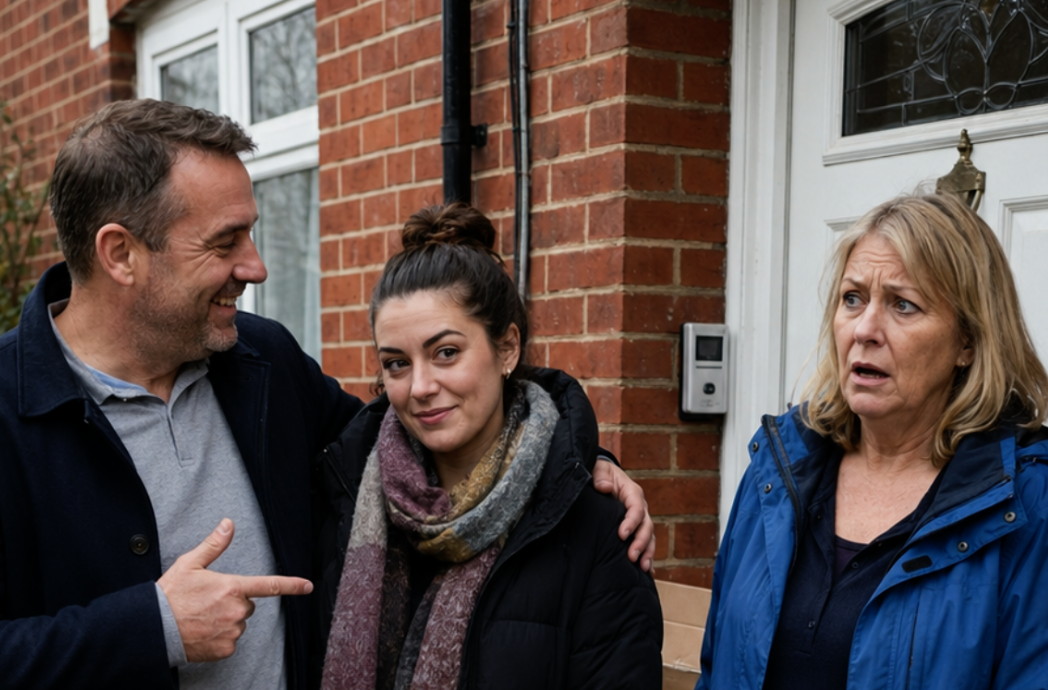
Two movers were busily unloading cardboard boxes, bags, suitcases, and packages from the truck. Beside Andrei stood a young woman Elena didn’t know—self-assured and completely at ease. She was speaking quietly with him and occasionally glancing up at the apartment windows.
“What on earth are you doing?” Elena finally managed to say.
Andrei didn’t look embarrassed in the slightest.
“Our house still isn’t finished. We’ll stay here for a few months. There’s plenty of room anyway.”
“Here?” Elena repeated.
“What’s the big deal? I invested in this apartment too. I did the renovations with my own hands. It’s not like I’m some stranger.”
The grocery bags seemed to grow heavier by the second. Elena stared silently at her ex-husband until the truth finally sank in.
He hadn’t come to ask for help.
He had come to move in.
Eleven years is practically a lifetime. Over that much time, you grow so accustomed to a person that you stop noticing the warning signs. At first they seem accidental. Then you dismiss them as quirks of personality.
And one day you realize that the person beside you has become someone completely different.
Elena had owned the apartment long before she got married. After her grandmother died, Elena sold the old two-bedroom apartment she had inherited, added her own savings, and bought a spacious three-bedroom apartment in a quiet neighborhood.
She still remembered the day she had first crossed its threshold with a single set of keys in her pocket and thought:
This is my home.
A year later, she met Andrei.
Soon they married, and two years after that their son Dima was born.
At first, their family life was peaceful. Andrei worked hard, spent his evenings playing with their little boy, and on weekends the three of them went to the park or visited Elena’s parents at their country house.
It seemed as though an ordinary, happy life lay ahead of them.
When Dima started school, Elena and Andrei decided to renovate the apartment. Andrei threw himself into the project enthusiastically.
“Why pay someone else a fortune?” he would say, rolling up his sleeves. “I’ll do it myself. We can use the money for something else.”
And he really did work hard. He hung wallpaper, replaced the interior doors, hauled building materials, and assembled furniture.
Elena was grateful and told him so more than once.
But it was during that renovation that he first said something that made her uncomfortable.
“After all this work, the apartment is practically half mine now,” Andrei joked.
Elena waved him off.
“Don’t talk nonsense.”
At the time, she thought it was just a bad joke.
Over the years, however, Andrei began staying late at work more and more often. Business trips suddenly became frequent. He stopped letting his phone out of his sight, and whenever Elena asked questions, he reacted irritably.
“Here you go again. I’m tired of being interrogated all the time.”
The truth came out by accident.
One day Elena saw him at a shopping mall with a young woman.
They were choosing kitchen furniture, arguing about the color of the cabinet fronts, and looked for all the world like an ordinary married couple.
At home, Andrei didn’t even try to deny it.
“Yes, there’s someone else. There has been for a long time.”
Those words erased eleven years of marriage in an instant.
A month later, he packed his things and moved in with Viktoria.
Their divorce was handled quietly, without screaming or public scenes. Elena saw no point in trying to hold on to a man who had already made his choice.
Her greatest concern was Dima.
The boy took his father’s departure badly. For a long time, he kept asking why Dad didn’t live with them anymore and when everything would go back to the way it had been.
Andrei promised to visit every weekend.
But the visits quickly became less frequent, and eventually they were reduced to brief phone calls.
Meanwhile, Andrei and Viktoria were building a new life together.
They sold Viktoria’s apartment, invested the money in the construction of a country house, and were convinced that within a few months they would be celebrating their move.
“We’ll be in by autumn,” Andrei confidently told Dima over the phone.
But autumn came and went.
Then winter arrived.
The contractor kept postponing deadlines, construction nearly ground to a halt, and the money began running out.
Andrei considered renting an apartment a pointless waste of money.
That was when he remembered his ex-wife’s apartment.
In his mind, the solution was obvious.
There was plenty of space. Elena lived there with just their son. And years ago, Andrei had helped renovate the place.
So naturally, he believed he had every right to stay there for a few months while his house was being finished.
He never even doubted that Elena would agree—if not for his sake, then at least for Dima’s.
That was why Andrei didn’t bother calling in advance or discussing anything with her.
He simply showed up with a moving truck, his new woman, and all their belongings, confident that Elena would have no choice but to accept the situation.
For the first few seconds, Elena simply stood there staring.
Her thoughts were tangled. Everything had happened too quickly.
Five minutes earlier, she had been choosing vegetables for dinner, thinking about making soup and checking whether Dima had finished his homework.
And now there was a moving truck outside her building, strangers were carrying someone else’s belongings toward her home, and her ex-husband was issuing instructions as though the matter had already been settled.
The movers worked calmly and professionally. Obviously, they had been hired for a normal relocation. They didn’t ask questions or pay attention to the argument.
They simply did their jobs.
It was Viktoria who finally snapped Elena out of her shock.
She stood a little to one side, quietly discussing something with Andrei while looking toward the windows on the second floor.
“Are those windows the big room?” Viktoria asked, pointing upward.
“Yes,” Andrei replied. “The largest one.”
Viktoria nodded with satisfaction.
“Perfect. Then we’ll stay in that room.”
Something flared inside Elena.
Not fear.
Outrage.
A strange woman was standing outside Elena’s home, calmly deciding which room she intended to occupy.
And Andrei was nodding along as though everything had already been agreed upon.
“Wait,” Elena said, not even sure which of them she was addressing.
Andrei turned toward her.
“Lena, don’t start. It’s temporary. As soon as the house is finished, we’ll move out.”
“Two or three months at most,” Viktoria added.
Elena slowly turned her gaze toward her.
“Excuse me… are you actually serious?”
Viktoria shrugged as though she genuinely couldn’t understand Elena’s surprise.
Andrei decided to finish the argument.
“It’ll be better for Dima too. He’s been saying for ages that he wants to see me more often.”
“Don’t use Dima as an excuse,” Elena said quietly. “You’ve barely shown any interest in him for the past six months. And now suddenly you remember you’re a caring father?”
And in that moment, everything became perfectly clear.
If she gave in even a little—if she agreed to let them stay for even a few weeks—they would remain.
And those promised “couple of months” could easily turn into years.
Elena slowly set the grocery bags down on the pavement and straightened her shoulders.
“Stop,” Elena said to the movers as they lifted the first box and headed toward the entrance. “You’re not taking anything inside. I haven’t given permission.”
The movers exchanged glances and stopped.
Andrei gave an irritated laugh.
“Lena, enough with the theatrics. I invested in this apartment too. And don’t forget—I’m still registered at this address.”
“This apartment belongs to me,” Elena replied calmly. “And nobody is entering it without my permission. As for your registration… we’ll take care of that.”
“You think after everything I did here, I don’t have any rights?”
His voice was getting louder.
People in the courtyard had begun stopping to watch. Zinaida Petrovna came out of the neighboring entrance with her dog. Someone on the second floor cracked open a window.
Elena silently took out her phone.
“What are you doing?” Andrei demanded.
“Calling the local police officer.”
“Have you completely lost your mind?”
“No. I just have no intention of arguing.”
Twenty minutes later, an official vehicle pulled up outside the building.
The district police officer was a man in his sixties with the calm, unhurried expression of someone who had long since stopped being surprised by anything.
He listened carefully to both sides, asked Elena to show the ownership documents for the apartment, and then turned to Andrei.
“Are you an owner of the property? Do you currently live here?”
“No,” Andrei hesitated. “But I used to live here. And I renovated the place.”
The officer nodded knowingly.
“That doesn’t change the situation. The owner objects, which means you cannot enter without her consent. If there’s a legal dispute, settle it through the courts—not like this.”
He gestured toward the moving truck.
The movers looked at each other.
“Boss, do we load everything back up?” one of them asked.
Andrei waved his hand in frustration.
“Load it back.”
One by one, the boxes disappeared into the truck again.
Viktoria silently got into the car without even looking at Elena.
Andrei remained outside the entrance for a few more seconds.
“You’ll regret this,” he said darkly.
Elena met his gaze calmly.
“No, Andrei. I did my regretting a long time ago.”
He said nothing, spun around sharply, and walked toward the car.
But Elena knew this wasn’t over.
That evening, she opened her laptop, found the contact information for a reputable housing lawyer, and immediately booked a consultation.
Andrei was still officially registered at her address.
That meant the matter had to be resolved once and for all, before he came up with another “brilliant” idea.
Only after closing her laptop did Elena finally feel that, for the first time in that endless day, she was standing firmly on her own ground again.
The lawyer was a man of few words.
He listened carefully without interrupting, then reviewed the documents Elena had brought before finally speaking.
“After the divorce, your ex-husband moved out voluntarily?”
“Yes. He packed his things and left.”
“Has he paid anything toward utilities since then?”
“Not once.”
The lawyer nodded and made several notes.
“Then we have a strong case. His claims about helping with renovations don’t change anything here. Doing repairs does not create ownership rights or an automatic right to use the apartment. What matters is that he moved out voluntarily, hasn’t lived there for a long time, and hasn’t contributed to the cost of maintaining the property.”
Elena felt the tension inside her begin to ease.
At last, someone had confirmed what she herself had understood but had been afraid to say aloud.
She spent the next week gathering documents.
At home, she took out a folder containing utility receipts from the past two years. Every single payment had been made by her.
Then she obtained a statement from the management company confirming that Andrei had not lived at the address for a long time and had not paid toward utilities.
After that, she spoke to the neighbors.
A woman from the third floor and an elderly man from the apartment opposite hers agreed without hesitation to provide written statements confirming that Andrei no longer lived there and appeared only occasionally.
“We haven’t seen him properly in nearly a year,” the neighbor said as she signed the statement. “And then suddenly there’s a moving truck under the windows. The whole building came outside to watch.”
At the same time, Elena called a locksmith and had the locks changed.
The next day, she had a video intercom installed.
When the locksmith left and the apartment became quiet again, Elena slowly walked from room to room.
She ran her hand along the doorframe and stopped by the window.
For the first time in a very long while, she truly felt at home.
The court hearing lasted less than an hour.
Andrei came alone.
Viktoria wasn’t with him.
While they waited for the proceedings to begin, he tried several times to speak to Elena, but she merely nodded briefly and turned away.
In court, Andrei spoke calmly.
He talked about their eleven years of marriage, about how he had hung wallpaper with his own hands, installed doors, and transported building materials.
“I put so much effort into that apartment,” he said. “Doesn’t that mean anything?”
The judge listened carefully to both parties, reviewed the documents, and asked several clarifying questions.
The ruling was what Elena had expected.
Andrei had voluntarily moved out of the apartment, had not lived there for a significant period, had not paid utilities, and had therefore lost his right to use the property.
The court ordered that his residential registration at the address be terminated.
After leaving the courthouse, Elena stood on the steps for a few seconds.
She took a deep breath of the cold air and suddenly realized just how exhausted she had become over the past few weeks.
A few days later, Andrei called.
“Lena, why did you have to take it all the way to court?” he asked wearily. “We lived together for so many years. Couldn’t we have worked something out?”
“We could have,” Elena replied calmly. “But not after you showed up at my home with a moving truck and decided you were going to move in with your new wife.”
There was a pause on the other end.
“I put so much work into that apartment…”
“Andrei,” Elena interrupted gently, “our marriage is over. You’re still Dima’s father, and nothing will ever change that. But this apartment has always belonged only to me. And it’s time you accepted that too.”
He didn’t answer.
The call ended.
Eventually, Andrei and Viktoria did finish their house—about six months later.
Elena found out by accident.
One day Dima returned from a weekend with his father and mentioned it casually.
“Dad’s moved in already. They even put a swing in the yard.”
Elena smiled.
“Did you like it?”
“It’s okay. There just aren’t any trees yet.”
And that was the end of the conversation.
One evening in early autumn, Elena was coming home from work.
It had been a long day. Her legs ached with exhaustion, and the heavy bag in her hand pulled at her arm.
She turned into the familiar courtyard.
Everything there was painfully familiar—the old poplar trees, the children’s playground, the warm glow from the windows.
Elena stopped involuntarily and looked up at the second floor.
There was a light on in her apartment.
She had forgotten to turn off the hallway lamp that morning.
There had been a time when the sight of her own building made her anxiously check her phone, listen for every ring, and wonder what the next unpleasant surprise would be.
Now it was simply her home.
Her home.
Without conditions.
Without anyone else laying claim to it.
Without the fear that one day she might come back and find another moving truck waiting outside.
Elena adjusted the bag on her shoulder and, with a faint smile, walked toward her entrance.