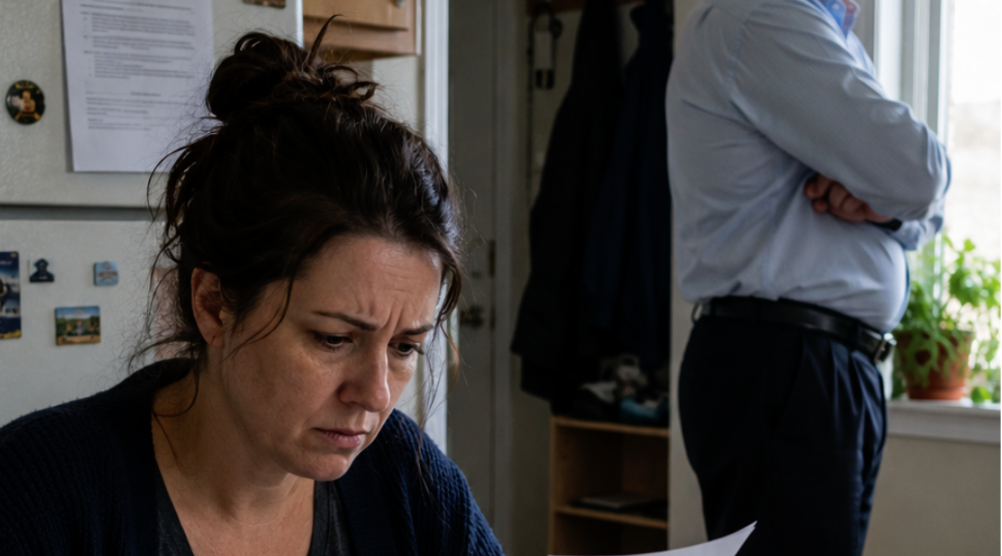
Marina noticed the envelope on the refrigerator one morning while she was making breakfast for Timur. It was an ordinary white envelope, unsealed, with the logo of a notary’s office in the corner.
Timur poked at his porridge with a spoon and grumbled about an upcoming test. He was eleven, and math tests seemed like the greatest injustice in the world to him. Marina nodded, but her eyes remained fixed on the envelope.
Gleb came out of the bathroom, buttoning his shirt.
“There’s something there for you,” he said.
He did not turn around. He offered no explanation.
Marina wiped her hands on a towel and pulled out two sheets of paper. The first was some kind of agreement form. The second was an information sheet printed in tiny type. She began reading and did not immediately understand what it was about.
The agreement stated that Marina Sergeyevna Volkova assumed responsibility for caring for Nina Pavlovna Volkova, born in 1954, due to the latter’s deteriorating health. Daily attendance for no fewer than six hours. Preparing meals. Accompanying her to medical appointments. Monitoring her medication. Cleaning the apartment.
Marina read it twice.
“Gleb, what is this?”
He was already standing by the door, putting on his shoes.
“Mom asked for it. She feels better when everything is put down on paper.”
“Feels better about what?”
He shrugged as though they were discussing a magazine subscription.
“You never know. If something happens, it’ll be clear who’s responsible.”
Timur looked up from his porridge and stared at his mother. Marina smiled at him, but the smile came out crooked.
Gleb left for work. Timur left for school. Marina remained in the kitchen with the two sheets of paper on the table and the feeling that something had quietly shifted over the past six months.
Six months earlier, Nina Pavlovna had fallen in the bathroom. She had fractured the neck of her femur. There had been surgery, a metal pin, and a long recovery. At the time, Gleb had said, “Mom can’t manage on her own. Let’s help her.”
Marina had agreed. Not because she loved her mother-in-law, but because Gleb had asked and Nina Pavlovna truly had no one except her son.
During the first few weeks, Marina visited her mother-in-law every other day. Nina Pavlovna lived in a one-room apartment on Ferganskaya Street, twenty minutes away by bus. The apartment was registered in Nina Pavlovna’s name. Marina cooked soup for her, helped her get to the bathroom, and changed her bed linen. Gleb came on weekends, brought groceries, and left an hour later. He said that work kept him busy during the week and that whenever he stayed with his mother, she immediately became irritable and started arguing with him. At first, Marina even believed him.
Then every other day became every day. After that, the daily visits began to include trips to the clinic. Then Nina Pavlovna started calling at seven in the morning.
“I feel terrible. Come over.”
Sometimes something was genuinely wrong: high blood pressure, weakness, dizziness. Other times, she was simply afraid of being alone. But every time, Marina dropped everything and went because it was impossible to assess the situation over the phone.
Marina abandoned breakfast and left. Timur ate alone.
By the fourth month, Marina realized that she was working as a caregiver. An unpaid caregiver with no days off and no schedule.
She worked remotely, doing layout work for a small publishing house, and that income was the only thing that belonged entirely to her. Twenty-eight thousand rubles a month, paid into a Sberbank account in her name. Gleb earned more—around eighty thousand. His salary went onto his card, which he used to pay the mortgage, utilities, and groceries.
During the fifth month, Marina tried to speak to Gleb.
“I can’t go there every day. I need to work. And Timur needs his mother at home, at least in the evenings.”
Gleb did not answer immediately. He was sitting on the sofa, scrolling through his phone.
“Then who’s going to do it? A caregiver costs forty thousand rubles a month.”
“She’s your mother, Gleb.”
“So what? I work. You’re at home.”
Marina was not at home. Marina was on the bus, at the clinic, in someone else’s apartment, or standing in line for a prescription. But she did not argue. Not because she was afraid. She simply knew how it would end: Gleb would refuse to speak to her for three days, and Timur would become anxious whenever his parents sat through dinner in silence.
And now there was the envelope.
Marina read the agreement a third time. At the bottom was a line for her signature and another for the notary’s signature.
The date was tomorrow.
She called her friend. Sveta worked at a public services center and understood paperwork better than anyone else Marina knew.
“Sveta, could you look at something? My husband slipped me some kind of agreement.”
Sveta called back twenty minutes later.
“Marina, this isn’t an employment contract or a service agreement. It’s a private agreement that wouldn’t legally obligate you to do anything in court. But do you know what it does?”
“What?”
“It creates a paper trail. By itself, the agreement can’t force you to do anything, but it could later be used in a family conflict. They could say that you voluntarily agreed to provide the care and then refused to do it. In a family dispute or a divorce, a document like this could be unpleasant, even if it isn’t decisive.”
Marina sat down on a stool.
“Wait. What exactly could happen to me because of it?”
“Nothing good directly. You’d be confirming in writing that you’re obligated to spend six hours every day with your mother-in-law. Later, they could keep throwing it in your face: you signed it yourself, you agreed to it yourself, so what are you complaining about now?”
Marina placed the phone on the table. The envelope lay beside it. Next to the envelope stood a cup of cold tea she had forgotten to drink.
Gleb returned from work that evening.
“Did you sign it?” he asked from the entryway.
Marina stood in the kitchen doorway.
“No.”
“Why not?”
“Because I want to understand why it’s necessary.”
Gleb took off his shoes and walked into the kitchen. He sat down. Marina noticed that he did not seem surprised.
“Mom wants everything to be fair. You’re taking care of her, so it should be formally recorded.”
“Fair means getting paid. Caregivers get paid, Gleb.”
“You’re not a caregiver. You’re family.”
“If I’m family, why do we need a notary?”
He did not answer. He picked up his phone and went into the other room. That was what he always did when a conversation became uncomfortable. He did not argue openly; he simply disappeared from it.
That infuriated Marina more than shouting would have.
Timur was doing homework at his desk. Marina could hear him whispering as he counted.
“Twenty-seven, twenty-eight, twenty-nine.”
The multiplication table.
The following day, Marina did not go to Nina Pavlovna’s apartment. For the first time in a long while, there were no phone calls, excuses, or rushing around. Instead, she sat down at her computer and did three things.
First, she opened the Federal Register’s website and ordered an official property extract for her mother-in-law’s apartment. It cost 350 rubles, which she paid from her own card.
Second, she wrote to the publishing house and said she was ready to take on additional work. The editor replied within an hour.
“Take it, Marina. We have a forty-page catalog. The deadline is three weeks.”
Third, she called a lawyer. Not a friend, but a paid lawyer. The telephone consultation cost 1,500 rubles.
The lawyer, a woman with a tired voice, listened and then asked:
“Whose name is the apartment where you currently live registered in?”
“My husband’s. We have a mortgage. I’m a co-borrower.”
“All right. And your mother-in-law’s apartment?”
“It belongs to my mother-in-law.”
“Is your husband the sole heir?”
“Yes.”
“Then listen carefully. This agreement does not, by itself, make you legally responsible for caring for her. But it could be used against you in a domestic dispute. If you divorce or begin arguing over money, your husband could say that you agreed voluntarily and that no one forced you. It wouldn’t be decisive in court, but it could still be unpleasant, especially if you have no other written arrangements.”
Marina understood.
Without her signature, there was no agreement except for spoken words.
With her signature, there would be a document that could later be turned against her: she had agreed willingly and understood everything.
The agreement did nothing in her favor.
“What should I do?”
“Don’t sign it. And start keeping records. Write down how many hours you spend there, how much income you lose, and how much a caregiver costs in your area. If the conflict eventually becomes a dispute over money or ends in divorce, those records will at least show what you were actually doing. But it would be better to reach an agreement. If your husband wants everything formalized, he can arrange a paid service contract with you. Or he can hire a caregiver. Or he can provide the care himself.”
Marina wrote everything down in a notebook: dates, hours, and amounts.
Over the previous months, she had spent hundreds of hours at her mother-in-law’s apartment. Even if she calculated those hours using a modest caregiver’s rate, the total made Marina feel uneasy.
Nearly one hundred thousand rubles’ worth of someone else’s convenience, paid for with her time.
The property extract arrived two days later. The apartment belonged to Nina Pavlovna. There were no liens, restrictions, or third-party owners. Marina did not fully understand why she had needed the extract, but after speaking with the lawyer, she wanted, for once, to rely on an official document rather than someone else’s words.
That same evening, Nina Pavlovna called. Not Marina, but Gleb.
Marina heard fragments of the conversation from the hallway.
“She didn’t come… I feel terrible… Am I a stranger to her? You promised…”
Gleb came out of the room. His face was gray.
“You didn’t go to Mother.”
“To your mother. And no, I didn’t.”
“She fell. She could barely reach the phone.”
Marina flinched. This sounded real.
“Did you call an ambulance?”
“She doesn’t want an ambulance. She wants you.”
“Gleb, she needs medical assistance. I’m not a doctor. Call an ambulance or go there yourself.”
He looked at her as though she had said something monstrous. Then he picked up his car keys and left.
Timur came out of his room.
“Mom, is Dad angry with Grandma?”
“No. Dad went to help Grandma.”
“Why didn’t you go?”
Marina crouched in front of her son. He came up to her shoulder now, tall and awkward. An eleven-year-old boy who heard much more than adults realized.
“Because Grandma needs a doctor, and I’m not a doctor. Sometimes helping means calling someone who can actually provide the right help.”
Timur thought about it.
“Like at school? When Dima cut himself, we didn’t try to treat him ourselves. We called the nurse.”
“Yes. Exactly.”
He nodded and returned to his room.
Gleb came home at eleven that night. Nina Pavlovna had not fallen. She had stood up from her armchair too quickly, become dizzy, and panicked. Gleb had spent four hours with her. He had heated her food, checked her medication, and arranged for a doctor to visit the following morning.
Marina was still awake when he entered the bedroom.
“How is she?”
“She’s fine. She got scared.”
“Gleb, we need to talk. Not tomorrow. Now.”
He sat on the edge of the bed without turning around.
“I’m not going to sign that agreement. And I’m not going to visit her every day anymore. Not because I don’t care, but because I’m not a caregiver. I have a job and a son who has been eating dinner alone for four months.”
Gleb remained silent.
“I calculated how many hours I’ve spent there. Hundreds of hours. At a caregiver’s rate, it comes to almost one hundred thousand rubles. I’m not asking for that money. But I want you to understand that this wasn’t simply helping out. It was labor I performed instead of doing my own work.”
“I never asked you to calculate it.”
“And I never asked you to slip me documents from a notary’s office.”
He turned around.
“Mom asked for it. She’s afraid you’ll abandon her.”
“She’s right to be afraid, because things can’t continue the way they are. Either we hire a caregiver, you take responsibility for part of the work, or we find another solution. But I’m not signing a document that officially turns me into unpaid domestic help.”
Gleb removed his watch and placed it on the bedside table.
“A caregiver costs forty thousand.”
“I know. Whose money will pay for it?”
“Mom’s pension is twenty-two thousand.”
“The remaining eighteen thousand is an expense for you and your mother. Not for me. I’m willing to help twice a week—Wednesday and Saturday, three hours each time. The rest is up to you or a professional.”
Marina expected silence. Or shouting.
Instead, Gleb did something else.
At eleven thirty that night, he picked up his phone and called his mother.
“Mom, Marina isn’t going to sign it. And I understand her. We need a caregiver.”
Marina heard Nina Pavlovna begin speaking quickly and loudly. She could not make out the words, but the tone was familiar: hurt feelings, reproach, and pressure.
Gleb answered briefly.
“We’ll talk tomorrow. Good night.”
Then he ended the call.
That did not settle everything.
Nina Pavlovna called the following morning. She did not call Gleb. She called Marina.
“Marina, what do you think you’re doing? Am I a stranger to you? Gleb raised his voice at his own mother because of you. You’re destroying this family.”
Marina held the phone to her ear and remained silent.
Fifteen seconds passed. Then twenty.
“Nina Pavlovna, I hear you. I’m not refusing to help. I’m refusing to sign a document that could harm me. And I can’t visit every day anymore because I have a job and a child.”
“What job? You draw pictures on a computer!”
“I earn money. Twenty-eight thousand rubles, and soon it will be more because I’ve taken on another project. It is my job, and it matters.”
Nina Pavlovna hung up.
Two days later, Gleb returned from work earlier than usual. He was holding a sheet of paper.
Marina tensed.
“It isn’t what you think,” he said. “It’s a price list. Three agencies. A caregiver with medical training starts at thirty-five thousand. A household assistant without medical training costs twenty-five. Someone who comes for four hours a day, five days a week.”
Marina took the sheet. It had three columns listing the agencies, telephone numbers, and prices.
“Did your mother agree?”
“No. She said I was a traitor and that you had turned me against her.”
“What did you say?”
“I told her I would visit on Saturday and bring a woman from an agency for a trial day. If Mom doesn’t like her, we’ll try another agency. If none of them work out, we’ll think of something else.”
Marina looked at him and tried to understand what had changed. For four months, he had remained silent, shrugged, and disappeared into another room. Now he had brought home a price list.
“Why now?”
Marina asked calmly, but anger still simmered inside her. It had taken him far too long to understand the obvious.
“Because that evening, I spent four hours with Mom. I heated her buckwheat. I checked her pills. I waited until she fell asleep. And I realized that you had been doing that every day for four months. And not once did I ask how you were.”
He did not apologize. He did not say, “I’m sorry.”
But for the first time, he did not pretend that the problem did not exist. To Marina, that mattered more than the correct words.
On Saturday, Gleb went to his mother’s apartment. Marina stayed home with Timur. They did his homework together and then made pancakes. Timur poured so much batter into the pan that the first pancake came out as wide as a dinner plate and as thick as a finger.
“That’s not a pancake. It’s a pillow,” he said.
Marina laughed.
For the first time in several weeks, she genuinely laughed.
Gleb called at three in the afternoon.
“Oksana from the agency came over. Mom didn’t like her. She says she doesn’t want a stranger in her home.”
“That was predictable.”
“I left Oksana there until the evening. I told Mom to try it for one day. If it’s completely unbearable, I won’t force her. But she has to give it a chance.”
“What did she do?”
“She shut herself in her room and turned the television up as loud as it would go.”
Marina smiled. That was Nina Pavlovna.
She was not evil. She was not cruel. She was simply a woman who had become accustomed to the world revolving around her and could not understand why it had suddenly stopped.
Gleb returned that evening.
“By six o’clock, Mom was already showing Oksana photographs from her youth and complaining about the clinic. Oksana listened to her. Professionally.”
“So are we hiring her?”
“For a trial week. Twenty-five thousand. Mom will pay twenty thousand from her pension, and I’ll cover the rest.”
Marina nodded. Five thousand rubles from Gleb’s budget would not be a catastrophe. And for the first time in six months, Nina Pavlovna would receive help from someone trained to provide it, rather than from a daughter-in-law sacrificing herself out of duty.
But Marina no longer believed that the envelope had appeared out of nowhere or solely out of concern.
A week later, she said to Gleb:
“I need to know one thing. Whose idea was that agreement? Your mother’s, or someone else’s?”
Gleb hesitated.
“Mom’s friend, Valentina Ivanovna. Her family went through something similar, and she told Mom that it was better to sign documents like that in advance, just in case.”
“Just in case of what?”
“So that no one could argue later about who had promised what to whom.”
Marina stared at him in silence.
“And you believed that?”
“At first, yes.”
“And later?”
“Later, I realized that for Mom it wasn’t only about keeping things organized. She wanted to protect herself.”
Marina felt the blood rush to her face.
“So your mother was setting a trap for me?”
“She didn’t see it that way. She believed she was protecting herself.”
“She wanted to make sure no one could later claim that she owed me anything for taking care of her.”
Gleb did not answer. But when he lowered his eyes, Marina understood that he knew more than he was saying.
“Did you know why she wanted the agreement?”
A long silence followed.
“Not at first. Mom said it was just to keep things in order, and I believed her. Later, I realized it wasn’t that simple.”
“And you still left the envelope for me on the refrigerator.”
“I thought you would sign it without looking into it.”
His honesty only made it worse, but at least everything had finally been said aloud.
“Gleb, I’m not planning to divorce you. But I want you to understand something. If money, property, or someone else’s interests ever come between us, I will protect myself and Timur. And I will never sign a document that works against me. Never.”
He nodded.
“One more thing. Call your mother and tell her that Valentina Ivanovna gave her bad advice. Tell her that if she needs help, she will receive it from Oksana, from you, and from me twice a week. But not on paper. In practice.”
Gleb called his mother. The conversation lasted twelve minutes.
Marina did not listen. She sat in the kitchen and finished the catalog layout. Timur sat beside her, drawing a robot in his notebook.
A month later, Oksana was coming five days a week. Nina Pavlovna had grown accustomed to her. She did not love her, but she had accepted her. She stopped calling Marina in the mornings. Instead, she called Gleb once every two or three days in the evening.
Marina visited her mother-in-law on Wednesdays and Saturdays. She brought groceries and occasionally cooked. Nina Pavlovna treated her coldly, but there were no arguments.
One day, as Marina was leaving, her mother-in-law spoke from behind her.
“Did you finish that catalog of yours?”
Marina turned around.
“I did. I’ve taken another one.”
Nina Pavlovna gave a small grunt. But for the first time, Marina heard something in it that sounded less like contempt and more like recognition.
The agreement remained unsigned. Marina put it in a drawer in her desk instead of throwing it away.
After everything that had happened, she understood all too well that a document was never merely a formality. It also represented someone else’s interests.
Timur received a grade of four out of five on his math test. He ran home, threw his backpack down, and shouted from the hallway:
“A four! Not a five, but a four!”
Marina came out of the kitchen and hugged him. He was almost as tall as she was now, angular and warm.
That evening, after Timur had fallen asleep, Marina opened the notebook in which she had recorded the hours she had spent caring for her mother-in-law. She reread the figures.
Then she closed it.
She opened a different file—a work file.
A forty-page catalog. A two-week deadline. A fee of twenty thousand rubles.
Her time belonged to her again.
And that mattered more than anyone else’s documents.