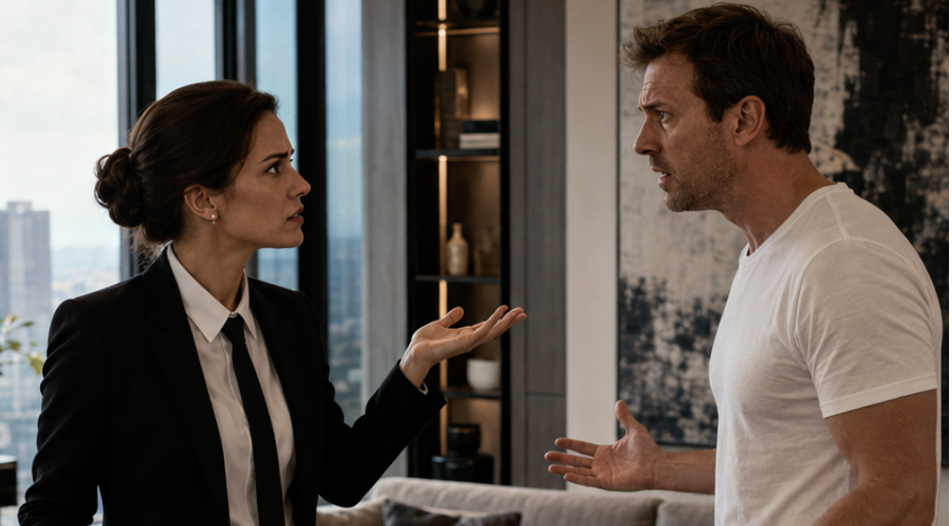
Lena stood in the hallway with a suitcase in her hands, staring at the enormous television that occupied almost the entire living-room wall. Her face was pale with anger, and her lips were trembling.
“Andrei, what is this?” Her voice was dangerously quiet.
Andrei appeared in the kitchen doorway with a satisfied smile, expecting admiration. He had spent the entire morning setting up his new purchase and was certain his wife would be delighted by the surprise.
“It’s a seventy-five-inch Samsung! Can you believe it was fifty percent off? I couldn’t pass up an opportunity like that,” he said, stepping closer without noticing the storm clouds gathering in her eyes. “You said yourself that our old television was too small.”
“Where did you get the money?” Lena slowly lowered the suitcase to the floor.
“From our savings,” Andrei replied with a shrug, as though it were the most obvious thing in the world. “The money was just sitting there doing nothing.”
“Doing nothing?” Lena’s voice rose to a shout. “That money was for the down payment on an apartment! I spent two years saving every penny!”
“Lena, don’t shout. The neighbors will hear us.” Andrei tried to hug her, but she pulled away. “We’ll save it again. We needed the television now. Discounts like that don’t happen every day.”
“Not every day?” Lena laughed hysterically. “Apartment prices are going up every day! Do you understand that during the two months I was away on my business trip, prices rose another ten percent?”
They had been living in a rented one-room apartment for three years. At first, it had seemed like a temporary arrangement—a young couple only beginning their life together. But time passed, and they were still no closer to owning a home. Lena had long understood that without a clear plan and strict budgeting, they would never save enough for a down payment.
“Lena, just think about it rationally,” Andrei said as he switched on the television to show off the bright picture. “Look at that quality! We’ll be able to enjoy movies every evening. Making a home feel comfortable is important too.”
“In someone else’s home!” Lena shouted. “In a rented apartment we could be thrown out of at any moment!”
She remembered how carefully she had planned their household budget, recording every expense in a special notebook. She had denied herself new clothes and saved money wherever she could. Meanwhile, Andrei regularly brought home new things he considered “necessary.”
First, there had been the expensive speakers.
“You love music,” he had justified himself at the time. “Just imagine how amazing everything will sound now!”
Then came an amplifier for the speakers.
“The speakers can’t reach their full potential without it,” Andrei had insisted while unpacking yet another box.
Next came the bicycles—two mountain bikes with an impressive number of gears.
“We said we wanted to exercise,” her husband had reminded her. “Now we can go cycling every weekend.”
Lena remembered how excited she had been about the bicycle. They really had gone to the park several times, and it had been wonderful. But the bicycles had cost the equivalent of two of her monthly salaries.
And what did she spend money on? Organic food, high-quality cosmetics, appointments with a cosmetologist, and regular visits to the salon for haircuts and coloring. Every time, she had to listen to her husband’s irritated grumbling.
“Why buy expensive yogurt when there’s a cheaper one?”
“Why do you need such an expensive facial serum?”
“You’re going to the cosmetologist again? You’re already beautiful.”
“I take care of my health and appearance!” Lena would defend herself. “Organic food doesn’t contain harmful chemicals, and quality cosmetics don’t damage my skin. I’m not doing it only for myself. I’m doing it for you too!”
“It’s all marketing,” Andrei would dismissively reply. “Ordinary products are just as good.”
And now, after returning from a two-month business trip, Lena had discovered that a significant portion of her savings had been spent on a gigantic television.
“I called you,” Andrei said defensively, “but you didn’t answer. I decided to surprise you.”
“I was giving an important presentation! I couldn’t answer the phone!” Lena felt tears rising in her throat. “You should have waited and discussed it with me!”
“But the discount ended that day,” Andrei said helplessly, spreading his hands. “I thought you’d be happy. We wanted a big television.”
“I wanted our own apartment!” Lena screamed. “Do you understand? Our own place! I don’t want to worry every month about whether we’ll have enough money for the rent! I don’t want to live with the thought that the landlady could tell us to move out tomorrow!”
Andrei shook his head.
“You worry too much about the future. We need to live in the present and enjoy life while we’re still young. We’ll buy an apartment later, when we start earning more.”
“Later! It’s always later!” Lena grabbed her head. “Prices are rising right now! The longer we wait, the more expensive housing becomes! I want my own apartment! Do you understand? My own place! I want it to be beautiful and comfortable, not one of these run-down rental apartments!”
“But at least we’re living a full life,” Andrei objected. “We have an excellent sound system, bicycles for outdoor activities, and now a television for relaxing evenings at home. Isn’t that happiness?”
Lena stared at him for a long moment. She could see genuine confusion in his eyes. He truly did not understand what she was feeling.
“You spend money on all kinds of nonsense, while I spend it on useful things!” her husband declared, never expecting what would happen next.
Lena slowly picked up her suitcase and headed toward the door.
“Lena, where are you going?” Andrei asked in alarm.
“To my mother’s,” she answered curtly without turning around.
“Wait. Let’s talk about this!”
“I don’t want to talk to you. I don’t even want to see you!”
The door slammed shut, leaving Andrei alone with his gigantic television.
For the first few days, Lena did nothing but lie in her childhood bedroom and cry. Her mother tactfully avoided asking questions. She simply brought her tea and occasionally stroked her hair.
“Mom, Andrei and I are completely different,” Lena admitted on the third day. “I don’t know whether we can stay together.”
“Tell me what happened,” her mother asked gently.
Lena told her about the television, the savings, and their constant arguments over money.
“You see,” she explained, “I buy good food because I care about our health. I take care of myself because I want to look beautiful for him. I save money because I dream of our future home. But he thinks all of it is nonsense!”
Her mother remained silent for a long time before finally speaking.
“Have you ever thought about why he buys all those things? The speakers, the bicycles, the television?”
“Because he’s irresponsible,” Lena replied with a bitter smile.
“Or perhaps because he is trying to make you happy in his own way,” her mother suggested. “Do you remember how excited you were when he switched on the new speakers and played your favorite song? Do you remember how much you laughed the first time you went cycling together?”
Lena fell silent. Yes, she remembered those moments. She remembered dancing together while music played through the new speakers. She remembered kissing him by the lake after their bike ride.
“He loves you, sweetheart,” her mother continued. “He simply expresses his love differently. You save for the future, while he invests in the present. Both are important.”
Meanwhile, Andrei was suffering alone at home. The enormous television no longer made him happy. Watching movies without Lena felt sad and meaningless. He realized that he had made a serious mistake by spending her savings without her permission.
Andrei went to his best friend, Max, for advice.
“I messed up,” he admitted. “I spent her money on a television because I thought she’d be happy.”
“Are you serious?” Max asked, shaking his head. “She spent two years saving that money, and you just blew it all?”
“But the television is amazing! And the discount was huge!”
“Andrei, you need to understand that the money represented their future to her. Every thousand she saved brought her one step closer to the dream of owning a home. And you turned that dream into a television.”
“But we could have enjoyed it together.”
“She wanted to enjoy living in her own apartment,” Max interrupted him. “And you know what? She’s right. You’re not students anymore. It’s time to think about stability.”
Andrei became thoughtful. For the first time in a long while, he tried to see the situation through his wife’s eyes.
A week passed. Lena missed her husband, but her pride prevented her from taking the first step toward reconciliation. Andrei was suffering too, but he did not know how to fix the situation.
Finally, he made a decision. He went back to the store and arranged to return the television. Fortunately, the store had a generous return policy. They did not refund the full amount—only eighty percent—but it was better than nothing.
Then he went to Lena’s mother’s house.
“Andrei!” she exclaimed in surprise when she opened the door.
“Hello, Galina Petrovna. May I speak to Lena?”
“She doesn’t want to see you.”
“Please. It’s important.”
Lena came out into the hallway. She looked tired and unhappy.
“What do you want?” she asked coldly.
Andrei held out an envelope filled with money.
“What’s this?”
“I returned the television. I’m sorry they didn’t refund the entire amount, but I got most of it back.”
Lena took the envelope with trembling hands.
“Why?”
“Because you were right. We need to think about our future. And because I had no right to spend your savings without your permission.”
Lena studied him carefully. She could see sincere remorse in his eyes.
“Andrei, sometimes it feels as though we speak different languages. You don’t understand why organic food and quality cosmetics matter to me, and I don’t understand why you need expensive speakers and bicycles.”
“But I want to understand,” he said quietly. “Explain it to me.”
They went into the living room and sat opposite each other.
“When I buy quality food,” Lena began, “I’m taking care of our health. Cheap yogurt is full of preservatives that can harm your stomach. Organic vegetables don’t contain pesticides. I want both of us to be healthy and live a long life together.”
Andrei nodded, truly listening to her words for the first time.
“What about cosmetics and the cosmetologist?”
“I want to look beautiful for you,” Lena admitted. “I want you to admire your wife. And yes, it matters for my self-esteem too. When I look good, I feel more confident and happier.”
“And the apartment savings?”
“That represents our stability and our future. It will be a place where we can raise our children and feel safe. A place we can renovate according to our own tastes, and where no one can force us to leave.”
Andrei remained silent for several minutes, processing everything he had heard.
“Now explain why all those purchases matter to you,” Lena asked.
“The speakers… I wanted our home to have a special atmosphere. I wanted us to listen to music and dance the way we did at the beginning of our relationship. Do you remember how we met at a concert? Music brings us joy. It gives us happiness right now.”
Lena nodded. Yes, she remembered that evening when they had accidentally bumped into each other in the crowd and he had gallantly helped her find a lost earring.
“The bicycles were supposed to give us something to do together. Exercise, trips, new experiences. I imagined us going somewhere every weekend, discovering new places and watching sunsets in the countryside. We would come home exhausted but happy.”
“And the television?”
“I imagined us watching movies together in the evenings, curled up on the sofa. I imagined inviting friends over to watch football. I thought it would make our home feel more comfortable.”
Lena finally understood that all his purchases had been connected to her, their relationship, and his desire to create a happy life together.
“So it turns out we both want the same thing,” she said slowly. “We want to be happy together. We simply understand happiness differently.”
“Yes,” Andrei agreed. “You build the foundation for future happiness, while I try to create happiness in the present.”
“Both are important,” Lena said, repeating her mother’s words.
“What should we do?” Andrei asked.
Lena thought for a moment.
“Perhaps we need a plan. A compromise. We can save part of our money for the apartment and spend another part on things we enjoy now. And we must discuss all major purchases with each other.”
“What if we make a shared wish list?” Andrei suggested. “Then we can decide together what to buy first.”
“That’s a good idea. We should also establish a limit. Any purchase above a certain amount must be discussed, regardless of what the money is being spent on.”
“Agreed. What about creating three separate savings accounts? One for the apartment, one for shared pleasures, and one for each person’s private expenses?”
For the first time in a week, Lena smiled.
“You know, that could actually work.”
“Lena, forgive me.” Andrei took her hands. “I was selfish. I didn’t think about your feelings or about how important those savings were to you.”
“And you forgive me,” she replied. “I was too judgmental and never tried to understand your motives.”
“Will you come home?”
“I will, but on one condition—we start taking our budget planning seriously.”
A month later, their small apartment had been transformed. A large sheet containing their income and expense plan was attached to the refrigerator. Three glass jars stood on a shelf, symbolizing their new approach to money: “Apartment,” “Shared Pleasures,” and “Personal Expenses.”
“Look,” Lena said, showing Andrei the figures in her notebook. “If we save thirty thousand every month for the apartment, we’ll have enough for a down payment in a year and a half.”
“How much will we put in the ‘pleasures’ jar?” Andrei asked.
“Fifteen thousand. That will be enough for movies, restaurants, and perhaps some household electronics.”
“And personal expenses?”
“Ten thousand each. You’ll be able to spend yours on concerts and restaurants, while I can spend mine on cosmetics and quality food.”
“That sounds fair,” Andrei agreed.
The first test of their new system came when video game consoles went on sale.
“Lena, the PlayStation is forty percent off!” Andrei announced excitedly when he returned from the store.
“How much does it cost?” Lena asked calmly.
“It isn’t too expensive, but it still exceeds our limit for shared purchases. Let’s discuss it.”
They sat down at the table and spoke honestly. Andrei explained that the console would be for both of them because they could play games together in the evenings. Lena admitted that she liked the idea, but such a purchase would mean they could not save the full amount for the apartment that month.
“What if we take fifteen thousand from the ‘pleasures’ jar and ten thousand from your personal money?” Lena suggested. “Next month, I’ll reimburse you from my personal funds.”
“Great idea!” Andrei replied enthusiastically.
A week later, Lena decided that she wanted to enroll in a French-language course.
“It costs eighteen thousand,” she told him. “That’s more than my personal spending limit.”
“Why do you need French?” Andrei asked.
“Our company is opening a branch in Africa. If I learn the language, I can apply for a position working with that branch. That would mean a higher salary, and we’d save for the apartment faster.”
“Then it’s an investment in our shared future,” Andrei decided. “Let’s take the money from the ‘apartment’ jar, and when you get promoted, we’ll put it back with interest.”
Lena covered his face with kisses.
“I love it when you think like a real investor!”
A year passed. Their system worked. There were no more impulsive purchases or arguments about money. Instead, they had many shared plans and dreams.
“You know,” Lena said one evening while calculating their savings, “we’ve already saved half the amount we need for the down payment.”
“Yes, and we don’t feel deprived,” Andrei added as he embraced her on the sofa. “Do you remember how afraid we were that saving money would ruin our lives?”
“Instead, it brought us even closer,” Lena said with a smile.
Their favorite movie was playing on the screen of their small television. They had purchased a simple model for a reasonable price. Pleasant music flowed from their quality speakers, and two glasses of good wine stood on the table—their weekly tradition.
“I’ve understood something,” Andrei said thoughtfully. “It isn’t about how much money you spend. It’s about how you spend it.”
“And it’s possible to spend money on both the future and the present,” Lena added. “The important thing is to find a balance.”
“We did well,” Andrei said with satisfaction.
“Yes, we make an excellent team,” Lena agreed, settling more comfortably into his arms.
Rain was falling outside, but their small apartment felt warm and comfortable. Soon, they would have a home of their own, but they were no longer trying to rush time. They had learned to be happy in the present without forgetting about the future.
And inside the three jars on the shelf, their dreams continued to grow slowly but steadily—transforming from wishes into real plans, and from plans into a future that was drawing closer every day.