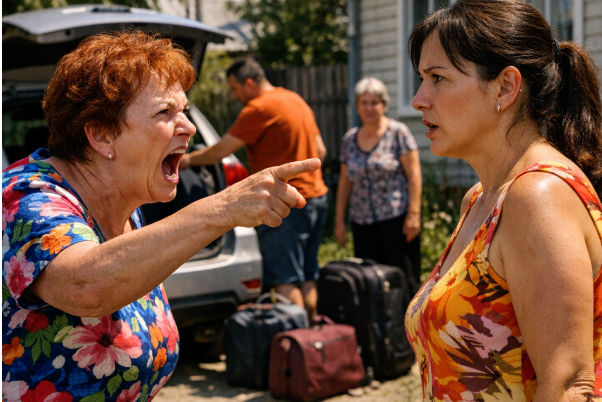
“Since you’ve come, you can leave the same way,” Albina said, refusing to let her pushy relatives into the dacha.
The dacha had not come to her through inheritance, nor had it been a gift — she had bought it herself, with her own money, which she had saved over several years. She had put aside a little at a time, denied herself many things, never went on vacation, and postponed updating her wardrobe, even though many of her clothes had long since needed replacing. When the realtor finally showed her this plot — small, but with a solid little house, apple trees along the fence, and currant bushes by the gate — Albina understood at once: this was it. The very place she had dreamed about during long winter evenings, when the city roared outside her window and the upstairs neighbors played music until midnight.
She moved in at the beginning of May, when the ground had already thawed from winter and smelled damp and full of promise. She rented out her city apartment — to a quiet couple, decent people who paid on time and did not bother her with trivial phone calls. The rent money went toward living expenses, the household, seeds, and seedlings. Everything was falling into place exactly as she had wanted.
The first summer began beautifully. Albina got up early, drank tea on the veranda, and listened to the birds. She planted tomatoes, weeded the beds, and read books that had sat untouched on her shelf for years. The neighbor on the other side of the fence, Valentina Stepanovna, turned out to be a pleasant woman — they exchanged the usual neighborly words over the picket fence, and it was exactly the right amount of interaction: not too little, not too much.
Trouble came from where Albina least expected it, though if she had been honest with herself, she might have guessed it would happen. Her sister Raisa found out about the dacha sometime in the middle of that first summer — maybe from a mutual acquaintance, or maybe Albina herself had let it slip during a phone call, saying something about tomatoes or apple trees. Raisa knew how to listen carefully and draw conclusions.
“A dacha?” she repeated in a tone as though they were talking about buried treasure. “You bought a dacha?”
“I did,” Albina confirmed, already feeling something unpleasant stir somewhere in the pit of her stomach.
“Well, would you look at that,” Raisa said. And in those words was everything: envy, calculation, and the beginnings of a plan already forming.
A week later, her niece Oksana called.
“Aunt Alya, we heard you have a dacha? Can we come for the weekend? The kids need fresh air — they’re completely worn out from the city.”
Albina never knew how to refuse nieces and nephews with children — it was her weak spot, and she knew it. So she said, “Come.” She regretted it the moment she put down the phone. But the word had been given. Oksana arrived with her husband Gennady and their two children — a boy of about eight and a younger girl. Gennady was loud, took up too much space, and immediately walked into the kitchen and opened the refrigerator without being invited. The children ran all over the vegetable patch despite Albina’s requests to stay on the paths — the boy trampled half the strawberry beds, and the girl picked several unripe cucumbers and threw them under the apple tree after taking a bite out of each one. After they left, the house was filled with a special kind of disorder — not just things left lying around, but something that seemed to seep into everything: crumbs in the sofa, rings from glasses on the wooden table, dirty footprints on the veranda, a broken latch on the shed gate.
Albina cleaned up in silence. She decided to treat it as an accident. Guests were guests, children were children.
But after Oksana came others.
Two weeks later, her cousin Lyudmila from a neighboring town called. She was coming with her husband and his mother — an old woman who “needed to be taken out into nature.” Albina agreed again, though much less willingly this time. Lyudmila’s husband spent the whole weekend standing by the grill, burning through an armful of firewood from the neatly stacked woodpile. The old woman occupied the only comfortable armchair and kept demanding tea, then a pillow, then that the window be closed, then that it be opened. Lyudmila helped with chores only as long as she thought someone was watching her; afterward she sat scrolling through her phone. When they left, they forgot a bag of trash on the veranda and left a stranger’s towel in the bathroom — stained and soaking wet.
After the third visit — this time Raisa’s brother-in-law arrived with his wife and their grown son, a silent young man who ate enough for three people and said no more than ten words the entire time — Albina called her sister.
“Raisa,” she said, trying to keep her voice calm, “did you tell everyone about the dacha?”
“Well, what’s wrong with that?” Raisa replied, with a slight note of offense in her voice, as if she were being unfairly accused of something. “They’re family, not strangers.”
“Family leaves a mess behind. The latch is broken, the strawberries have been trampled, and I’m almost out of firewood.”
“Oh, Albina, don’t be childish. A latch costs pennies, the strawberries will grow back, and more firewood can be chopped. What, are you really that stingy with family?”
“That’s not the point.”
“Then what is?”
It was impossible to explain it to Raisa. Albina tried — she said something about personal space, about how her dacha was not a sanatorium or a hotel, that the dacha was her home, her only home now, not a public place. Raisa listened with half an ear and, at the end of the conversation, said:
“You’ve always been a bit selfish. Ever since childhood.”
That ended the conversation.
Afterward, Albina sat on the veranda for a long time, looking at the apple trees. The evening was quiet, smelling faintly of freshly cut grass somewhere nearby. She thought about how all her life she had tried not to be selfish — she helped people, bailed them out, lent money that no one ever seemed in a hurry to repay, listened to other people’s troubles, and never burdened anyone with her own. And now, trying to protect her own home was being called selfishness. Something about that was deeply wrong, but she could not yet quite put her finger on where exactly that wrongness lived.
Summer moved on. The relatives kept coming — now with a kind of brazen regularity, as if they had made a schedule. They came on weekends, sometimes giving her a day’s warning, sometimes simply calling from the road: “We’re already on our way, come out and meet us.” Every time Albina opened the gates, fed them, and cleaned up after them. Every time, something got broken, trampled, or used up without permission.
One day she discovered that her nephew by marriage, Gennady — that same loud husband of Oksana’s — had gone into the shed and taken her gardening tools without asking: a shovel, a rake, and a few other things. “Just borrowing them,” he explained when Albina asked. When he returned them, the shovel was broken. “It’s nothing, you’ll buy a new one — this one turned out to be flimsy,” Gennady said without the slightest embarrassment.
Then her cousin Lyudmila left fish bones and tails right on the kitchen table. They spoiled overnight and smelled so bad the whole house had to be aired out.
Then one of the children broke a pane of glass in the greenhouse. No one confessed, and no one offered to pay for it.
Albina stored all of this up somewhere inside herself, like stones being dropped into a sack. Silently. Carefully. One after another.
She called Raisa again. Raisa brushed her off again. Once, with irritation, she said:
“Albina, just understand — people come to see you, that’s an honor. You should be happy that you’re needed.”
“I don’t want to be needed like this,” Albina said.
“Fine then,” Raisa replied. “Then live there alone with your garden beds.”
It was meant to sound like an insult. But Albina thought: actually, that sounds wonderful. Living alone with the garden beds. That was exactly what she wanted.
By autumn, the invasions died down a little — the gardening season was coming to an end, and the romance of country life had faded. Albina breathed out in relief. Little by little, she began restoring what had been damaged: she fixed the latch, replaced the broken greenhouse glass, bought a new shovel. Her neighbor Valentina Stepanovna, who had watched the whole summer’s pilgrimage of guests, shook her head sympathetically.
“You’re too kind,” she would say. “Kind people are always used.”
“I know,” Albina would answer.
“Then why?”
“I don’t know how to say no.”
Valentina Stepanovna looked at her with understanding — apparently, she had a similar story of her own. They drank tea on her veranda and stayed silent about the things they both understood without words.
Winter was calm. Albina lit the stove, read, knitted, and walked along the snow-covered paths. The relatives did not come — it was too far, too cold, there was no point. She enjoyed the silence and thought. She thought a lot.
She thought about how all her life she had been taught that family was sacred. That you do not abandon your own. That you have to share, help, endure. That if you refuse a relative, you are a bad person, selfish, stingy. Those beliefs had been driven into her so deeply that she had never noticed when they stopped working for her and started working against her…
Continuation just below in the first comment.
The dacha did not come to her by inheritance, nor was it a gift — she bought it herself, with her own money, which she had saved over several years. She put aside a little at a time, denied herself many things, did not go anywhere on vacation, and kept postponing updates to her wardrobe, even though many of her clothes had long needed replacing. When the realtor finally showed her this plot — small, but with a sturdy little house, apple trees along the fence, and currant bushes by the gate — Albina understood at once: this was it. The very place she had dreamed of during long winter evenings, when the city roared outside the window and the neighbors upstairs played music until midnight.
She moved in at the beginning of May, when the ground had already thawed from winter and smelled damp and full of promise. She rented out her city apartment to a quiet couple — decent people who paid on time and did not bother her with pointless calls. The rental income went toward living expenses, the household, seeds, and seedlings. Everything was falling into place exactly as she had wanted.
The first summer began beautifully. Albina got up early, drank tea on the veranda, listened to the birds. She planted tomatoes, weeded the beds, read books that had sat untouched on the shelf for years. The neighbor beyond the fence, Valentina Stepanovna, turned out to be a pleasant woman — they exchanged the usual words neighbors toss over a picket fence, and it was exactly the right amount of communication: neither too little nor too much.
Trouble came from where Albina did not expect it, though if she were honest with herself, she might have guessed it would happen. Her sister Raisa found out about the dacha sometime around the middle of that first summer — either through a mutual acquaintance, or maybe Albina herself let it slip during a phone call, mentioning something about tomatoes or apple trees. Raisa knew how to listen carefully and draw conclusions.
“A dacha?” she repeated in a tone as though they were talking about buried treasure. “You bought a dacha?”
“I did,” Albina confirmed, already feeling something unpleasant somewhere in the pit of her stomach.
“Well, imagine that!” Raisa said. And that “well, imagine that” contained everything: envy, calculation, and a plan already beginning to take shape.
A week later her niece Oksana called.
“Aunt Alya, we heard you have a dacha? Can we come for the weekend? The children need fresh air, they’re completely worn out from the city.”
Albina did not know how to refuse nieces and nephews with children — that was her weak spot, and she knew it. She said: come. She regretted it as soon as she hung up. But the word had been given. Oksana came with her husband Gennady and two children — a boy of about eight and a younger girl. Gennady was loud, took up a lot of space, and immediately went into the kitchen and opened the refrigerator without being invited. The children tore around the garden despite Albina’s request to stay on the paths — the boy trampled half the strawberry beds, and the girl picked several unripe cucumbers and threw them under the apple tree after taking a bite from each one. After they left, the house was left with a particular kind of mess — not just things scattered around, but something ingrained: crumbs in the sofa, rings from glasses on the wooden table, muddy footprints on the veranda, a broken latch on the shed gate.
Albina cleaned in silence. She decided to treat it as an accident. Guests are guests, children are children.
But others followed after Oksana.
Two weeks later her cousin Lyudmila from a neighboring town called. She was coming with her husband and his mother — an elderly woman they “needed to take out into nature.” Albina agreed again, though less willingly this time. Lyudmila’s husband spent the whole weekend standing by the grill, going through an armful of firewood from the neatly stacked woodpile. The old woman occupied the only comfortable armchair and kept demanding first tea, then a pillow, then that the window be closed, then that it be opened. Lyudmila helped with household chores only as long as she thought someone was watching, and then she sat down to scroll on her phone. When they left, they forgot a bag of garbage on the veranda and left a чужое towel in the bathroom — stained and wet.
After the third visit — this time Raisa’s brother came with his wife and their grown son, a silent young man who ate for three and said no more than ten words the entire time — Albina called her sister.
“Raisa,” she said, trying to stay calm, “did you tell everyone about the dacha?”
“So what if I did?” Raisa replied with slight offense in her voice, as though she were being unfairly accused of something. “They’re family, not strangers.”
“Family leaves a mess behind. My latch is broken, the strawberries are trampled, and I’m almost out of firewood.”
“Oh, Albina, why are you acting like a child? A latch costs pennies, the strawberries will grow back, more firewood can be chopped. What, are you sorry to let your relatives stay?”
“That’s not the point.”
“Then what is?”
It was impossible to explain it to Raisa. Albina tried — said something about personal space, about the fact that her dacha was not a sanatorium and not a hotel, that the dacha was her home, now her only home, and not a communal place. Raisa listened with half an ear and at the end of the conversation said:
“You were always a bit selfish. Even as a child.”
That ended the conversation.
Afterward Albina sat on the veranda for a long time, looking at the apple trees. The evening was quiet, and somewhere nearby the scent of freshly cut grass drifted through the air. She thought about how all her life she had tried not to be selfish — she had helped, bailed people out, lent money no one hurried to repay, listened to other people’s troubles and did not burden them with her own. And now her attempt to protect her own home was being called selfishness. Something about it was deeply wrong, but she could not yet grasp exactly where that wrongness lived.
The summer went on. The relatives kept coming — now with an almost brazen regularity, as though they had drawn up a schedule. They came on weekends, sometimes warning her the day before, sometimes simply calling on the road: “We’re already on our way, come out and meet us.” Every time Albina opened the gate, fed them, and cleaned up after them. Every time something was broken, trampled, or used up without permission.
One day she discovered that her nephew by marriage, Gennady — Oksana’s loud husband — had gone into the shed and taken garden tools without asking: a shovel, a rake, and something else. “Just borrowing,” he explained when Albina asked. When he returned them, the shovel was broken. “Never mind, you’ll buy a new one, this one turned out to be flimsy,” Gennady said without a trace of embarrassment. Then her cousin Lyudmila left fish bones and tails right on the kitchen table. They spoiled overnight and stank so badly that the whole house had to be aired out.
Then one of the children broke a pane of glass in the greenhouse. No one confessed, and no one offered to pay for it.
Albina kept track of all of it somewhere inside herself, the way stones are piled into a sack. Silently. Carefully. One after another.
She called Raisa again. Raisa brushed her off again. Once she said irritably:
“Albina, you have to understand — people are coming to you, that’s an honor. You should be glad you’re needed.”
“I don’t want to be needed like this,” Albina said.
“Well then, fine,” Raisa answered. “Live alone with your garden beds.”
It was meant to sound like an insult. But Albina thought: actually, that sounds good. Living alone with garden beds. That was exactly what she wanted.
In the autumn the invasions slowed down a little — the gardening season was ending, and the romance of country life had faded. Albina exhaled. She slowly began restoring what had been damaged: repaired the latch, replaced the broken greenhouse glass, bought a new shovel. Her neighbor Valentina Stepanovna, who had watched the pilgrimage of guests all summer, shook her head sympathetically.
“You are too kind,” she said. “Kind people are always used.”
“I know,” Albina replied.
“So what then?”
“I don’t know how to say no.”
Valentina Stepanovna looked at her with understanding — apparently she had a similar story of her own. They drank tea on her veranda and sat in silence about what both of them understood without words.
Winter was peaceful. Albina heated the stove, read, knitted, walked along the snow-covered paths. The relatives did not come — it was too far, too cold, no point. She enjoyed the silence and thought. Thought a great deal.
She thought about how all her life she had been taught that family is sacred. That you do not abandon your own. That you must share, help, endure. That if you refuse a relative, you are a bad person, selfish, stingy. These beliefs had been driven into her so deeply that she did not notice when they stopped working for her and began working against her.
She thought about the shovel. The greenhouse glass. The strawberries. The garbage bag on the veranda. The rings from glasses on the wooden table. And the fact that no one had apologized even once. Not because they were bad people — it simply never occurred to them that there was anything to apologize for. In their picture of the world, Albina’s dacha was a common place, something like a boarding house for family, and Albina herself was part of that boarding house — the service staff.
By spring she knew what to do.
She was not angry. That is important — she was not angry. Anger would have been an unstable foundation. She simply understood everything. Understood it clearly and calmly, the way one understands something long known but only finally put into words.
The first warm weekend in May brought the first call. Oksana:
“Aunt Alya, we’re coming! The children miss the fresh air. We’ll be there in about two hours.”
“No,” Albina said.
A pause.
“What do you mean, no?”
“Don’t come. I’m not expecting guests.”
“But we already…” Oksana seemed confused. “We’re already getting ready.”
“Then don’t get ready.”
Oksana called Raisa. Raisa called Albina. The conversation was heavy — Raisa spoke about family, about how people do not behave like this, about children who need fresh air, about how Albina was becoming a stranger. Albina listened. Then she said:
“Raisa, this is my home. I live here. I do not receive guests without an invitation.”
“But it’s family!”
“Family does not break other people’s things and leave garbage behind.”
Raisa took offense and hung up. But the lesson was not learned. Or only partly learned. The following weekend Lyudmila called — she too was “coming, already on the road.” Albina said the same thing. Lyudmila was slightly less offended than Oksana, but offended all the same.
And then came that weekend.
It was a warm June day. Since morning Albina had been busy in the garden beds, planting tomato seedlings. It was a good day — quiet, sunny, with a light breeze. She wore her favorite old apron, her hair tucked under a kerchief, her hands in the soil — and it was exactly in such a state, unseen and with no need to pretend, that she was happiest.
The car appeared shortly before noon. Albina heard the engine before she saw it — the road in front of the property could be seen clearly from the garden. She straightened up, took off one glove, and shaded her eyes from the sun with her hand.
The car was familiar to her. Gennady. Oksana. The children. And, it seemed, someone else — silhouettes could be seen in the back seat.
They stopped at the gate. Gennady honked — short, proprietorial. That habit of honking as though this were his own garage.
Albina did not move from where she was.
Gennady got out of the car. He went to the gate, tugged at it — locked. He looked through the pickets.
“Aunt Alya! We’re here!”
Albina slowly removed the second glove. She walked to the gate — unhurriedly, at her own pace. She stopped on the other side. Looked at Gennady, at Oksana, who had gotten out of the car and was squinting in the sun, at the children already fidgeting by the gate.
“Hello, Gena,” Albina said.
“Hey! Open up, we’re here,” Gennady said, smiling that broad smile that had long since stopped seeming friendly to her.
“I wasn’t expecting you.”
“So what? We came anyway, without warning. Like family.”
“No,” Albina said.
Gennady stopped smiling.
“What do you mean, no?”
“I’m not opening.”
“Are you serious?” Oksana came closer, standing beside her husband. “Aunt Alya, we drove for more than an hour. The children are tired. We’re here to see you, as family.”
“You came without an invitation. I did not invite you.”
“But we’re family!” Oksana raised her voice. “You can’t treat relatives like this. What will people say?”
“I am not interested in what people will say.”
The others who had been in the back seat got out of the car: Raisa’s brother Pavel and his wife Nina. So, a whole delegation. Albina looked at them — they stood a little aside, awkwardly, like people who felt they had arrived at the wrong place at the wrong time but were not prepared to admit it.
“Albina,” Pavel said in a conciliatory tone, “come on, let’s not quarrel. Since we’ve already come, just let us in. One foot in, one foot out — we’ll have some tea and leave.”
“No, Pasha.”
“What do you mean no!” Gennady raised his voice again, and that was his mistake. “What kind of nonsense is this? A person lives alone in a big house, family comes to see her, children come, and she says no! Is that normal?!”
Albina looked at him. Calmly. Without anger. She discovered that there was no anger in her at all — only a quiet certainty, like the ground beneath her feet.
“Gena,” she said, “this is my home. Not the family’s, not shared, not a boarding house. Mine. I live here. You broke my things, trampled my garden, used up my belongings, and never thought it necessary to apologize. I endured it for a long time. I won’t anymore.”
“You’re serious over some shovel?!”
“It’s not about the shovel.”
“Then what is it about?!”
“It’s about the fact that this is my home.”
The pause was long. The children fell silent — children always sense tension among adults. Oksana looked at her husband, Nina at the ground, Pavel somewhere off to the side.
“So what are we supposed to do now, leave?” Oksana finally asked. Her voice had grown thin, injured. “We came all this way. We made plans. The children were looking forward to it.”
Albina looked at her. Looked at the children — they were standing by the car, and it was clear they were tired. She felt sorry for them, for the children. But not enough to open the gate.
“You came here, so you can leave the same way,” she said.
It did not sound cruel. Simply like a fact. Like a closed door behind which lives a person who has the right to live there.
Gennady cursed — quietly, under his breath. He got into the car. Oksana stood a little longer, looking at Albina with an expression in which resentment, surprise, and something like respect were mixed together, though she probably did not understand that herself. Then she too went back to the car. The children followed her.