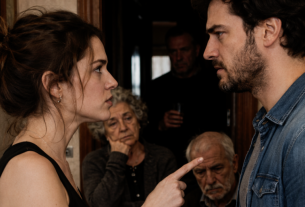
Dmitry stood in the middle of the kitchen with his legs apart, like a man accustomed to occupying every inch of available space. He looked down at Marina—not because he was taller, but because he had learned that look in childhood. Marina sat at the table, one hand wrapped around her morning coffee, waiting for him to speak.
“All right, here’s what’s going to happen,” Dmitry began, snapping his briefcase shut. “My mother was in an accident. She fractured her hip and cracked a vertebra. Her recovery will take at least eight months.”
Marina looked up at him.
“That’s terrible. Does she need help?”
“She needs you,” Dmitry said sharply. “You’ll move to her house outside the city. You’ll take care of the house, look after her, and watch the children. The nanny and driver are already paid for. The house is huge. There’s plenty of room.”
Marina carefully set down her cup. Their eldest daughter, Liza, was starting first grade in two weeks. Maxim had only just begun adjusting to kindergarten. She drew a breath, trying to find words that would not provoke the familiar wave of irritation.
“Dima, I understand that the situation is serious. But Liza is starting school. Maxim is four, and he has only just settled in. Couldn’t we find another solution? A professional caregiver, perhaps?”
“What caregiver?” Dmitry jerked one shoulder. “Do you even hear yourself? This is my mother. Thanks to her and my father—may he rest in peace—we live the way we do. The apartment, the car, the bills—it all comes from her money. Meanwhile, you sit at home doing nothing and lecture me about caregivers.”
“Doing nothing?” Marina swallowed. “I’m raising two children, Dima.”
“Liza can attend the school in the village. It’s no worse than a Moscow school. Maxim will stay with you. Stop whining and pack your things. You’ll look after my mother and the children. End of discussion.”
She looked at him, trying to find even the smallest hint of a request in his words. Some sign that he understood what he was demanding of her. But Dmitry was already fastening his briefcase, as though he had just signed a contract.
“Dima, let’s at least discuss this tonight. Calmly, together. I’m not refusing to help, but I need time to prepare.”
“Tonight?” He smirked. “By tonight, you should already be there. The driver will arrive at one.”
“At one?” Marina half rose from her chair. “Are you serious? I can’t even pack everything in four hours. Liza has an orthodontist appointment tomorrow, and Maxim—”
“Cancel it. They have doctors there too.” Dmitry put on his jacket. “Marina, don’t make this complicated. I’ve thought of everything. You’ll be better off there than here. Fresh air, a garden, a swimming pool. The children will love it.”
Marina slowly sat back down. A faint hope still flickered inside her that this was simply his way of expressing fear for Galina Petrovna. That beneath his harshness was ordinary concern for someone he loved. She decided not to argue.
“All right,” she said quietly. “I’ll pack.”
Dmitry nodded as though he had expected no other answer. At the door, he turned around.
“One more thing. Take only the essentials. Everything you need is already there. Don’t bring your winter coat. We’ll buy you a new one.”
He left. Marina heard the lock click behind him.
She packed two suitcases, Liza’s backpack with her schoolbooks, and a bag of Maxim’s toys. Liza, unusually serious for her age, stood in the hallway watching.
“Are we moving?” her daughter asked.
“We’re going to Grandma Galya’s,” Marina replied as she zipped up the suitcase. “She needs help. We’ll manage.”
“What about Dad?”
“Dad will stay in the city. He has a lot of work.”
Liza said nothing. Marina noticed how tightly her daughter hugged her stuffed cat, and the gesture filled her with bitterness.
Galina Petrovna’s mansion stood behind a high brick wall, forty minutes from Moscow. The two-story house with an attic, the manicured yard, the greenhouse, and the apple orchard looked like scenery from a film about a comfortable retirement. Marina stepped out of the car with Maxim in her arms and looked toward the porch.
Galina Petrovna was sitting in a wheelchair near the entrance, wrapped in a dark burgundy shawl. Her face was stern, her lips pressed together, her eyes like two gray stones. She examined her daughter-in-law from head to toe and said:
“Come inside. Don’t stand there like strangers.”
Marina climbed the steps.
“Hello, Galina Petrovna. How are you feeling?”
“Like a woman with a broken hip,” she replied dryly. “Not particularly cheerful. All right, let me see the children. Maxim has grown. And Liza is the image of her father in a skirt.”
“Grandma Galya, do you have a cat?” Liza asked, peering behind the wheelchair.
“I do. A ginger bandit named Porthos. He’s been hiding under the veranda for three days. If you lure him out, he’s yours for the rest of the evening.”
Liza dashed into the yard. Maxim reached after his sister. Marina remained standing in front of her mother-in-law, unsure what to do with her hands.
“Dmitry said you needed constant assistance,” she began cautiously.
“Dmitry says many things.” Galina Petrovna turned her wheelchair toward the door. “Come inside. The bedrooms are upstairs, on the left. The bedding is clean, and the towels are in the cupboard. Dinner is at seven. Don’t be late. I don’t like lateness.”
The first few weeks were difficult. Galina Petrovna was demanding, sharp-tongued, and had no patience for pointless conversation. Marina got up at six, prepared breakfast, drove Liza to the local school, returned, and took care of the house. In the evenings, she read bedtime stories to Maxim and then went downstairs to sit with her mother-in-law on the veranda.
“Sit down,” Galina Petrovna would say. “You look like an exhausted horse.”
“I’m fine.”
“When a woman says she’s fine, it means she’s holding herself together by her last thread. I used to say the same thing. Sit down and pour the tea.”
Marina sat. They drank tea in silence. Sometimes Galina Petrovna told her stories from the past. She spoke about working in a roadside café, counting every coin, and never believing that life could take a different turn. She told Marina how she had met Viktor Pavlovich when he stopped for coffee and stayed for two hours.
“He told me, ‘You’re no princess, but you have the eyes of a queen,’” Galina Petrovna said with a snort. “He was a smooth talker. But an honest smooth talker. A rare breed.”
“Did you love him?” Marina asked.
“I loved him. And I hated him. Sometimes both at once. That’s normal when the man is worth something. The real problem begins when you hate him and there is nothing left to love.”
Marina lowered her eyes. Dmitry called once a week, briefly and in a businesslike manner. He asked about the children, though not every time. He never asked about her.
One day, Marina’s phone broke after Maxim dropped it down the stairs. When Galina Petrovna found out, she summoned the driver.
“Go into the city and buy her a proper phone. Not some cheap piece of junk—a good one, with a decent camera. She should be able to photograph the children.”
“Galina Petrovna, you don’t need to. I can buy one myself.”
“You won’t buy anything yourself because you barely have any money. I saw you counting the change from the shop yesterday. Don’t argue. Consider it a gift.”
Marina accepted the phone. There was more warmth in that gesture than in everything Dmitry had said to her over the previous two years.
Meanwhile, on the very day Marina and the children left, Kristina appeared at the Moscow apartment. She wheeled a suitcase into the hallway, kicked off her shoes, and wandered through the rooms, running her fingers over the curtains, cushions, and vases.
“Finally,” she said, wrapping her arms around Dmitry’s neck. “I thought you would never make up your mind.”
“I did,” he replied, kissing her. “Everything is going according to plan. In six months, I’ll file for divorce. I’ll keep the children and give Marina a little money. She’s quiet. She won’t make a scene.”
“What if she does?”
“She won’t. She isn’t capable of conflict. The perfect victim.”
Kristina laughed.
“I’m the perfect victim. I’ve been waiting an entire year for you to make a decision.”
“Wait a little longer.” Dmitry stroked her hair. “Soon, all of this will be ours.”
Six months passed. Marina became accustomed to the rhythm of country life. Liza loved her new school, and Maxim ran through the garden with Porthos the cat. Galina Petrovna gradually recovered. She was already walking with a cane, scolding the physiotherapist, and berating the gardener whenever the bushes were trimmed unevenly.
Dmitry arrived on a Saturday without warning. He stepped out of his car, adjusted his shirt collar, and headed toward the house. Marina met him near the porch.
“You didn’t tell us you were coming,” she said.
“Was I supposed to?” He walked past her into the house and sat at the kitchen table. “Where are the children?”
“Liza is at her art class. Maxim is asleep. What happened?”
Dmitry placed an envelope on the table. It was white, thick, and official-looking.
“Marina, I’m going to be direct. It’s over between us. It has been for a long time. You know it, and I know it. These are the divorce papers. Sign them, and we can separate peacefully.”
Marina looked at the envelope. Then she looked at him.
“Over?” she repeated. “When did it end, Dima? When you sent me here? Or before that?”
“It doesn’t matter when. What matters is that it’s over. There are no feelings left. There’s no point in living together. The children will stay with me. I’ll provide them with everything they need. I’ll transfer some money to you—enough to get started.”
“Some money?” Marina stood up. “You talk about our children as though they’re clauses in a contract. ‘The children will stay with me.’ You’ve seen them four times in six months, Dmitry. Four times.”
“I was busy.”
“Doing what?”
“That’s none of your business.”
“No, it is my business. Because I know what you were doing.”
She spoke calmly, but every word landed on the table like a stone. Dmitry narrowed his eyes slightly.
“What do you know?”
“Kristina. Your assistant. She has been living in our apartment since the day you threw me out and sent me to the countryside. Do you think no one in this village ever goes to Moscow? Do you think no one saw her parking in our space or ordering food to our address?”
Dmitry leaned back in his chair. Confusion flashed in his eyes for a moment, but he quickly regained control.
“So what? Even if that’s true, it changes nothing. I have a right to a personal life. We haven’t really been together for six months. Sign the papers and leave.”
“Leave for where?”
“Wherever you want. Rent an apartment. Find a job. You’re a grown woman.”
“And the children?”
“The children are mine. I have resources, proper living conditions, and opportunities. What do you have? Empty hands and a room in my mother’s house?”
Marina stood before him, and something inside her slowly shifted. The hope she had carried all those months like a fragile vase cracked and shattered. There was no patience left. No gentleness. Only a cold, precise understanding of the man she had lived with for seven years.
“You’re a bastard,” she said evenly.
“Call me whatever you like. Sign the papers and leave.”
“No.”
“What do you mean, no?”
“No, I won’t sign. No, I won’t leave. And no, you are not taking the children.”
Dmitry stood up. He was a head taller than she was, broad-shouldered, and accustomed to using his size to intimidate people.
“Marina, don’t be stupid. I have lawyers, money, and connections. You’ll lose no matter what you do. Don’t ruin your life. Leave quietly.”
“And if I don’t?”
“Then tomorrow the children will meet my new wife, and you will never see them again.”
That was when Marina did something she had never done before in her life. She stepped right up to Dmitry—he did not even have time to move away—and slapped him across the face. Hard, loud, and with the full force of her shoulder. His head jerked to the side.
Dmitry froze. A red handprint appeared on his cheek, and his eyes filled with pure astonishment. In seven years of marriage, Marina had never once raised her voice at him. And now she had slapped him.
“You…” he began.
“Shut up,” Marina cut him off. “You wanted honesty, so here it is. You didn’t send me here because of Galina Petrovna. You cleared the apartment for your mistress. You used your own mother’s illness as an excuse. You lied to me every day, during every phone call, with every fake ‘How are you?’ And now you stand here and tell me you’re taking my children?”
“Our children.”
“Now you remember they’re ours? When was the last time Maxim called you before bed? When did Liza last show you one of her drawings? You don’t know her favorite color. You don’t know that Maxim is afraid of thunderstorms and can only fall asleep with his owl-shaped night-light. You are nobody to them. Just a man who occasionally appears and then leaves again.”
Dmitry rubbed his cheek. He clearly had not expected events to take this turn.
“You’re hysterical,” he muttered. “Calm down. We’ll talk tomorrow.”
“Tomorrow? No, Dima. We are finished talking. Right now.”
She picked up the envelope from the table and tore it in half. Then she tore it again and threw the pieces at his feet.
“Leave. And tell your mistress that the apartment does not belong to her.”
Dmitry looked down at the torn papers and then back at Marina.
“You’ll regret this,” he said quietly.
“You already regret it. You just haven’t realized it yet.”
He turned around and stormed out, slamming the door so hard that the glass shook.
Marina did not wait another minute. She went upstairs, walked down the hall, and knocked on her mother-in-law’s bedroom door. Galina Petrovna was sitting beside the window with a book.
“Come in. I heard the door slam. Dmitry?”
“Yes.” Marina sat down across from her. “Galina Petrovna, I need to tell you something. Right now.”
“Go ahead.”
“Dmitry came with divorce papers. He wants to take the children. He is living with another woman—Kristina, his assistant. Their affair has been going on for at least a year. He didn’t send me here because of your accident. Or rather, the accident gave him a convenient excuse. He wanted the apartment empty.”
Galina Petrovna closed her book. Slowly, she placed it on the side table and removed her glasses.
“Repeat that last part.”
“He sent me here to take care of you so that he could move his mistress into the apartment. That entire speech about family duty was an act.”
Her mother-in-law said nothing. Her expression did not change, but the fingers resting on the arm of her chair trembled slightly.
“Kristina, you say,” she said at last. “Young?”
“Five years younger than me.”
“Pretty?”
“I don’t know. I’ve seen a photograph. She looks ordinary.”
“Ordinary,” Galina Petrovna repeated. “They’re always ordinary. Viktor Pavlovich, God rest his soul, once found himself an ‘ordinary’ woman too. I didn’t stay silent then. I went to her workplace and explained the situation. With words. No violence. One conversation was enough.”
“I don’t know what to do. He’s threatening me with lawyers. He says he has money and connections.”
“Money?” Her mother-in-law raised an eyebrow. “What money? The apartment is registered in my name. This house is mine. The capital Viktor Pavlovich left behind is in my accounts. Dmitry manages the business, but the assets belong to me. Has he forgotten?”
Marina said nothing.
“Apparently, he has.” Galina Petrovna reached for her phone. “In that case, we’ll remind him.”
She dialed a number. The call was answered after the first ring.
“Arkady Semyonovich? This is Galina Ilyinichna. Yes, hello. I need your help. No, not tomorrow. Today. Come this evening. Yes, bring the documents. All of them. This concerns my son. I’ll explain the details when you arrive.”
She ended the call and turned toward Marina.
“Arkady Semyonovich handled Viktor Pavlovich’s affairs for twenty years. He knows every comma in every document. In two days, Dmitry will receive papers that will make his vision go dark.”
“You… you’re taking my side?” Marina could hardly believe it.
“I’m taking the side of the truth,” Galina Petrovna said sharply. “My son is still my son. But if he has chosen to behave like the lowest kind of scoundrel, I will not pretend otherwise. Liza and Maxim are my grandchildren. No Kristina is going to raise them. Not while I’m alive.”
Two days later, Dmitry was served with a package of documents: a claim regarding the division of property, a petition requesting that the children’s primary residence be established with their mother, and a letter from his mother. It was dry, formal, and half a page long. It stated that the house, apartment, assets, and accounts were Galina Petrovna’s property. His authority to manage the family business could be revoked at any time. Marina and the children were staying. It was time for him to find another apartment.
Dmitry called that same evening. Not Marina—his mother.
“What are you doing?” Panic flooded his voice.
“Me?” Galina Petrovna spoke evenly. “Nothing unusual. I’m protecting my family. My real family.”
“I’m your son!”
“You are my son who threw his wife and two young children out of their home so he could play at being in love with some girl. You used my accident. My pain. My name. Did you think I would never find out? Dmitry, I lived beside Viktor Pavlovich for thirty years. I learned to recognize a lie from a mile away.”
“My relationships are my own business.”
“Your relationships are yours. The property is mine. Do you understand the difference?”
“You can’t do this to me!”
“I already have. The lawyer is working on it. If you want to discuss the terms, come here. But do not bring Kristina. I have no intention of seeing her.”
Dmitry hung up. He was trapped, and it was a trap he had built himself out of his own greed and deceit. Every brick was his. Every lock was his.
A year passed. Twelve months that changed everything.
Marina remained in Galina Petrovna’s house. Liza entered second grade with excellent marks and joined an art club. Maxim started preschool and spent every evening telling Grandma Galya how he had made clay dinosaurs. Porthos grew fat and slept exclusively on Maxim’s pillow.
Marina began working with a charitable foundation that helped women facing difficult circumstances. She knew what it felt like to be erased from someone’s life with a single command. She knew what it was like to stand in front of a closed door with two children and a suitcase.
Galina Petrovna recovered. She abandoned her cane, bought herself a pair of new sneakers, and exercised on the veranda every morning, causing the gardener to cross himself in astonishment whenever he saw her. She and Marina learned to live together not as mother-in-law and daughter-in-law, but as two women whom life had taught the same lesson.
“Do you know what I’ve realized?” Galina Petrovna said one evening over dinner.
“What?”
“My son is a copy of his father, except for one detail. Viktor Pavlovich knew when to stop. He understood when he had crossed the line, and he came back. Dmitry doesn’t. He keeps going until the very end, even when there’s a wall in front of him.”
“He called yesterday,” Marina said.
“I know. He called me too. He asked for ‘one more chance.’ I asked him, ‘A chance to do what?’ He didn’t answer.”
Dmitry and Kristina’s marriage—they had officially married one month after his divorce from Marina—lasted exactly six months. Kristina turned out to be a practical woman. When she discovered that Dmitry had neither an apartment nor control over the family fortune, her love evaporated with remarkable speed. She packed her belongings as easily as she had once wheeled her suitcase into someone else’s hallway.
Dmitry came to see his mother in November. He sat in the same kitchen where, a year earlier, he had thrown the envelope of divorce papers in front of Marina.
“Could I have some tea?” he asked quietly.
Galina Petrovna silently placed a cup in front of him.
“Where’s Marina?”
“Upstairs with the children.”
“I need to speak to her.”
“Why?”
“To apologize.”
“Apologize,” Galina Petrovna repeated. “A beautiful word. And then what?”
“I don’t know. Maybe we could…”
“No,” a voice said from the doorway.
Marina stood at the entrance to the kitchen. She looked different—calmer, stronger, more confident. Six months earlier, she had torn up his envelope. Today, she stood in the doorway as though the space belonged to her.
“Marina, I was wrong,” Dmitry began. “I made a terrible mistake. Kristina was an obsession, a moment of temporary madness. I lost my head.”
“You didn’t lose your head,” Marina replied, sitting across from him. “You calculated everything. You planned it and carried it out. The only thing you failed to consider was that the people around you were capable of thinking too.”
“I want to come back.”
“Come back where?”
“To the family. To you. To the children.”
“A family isn’t a hotel, Dima. You can’t check out, move another guest into your room, and then return later saying, ‘Sorry, there’s been a mistake.’”
“But I’m still their father.”
“Their father.” Marina nodded. “Fine. You want to be a father? Then be one. Come on weekends. Call the children. Remember their birthdays. Liza turns eight in two months. Maxim turns five in April. Write it down so you don’t confuse them.”
“What about us?”
“There is no us anymore. You decided that a year ago when you placed that envelope on this table.”
Dmitry sat staring into his cup. He looked like a man who had built a house of cards and then blown it down himself.
“Marina, I’m asking you…”
“Dmitry, I’m going to tell you one thing, and you are going to remember it. I was a good wife. I endured everything, stayed quiet, and obeyed you. I went to the countryside at your first command. The only thing I regret is that I didn’t slap you sooner. Maybe then you would have come to your senses.”
“But you did slap me.” Without thinking, he touched his cheek.
“Yes. That slap was the best thing I ever did for you. Before it, you thought I was a piece of furniture. Afterward, you realized that furniture could fight back.”
Galina Petrovna snorted into her cup but said nothing.
Dmitry stood up.
“So that’s it?”
“That’s it.”
He headed toward the door. At the threshold, he turned around.
“Can I at least see the children?”
“Saturday. From noon until six. Call beforehand.”
He nodded and left.
When the sound of his footsteps faded, Galina Petrovna set down her cup and looked at her daughter-in-law.
“You know, there’s something I’ve wanted to tell you for a long time.”
“Yes?”
“When Dmitry brought you here to meet me seven years ago, I thought you were quiet, obedient, and convenient. I decided my son had chosen well. Now I think differently.”
“How?”
“Now I think you were too good for him from the very beginning. Neither you nor I understood it at the time.”
Marina felt a lump rise in her throat. She swallowed.
“Thank you, Galina Petrovna.”
“Don’t thank me. Put the kettle on instead. And take out the cherry jam Liza helped make. It’s going to be a long evening.”
Marina stood and switched on the kettle. Outside, the season’s first snow was falling. Liza ran in from her room, followed by Maxim carrying Porthos. Galina Petrovna grumbled at the cat, Liza laughed, and Maxim demanded a second helping of jam.
A week later, Marina learned the final piece of the story. When Kristina left Dmitry, she had taken copies of all the financial documents from his work computer and tried to sell them to Galina Petrovna’s competitors. Arkady Semyonovich intercepted the deal and passed along the information. Kristina now faced a damages lawsuit for an amount that made her knees buckle.
When Dmitry learned what had happened, he called his mother.
“She… she was stealing from us?”
“From you,” Galina Petrovna corrected him. “She took nothing from us. Because ‘we’ means me, Marina, Liza, and Maxim. You, Dmitry, chose your own company.”
He remained silent.
“And one more thing,” his mother added. “I have transferred the assets. Marina now has the lifelong right to live in this house. The children have an educational trust. You receive nothing. For now.”
“For now?”
“Until you prove that you are worth something. Not with words—with actions. Come see the children on Saturday. Be on time. And don’t bring presents. Bring yourself. Your real self, assuming any of it is still left.”
She ended the call.
Marina had been standing nearby and heard everything. She did not feel triumphant. She did not celebrate. She simply understood one thing now: someone else’s happiness is not something that can be stolen. It can only be built—with your own hands, your own patience, and your own pain.
And when someone tries to take what belongs to you, do not let them.
Even if you have to strike back.
Especially if you have to strike back.