Nina carried Dasha across the garden plot, her back aching so badly that she wanted to sit down right there on one of the beds. Her daughter had her arms wrapped around Nina’s neck, her legs dangling uselessly—the same legs that had refused to obey her for the past three months. After a severe illness that winter, when her fever had stayed above forty degrees Celsius for a whole week, four-year-old Dasha’s legs had simply stopped working. The doctors said recovery was possible, but it would take time, exercises, fresh air, and patience. Nina had plenty of patience. Everything else was running out.
“Mom, put me over there where the bugs are,” Dasha asked.
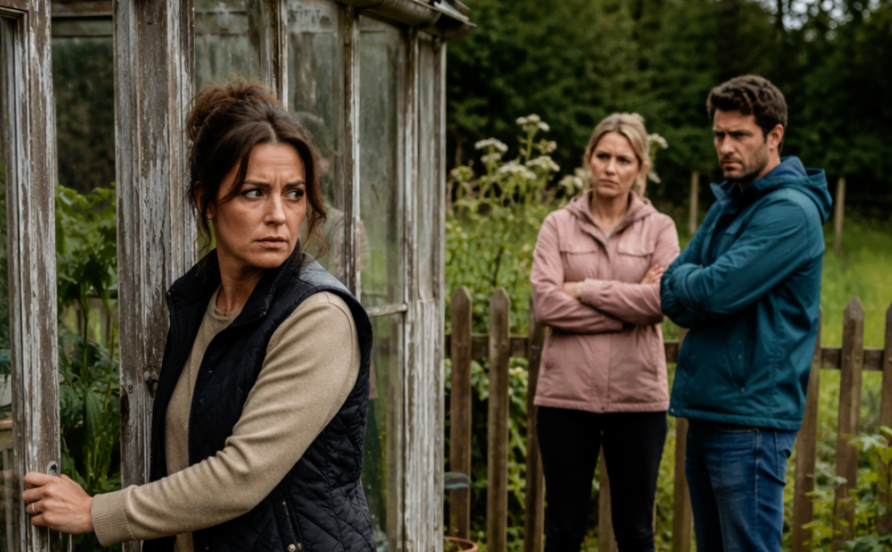
Nina spread an old blanket between the garden beds, sat her daughter down, and tucked a pillow behind her. Dasha immediately began digging in the soil with her fingers, carefully searching for worms. Nina straightened up and looked over the property. Six hundred square meters inherited from her grandmother, a small house, a leaning fence, and a greenhouse with cracked glass. The ground had barely thawed, yet Nina already had boxes of seedlings all over the house—tomatoes, peppers, cucumbers, and eggplants.
Back in February, she had worked everything out. If she could grow a good harvest, she could sell produce at the local market near the railway station. Elderly women sold vegetables there by the bucket, and no one chased them away. It would not make her rich, of course, but at least it would bring in something.
Because she had almost no money left.
Igor had left at the beginning of March. It was not exactly a bolt from the blue—he had started distancing himself while Dasha was still in the hospital. At first he came every other day, then every two days, then he began calling instead of visiting. Nina had spent entire days and nights beside her daughter and barely noticed. She had no energy left for her husband’s moods.
Then Dasha was discharged.
The little girl sat on the hospital bed smiling, waiting for her father to carry her to the car. Igor stood in the doorway of the room and stared at her as though someone had shown him a stranger’s child.
“So she needs a wheelchair now?” he asked Nina in the hallway.
“Temporarily. The doctor said that with the right therapy, everything could come back within a few months.”
“But it might not,” Igor clarified.
“It might not,” Nina repeated, because she had never been good at lying.
For the next two weeks at home, Igor walked around looking as though he himself were in pain. Nina rushed between Dasha’s exercises, cooking, and her remote job. She did bookkeeping for a small company. The pay was low, but at least it was something.
Igor went to work regularly, but at home he seemed to switch off. He would sit down, stare at his phone, and say nothing.
“Could you work with her while I make dinner?” Nina asked him one evening.
“What am I supposed to do with her?” Igor looked confused. “She can’t walk.”
“You need to massage her legs and bend and straighten them, the way the doctor showed us.”
“I’m not a massage therapist,” he muttered before leaving the room.
The conversation Nina would remember most happened on a Friday evening. Dasha was already asleep, and Nina had sat down to drink some tea. Igor put his gym bag on the table in front of her. It was stuffed with clothes.
“Nin, I can’t do this anymore,” he said. “I didn’t sign up for a disabled child. I need some positivity in my life.”
Nina held her mug and stared at the bag. Blue. They had bought it together at Sportmaster three years earlier, when Igor had joined a gym and managed to keep going for exactly a month and a half.
“Where are you going?” she asked so calmly that she surprised herself.
“I’ll stay with Sergey for a while, then I’ll figure things out. I need to get myself together. This is all too much.”
“It’s too much for you,” Nina repeated.
“Well, what do you expect? I come home and it’s procedures all the time, crying, these exercises. There’s no normal life anymore. I’m thirty-five. I’m not ready to live like this.”
“And I’m thirty-three, so apparently I am?”
“You’re her mother. It’s natural for you,” Igor said, and Nina nearly choked on her tea.
“And what exactly is natural for you as her father?”
“Listen, don’t corner me. I’m being honest about how I feel. Better to leave now than wait until we start tearing each other apart with arguments and accusations.”
He left.
Nina finished her tea, washed the mug, and went to bed.
The next morning Dasha asked where her father was. Nina said he had gone away for work. Dasha nodded and asked for porridge.
A week later, Nina called Igor about money. At first he did not answer. Later he called back and began explaining that things were difficult for him financially and that he would transfer money as soon as he sorted everything out.
“Igor, Dasha is outgrowing her special shoes. She needs the next size. They cost twelve thousand.”
“Twelve thousand for children’s shoes?” he said in surprise. “Where are you buying them?”
“They’re orthopedic shoes. Special ones. Regular shoes don’t work for her. You know that.”
“I’ll see what I can do next week,” he promised.
There was no money the next week.
Or the week after that.
Nina checked the joint account where they had kept their savings. There had been 180,000 rubles in it, money they had been putting aside for Dasha’s preschool and a summer vacation.
The balance showed 4,200 rubles.
At first Nina thought the banking app had frozen. She restarted it and checked the transaction history.
Igor had withdrawn everything in a single transaction three days before leaving.
She called him.
He did not answer immediately.
“Well, what did you expect? It’s our shared money,” he said instead of hello. “I need something to live on too. Or am I supposed to sleep in the street?”
“You withdrew 176,000 rubles, and you’re asking what you’re supposed to live on?”
“Half of that money was mine.”
“And the other half belonged to your daughter, by the way.”
“I’ll pay it back later. This isn’t the time to start keeping score,” Igor snapped before hanging up.
Nina sat on the stool for a minute. Then she got up and began packing for the dacha.
There was no point staying in a rented apartment that cost twenty-five thousand rubles a month. At the dacha, at least she would not have to pay rent. Electricity was cheap at the rural rate, and there was land that could bring in some kind of income.
In April, only about five of the twelve houses in the Rassvet gardening settlement were occupied. Most summer residents did not arrive until the May holidays.
Nina’s grandmother had died four years earlier, and Nina had maintained the dacha as best she could. She and Igor used to come on weekends, mow the grass, and patch the roof. Her grandmother had built the greenhouse back in the 1990s using old window frames that everyone seemed to be hauling away from some construction site in those days. The glass was cracked in many places, but the frame was still standing.
The neighbor on the right, Tamara Vasilyevna, spotted Nina carrying Dasha on the very first day and came over to the fence.
“Does the child have trouble with her legs?” she asked directly.
“She can’t walk yet after an illness,” Nina answered briefly.
“My late Petrovich spent three months walking along the walls after he came home from the hospital. Then he got back on his feet just fine,” Tamara Vasilyevna informed her. “But tell me this—are you staying here alone, or is your husband coming?”
“Alone.”
Tamara Vasilyevna stood there for a moment, nodded, and went back home.
Half an hour later she returned with a pot of stewed potatoes and meat and a three-liter jar of fruit compote.
“Take it and don’t argue. My husband is dead, the children are in the city, and I can’t eat this much by myself,” she declared firmly. “You settle in. Tomorrow I’ll come over and show you where the good water is and where the rusty water comes from.”
Nina took the pot, thanked her, and barely managed to keep herself together.
Dasha ate with such an appetite that she asked for seconds, even though normally she picked at her food for half an hour.
The days began to resemble one another, but not in a bad way.
In the morning Nina lifted Dasha out of bed and did leg exercises with her. They ate breakfast, and then Nina carried her outside. She spread out a blanket, gave her daughter a little shovel and a bowl, and Dasha played in the soil while Nina worked in the garden.
After lunch came more exercises. Then Nina sat down at her laptop and did the company accounts. She earned thirty thousand rubles a month. It was enough for food and basic necessities as long as she was extremely careful.
By the May holidays, the settlement came alive, and Nina got to know two more neighbors whom she had previously only greeted over the fence.
On the left lived Gennady Palych and his wife Vera. Both were pensioners, sturdy and loud.
The first thing Gennady Palych did was walk around Nina’s property and inspect the greenhouse.
He whistled.
“Who puts glass in like that? Chickens would laugh at this,” he concluded. “I’ve got some polycarbonate left over from my greenhouse. I can cover yours with it if you don’t mind using someone else’s material.”
“Gennady Palych, I’ll pay you. Just not now. Once the harvest comes in,” Nina immediately began.
“Pay me? Don’t make me laugh,” he waved her off. “It’s been lying in my shed for three years. I should be thanking you for clearing out the space. Tomka told me you’re here alone with the little one. We’ll start tomorrow morning.”
Tomka was what he called Tamara Vasilyevna, and she did not mind at all. They had known each other for around twenty years, and Nina quickly understood that in this settlement everyone knew almost everything about everyone else.
Gennady Palych repaired the greenhouse in two days, and Nina was finally able to plant the seedlings she had been growing since February.
Tomatoes filled three rows. Peppers and eggplants took up two more. She trained the cucumbers up a trellis along the wall. Outside, she planted zucchini and pumpkins.
Vera, Gennady Palych’s wife, brought her packets of dill, parsley, and basil seeds.
“I’ve got so many seeds it’s ridiculous. Every year I buy more and forget I already have them,” Vera laughed. “And herbs always sell well at the station market. They’re the first thing people buy.”
Nina planted every free patch of soil. She put onions between the rows of carrots and scattered radish seeds along the edges of the beds.
The garden, which had looked abandoned in April, had become a model vegetable plot by the middle of May.
Dasha sat in the middle of it all and issued instructions.
“Mom, that tomato over there is leaning. Tie it up.”
“Dasha, that’s a pepper.”
“Well, a pepper. It’s still leaning.”
At the end of May, Nina noticed that Dasha had begun pulling herself up with her arms, trying to stand whenever she thought her mother was not watching.
One day Nina came around the side of the greenhouse and saw her daughter holding onto the edge of a garden bed, kneeling and rocking forward as she tried to put weight on her feet.
Nina turned away and quietly burst into tears over the zucchini bed.
Then she wiped her face, went back, and said as though nothing had happened:
“Dasha, let’s exercise your legs. I think they’re feeling energetic today.”
“I tried by myself, but they’re still a little lazy,” her daughter replied seriously.
Tamara Vasilyevna came over every day. Sometimes she brought a jar of jam, sometimes half a chicken, sometimes a bag of grain.
At first Nina refused, but then she realized the neighbor needed this no less than Nina did. Tamara Vasilyevna had lived alone since her husband died. Her children visited once every two weeks, and Dasha became something like the granddaughter she had never had.
“As long as your hands are in the soil, your head stays right, Ninka,” the neighbor reasoned while sitting on the bench as Dasha made her a daisy crown. “You did the right thing coming here. In the city, stuck inside four walls, the child definitely wouldn’t have recovered.”
“Tamara Vasilyevna, do you actually know that, or are you just trying to make me feel better?” Nina smiled.
“I’ve lived in this settlement for forty years. I know everything here,” the neighbor replied seriously. “The Kuzmins’ grandson used to stutter. Spent two summers here and it disappeared. The Fedotovs’ grandmother was bedridden. She got up.”
“You should be working at the clinic.”
“They’d throw me out after one day because of all my advice,” Tamara Vasilyevna chuckled.
Dasha’s birthday was June 10.
She was turning five.
A week before it, she asked:
“Mom, is Dad coming?”
Nina called Igor that evening.
He answered after the fifth ring. Music was playing in the background.
“Igor, Dasha’s birthday is in a week.”
“I remember.”
“She keeps asking if you’re coming.”
“Well, I’ll try. It’s hard for me to plan things right now, but I’ll bring her something. A cake or a present.”
“She doesn’t need a cake. She needs her father. Even just for a couple of hours.”
“Nin, don’t pressure me. I said I’ll try.”
All week Dasha collected dandelions along the edge of the property. Nina carried her to the fence where the biggest ones grew.
Her daughter made crowns from them with such concentration that it seemed as though something extremely important depended on it.
By June 10, she had made three.
“This one is for Mom, this one is for Tamara Vasilyevna, and this one is for Dad when he comes,” Dasha explained.
That morning Nina set the table outside with a tablecloth, plates, and food. Tamara Vasilyevna brought a raisin cake, and Vera fried pancakes with condensed milk.
Dasha sat at the head of the table wearing a dandelion crown and looked completely happy.
Nina kept glancing at her phone all day.
By four o’clock Igor had neither arrived nor called.
Nina called him herself.
The phone was unavailable.
That evening, when Dasha was already falling asleep, a message arrived.
A photograph showed a swimming pool and a deck chair. In one corner of the image was a woman’s hand with bright nail polish.
The caption read:
“Sorry, work stuff. I’ll bring the present later. Kiss Dasha for me.”
Nina placed the phone face down and went to wash the dishes.
She dropped a plate.
For a moment she simply stood there looking at the pieces.
Then she picked them up, threw them away, and finished washing everything.
The next morning Dasha put the remaining dandelion crown on Nina’s head.
“Mom, you’re the prettiest. And the best. I don’t need Dad. I have you and Tamara Vasilyevna.”
“And Tamara Vasilyevna,” Nina nodded, adjusting the crown.
“My late Petrovich was the same way,” Tamara Vasilyevna unexpectedly commented as she walked over. “Promise, promise, promise, and then suddenly he had to go fishing. At least mine brought fish home.”
By July, Nina had picked up momentum.
The first herbs were ready at the end of May, the radishes in early June, and by July the cucumbers and early tomatoes had ripened.
Twice a week Nina went to the market near the railway station. She woke at five in the morning, loaded boxes onto an old cart, and dragged them a kilometer and a half to the train.
They gave her a spot at the far edge of the market, an inconvenient one, but Nina quickly figured something out: if she displayed seedlings in small pots alongside the vegetables, more customers stopped.
The seedlings came from extras—rooted tomato suckers and pepper seedlings that had grown too large to fit inside the greenhouse.
In June Nina earned twenty-two thousand rubles at the market.
Together with her bookkeeping salary, that made fifty-two thousand.
It was enough to live on if she counted every kopek.
Just barely enough to buy Dasha’s orthopedic shoes.
In three months Igor had transferred exactly ten thousand rubles—two payments of five thousand each.
He no longer answered any of Nina’s calls about money. In messages he always wrote the same thing:
“Things are difficult right now. We’ll sort it out later.”
“Nin, have you looked at your husband’s social media page lately?” Tamara Vasilyevna asked one evening while leaning against the fence.
“I don’t visit his page. I already have enough ways to upset myself.”
“Well, maybe you should. He’s been posting pictures with some young woman, and judging by the dates, it’s been going on for quite a while. Lidka showed me. She’s my daughter. She found them through mutual acquaintances.”
That evening Nina opened Igor’s page.
The photos dated back to the end of January.
Which meant he had already been seeing this woman while Dasha was still in the hospital.
Her name was Kristina. She looked about twenty-five.
The captions beneath the photographs said things like “us,” “our morning,” and “love.”
The newest picture was the same swimming-pool photo Nina had received on Dasha’s birthday.
Except the full version showed Kristina sitting beside Igor, holding his hand.
Nina closed the laptop.
Suspecting something was one thing.
Seeing with her own eyes that her husband had been relaxing with another woman while she spent sleepless nights beside their sick child was something else entirely.
“Well, that is beyond shameless,” Tamara Vasilyevna concluded when Nina told her. “At least my husband had enough conscience not to parade things around. But this Igor of yours—he has no brakes at all.”
“Tamara Vasilyevna, my main concern is getting Dasha back on her feet. I’ll deal with Igor later.”
“Correct,” the neighbor approved. “But file for child support. That advice doesn’t even come from Petrovich.”
In August, the thing Nina had been getting up at six every morning for finally happened.
Dasha stood up by herself.
Not holding onto a garden bed.
Not gripping Nina.
She simply stood in the middle of the property between the tomato beds.
She remained upright for about ten seconds, swayed, and took a step.
One step across the grass.
Then a second.
Then a third.
On the fourth, she sat back down and burst into tears.
“Mom, I’m walking,” she said through her tears. “My legs remembered.”
Nina sat down beside her right on the ground and cried so hard that Tamara Vasilyevna came running from the neighboring plot, thinking something terrible had happened.
“She’s walking,” Nina said, pointing at her daughter.
Tamara Vasilyevna stood still, wiped her eyes with the edge of her apron, and said:
“There you go. And you were worried.”
As though it had been obvious all along.
By September, Dasha was walking almost confidently.
She still limped slightly and tired quickly, but she walked.
The doctor at the district clinic, whom Nina visited once a month, said the progress was excellent and that by winter the child would most likely be running.
In September, the harvest was making its final push.
Nina canned tomatoes in jars, sold them by the box, and gave them away to the neighbors.
Tamara Vasilyevna received so many jars that she finally protested:
“Ninka, my cellar is already bursting. Enough.”
“Tamara Vasilyevna, in spring you brought me a pot of potatoes when I had four thousand rubles left to my name. You’ll have to endure it.”
“All right. Two more jars, but those are the last ones,” the neighbor surrendered.
Nina brought Gennady Palych one bucket of cucumbers and two buckets of tomatoes as repayment for the greenhouse.
He complained that he did not need anything, but Vera accepted everything gratefully and later quietly told Nina:
“Don’t pay attention to him. He’s just embarrassed. He’s happy he was able to help. We’ll preserve the vegetables. We have an attic full of empty jars.”
In the middle of September, Nina was picking the last tomatoes and calculating whether their supplies would last until spring when an unfamiliar car stopped at the gate.
A white Toyota Camry, so clean it looked as though it had just come out of a car wash.
Igor got out.
Kristina followed him.
In person, she looked smaller than in the photographs—slim, wearing jeans and a leather jacket, her hair carefully styled.
Nina stood there holding a bucket of tomatoes in one hand and pruning shears in the other.
“Hi,” Igor said as if he had been there yesterday. “Looks pretty good here.”
“Hello,” Nina replied. “What do you want?”
“We need to have an adult conversation,” Igor said, leaning against the fence and folding his arms. “This is Kristina. We’re together.”
“I know.”
“Well, good. Then that makes things easier. Nin, here’s the situation. Kristina and I have decided to settle down seriously. She needs an apartment because she has her own complicated circumstances. And you and I have jointly owned property that needs to be divided.”
“What jointly owned property?” Nina did not understand. “We rented the apartment. The car is registered to you. The dacha belonged to my grandmother and I inherited it.”
Kristina, who had remained silent until then, suddenly spoke.
“We consulted someone. Under Article 37 of the Family Code, if investments made during a marriage from jointly owned funds significantly increase the value of one spouse’s property, that property may be recognized as jointly owned. You have the greenhouse, the fence, and the roof.”
Nina stared at her in such disbelief that she set down the bucket.
“The greenhouse consists of my grandmother’s window frames from the 1990s. The fence has been leaning since Yeltsin was president. And the roof was patched by Gennady Palych, the pensioner next door, in exchange for a bucket of cucumbers.”
“Don’t exaggerate,” Igor frowned. “I invested plenty of my own money here.”
“What money, Igor? In four years you came here twelve times and painted one wall. I even bought the paint.”
“That’s not the point. We need to sell this dacha and divide the money,” Igor straightened and looked directly at her. “The land here is good. Six hundred square meters in a place like this is worth close to two million now. That would be enough for my down payment.”
Nina heard the door behind her open.
She turned.
Dasha was standing on the porch holding the railing.
She had come outside by herself after hearing voices.
“Dad,” Dasha said.
Igor looked at his daughter.
Then he looked at her legs.
“Oh, so she’s walking now,” he observed, as though they were discussing seedlings instead of his child.
“She is,” Nina confirmed. “Somehow we managed without your positivity.”
“Nin, let’s not make a scene in front of the child,” Igor lowered his voice. “We came here on business, not to argue. The dacha has to be sold. That’s a fact. You’ll also be getting a letter from my lawyer soon.”
“What lawyer? You don’t have money for your daughter, but you found money for a lawyer?”
“My finances are my business,” Igor snapped.
Kristina stood slightly to one side, scrolling through her phone and pretending the conversation barely interested her.
But Nina could see that she was listening to every word.
“By the way,” Kristina looked up from the phone, “we’re not bad people. It’s just that the dacha is an asset, and it should be divided fairly. You can live anywhere, while Igor needs to start a new life.”
A woman Nina was seeing for the first time in her life was standing on her grandmother’s land explaining that Nina could live anywhere.
With a five-year-old child who had only started walking a month earlier.
Nina did not have time to answer.
Tamara Vasilyevna’s voice came from behind the fence.
“What kind of meeting is this?”
The neighbor was already coming through her gate and heading straight toward Nina’s property.
Behind her appeared Gennady Palych, who had apparently noticed the unfamiliar car as well.
“Tamara Vasilyevna, this is my business. I can handle it,” Nina began.
“Your business is your business. But strangers on someone else’s property become a matter of public order,” Tamara Vasilyevna declared before turning to Igor. “And who might you be, young man?”
“I’m Nina’s husband,” Igor answered.
“Former husband,” Tamara Vasilyevna corrected him. “The one who abandoned his wife with a sick child in March and transferred ten thousand rubles over six months. Don’t make that face. Everyone knows everything in this settlement. This isn’t the city.”
Gennady Palych silently came over and stood beside the greenhouse he had repaired, folding his arms.
“So I understand you’re planning to sell the dacha?” he asked Igor.
“That’s none of your business,” Igor snapped.
“Actually, it is. I’m the chairman of the gardening association, and I have every document for every plot filed away. The property is registered to Nina Sergeyevna Voronova. She inherited it from her grandmother in 2021. Your marriage was registered in 2019. Property inherited by one spouse is not subject to division. That’s Article 36 of the same Family Code your companion was citing. End of discussion.”
“Well, we’ll see about that. We’re talking about improvements made with jointly owned funds,” Igor persisted.
“What improvements, my friend?” Gennady Palych actually laughed. “Show me one receipt. One invoice. One photograph of you doing any work here. I’ve watched you for four years. You came here with a phone in one hand and a sandwich in the other. You grilled kebabs, and even then Nina was the one who marinated the meat.”
Kristina tugged at Igor’s arm.
“Come on. There’s no point talking to these people. We’ll settle everything in court.”
“Court is fine,” Tamara Vasilyevna nodded. “But remember, dear, everyone in this settlement can testify. Who repaired the roof, who covered the greenhouse, who fed the child while Daddy was sunbathing at a resort. We’ll all come. Every single one of us. My late Petrovich used to say that shamelessness is a second kind of happiness, but only until your first court hearing.”
Igor jerked his shoulder, turned around, and headed toward the car.
Kristina hurried after him.
At the gate he turned around and shouted:
“Nin, you’re going to regret that we couldn’t settle this peacefully.”
“Igor, my child can walk. I’m not going to regret anything anymore,” Nina replied.
The car drove away.
Tamara Vasilyevna watched it disappear and turned to Nina.
“Don’t be afraid. He won’t win anything from you. I once went to court against my husband’s relatives over a house, so I know how this works. They don’t have a single document. And Article 37, the one they’re trying to scare you with, requires proof that the property’s value was substantially increased. Let them try to prove that painting one wall doubled the value of the land.”
“Tamara Vasilyevna, what if he starts demanding Dasha through the courts? You know, saying he’s the father and has rights?” Nina’s voice had gone hoarse.
“With ten thousand rubles in six months?” Gennady Palych snorted. “Any judge will look at him and ask, ‘Where’s the child support, Dad?’ Instead of being afraid, file for official child support. Tomorrow I’ll give you the number of a good lawyer. He works with our association. Charges three thousand for a consultation.”
Dasha was still standing on the porch.
Nina walked over, picked her up out of habit even though her daughter could walk on her own now, and carried her inside.
“Mom, did Dad come for tomatoes?” Dasha asked.
“Something like that.”
“Did you give him any?”
“No.”
“Good,” her daughter approved. “He didn’t come to my birthday.”
That evening Nina went out onto the porch.
A light was burning in Tamara Vasilyevna’s house. Beyond the fence, Gennady Palych and Vera were quietly talking about something.
Dasha was asleep hugging a stuffed rabbit that Tamara Vasilyevna had given her because it had supposedly “been sitting uselessly in the cupboard gathering dust for three years, and maybe the child could use it.”
Nina’s phone lay on the table with a message from Igor:
“I’m serious about going to court. And I did pay you child support, so don’t lie.”
Ten thousand rubles in six months.
Nina switched off the phone.
The last tomatoes were still hanging in the garden, green and needing more time to ripen.
Tamara Vasilyevna had taught Nina to put them in a box lined with newspaper so they would turn red by October.
Nina covered the bed with plastic to protect it from frost and went to inspect the greenhouse.
The polycarbonate Gennady Palych had brought over was still straight and secure.
The next morning she needed to see the lawyer, then go to the market, then pick up Dasha from Tamara Vasilyevna, who had volunteered to babysit.
Nina locked the greenhouse, went inside, and took out the notebook where she recorded her expenses and income.
Over the summer and the beginning of autumn, she had earned 138,000 rubles at the market.
Together with her bookkeeping work, she had made a total of 318,000 rubles in six months.
Minus living expenses.
Minus Dasha’s shoes.
Minus electricity.
Minus seeds and fertilizer for the next season.
There were 61,000 rubles left in the account.
It was not much, but her bookkeeping job would continue through the winter, and the cellar was filled to the ceiling with jars of preserved vegetables.
Nina closed the notebook, turned off the light, and went to bed.
Tomorrow morning Dasha would want to walk to the garden bed by herself.
They would just have to put on her orthopedic shoes first—the new ones Nina had paid for with the money she earned during her first month of selling vegetables.