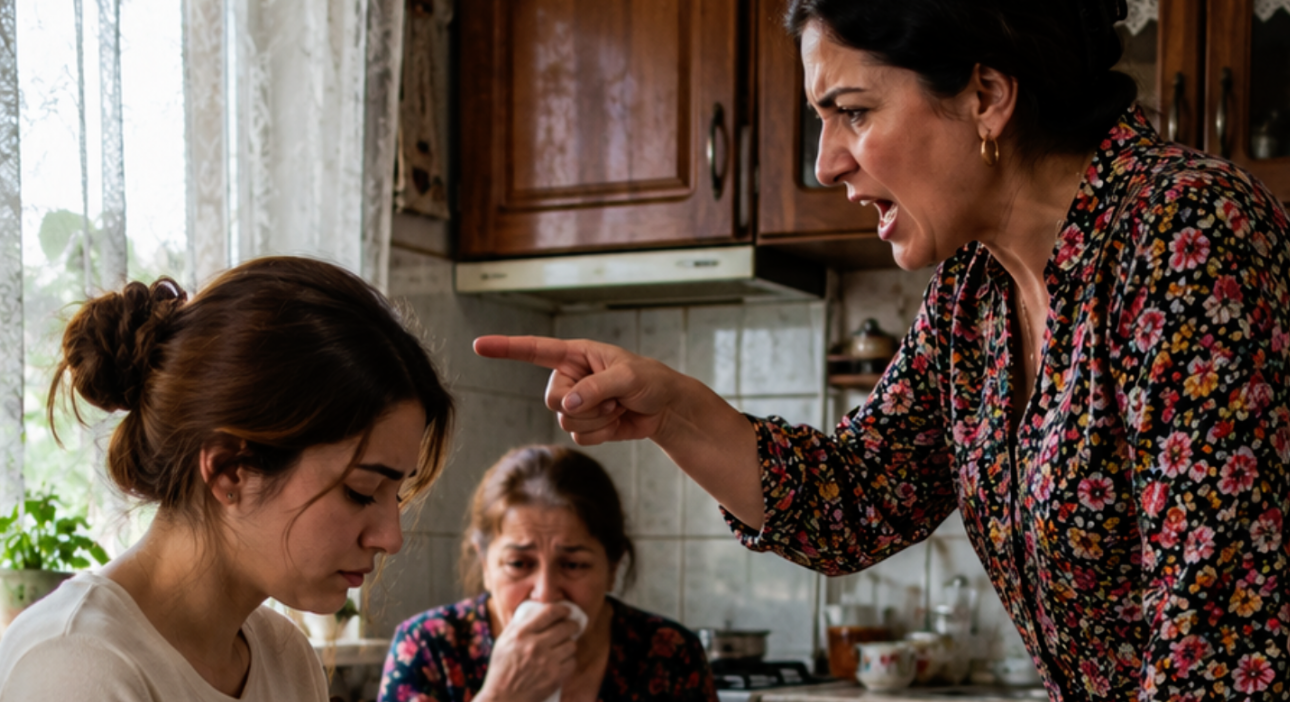
“Did you set me up on purpose?! I almost got taken to the police because of you!”
Marina’s voice broke into a hoarse shriek. She threw a crumpled rectangle of thick paper onto the table. It bounced off the ceramic butter dish and landed directly on a plate of sliced bologna, soaking up the grease.
I silently stared at the scrap of paper.
My lottery ticket.
The winning one.
Five million rubles.
Mother sat on a stool by the window, nervously picking at the corner of the worn oilcloth table covering. She looked neither at me nor at Marina. She simply ran her knotted fingers again and again over the faded sunflowers printed on the tablecloth.
“Why did you take it out of my folder?” I asked calmly.
My voice sounded dull. I wasn’t shouting. I simply didn’t have the strength to shout.
“Because!” Marina planted her hands on her hips. Red blotches spread across her face, and her chest rose and fell heavily beneath her cheap synthetic blouse. “Because it isn’t fair! You don’t need that much money all to yourself! You don’t have a family or children. You’ll waste it on some nonsense! We still have ten years left on our mortgage, Vova needs his car repaired, and Nikita needs to be enrolled in sports classes. We need that money more. We have children!”
I turned my eyes toward Mother.
“Mom. I asked you to put the folder with my documents in the cabinet while my apartment was being renovated and covered in dust. I asked you not to touch anything.”
Mother finally looked up. Her eyes were already shining with those familiar, habitual tears.
“Lenochka, sweetheart… Why are you starting this? Marinochka only came over for a visit, and we got talking. I told her how incredibly lucky you’d been. She said, ‘Let me surprise Lena. I’ll go to the center myself and arrange everything for her.’ She only wanted to help.”
“Help?” I gave a bitter laugh as I felt a tight, cold knot forming inside me. “Giving yourself my five million rubles is called helping now?”
Marina jerked one shoulder as though swatting away an annoying fly and dropped heavily into the chair opposite me.
“Yes, I wanted it transferred to my account! So what? I would have given you some of it. I would have given you a million. That would be more than enough for your renovation. We’d keep the rest. Are we family or not? Why should I count every penny and save money on my children while my older sister lives in luxury?”
She said it with such unshakable certainty that for a moment I wondered whether I was losing my mind.
In Marina’s version of reality, she hadn’t stolen somebody else’s winning lottery ticket. She had merely restored universal justice.
After all, she had two children and was carrying a lazy husband on her shoulders.
And I was a lonely divorced woman.
I lived in my own tiny one-room apartment, worked as an accountant, and apparently had the audacity to spend my salary on myself.
Two days earlier, I had bought the ticket from a kiosk near the subway station. Just on a whim, with my change.
That evening, when I checked the draw online, I couldn’t believe my eyes.
The numbers matched.
Every single one.
Five million rubles.
It was enough money to erase all my fears about the future at once. I could finally buy the small country house I had dreamed about for the last five years, saving little by little from every paycheck.
That same day, a pipe burst in my apartment. Plumbers arrived, and suddenly everything was chaos—dust everywhere, water across the floor.
I grabbed the folder containing my important documents, put the ticket inside, and took it to Mother, who lived in the neighboring building.
“Mom, hide this in the cabinet behind the crystal glasses. There’s a lot of money involved. I’ll go claim it tomorrow.”
She hid it.
And then Marina came over.
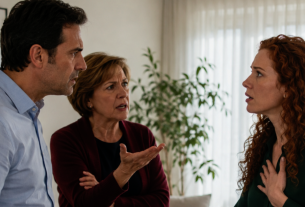
“You know what’s really disgusting, Lena?” my sister’s voice began climbing again into hysterical indignation. “You knew! You knew everything and deliberately didn’t tell me! You set me up!”
I carefully caught the dry edge of the ticket, pulled it out of the plate of bologna, and placed it on a paper napkin.
“I set you up by not explaining the rules for claiming major lottery prizes?” I asked quietly.
That was exactly what had caused Marina’s failure—and her current fit of hysterics.
She had imagined life worked like an old movie: you walked in with a piece of paper, pushed it through a window, and walked away with a suitcase full of cash.
She took the ticket from Mother’s cabinet, grabbed her own passport and bank details, and went to the lottery company’s central office.
But there was one thing she hadn’t taken into account.
When I bought the ticket, it had been linked to my phone number. The kiosk clerk entered my number into the terminal, I received an SMS verification code, and that code became permanently connected to the barcode on the paper ticket.
When Marina proudly placed the ticket on the prize counter, already imagining herself rich, the clerk scanned it and politely said:
“Please tell me the phone number and the verification code from the SMS.”
Marina gave them her own number.
The system returned an error.
The clerk asked for her passport.
Same surname.
Different first name.
The clerk frowned, looked at the screen, and said:
“Ma’am, this ticket is registered to another phone number. You cannot claim this prize. Where did you get it?”
She tried to make a scene.
She tried to explain that the ticket belonged to her sister, that her sister was sick, busy, and had authorized her to handle everything.
They asked her for a notarized power of attorney.
Naturally, she didn’t have one.
Eventually, the shift supervisor directly asked whether she had found the ticket somewhere and warned her that if someone attempted fraud involving a major lottery prize, they were required to call the police.
Marina fled the place as though she’d been burned.
Then she rushed straight here, to Mother’s apartment, where I happened to be drinking tea after work and preparing to collect my folder.
“You could have warned me!” my sister barked, nervously tugging at the clasp of her handbag. “I stood there looking like an idiot! That security guard was staring at me like I was some thief!”
“And what are you?” I looked directly into her eyes.
A heavy, sticky silence filled the kitchen.
Only the old refrigerator in the corner suddenly rattled to life, breaking the silence.
“Girls…” Mother finally spoke weakly.
She rose heavily from the stool, came to the table, and began absentmindedly gathering crumbs into her palm.
“Why are you doing this to each other? Lena, apologize to your sister. Why are you insulting her like this? What kind of thief is she? She’s family. Your own sister. All right, she made a mistake. She acted foolishly. Money goes to people’s heads.”
I closed my eyes.
A deep breath.
Then out.
Apologize?
Me?
“Mom, she stole my ticket. She went there to have my money transferred into her own account. If it hadn’t been for the electronic security system, I would be sitting here without a penny while she explained how badly she needed to pay her mortgage. And you want me to apologize?”
Mother pursed her lips.
Her face took on that familiar expression of sorrowful martyrdom that she always used whenever she wanted to force someone into accepting her decision.
“Lena, you’ve always been cruel. You have no heart. You don’t understand what it’s like having two children depending on you. Vova is unemployed again. Marina can’t even afford to buy Dasha a winter coat. And those millions just fell out of the sky for you. Easy come, easy go. If you helped your family, God would reward you for it.”
Feeling that she had Mother’s support, Marina immediately changed tactics.
Her anger gave way to tearful self-pity.
She sniffed, pulled a paper tissue from her pocket, and began dabbing at her eyes.
“I really did want what was best… I thought I’d collect the money, bring it home in cash, and then we’d sit down and divide it like reasonable people. I definitely would have given you half. We’re sisters. But you treat me like I’m a stranger. Like an enemy.”
“Half?” I tilted my head slightly. “So out of my five million, you would have generously allowed me to keep two and a half?”
“Well, why would you need more?” Marina asked with genuine surprise and not a trace of irony. “You already have an apartment. Sure, it needs renovation, but it’s yours. You don’t have a husband. Nobody depends on you. What would you even spend it on? I have three hundred thousand in credit card debt alone.”
She said it so simply, so casually, that it frightened me.
What frightened me was realizing just how deeply they believed that my life, my accomplishments, and my good fortune did not actually belong to me.
They belonged to “the family.”
And in their minds, “the family” meant Marina and her children.
I was merely a function.
An emergency reserve fund.
I remembered how, five years earlier, I had sold the plot of land I’d inherited from our grandmother.
I sold it because Mother had cried over the phone that Marina had just given birth to her second daughter, that their rented one-room apartment was too cramped, and that they needed a down payment on a mortgage.
I gave them every ruble from the sale.
Just gave it away.
It wasn’t even a loan.
I remembered how every August I transferred money to Marina for the children’s school supplies because Vova was “trying to find himself,” while backpacks and notebooks supposedly cost a fortune.
I remembered lying in the hospital with pneumonia last year.
During those two weeks, Mother visited me once, bringing a bag of cheap tangerines.
“Marina has it difficult. I’m looking after the grandchildren. I don’t have time to keep running to hospitals.”
And now, when fate had finally given me a chance to live a little for myself, my own sister tried to steal that chance while my mother accused me of cruelty.
I slowly stood up from the table.
I took the paper napkin and dabbed the greasy bologna stains from the ticket.
Then I folded it in half and slipped it into the inside pocket of my jacket, which was hanging over the back of the chair.
“What are you doing?” Marina tensed.
“Taking what belongs to me. Tomorrow I’m going to the prize center. With my passport and my phone.”
Mother stepped toward me, reaching out her hands as though she wanted to block my path.
“Lena, wait. Don’t make any rash decisions. Let’s settle this like a family. You’ll get the money. Keep a million for your renovation and transfer the rest to Marina for the mortgage. That would be fair. You’re sisters. You share the same blood. How are you going to sleep peacefully knowing your nieces and nephews are growing up surrounded by debt?”
I looked at Mother carefully, almost as if I were seeing her for the first time.
The wrinkles around her eyes.
The gray strands that had escaped from her hair clip.
The anxiously tightened mouth.
She wasn’t evil.
She was simply accustomed to solving the weaker person’s problems at the stronger person’s expense.
I had always been the strong one.
So apparently, I could be drained forever.
“Mom,” I said, my voice becoming calm and cold. “What if I hadn’t won the lottery? What if this ticket didn’t exist? How would Marina pay her mortgage then?”
“Well… they would have managed somehow…” Mother said uncertainly.
“Then let them manage.”
I picked my handbag up from the chair and began closing the zipper.
Marina jumped to her feet.
The tearfulness vanished instantly, like cheap paint washing away in the rain.
Her face twisted with anger again.
“You greedy bitch!” she spat, stepping toward me. “I knew it! You’ve always hated us! You’re jealous because I have a family, because my husband loves me, because I had children while you’re alone! A useless old spinster nobody needs! Choke on your millions! I hope that money gets stuck in your throat!”
“Marina, stop!” Mother gasped, although weakly and without conviction.
I silently put on my jacket.
There was emptiness inside my chest.
No anger.
No hurt.
No tears.
Only perfect clarity.
“You know, Marina,” I said, stopping in the kitchen doorway and looking at her flushed, furious face, “you don’t even understand what you’ve just lost.”
She snorted and folded her arms.
“What did I lose? Your handouts? Go to hell!”
“If you hadn’t gone through my folder,” I continued calmly, “if you had simply been happy for me, I would have offered to pay off part of your mortgage myself. Simply because I’ve always helped you. Out of habit.”
Something resembling panic flashed in my sister’s eyes, but she immediately buried it beneath her usual aggression.
“You’re lying! You wouldn’t have given me a kopek, you miser!”
“Believe whatever you want. But starting today,” I looked first at her and then at Mother, “my help is over. No money for school supplies. No money for Vova’s car repairs. No winter coats. From now on, you’re on your own. You have your family. Deal with your problems as a family.”
I turned around and walked down the narrow hallway toward the front door.
Curses flew after me.
Marina screamed that she would never set foot in my home again, that I was dead to her, and that she would forbid the children from speaking to me.
Mother cried loudly, lamenting that I had destroyed the family over a piece of paper.
I unlocked the door, stepped onto the landing, and firmly closed it behind me, cutting off the noise.
Claiming the lottery prize took a couple of hours.
At the lottery company’s office, everything went calmly and professionally.
I filled out an application, presented my passport, showed them the phone that had received the SMS code, and handed over my crumpled lottery ticket that still smelled faintly of bologna.
The money, minus tax, was deposited into my account several weeks later.
During that time, my life turned into a fortress under siege.
At first, there was silence.
For an entire week, none of my relatives called.
Apparently, they were waiting for me to come to my senses, feel guilty, and crawl back to them on my knees carrying bundles of cash.
Then their tactics changed.
Mother began calling.
She called every evening without fail, usually around eight.
She always started from a distance.
She talked about the weather.
About her aching joints.
About prices at the market.
And then, inevitably, she moved on to the real subject.
“Lenochka, Marina is completely falling apart. The poor girl had a nervous breakdown. Vova argues with her all day long. He found out about the ticket and keeps yelling that she’s an idiot, that she should have negotiated with you nicely. They don’t even have enough money to pay for Dasha’s kindergarten…”
I listened while standing by my kitchen window, looking down at the wet asphalt in the courtyard.
“Mom, I’m not interested.”
“How can you not be interested?” Mother’s voice trembled with indignation. “She’s your sister! That’s your niece! Lena, have some humanity! You have all that money sitting in your bank account now! What would it cost you to transfer her even two hundred thousand? Just so Vova calms down and doesn’t leave his family!”
“If Vova abandons his family because he didn’t get my money, then he isn’t worth much as a husband. Mom, I’ve said everything I have to say. There will be no money.”
“You’re a cruel, heartless egoist!” Mother would snap. “Your stubbornness is going to put me in the grave! Marina won’t even let me see the grandchildren now. She says it’s my fault for raising you this way!”
She would hang up.
Then call again the following day.
Later, Vova himself tried to contact me.
He sent me a long, rambling message.
He wrote that Marina was a stupid woman who had acted foolishly, and begged me to understand and forgive her.
Then, almost casually, he mentioned at the end that he had found a great used engine for his car for only one hundred and fifty thousand rubles.
If I could “lend” him the money for a year or two, he would apparently be grateful for the rest of his life.
I didn’t reply.
I simply blocked his number.
I renovated my apartment.
I hired a good crew and didn’t haggle over every last ruble.
I replaced the plumbing, leveled the walls, and bought comfortable new furniture.
I invested most of the remaining money in a small but solid brick house in a summer cottage community forty kilometers outside the city.
It came with a six-hundred-square-meter plot, old apple trees, peace and quiet, and a lake nearby.
Exactly what I had dreamed about while looking at pictures online during long winter evenings.
The purchase was finalized at the end of October.
It was chilly, and a piercing wind was blowing.
When I walked out of the public services center with the property documents bearing my name, a fine, unpleasant rain was falling.
I got into a taxi, gave the driver the address of my workplace, and for the first time in a very long while, I felt complete, undisturbed peace.
I was no longer anyone’s emergency fund.
I was simply Lena.
A person with her own home, her own life, and the right to decide what to do with both.
That same evening, the doorbell rang.
I went to the peephole.
Mother was standing on the landing.
She looked exhausted, dressed in an old coat and holding some kind of plastic bag.
I opened the door.
“Hello, Lena,” she said quietly without looking up.
“Come in, Mom.”
She removed her shoes in the entryway, awkwardly shifting from one foot to the other.
She looked around at the new pale wallpaper, the beautiful mirror, and the clean floor.
Then she walked into the kitchen.
She sat on the edge of one of my new chairs with the bag resting on her knees.
I silently poured her tea and placed the cup in front of her.
“It’s beautiful here now,” Mother sighed, looking around at the kitchen cabinets. “It must have been expensive.”
“It was fine, Mom. What happened? You never come over for no reason.”
Mother hunched over even more.
Her fingers nervously twisted the handles of the plastic bag.
“Marina threw me out,” she suddenly said in a colorless voice.
Large, heavy tears rolled down her cheeks.
I slowly lowered myself onto the chair opposite her.
“She threw you out? What do you mean?”
“Just like that…” Mother sobbed, wiping her face with the back of her hand. “Vova left her. He said she was a greedy idiot, that because of her scandal they’d lost their last chance at a normal life. He packed his things and moved back in with his mother. Marina has been hysterical for two days. I went over to look after the grandchildren while she went to work, and she suddenly turned on me…”
Mother fell silent, trying to steady her breathing.
“She said, ‘It’s your fault! You always loved Lena more! If you had properly shamed her, she would have given us the money! And now I’m alone with two children, I can’t pay the mortgage, and the bank keeps calling!’ She screamed at me so loudly the children started crying. Then she said, ‘Get out and don’t come back until Lena pays me what she owes me.’ What debt, Lenochka? What does she mean, owes her? I gave her my entire pension. Everything I could…”
Mother cried bitterly and hopelessly.
She cried over the shattered illusion of a strong, loving family.
Over the daughter who had stepped over her without hesitation because of money and resentment.
I looked at her, and I felt sorry for her.
Truly, humanly sorry.
She had created this monster herself, always excusing Marina’s envy and laziness as the result of “difficult circumstances.”
And now the monster had devoured her too.
I stood, walked over to Mother, and placed my hand on her trembling shoulder.
“Calm down, Mom. Drink your tea.”
“Lenochka…” She raised her tear-filled eyes toward me, full of some pitiful hope. “Maybe you could give her some money? Please? Just something, so she can make this month’s mortgage payment. Then she’ll calm down and bring Vova back. The children shouldn’t grow up without their father…”
My hand tightened on her shoulder.
The pity didn’t disappear.
But now it was mixed with a bitter realization.
Some people never change.
Even after being crushed and thrown out onto the street, they continue playing by the same old rules.
I removed my hand.
Then I returned to my seat.
“No, Mom. I have no money for Marina. Not a single kopek.”
“But she…”
“She’s an adult, Mom. She tried to steal a large amount of money from me. When that failed, she insulted me and cursed me. And now she has thrown you—the person who spent her entire life sacrificing for her—out of her home. Do you know what will happen if I give her money now?”
Mother blinked at me in confusion.
“What?”
“She’ll learn that blackmail works. She’ll learn that she can wipe her feet on the people closest to her, steal, throw tantrums, kick her own mother out of the house—and then get paid for it. I’m not going to finance that kind of behavior.”
“So what are we supposed to do now?” Mother whispered helplessly, staring at her cooling tea.
“Live,” I answered simply. “If you want, you can move into my country house. I bought a house. It’s peaceful there. Quiet. There’s a stove. You can breathe fresh air and plant flowers. Or, if you prefer, stay in your own apartment. I’ll visit you, bring groceries, and pay for your doctors.”
Mother stared at me with wide eyes.
“And Marina?”
“Marina can solve her own problems. She can find a second job, sell the apartment, divorce Vova—whatever she chooses. It’s her life. And it no longer concerns me.”
The kitchen became very quiet.
Outside the window, we could hear the soft hiss of car tires against the road and the low hum of my new refrigerator.
Mother sat with her head bowed.
It seemed as though some painful internal struggle was taking place inside her.
Patterns built up over decades were beginning to break.
Her entire worldview—the one in which the older daughter was obligated to sacrifice herself for the younger simply because she had been born first—was falling apart.
Finally, she slowly nodded.
“You said you bought a house?” she asked quietly without lifting her eyes.
“I did. It has apple trees.”
“Apple trees are good. They need to be pruned before the cold weather…” Mother murmured.
Then she reached for her cup and took a sip.
Her hands were no longer trembling.
I looked at her and understood that this still wasn’t the end.
There would be more calls from Marina.
More attempts at manipulation.
Threats to keep the children away from me.
Tantrums.
Accusations that I was cold and heartless.
All of that would still happen.
But none of it mattered anymore.