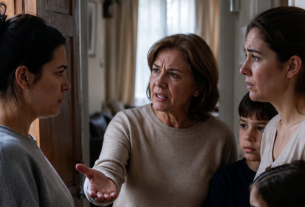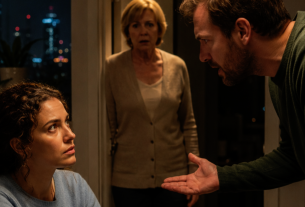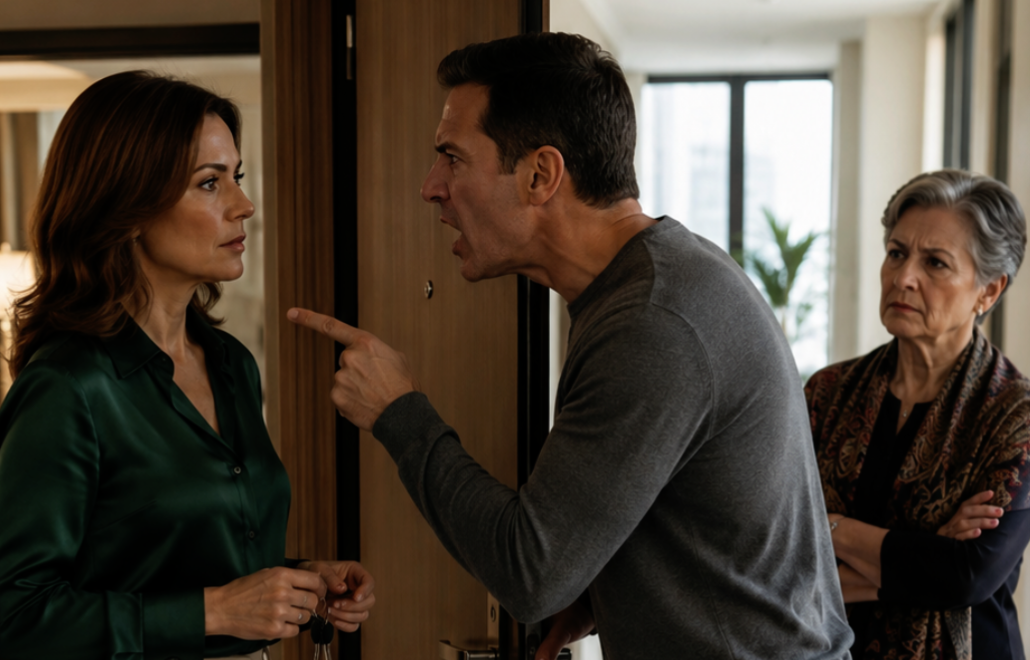
“Mom damaged your international passport, so you’re staying home,” Lev said with a smirk, pushing my document organizer away from himself. “You’re not flying anywhere now, Ksyusha. Your business trips are over.”
I stood by the kitchen table, staring at the empty transparent folder. That morning, it had contained my international passport, my ticket, the invitation to an overseas internship, and a letter from the head office. In six days, I was supposed to fly out for a three-month program for regional-level managers.
Raisa Albertovna was sitting by the stove in my cashmere stole. Seventy-four years old, perfectly styled hair, the calm face of a person who had already decided everything for everyone and was waiting to be thanked.
“I didn’t do any harm,” she said. “I removed the problem. A woman at fifty-two should be thinking about her home, not running after positions.”
On the edge of the sink lay the remains of the cover and a few gray scraps of paper. Raisa Albertovna had already wiped the stove and removed everything unnecessary, as if we were not talking about my document, but a stain left after dinner.
“You took my international passport from my study?” I asked.
Lev snorted and reached for the bowl of candies. He always ate when he wanted to show that the conversation was not important to him.
“Don’t start. Mom wanted what was best. You’ll make a new one later, when you calm down. Right now you need to stay home. It’s inconvenient for me alone, and Mom needs help too.”
He was fifty-three. Over the past three years, he had changed several ideas about work, but not one of them had reached even an interview. Yet he knew perfectly well where my additional card was kept, when the cleaning service came, how much food delivery cost, and which of Raisa Albertovna’s medicines had to be paid for “before her pension, otherwise it would be awkward later.”
To them, the internship was not my career. It was a threat to their familiar order. If I left, there would be no one to pay for the apartment, groceries, doctors, taxis, subscriptions, Lev’s new phone, and the little “Mom’s requests” that somehow always ended with a transfer from my account.
“You’re silent because you understand,” Lev said. “We stopped you from doing something stupid.”
Raisa Albertovna adjusted the stole and looked at me the way one looks at a guilty schoolgirl.
“Levochka is right. You think far too highly of yourself. A position is a position, but family is more important. We are family, Ksyusha.”
I picked up my phone from the table and turned on the recorder. My hands were not shaking. It simply became clear: if I started arguing now, they would play the role of caring relatives. If I started shouting, tomorrow they would tell everyone I had lost control over nothing.
“Repeat what happened to my international passport,” I said.
Lev did not even become cautious. He was sure he had won.
“Mom damaged your international passport. And she did the right thing. Now you’ll stay home instead of being somewhere out there. You should have chosen your family long ago.”
“I wanted to save your marriage,” Raisa Albertovna added. “Lyova has a soft character. He can’t forbid you himself. So I took the unpleasant decision upon myself.”
I stopped the recording and sent the file to my cloud storage. Then I photographed the empty folder, the remnants of the document by the sink, and the general view of the kitchen.
“What are you filming?” Lev asked, suddenly wary.
“Facts,” I replied.
He immediately stopped smiling.
The apartment was mine. Bought in 2012, before the marriage, with my own money and a mortgage I had paid off myself. Lev and I registered our marriage later. He was not an owner and was not registered here. Raisa Albertovna certainly was not either. Both of them were registered at her apartment, but living at mine was more convenient: a building with security, parking, good appliances, and groceries always paid for.
Raisa Albertovna had moved in with us “for two weeks.” Back then, Lev assured me that his mother was having repairs done in her bathroom, that she was quiet, and that she would not take up much space. A month later, the repairs were finished, but my mother-in-law stayed. First, she rearranged the spices. Then she removed my wine glasses from the top shelf because “a daughter-in-law should stop pretending she runs a restaurant.” Then she began checking the utility bills and meeting me in the hallway with the question of whether I had received my salary.
Lev laughed every time, as if all of it were family jokes. Then he asked me to pay for his mother’s dentist, jacket, mattress, armchair, and another medical examination. I transferred the money because after twelve hours of work, I did not want to spend another three hours listening to speeches about “heartless daughters-in-law” and “poor little Lyova.”
That evening, I understood not some beautiful truth, but a simple everyday fact: they were no longer asking. They were managing me, my work, my money, and my apartment as if all of it were their shared resource.
I went into my study. My national passport was lying on the desk. In the safe were the apartment purchase agreement, the extract from the Unified State Register of Real Estate, the prenuptial agreement, the marriage certificate, insurance papers, and copies of documents. We had signed the prenuptial agreement a year after the wedding. Lev had waved it off then: “I’ll sign it if it makes you feel calmer for work.” Raisa Albertovna had said that papers could not replace family.
They remembered family every time they needed my consent, my money, or my access.
I sent the recording and the photos to a lawyer I worked with on corporate contracts. She had warned me long ago that too many people in my home were using my resources and too few were carrying any responsibility. Back then, I did not want to hear it. Now there was nothing left to argue with.
Lev’s voice came from the kitchen.
“Ksyush, Mom and I are going to a restaurant. Her friend is celebrating an anniversary. Give me your card, mine isn’t going through again.”
I went out into the hallway with my wallet. Raisa Albertovna was already standing there in my stole, holding her handbag as if she were going not to a restaurant, but to a formal reception. Lev was turning my set of keys in his hands.
“Why do you need my keys?” I asked.
“I’ll take them just in case,” he said. “You might get offended now and start acting strange. We’re not strangers.”
“Give back the keys.”
“I’ll return them after the restaurant. Don’t make a scene in front of Mom.”
Raisa Albertovna sighed and looked at me with tired reproach.
“Ksenia, you are a grown woman, yet you behave like a little girl. Are you coming with us, or will you stay here and think about your behavior?”
“I’ll stay,” I said.
Lev shoved the keys into his pocket and opened the door.
“Then think. Just don’t throw a tantrum. We’ll come back tonight and talk normally.”
When the door closed behind them, I did not wait for my anger to pass. At that moment, anger was useful: it kept me from once again justifying them because of age, habit, and “family circumstances.”
I called an emergency access and lock replacement service. I explained that I was the owner of the apartment, that I was inside, that my unregistered spouse was keeping my keys, and that I needed the lock cylinders replaced and an official act drawn up. The dispatcher asked me to prepare my passport and the documents for the apartment.
While the locksmith was on his way, I opened my banking app. I closed Lev’s additional card, reduced the limits on the family account to the minimum, and disabled automatic payments for his subscriptions. Through the management company’s app, I changed the intercom code and sent a request to security: do not let Lev or Raisa Albertovna into the building without my written confirmation.
Then I started drafting a petition for divorce. Without emotion and without long explanations. There were no minor children. The apartment had been acquired before the marriage. There was a prenuptial agreement. Separately, I prepared a complaint about the deliberate damage to an important personal document and attached to the folder the confession recording, the photographs, and a short description of the events.
The locksmith arrived forty minutes later. I showed my national passport, the register extract, and the apartment contract. He drew up the act, removed the old cylinders, and installed new ones. A year earlier, Lev himself had insisted on an expensive system because “a home must be protected.” This time, that protection finally worked not against strangers, but against those who had decided they could control my keys without me.
When the locksmith left, I gathered Lev’s and Raisa Albertovna’s belongings. Shirts, chargers, the game console, headphones, magazines, creams, a robe, slippers, and my mother-in-law’s jewelry box went into suitcases and a box. I did not throw away or damage anything. I filmed every item on my phone, made an inventory, and signed it: “Handed over for release to the owners of the belongings in the presence of witnesses.”
The stole was not included in the list. It was mine, and Raisa Albertovna had left wearing it. The hallway camera had recorded that.
I called the security desk.
“Igor, good evening. I have a family conflict. I’m about to bring down Lev’s and Raisa Albertovna’s belongings. Please accept them at the desk until they return. If they try to enter without my permission, call a patrol.”
For several years, Igor had watched Lev enter the building empty-handed and leave with my bags.
“Understood, Ksenia Viktorovna. Bring them down in the service elevator. I’ll turn on the recording at the desk.”
The belongings went downstairs. The apartment did not become empty. It became normal: without other people’s bags in the hallway, without Mom’s magazines on my desk, without Lev’s boxes where documents should have been.
I washed the sink, put the organizer into the safe, and wrote a short email to the project manager: “A situation has arisen with a document. I am resolving it. I am ready to participate in the preparatory block remotely, according to schedule.” I did not explain the details. At work, I was used to speaking in facts.
The reply came quickly: “Ksenia, the slot is yours. Join tomorrow.”
Lev and Raisa Albertovna returned around ten in the evening. First the intercom rang. Then my phone. Then Lev began knocking on the door with his palm.
I went to the video panel. On the screen, he was standing in an unbuttoned coat, while Raisa Albertovna stood beside him, wrapped in my stole and clutching her handbag to her chest. At their feet were the suitcases and the box.
“Why doesn’t the key fit?” Lev asked, no longer wearing his former smirk.
“Because without my consent, you no longer enter my apartment,” I replied. “Your belongings are with security. The inventory has been made, and there is video.”
Raisa Albertovna leaned toward the camera.
“Ksyusha, open the door immediately. I can’t stand downstairs. I am an elderly person.”
“You have your own apartment. You are registered there. Lev is registered there too.”
Lev raised his voice.
“You’re kicking your husband out of the house? Do you even understand what you’re doing?”
“I understand that you are not the owner, you are not registered here, and today you admitted on recording that my document was deliberately damaged. If you believe you have the right to use this apartment, settle it through a lawyer and the court. I will not open the door.”
“I am your husband!”
“For now, yes. That is why the divorce documents will be handled separately.”
Raisa Albertovna immediately changed her tone. A softness appeared in her voice that had not been there when she had explained to me where my place was.
“Ksenia, why so harshly? I didn’t do it for myself. You’ll leave, and Lyova will be alone. His everyday life is not arranged, he isn’t used to it. I’m his mother, I worry.”
Once again, she was speaking only about him. She did not care that my document, my work, and my schedule had been sabotaged. In her world, the problem was that life would become inconvenient for Lyova.
“Raisa Albertovna, tomorrow I will file a complaint about the damage to the document. From now on, communication will only be in writing.”
Lev turned to his mother.
“You said she would make noise and calm down.”
“I thought she was reasonable,” my mother-in-law replied, forgetting that the camera was still on.
“Ksenia, open the door,” Lev demanded again. “Don’t disgrace yourself in front of security.”
“Security already knows. You can collect your things from the desk.”
He said he would call the police. I answered that he had that right and prepared the documents myself. The patrol arrived twenty minutes later. I opened the door only to the officers, showed my passport, the register extract, the locksmith’s act, the confession recording, and my correspondence with security. I explained that two adults with no registration were trying to enter my apartment after damaging my personal document. Their belongings had been handed over according to an inventory. If they believed they had the right to reside here, they could apply through the proper procedure.
The officer went out to them. The conversation was short and without family drama. Lev was asked whether he had documents confirming the right to live at this address. He repeated several times that he was my husband, but he had neither registration nor ownership rights. He was told that he could not break the door or disturb the residents.
Raisa Albertovna finally said:
“Levochka, let’s go to my place. We’ll sort it out in the morning.”
“What do you mean, your place?” he snapped. “Everything there is packed with stuff.”
That sentence put the final point better than any scandal could have. He did not need family. He needed a convenient place where someone paid for him, cooked for him, solved his problems, and tolerated his mother.
The next day, I worked from home. At nine in the morning, I sent the entire package to the lawyer. At ten, I filled out the application for a new international passport. At eleven, Lev came for the remaining belongings with Raisa Albertovna. She returned my stole to the security desk and pretended she was showing nobility.
I came downstairs with Igor and a second security guard. I had the inventory in my hands.
“Sign for receipt of the belongings,” I said to Lev.
He tried to walk past me toward the elevator, but Igor calmly stepped in beside him.
“You do not have access, Lev Alexandrovich.”
“Ksenia, have you completely lost it?” Lev asked.
“Signature. Or we will mark your refusal in front of witnesses.”
Raisa Albertovna tugged at his sleeve.
“Sign it, Lyova. Don’t make a scene here.”
He signed. Sharply, pressing hard, as if he wanted to punch through the paper. Then he quietly said that I would regret it. I did not answer. At that moment, any argument would have been a gift to him, and the gifts were over.
After lunch, messages from Lev began pouring in. First he asked me to return the card because he needed to eat. Then he wrote that Mom was nervous. Then he accused me of destroying the marriage. On the fourth message, I sent him the lawyer’s contact and did not reply again.
Two days later, he left a letter with security. He asked me not to proceed with the passport complaint because Raisa Albertovna was elderly and he “didn’t want consequences.” He also asked me to let him back in at least until the divorce and separately wrote that finding work quickly was difficult for him. I forwarded the letter to my lawyer. The reply was brief: access would not be granted, the belongings had been handed over, property matters would be resolved during the divorce process, and a separate review was underway regarding the document.
Lev tried to pressure me through relatives and acquaintances of Raisa Albertovna. People called me with phrases like “you’re a grown woman” and “she is a mother, have pity.” I replied the same way every time: all questions through my representative. After the third such conversation, the calls stopped. Apparently, pity works poorly when it does not open the door or attach a bank card.
I completed the preparatory block of the internship remotely. My colleagues saw only my neutral background, presentations, and work tables. I gave a talk on the integration of regional processes, received access to the materials, and kept my place in the program. They had damaged my document, but I did not give up my professional path.
A few weeks later, I had a new international passport. I did not tell Lev the departure date. He found out only from a letter from my lawyer, which stated that during my absence, any attempts to enter the apartment without my consent would be recorded by security and sent to my representative.
On the day of departure, I checked the safe, documents, windows, and gave security a power of attorney to receive correspondence. In my bag were my laptop, my new international passport, and a folder with copies of the complaints. Lev sent one message: “You’ll come back anyway.” I deleted the conversation and went to the airport.
I completed the internship in full. Three months without Lev’s daily demands turned out not to be loneliness, but a normal working life. I made decisions, gave presentations, argued over numbers, and not once did I have to explain to an adult man why groceries did not appear by themselves.
By the time I returned, the marriage had been dissolved. The apartment was not divided: the documents proving premarital ownership and the prenuptial agreement closed that issue without theatrics. Lev did not file a separate claim for the right to live there. Apparently, a lawyer had explained to him the difference between the phrase “I am her husband” and documents for an apartment.
The complaint about the passport was still under review. I was not waiting for some beautiful revenge. It was enough that Raisa Albertovna no longer controlled my shelves, Lev no longer wrote “return the card,” and the keys to my door were in my hands only.
Late in the evening, I came home. Security gave me my correspondence. I went up to the apartment and placed my suitcase in the hallway. The documents were in the safe, the desk was exactly as I had left it, and a new international passport had appeared in the organizer.
I had not returned to their rules. I had returned to my home. And if family help begins with someone else’s keys, someone else’s cards, and someone else’s documents, then where does family end and ordinary shamelessness begin?