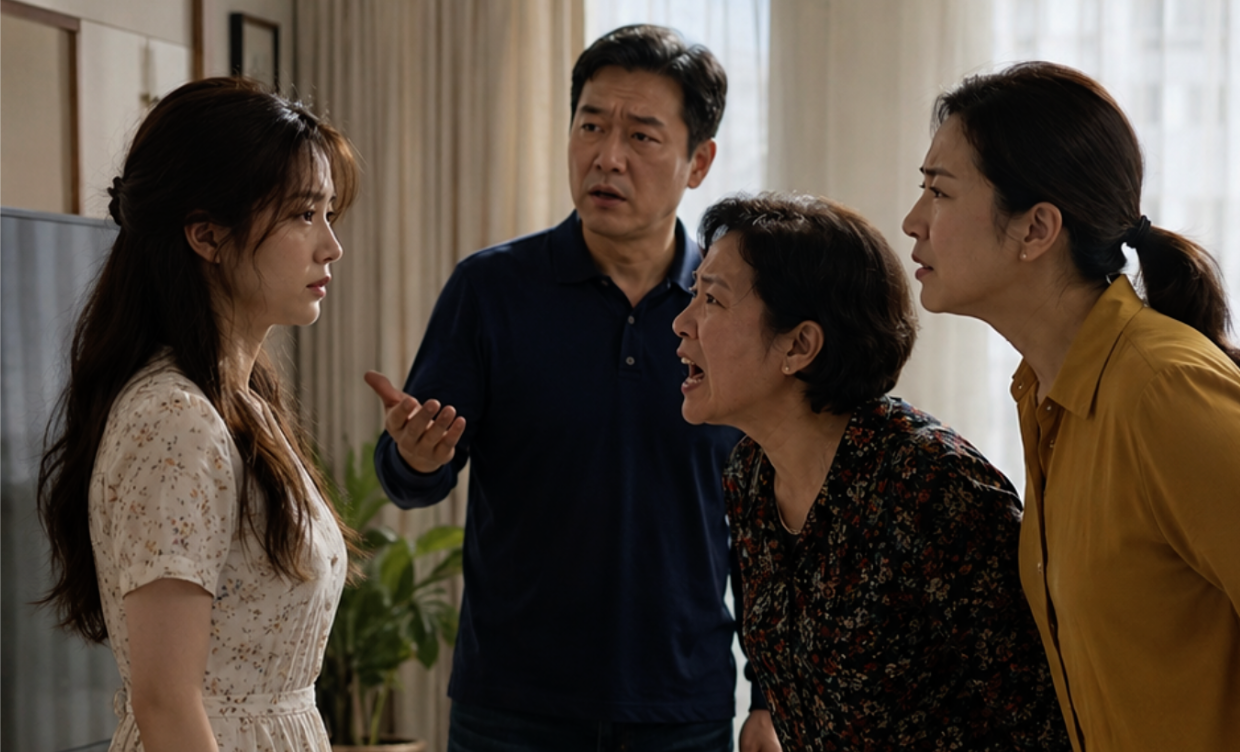
“Just so you know, darling: if you don’t like it, go back to your mommy!”
That was the first thing Nina heard the moment she got out of the car. Not “hello,” not “how was the drive,” nothing of the sort. Her sister-in-law Svetlana was standing by the gate of the country-house plot, arms crossed over her chest, looking at Nina as if she had shown up there uninvited. Even though it was precisely here, to this dacha twenty kilometers outside the city, that Nina herself had once packed boxes of bed linens, brought pots of seedlings, and bought new curtains three years earlier.
Her husband Kostya silently opened the trunk. He was a virtuoso at silence — that particular cowardly silence of a man who is afraid of his wife, his mother, and his sister all at once, and therefore protects none of them.
Nina began unloading the bags. Heavy, awkward ones — a thermos, gardening gloves, jars of pickles she had preserved back in September. Her hands were busy, and that was good: when your hands are busy, it is harder to lose control.
“By the way,” Svetlana said in the same flat, almost bored voice, “we’ve already sold this dacha without your consent. Split the money three ways.”
Nina lowered the bag to the ground.
Slowly. Very slowly, she straightened up and looked at her sister-in-law. Svetlana was forty-two, wore her hair dyed an unnatural red, and always — always! — spoke in a tone as if she were doing everyone around her a favor simply by existing.
“Say that again,” Nina said.
“What’s unclear? Mom has wanted to move closer to Vera for a long time — to her cousin, in Krasnodar. So we decided. The money was divided fairly: half to Mom, a quarter to Stas and me, and a quarter to Kostya. All in the family.”
At that moment, Kostya was carrying a box of books and making a great effort to stare at his feet.
Nina did not shout. She had never really known how to shout in a way that made an impression — her voice was low, calm, and that sometimes frightened people more than yelling.
She went into the house.
The dacha was small — four rooms, a veranda, a summer kitchen. She and Kostya had invested quite a lot into it: replaced the roof, changed the windows, and Nina herself had painted the fence the summer before last, getting so sunburned she blistered. Her money. Her vacation. Her back, which then ached for three days.
Her mother-in-law, Zinaida Petrovna, was sitting in the large room in front of the television with the look of a person who was already innocent of everything and had nothing to do with anything. Small, plump, in a washed-out housecoat — she knew how to look like such a harmless village grandmother that strangers found her endearing. Strangers did not know how she talked behind people’s backs. How, for years, she had dripped poison into Kostya’s ears: “Nina is selfish,” “Nina doesn’t respect the family,” “Nina only thinks about herself.”
“Zinaida Petrovna,” Nina said, “can we talk?”
“Oh, Ninochka, I’m tired today.” Her mother-in-law did not even turn around. “We’ll talk later, all right?”
Tired. Nina slowly looked around the room. Dirty cups on the table, bags on the windowsill that, judging by their appearance, had been sitting there since last week. Zinaida Petrovna had never especially burdened herself with cleaning. Nina had always done that too — she would arrive, spend the weekend washing, scrubbing, putting everything in order, and the next time, it would all be the same again.
Kostya came in after her and put the box in the corner.
“Why are you reacting like that?” he said quietly. “Mom is elderly already, she needs to be near Vera…”
“Kostya.” Nina looked at her husband. “This dacha is registered in both our names. Do you understand that?”
He opened his mouth. Closed it. Scratched the back of his head.
“Well… Mom said the notary said…”
“What notary, Kostya?!”
That was when something clicked. Not loudly, not dramatically — something simply settled into place inside her. Like a lock finally snapping shut.
Nina went out onto the veranda. She took out her phone and found Roman Evgenyevich in her contacts — a lawyer they had once worked with on another case, a small one, long forgotten. Roman Evgenyevich specialized in property disputes.
He answered after the second ring.
“Roma, I have a question. Can one spouse sell jointly acquired property without the consent of the other?”
A pause.
“Nina, is that you?” Roman Evgenyevich seemed to understand at once that this was not a social call. “No, they can’t. That is a direct violation of Article 35 of the Family Code. The transaction is contestable. What happened?”
“The dacha was sold. I found out today. After the fact.”
The silence was short but weighty.
“When will you be in the city?”
“Tomorrow morning.”
“Come by. This can be resolved.”
Nina put away the phone. Behind her, the door creaked — Svetlana came out and stood beside her with the air of someone who had come to look at an interesting insect.
“Already calling lawyers?” she smirked. “Well, well. Aren’t you clever.”
“Svetlana,” Nina said very calmly, “go inside.”
Something in that tone made her sister-in-law fall silent for a second. Only a second — but Nina noticed.
“Do you understand that you’re going against the family?” Svetlana said anyway. “We’re relatives.”
Relatives. Nina looked at the neatly trimmed currant bush by the fence — she had planted it four years earlier, and now it had grown thick, dark green, beautiful. Someone else’s now, apparently.
“I’ve understood one thing,” she said at last. “Kinship is not an excuse. It is just a word.”
She went back into the house, took her bag — the very one she had first taken out of the car — and headed for the exit.
“Where are you going?” Kostya asked from the hallway, confused.
“To the city. I need to check something.”
“Nina, wait…”
But she was already walking toward the car. The garden gate clanged behind her — brief, like a period at the end of a sentence.
The drive to the city took twenty minutes. Nina drove and thought about the fact that the documents for the dacha — both copies of the purchase agreement from when they had bought it — were at home, in a folder with a red elastic band, in the drawer under the bed. She had always kept the documents herself. Kostya never paid attention to such things.
That, perhaps, was the first bit of foresight that was now worth a great deal.
She parked by her building, went up to the third floor, and opened the apartment. The entryway was quiet and smelled familiar — of coffee and a faint trace of lavender from the air freshener.
Nina went into the bedroom, knelt beside the bed, and pulled out the folder.
The documents were there.
She opened the folder, found the necessary sheet — the certificate, both signatures, hers and Kostya’s, the notary’s stamp. She ran her finger over it.
So that was how it was.
Tomorrow morning she would go to Roman Evgenyevich. Then together — or alone, it no longer mattered — they would find out exactly what had been signed and who the buyer was. Because there was one weak spot in this story that Svetlana, in her self-confidence, had apparently failed to account for: a transaction made without a spouse’s consent was not simply a violation. It was grounds to have it declared invalid in court.
Nina closed the folder and put it back.
She sat on the edge of the bed. Her phone vibrated — Kostya. She looked at the screen and waited until it stopped ringing. Then she wrote briefly: When you come home, we’ll talk. Seriously.
She sent it. Put away the phone.
Outside the window, the city went on with its ordinary life — cars hummed, someone honked in the distance. Nina sat and thought about how all this time she had tried to be good. Polite. Not create conflicts. Give in where, in truth, she should not have given in.
No matter. Lesson learned.
Kostya arrived an hour later.
Nina heard him fumbling with the lock — for a long time, awkwardly, as if he hoped that while he was doing it, she would disappear somewhere or change her mind about talking. She would not disappear. She would not change her mind.
He entered the room with the expression of someone walking into a dentist’s office — guilty in advance and a little miserable. He sat on the chair by the window without taking off his jacket and stared at his hands.
“Well?” Nina said.
“Nin, you have to understand…” he began.
“Kostya, I’m asking you: don’t explain to me right now what I have to understand. Just tell me — did you know?”
A pause. A long, eloquent pause.
“Mom said it was just talk for now…”
“When did she tell you?”
He rubbed his forehead.
“Well… about two months ago, probably.”
Two months. Nina slowly exhaled. For two months he had walked beside her, drunk coffee in the mornings, watched TV shows in the evenings — and kept silent. Not because he was evil. Simply because he was used to his mother deciding, his sister commanding, and him standing in the middle, quiet and convenient for everyone.
“So you knew,” she said.
“Nina…”
“That’s all, Kostya. Tomorrow I’m going to a lawyer. You can come with me or not — that’s your choice. But I’m going to challenge this transaction.”
He looked at her as if she had told him something absolutely impossible.
In the morning, Nina got up at seven. While she was making coffee, Svetlana called. Nina put the phone on the table and watched the vibrating screen with her sister-in-law’s name until it went silent. Then she wrote briefly: I’m busy. I’ll call later.
The reply came immediately — an entire monologue, about twenty lines, in capital letters, with exclamation marks after every other word. Nina skimmed it: “you want to go against the family,” “Mom is already an elderly person,” “we only wanted what was best,” “a lawyer won’t do anything for you,” and at the end, the crowning phrase: who are you anyway to tell us what to do?
Nina put the phone away.
She drank her coffee. Got dressed. Took the folder with the documents.
Roman Evgenyevich’s office was in the city center, on Pushkinskaya Street, on the second floor of an old pre-revolutionary building with high ceilings and creaking parquet. Nina liked the place — everything there was real, without cheap renovations and plastic.
Roman Evgenyevich was exactly as she remembered him — a short, neat man of about fifty, with a manner of speaking slowly and to the point.
He studied the documents for about fifteen minutes. Then he looked up.
“So. The dacha is registered as the spouses’ joint property. To sell it, notarized consent from the second spouse was required — that is, yours. If there was no consent, the transaction is contestable. Were you asked for consent?”
“No one asked me about anything.”
Roman Evgenyevich nodded with the look of someone who was not surprised.
“Understood. We need to find out who the buyer is and exactly when the transaction was registered. If it has already gone through Rosreestr, we will file a lawsuit to have it declared invalid. This is realistic, Nina. There are precedents.”
“How long will it take?”
“Three or four months, if they don’t drag it out. It could take longer.” He paused. “Does your husband know?”
“He knows.”
“Is he on your side?”
Nina thought for a second.
“I don’t know yet.”
When she went outside, her phone came alive again. This time it was not Svetlana calling — it was Zinaida Petrovna herself. Nina stopped by the entrance, under an old linden tree, and finally answered.
“Ninochka,” her mother-in-law began in the voice of a tired, tormented woman, “what have you started? I’m already sick as it is, my blood pressure has been high since morning…”
“Zinaida Petrovna, let’s not do that.”
“Not do what?!” Her tone changed instantly. “What exactly, I don’t understand?! We are dividing our own money, our own property, and you are interfering!”
“The dacha is mine and Kostya’s property. Joint property. It is written in the documents.”
“We bought that dacha before you came along!” her mother-in-law blurted out — and stopped short.
Before you. Nina smirked. No, not before her. She and Kostya had bought the dacha in their third year of marriage; she remembered it perfectly because that was when she had taken out the loan, which she then paid off herself for another year and a half. Zinaida Petrovna was simply lying. Easily, habitually, without thinking — as naturally as breathing.
“Goodbye, Zinaida Petrovna,” Nina said, and ended the call.
Svetlana showed up in person that evening.
Nina had just returned home and put the kettle on when the doorbell rang — sharply, several times in a row, the way people ring when they are certain the door must be opened for them immediately.
Her sister-in-law stood on the threshold in an unbuttoned jacket, a bag over her shoulder, and an expression as if she had come to restore justice.
“May I come in?”
“You already have,” Nina said, stepping aside.
Svetlana went straight into the kitchen, looked around — proprietorially, with that special lack of ceremony that was her trademark — and sat at the table without being invited.
“So, you went to the lawyer.”
“I did.”
“And what nonsense did he feed you?”
“That is between me and my lawyer.”
Svetlana smirked — nastily, narrowing her eyes.
“Nina, listen. You’re a smart woman, I understand that. But there’s one thing you don’t understand: family is not a courtroom. We’re not in court. We are relatives. And Kostya is on our side, no matter how hard you try.”
“Kostya is an adult,” Nina said calmly. “Let him decide for himself whose side he is on.”
“He already has.” Svetlana placed her elbows on the table. “Do you think he’ll go against his mother? For you? Nina, you’ve lived with him for eight years and still haven’t understood that?”
She said it not with anger, but with a strange, almost sincere surprise. As if she truly believed she was explaining something obvious.
And that was exactly what stung most. Not the rudeness, not the arrogance, but that certainty. That everything had already been decided. That Nina was merely a detail in someone else’s scheme, one that could be moved aside or removed.
“Svetlana,” Nina said, “I’m not going to argue with you. But you made one mistake.”
“What mistake?” her sister-in-law asked ironically.
“You decided I would stay silent.”
Svetlana opened her mouth — and closed it. Something in her face twitched, just a little, almost imperceptibly. Then she stood, adjusted the bag on her shoulder.
“You’ll regret this,” she said at the door. “We’ll make your life—”
“Please leave my apartment.”
The door closed. Nina stood in the silence of the kitchen and heard her heart beating evenly and calmly. No panic. No fear.
The kettle boiled.
She made tea and sat by the window. It was already getting dark outside; lights were coming on in the windows of the buildings across the street. Somewhere out there, in this city, was the buyer of the dacha — a person who possibly did not even know he had been dragged into someone else’s family fraud.
Nina took out her phone and wrote to Roman Evgenyevich: We need to find out who the buyer is. How can we do that faster?
The reply came a minute later: Tomorrow we file a request with Rosreestr. Come at ten.
She put the phone on the table. Took the mug in both hands.
Tomorrow. Then tomorrow.
Rosreestr responded four days later.
Roman Evgenyevich called her himself — which already said a lot, because he usually wrote in a messenger.
“Nina, come by. There’s something interesting.”
She arrived forty minutes later. Roman Evgenyevich met her at the door, led her into the office, and placed a printout in front of her — several pages densely filled with text.
“Look here.” He pointed at a line. “The buyer is a certain Vadim Sergeyevich Kruglov. The transaction was registered eighteen days ago. And now the most interesting part: Kruglov is the husband of your sister-in-law’s friend. They’ve known each other for about ten years.”
Nina slowly raised her eyes.
“So he’s not a random buyer.”
“Not random at all. This is called a sham transaction. They sold the property to one of their own — most likely so you couldn’t demand your share through a division of assets. They thought that once it went to an outsider, you wouldn’t be able to reach it.”
“But I can?”
Roman Evgenyevich smiled slightly.
“You can. Precisely because he is not an outsider — this is their scheme, and it’s stitched together with white thread. We’ll file a lawsuit to have the transaction declared invalid. Plus a separate claim that the transaction was made without notarized spousal consent. Those are two different grounds, Nina. Two.”
Kostya found out that same evening.
Nina did not hide anything — she told him everything calmly, without unnecessary words. About Kruglov, about the sham transaction, about the two grounds for the lawsuit. Her husband listened while sitting at the kitchen table, turning an empty mug in his hands — back and forth, back and forth.
“Nin,” he finally said, “do you understand there will be a scandal?”
“Kostya, there already is a scandal. You just haven’t noticed it yet.”
He fell silent.
“Mom didn’t know it was illegal.”
“Mom didn’t know,” Nina repeated evenly. “Fine. What about Svetlana? And you? You stayed silent for two months.”
He lowered his head. And right then, something in him seemed to shift — slowly, with a creak, like an old door that had not been opened in a long time. He looked up, and Nina saw something unfamiliar in his face. Not an excuse. Not a plea. Something resembling shame.
“I should have told you right away,” he said quietly.
“Yes,” she agreed. “You should have.”
They did not speak about it again that evening. But something between them had changed — like the way the air changes before a thunderstorm, when nothing has started yet, but it is already clear that it will.
The lawsuit was filed a week later.
Svetlana called that very day — apparently, Kruglov or his wife had already received the notice. Her voice was different now — not commanding, not mocking, but sharp, with poorly concealed anxiety behind the sharpness.
“Do you even understand what you’re doing?! Vadik already paid the money, it went into Mom’s account, everything was honest!”
“Svetlana,” Nina said, “do you have a lawyer?”
“What?”
“A lawyer. An attorney. I suggest you find one.”
And she hung up.
After that came two weeks of relative silence — the special kind of silence that happens when everyone understands everything, but still pretends that maybe it will somehow pass. Zinaida Petrovna did not call. Svetlana sent one message: you destroyed the family. Nina read it and put the phone away.
The hearing was set for the beginning of autumn.
A month before the hearing, something unexpected happened. Roman Evgenyevich called and said that Kruglov wanted to meet — without lawyers, just to talk.
Nina thought about it and agreed.
They met in a small café on Sadovaya Street. Nina arrived first, ordered an Americano, and sat by the window. Kruglov turned out to be a man of about forty-five, stocky, with a tired face and the guilty eyes of a person who had been pulled into someone else’s story.
“Svetlana asked me,” he said as soon as he sat down. “I didn’t know the transaction was without your consent. I was told everything was clean.”
Nina looked at him.
“Did you pay the money?”
“Three hundred twenty thousand. Below market price, by the way. I was surprised, but Sveta explained that the family needed it urgently.”
Three hundred twenty. Nina knew how much the dacha was worth — they had had it appraised two years earlier. Four hundred fifty, minimum. So Svetlana and her mother had even managed to sell it below market value — apparently in a hurry, before Nina found out.
“Vadim Sergeyevich,” she said calmly, “I am not fighting you. You are an injured party too, just like me. But the dacha has to be returned. The people who took the money are the ones who must return it to you.”
He nodded — slowly, heavily.
“I understand. That’s why I wanted to talk. I will not oppose the lawsuit. Let the court decide.”
The court decided.
The transaction was declared invalid — the court accepted both grounds, just as Roman Evgenyevich had predicted. The dacha was returned to the joint ownership of the spouses. Zinaida Petrovna was ordered to return the three hundred twenty thousand to Kruglov — although she had already spent about one hundred thousand of it, and that became a separate headache for the entire family.
Svetlana sat in the courtroom looking like an offended queen and did not look at Nina.
Kostya sat beside his wife.
It was probably the first adult decision he had made in eight years of marriage — to sit beside her instead of stepping aside. Nina noticed it. She said nothing, but she noticed.
After court, the two of them went to the dacha together.
It was September, already truly autumnal — with yellow leaves on the path and the smell of Antonovka apples from the garden. The currant bush by the fence stood dark and calm.
Nina got out of the car and opened the gate. She walked along the path, climbed onto the veranda, and sat on the old wooden chair she had bought at a fair three years earlier for two hundred rubles.
Kostya sat beside her.
They were silent for a while.
“Nin,” he finally said, “I want you to know. I was wrong. Not just then, with the dacha. In general. For a long time.”
She looked at him. His face was tired and somehow different — as if, while the trial was going on, he had grown up a little. Late, absurdly, at forty — but still.
“I know,” she said.
“Will you forgive me?”
Nina looked at the garden for a long time. At the apple tree they had planted together. At the crooked fence that should have been repaired last year.
“I don’t know, Kostya. Honestly, I don’t know. But I’m here. For now, I’m here.”
He nodded. Accepted it as it was — without objections, without bargaining. Perhaps that, too, was part of growing up.
The sun was sinking toward the horizon, and long shadows stretched across the entire plot. Somewhere inside the house, a dried-out vent window creaked.
Nina thought that it would need to be fixed. And the fence. And a few other things in this life would have to be changed as well — slowly, without unnecessary noise, but thoroughly.
She knew how to do things thoroughly.
They had already understood that.