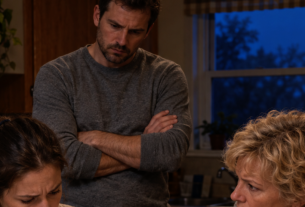
“We’ll be there by lunchtime. Buy plenty of meat and make some salads. There’ll be nine of us,” Artyom announced as casually as if he were asking his wife to pick up a loaf of bread on her way home.
Lyudmila slowed down near the checkout counter of the hardware store and tightened her grip on the box containing a new sprinkler attachment.
“Lunch where?”
“At the dacha, of course. Mom’s been wanting to come for ages. Dad will be with her, Denis and Oksana, their boys, and Aunt Nina. My cousin might come too.”
“Today?”
“Yeah. Why put it off? The weather’s great.”
Beyond the store’s glass doors, the asphalt shimmered in the heat. It was only half past ten in the morning, yet the air already smelled of hot metal and dry grass. Lyudmila looked at her cart, which held ant killer, a hose, greenhouse fasteners, and two packages of screws. She had driven into the district center that morning specifically to buy the small things she needed to finish the canopy over the summer kitchen.
An ordinary working day was waiting for her at the dacha: installing the irrigation system, treating the paths, checking the water tank, and harvesting the ripe cucumbers. The day before, Lyudmila had warned her husband that she wanted to spend Saturday quietly and finish everything before the evening thunderstorm.
Artyom had nodded and said he would stay in the city. Now it turned out that not only was he coming after her, but he was bringing enough people to fill the entire small property.
“You invited nine people and decided to tell me an hour and a half before they arrive?”
“Don’t exaggerate. We’ll buy everything on the way.”
“What exactly?”
There was a rustling sound on the phone, followed by the muffled voice of her mother-in-law. Lyudmila made out the words, “Tell her she has plenty of fresh herbs there.”
“We’ll bring charcoal and drinks,” Artyom answered quickly. “You have everything else. Potatoes, vegetables, pickles. The freezer is full.”
“It’s not full so your relatives can come and conduct an inventory.”
“Lyuda, don’t start. People are coming to relax, not to eat you out of house and home.”
“Then tell them to bring food.”
“They will.”
He answered too quickly. Lyudmila knew that tone well. Artyom used it whenever he wanted to end an unpleasant conversation before she could ask the next question.
“Tell them I won’t open the gate unless they bring food.”
“Are you serious?”
“Completely.”
Lyudmila ended the call, paid for her purchases, and walked out to the parking lot. The dacha was a twenty-minute drive away. Her phone vibrated in her handbag the entire way, but she ignored it. Artyom sent several messages: first an indignant one, then a conciliatory one, and finally a photo of two bags of charcoal and several bottles of lemonade in the trunk.
There was no food in the picture.
The dacha belonged to Lyudmila. She had inherited the small house and its eight hundred square meters of land from her grandfather before she got married. Over the past ten years, she had put the property in order: reinforced the foundation, installed running water, replaced the wiring, built a greenhouse, and set up a summer kitchen. Artyom occasionally helped with physical work, but he treated the dacha mainly as a place for barbecues. He might mow the lawn after being reminded three times, yet he happily told his friends how “they had fixed up their country house.”
His relatives had visited twice before. The first time, her mother-in-law, Elena Grigoryevna, took home four jars of pickled cucumbers, a bucket of apples, and almost all the fresh herbs, claiming the produce would go to waste anyway. The second time, Denis and his wife spent the weekend around the barbecue, and before leaving, they loaded all the remaining meat from the refrigerator into their car. Oksana explained that the children would need something to eat that evening.
After their visits, Lyudmila spent three hours collecting plastic cups from around the property and scrubbing the greasy barbecue rack Denis had abandoned near the water pump.
She had invited no one for a third visit.
When she reached the dacha, Lyudmila carried her purchases into the house, checked the refrigerator, and quickly made a decision. She packed the meat, cheese, homemade preserves, and containers of prepared food into a portable cooler and drove them to her neighbor, Tamara Semyonovna, who lived two properties away.
“Unexpected guests?” the neighbor guessed when she saw what was inside the cooler.
“They’re about to arrive. But they’ll have to set the table with whatever they bring themselves.”
Tamara Semyonovna grinned knowingly.
“Good for you. Last time your mother-in-law asked me for raspberries. Said you’d given her permission.”
Lyudmila stopped.
“Did you give her any?”
“A bowl. Then I asked you about it and realized I shouldn’t have.”
“Today, don’t give them anything without my permission. Even if they say I asked you to.”
“Don’t worry.”
When Lyudmila returned, she harvested cucumbers and tomatoes, but instead of taking them into the kitchen, she locked them inside the utility shed. She left only a pitcher of water and an empty vase on the table. Then she opened the canopy, laid out her tools, and started working on the irrigation fittings.
Around noon, someone honked outside the gate.
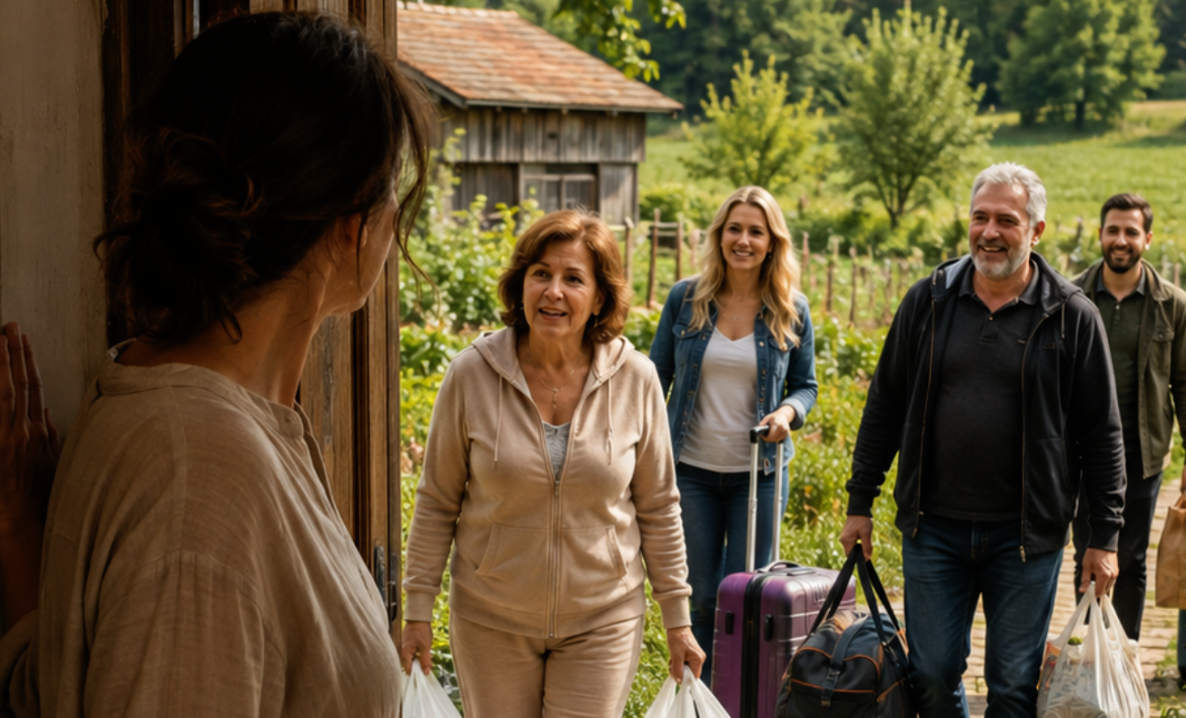
Artyom entered the yard first, carrying a pack of lemonade. Elena Grigoryevna followed him in a light-colored pantsuit and straw hat. Behind her came Lyudmila’s father-in-law, Georgy Petrovich, carrying a folding chair. Denis hauled the charcoal, Oksana carried a beach bag, and their sons argued over an inflatable ball. Aunt Nina brought in a rolled-up blanket. Last came a man in his forties whom Lyudmila didn’t know and who was introduced as Artyom’s cousin Sergei.
Everyone had bags, shopping bags, and backpacks. Lyudmila carefully examined what they were carrying.
One transparent bag contained paper plates.
The rest of the plastic bags were empty, neatly folded one inside another.
“Is the food still in the car?” she asked.
Artyom looked toward the barbecue grill.
“We thought we’d sort that out here. There’s a store nearby.”
“So there’s no food.”
“But we bought charcoal,” Denis cut in. “We didn’t come empty-handed.”
“Charcoal without food is an interesting purchase.”
Elena Grigoryevna took off her hat and fanned her face with it.
“Lyudochka, we haven’t eaten since morning. We thought you’d welcome us properly. Artyom said you had everything here.”
“Artyom was wrong.”
“What do you mean?”
“It’s simple. I didn’t prepare anything for nine uninvited guests.”
Oksana put her beach bag down on the bench.
“The children are hungry. At least make them some sandwiches, and then we’ll go to the store.”
“What’s in the bag?”
“Towels, sunscreen, spare clothes.”
“So you remembered the sunscreen but forgot food for your own children.”
Oksana frowned.
“Why are you talking like that? We were told we were invited.”
“Guests are invited by the host. I didn’t invite any of you.”
Artyom stepped closer.
“Lyuda, stop it. Everyone’s already here. We’re not going to send people straight back home.”
“That depends on how they intend to behave.”
“We’re family, you know,” Denis said.
“Being related doesn’t turn my refrigerator into a free warehouse.”
Denis was about to respond, but Georgy Petrovich stopped him with a gesture.
“That’s enough arguing at the gate. Son, go to the store. We’ll all chip in.”
Her father-in-law spoke calmly and was clearly uncomfortable. Lyudmila liked him more than the others. He never interfered with her household and had always cleaned up after himself during previous visits. But even he had arrived today with nothing except a chair.
Artyom shrugged irritably.
“Why should I be the only one who goes?”
“Because you invited everyone,” Lyudmila replied. “And you promised you’d bring food.”
“I said we’d buy it on the way.”
“And on the way, you bought empty plastic bags?”
Sergei laughed, but when he saw the expression on Artyom’s face, he immediately turned away.
Oksana started listing what they needed to buy: meat, bread, vegetables, fruit, sauces, water, and sweets for the children. Elena Grigoryevna added cheese, sausage, and something for dinner. Aunt Nina remembered coffee.
Listening to the list, Lyudmila became increasingly certain that no one intended to leave after lunch.
The relatives had come prepared to stay until the following day. Oksana’s beach bag contained more than just spare clothes for the children. Toothbrushes protruded from one of the side pockets. A small bag containing a nightgown was tied to Aunt Nina’s blanket.
“Were you planning to stay overnight?” Lyudmila asked.
Elena Grigoryevna smiled as though she were revealing a pleasant surprise.
“Why drive home in the evening? Tomorrow is Sunday. We thought we’d stay in the house. The boys can sleep on folding beds, Nina can take the sofa, and the small room will be enough for your father-in-law and me.”
“There are two rooms in the house. Artyom and I sleep in one. The other contains my belongings and my desk.”
“The desk can be moved onto the veranda,” her mother-in-law decided lightly.
“No, it can’t.”
“What is wrong with you today?” Elena Grigoryevna raised her voice. “We’re not strangers. Are you really that stingy about a little space?”
“I’m not stingy about space. I don’t like other people deciding who will spend the night in my house without asking me.”
Artyom dropped the charcoal next to the grill.
“No one decided anything for you. We wanted it to be a surprise.”
“A surprise is when someone receives something pleasant. Nine people arriving with empty bags is more like a military landing.”
Aunt Nina snorted with laughter, then immediately pretended to cough.
“Fine,” Artyom said irritably. “I’ll go to the store. Just stop humiliating me in front of everyone.”
“You managed that yourself when you invited people onto someone else’s property without permission.”
“I’m your husband.”
“And how does that change the name on the property documents?”
The yard became silent. The children stopped throwing the ball and stared at the adults. Lyudmila didn’t want to argue in front of them, so she turned to Oksana.
“There’s a lake nearby. It’s a seven-minute walk. While the men go for groceries, you can take the children swimming. But don’t walk through the house while wet, don’t step on the garden beds, and don’t open the greenhouse.”
“Should we write the rules down?” Oksana asked.
“I can write them down if three rules are difficult to remember.”
Oksana took her sons and silently headed toward the gate. Aunt Nina went with them. Sergei volunteered to accompany Artyom and Denis to the store. Georgy Petrovich stayed beside the barbecue while Elena Grigoryevna settled under the canopy.
Lyudmila returned to her irrigation system. She deliberately refused to play hostess. She didn’t offer anyone drinks, run around fetching dishes, or clear rooms for them.
When Elena Grigoryevna asked for some cold water, Lyudmila pointed to the pitcher.
“That’s warm.”
“There isn’t any other water.”
“What about the refrigerator?”
“The refrigerator isn’t serving visitors today.”
Her mother-in-law narrowed her eyes.
“Have you decided to show everyone what a strong personality you have?”
“No. I’ve decided to stop serving people who take my work for granted.”
“What work? You’re relaxing out here.”
Lyudmila silently pointed at the disassembled irrigation system, the tools, and the boxes of fittings.
“You could do all of that tomorrow.”
“I could. Except I was planning to rest tomorrow.”
Elena Grigoryevna was silent for a moment, then walked toward the house.
Lyudmila straightened.
“Where are you going?”
“To the bathroom.”
“The toilet is outside, to the right of the house.”
“I’m not using an outdoor toilet.”
“Then you’ll have to wait until Artyom comes back and ask him to drive you home.”
Her mother-in-law opened her mouth in outrage.
“You’re not going to let me into the house?”
“I’ll let you use the bathroom and nothing else. But leave your bag here first.”
“Why?”
“So nothing else accidentally leaves the house with you.”
Elena Grigoryevna’s face flushed.
“Are you implying that I steal?”
“I’m reminding you that after your last visit, several jars of preserves, a bag of frozen berries, and a brand-new set of towels disappeared.”
“You told me I could take the cucumbers!”
“I said you could take two jars. You took six. I didn’t give you permission to take the berries or the towels.”
Her mother-in-law turned toward the gate as if hoping her son would suddenly appear there. But the road was empty.
“Oksana took the towels for the children. She probably mixed them up.”
“The new towels were in a closed cupboard. To mix them up, she first had to find them.”
Elena Grigoryevna said nothing. She left her handbag on the bench and went inside. Lyudmila remained beside the open door.
Several minutes later, her mother-in-law emerged with a stony expression and didn’t ask for water again.
The men returned forty minutes later. The trunk of the car was packed with groceries. Artyom demonstratively carried out the meat and dropped it on the table.
“Happy now?”
“Did you keep the receipt?”
“Why?”
“So you can divide the expenses properly among yourselves afterward.”
Denis laughed.
“You’ve got a nice setup here. It’s your dacha, we buy our own food, and now we have to cook it ourselves too?”
“At last, you understand the rules.”
“That’s not how it works when people come to visit.”
“You didn’t come to visit. You came here for a vacation after presenting me with a fait accompli. Those are two different things.”
Lyudmila didn’t touch the food they had bought. Denis and Sergei prepared the meat, Georgy Petrovich lit the grill, and Artyom chopped vegetables.
When the women returned from the lake, they waited for a while, expecting the hostess to take over the meal preparation. When she didn’t, Oksana took out the dishes and started setting out the food herself.
The carefree celebration Artyom had imagined turned into ordinary work.
The men argued over how to grill the meat. The children wanted to eat immediately. Elena Grigoryevna repeatedly demanded a knife, a bowl, and a cutting board.
Each time Lyudmila gave the same answer:
“The kitchen is right there. Get it yourself and wash it afterward.”
By four o’clock, everyone was finally seated under the canopy. Lyudmila poured herself some water and took a place at the end of the table.
She didn’t refuse the food out of principle. The guests had bought it and cooked it themselves, so as far as she was concerned, the matter was settled.
The conversation remained calm for the first twenty minutes.
Then Aunt Nina complimented the garden and asked how many cucumbers had already been harvested.
“Enough,” Lyudmila replied.
“We could take some home,” Elena Grigoryevna said eagerly. “Everything’s expensive at the market now, and yours will only go to waste.”
“They won’t.”
“What are you going to do with so many?”
“I’ll preserve some and give some to my neighbor, who helps me look after the property.”
Her mother-in-law stopped chewing.
“You’ll give them to a neighbor but not to your own family?”
“Tamara Semyonovna waters the greenhouse when I’m away, calls repairmen if something breaks, and checks the property during the winter. She never takes anything without asking, and she never arrives carrying empty bags for leftovers.”
Everyone’s gaze shifted simultaneously toward the bench.
Underneath it was a stack of clean plastic bags that Elena Grigoryevna and Oksana had brought with them.
They hadn’t even tried to hide what the bags were meant for.
Oksana was the first to break the silence.
“Mom brought them just in case. There might be food left over.”
“The food you bought belongs to you. Take all of it if you want. The produce from my garden stays here.”
“Can the boys at least pick some apples?” Denis asked.
“The apples aren’t ripe yet.”
“There are plenty on the tree.”
“They’re sour.”
“The kids can decide for themselves.”
Lyudmila turned to the boys.
“Do either of you want sour apples?”
Both shook their heads.
“There you go,” she told Denis. “The children decided.”
Denis sulked but said nothing.
After lunch, the guests spread out around the property. Georgy Petrovich lay down in a lounge chair. Sergei went to the lake. Aunt Nina read under the canopy. Oksana settled onto the blanket, and the children started playing with the ball again.
Lyudmila continued working.
She had almost finished connecting the hose when she heard a cracking sound behind the greenhouse.
One of the boys was standing in a garden bed while the other was trying to retrieve the ball from between the plants. Several stems had been broken.
“Stay exactly where you are,” Lyudmila said sharply.
The boys froze.
Oksana raised her head from the blanket.
“What happened?”
“Your sons climbed into the garden bed.”
“The ball rolled in there. It’s not a big deal.”
Lyudmila walked over, picked up the ball, and handed it to Denis.
“You’ll play outside the gate.”
“No way,” he protested. “Cars drive there.”
“Then put the ball away.”
“Children need exercise.”
“Then let them exercise somewhere they won’t destroy something I’ve spent months growing.”
Oksana walked over to her sons, examined the plants, and shrugged.
“It’s only two plants.”
“Then this evening, buy two identical mature plants with vegetables already growing on them and plant them in place of the broken ones.”
“It’s July. Who sells plants like that now?”
“Then explain to your children that someone else’s work can’t be restored with a shrug.”
Artyom heard the commotion and approached from the direction of the house.
“Lyuda, they didn’t mean to.”
“I know. That’s why I’m speaking to their parents instead of scolding the children.”
“You’ve spent the whole day looking for reasons to pick at everyone.”
Lyudmila slowly turned toward her husband.
“You brought nine people here without warning. They arrived without food, planned to spend the night without permission, tried to take over my house, and walked through my garden beds. I still haven’t thrown anyone out. I wouldn’t advise you to test how much more I’m willing to tolerate.”
Artyom looked around at his relatives. His expression hardened.
“We’ll talk this evening.”
“No. This evening, you’re leaving with everyone else.”
“I’m staying at my own dacha.”
“This isn’t your dacha.”
“I’m your husband. I have the right to be here.”
“You have the right to be here as long as the owner doesn’t object. Today, the owner objects to anyone staying overnight.”
Georgy Petrovich got up from the lounge chair.
“Artyom, don’t argue. She didn’t know in advance. We’ll go home this evening.”
“Dad, stay out of it.”
“No, I won’t. You invited us without asking Lyudmila. That was your mistake.”
Elena Grigoryevna stood up from the table.
“Georgy, are you taking sides against your own son now?”
“I’m against a grown man treating someone else’s house as if it belonged to him.”
Her mother-in-law stared at her husband as if he had betrayed the entire family.
Georgy Petrovich didn’t look away.
After that, the mood deteriorated completely.
The relatives stopped pretending they were having a cheerful holiday and began packing earlier than planned. Oksana folded the towels, Denis packed the leftover food they had bought into bags, and Aunt Nina helped wash the dishes.
Quietly, she said to Lyudmila:
“You’re right. They’re just used to everyone giving in to them.”
“Habits change when they stop being useful.”
By seven o’clock, a mountain of bags had accumulated beside the car.
Elena Grigoryevna walked around the property looking for something else she could take. Several times, she glanced toward the utility shed, but the door was locked.
“You really won’t give me any cucumbers?” she asked before leaving.
“No.”
“Too stingy to spare a few.”
“I don’t discuss decisions concerning my property.”
“With that kind of pettiness, you’ll end up alone.”
Lyudmila glanced at Artyom. He was standing beside the trunk, clearly waiting to see how his wife would respond.
“Maybe,” she said calmly. “But at least I won’t wake up one day and discover that nothing is left of my house except empty jars and someone else’s rules.”
Her mother-in-law got into the car and slammed the door loudly.
Artyom didn’t hurry to get in.
“I’ll come back later,” he said.
“No, you won’t.”
“Why not?”
“Because after today, you’re going to stay with your mother for a while and decide what matters more to you: our marriage or your ability to treat my property as your own.”
He gave an incredulous laugh.
“You’re throwing me out over lunch?”
“Not over lunch. Because you deliberately deceived me. You knew I wouldn’t agree, so you told me about everyone coming only after they had already made their plans. You promised your relatives they could spend the night in my house. You told them there was food here even though you hadn’t bought any. You were counting on me being too embarrassed to object in front of everyone and taking responsibility for the entire visit.”
Artyom opened his mouth, but Lyudmila raised a hand.
“I’m not finished. Your mother arrived with empty bags because she was certain she would take food and produce home. Your brother came with children but didn’t bring food for them. And you didn’t see anything strange about that. Which means this arrangement suits you.”
“I just wanted to spend the day with my family.”
“Then organize it at your own expense, on your own property, and with your own labor.”
“We have a shared apartment in the city.”
“I bought that apartment before we married. You aren’t registered as an owner and you have no ownership rights to it. Today, you’ll collect the things you need. We’ll discuss everything else later.”
The smile disappeared from Artyom’s face.
“You decided all this in advance?”
“I started deciding after your phone call. I made the final decision when I saw the empty bags.”
For several seconds, he stared at his wife, trying to determine how far she was prepared to go.
Lyudmila held his gaze.
She had no intention of shouting, explaining the obvious, or waiting for remorse. Artyom was intelligent enough to understand everything.
It had simply been convenient for him to believe that her patience had no limits.
“You’ll regret this,” he finally said.
“Then that will be my mistake. Today, I’m correcting yours.”
Artyom got behind the wheel. His car drove out through the gate, followed by the second vehicle in which Denis and Sergei had arrived.
Lyudmila waited until both disappeared around the bend, closed the gate, and returned to the canopy.
Crumbs, greasy plates, and empty bottles remained on the table.
One forgotten plastic bag lay beneath the bench. Lyudmila picked it up with two fingers, opened it, and saw a plastic food container inside. Apparently Elena Grigoryevna had prepared it in advance for meat or garden produce.
Lyudmila threw the bag into the trash.
Then she called Tamara Semyonovna and collected her food. The neighbor brought the containers over herself and, after looking around the now-empty property, nodded approvingly.
“They left quickly.”
“Apparently the vacation required too much independence.”
“Your husband too?”
“Him too.”
Tamara Semyonovna didn’t ask any more questions. She helped gather the dishes, accepted several cucumbers, and left before dark.
That evening, a thunderstorm began.
Clouds covered the sky, the wind bent the branches of the apple tree, and heavy raindrops drummed against the roof.
Lyudmila sat on the veranda reading her husband’s messages.
At first, Artyom accused her of cruelty.
Then he wrote that his mother was crying.
After that, he said his relatives were offended and would never visit again.
Lyudmila regarded that last message as the only positive result of the entire day.
Closer to midnight, his tone changed. He admitted that he should have warned her in advance. He suggested they forget the argument and that he return in the morning.
Lyudmila replied with one sentence:
“We’ll discuss it after you explain to every person who came today that the dacha belongs to me and that you will never again invite anyone there without my permission.”
There was no reply.
The next morning, Lyudmila finished installing the irrigation system.
She checked the connections, turned on the water, and spent several minutes watching the even streams fall across the soil. She tied up the broken plants, although she understood that part of the harvest had already been lost.
Artyom didn’t arrive until Sunday evening.
He came alone, without his mother and without any belongings.
Lyudmila met him at the gate but didn’t open it immediately.
“Did you talk to your relatives?”
“I did.”
“What did you tell them?”
“That I was wrong. That I invited them without your consent.”
“And?”
“That they can’t take food or produce from the dacha without permission. And that staying overnight has to be arranged with you in advance.”
Lyudmila opened the gate.
“Come in.”
Artyom walked into the yard and stopped near the canopy.
After a full day, he had calmed down. He no longer looked offended, only tired.
“Mom said she’ll never come here again.”
“That’s her decision.”
“You could have been gentler.”
“I could have. Then they would have come again.”
He ran his hand over the back of the bench.
“I really thought it would all work out.”
“Exactly. You weren’t relying on my agreement. You were relying on the fact that I’d feel too uncomfortable to refuse in front of everyone.”
Artyom didn’t argue.
For the first time, his silence wasn’t an attempt to punish his wife. He was actually thinking about what she had said.
“I didn’t mean to use you.”
“Intent doesn’t erase the result.”
“What happens now?”
“Now we have rules. Nobody comes to the dacha without arranging it with me first. Everyone brings their own food. Everyone cleans up after themselves. Produce from the garden goes only to people I personally offer it to. Overnight stays happen only when I explicitly invite someone.”
“What if I want to invite friends?”
“You ask me first.”
“And will you ask me too?”
“If we’re talking about our shared apartment, yes. If we’re talking about my dacha, I’ll tell you when guests are coming because I respect the person I live with. But permission concerning this property still comes from its owner.”
Artyom slowly nodded.
“I understand.”
“One more thing. If you ever try to present me with a fait accompli like this again, you’ll move out permanently. There won’t be a long discussion.”
He looked at her carefully.
“Were you really prepared to leave me?”
“I was prepared to protect my home. Whether we stayed together depended on how you behaved afterward.”
Artyom sat down on the bench and remained silent for a long time.
Lyudmila didn’t rush him.
She didn’t need an immediate promise made simply to regain access to the house. She wanted to see whether her husband was capable of recognizing a boundary he had previously treated as a technicality.
“I understand,” he finally said. “It took me a while, but I understand.”
“We’ll see.”
Lyudmila didn’t pretend one admission was enough.
Over the following months, she watched his actions rather than his words.
Artyom never invited anyone again without discussing it with her first. When Denis suggested coming back with the children in August, Artyom himself replied that he would have to ask the owner first.
When Lyudmila said no, he didn’t argue or try to pressure her through his mother.
Elena Grigoryevna really didn’t appear for the rest of the summer.
One day, however, she sent some empty jars through her son and asked for cucumbers.
Lyudmila returned the jars clean and empty.
“She’ll be offended,” Artyom warned.
“That isn’t an emergency.”
In September, her mother-in-law finally called Lyudmila herself.
Her tone was stiff but lacked its former superiority.
She asked whether she and Georgy Petrovich could come for a few hours and help harvest the apples.
Lyudmila agreed.
They arrived with meat, bread, vegetables, and two containers of prepared food.
There were no empty plastic bags in the car.
After lunch, Georgy Petrovich gathered fallen branches while Elena Grigoryevna washed the dishes.
Before they left, Lyudmila herself filled a basket with apples and handed it to them.
Her mother-in-law looked at her in surprise.
“I didn’t ask for these.”
“That’s why I’m giving them to you.”
Elena Grigoryevna seemed about to say something, then changed her mind.
She took the basket and thanked her.
Lyudmila watched their car drive away and returned to the house.
She had never needed to defeat her husband’s relatives or permanently close the gates to them.
She had achieved something more important.
Now everyone who came to her dacha understood that hospitality did not begin with empty plastic bags brought along for leftovers.
It began with respect for the hostess.