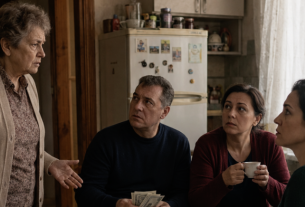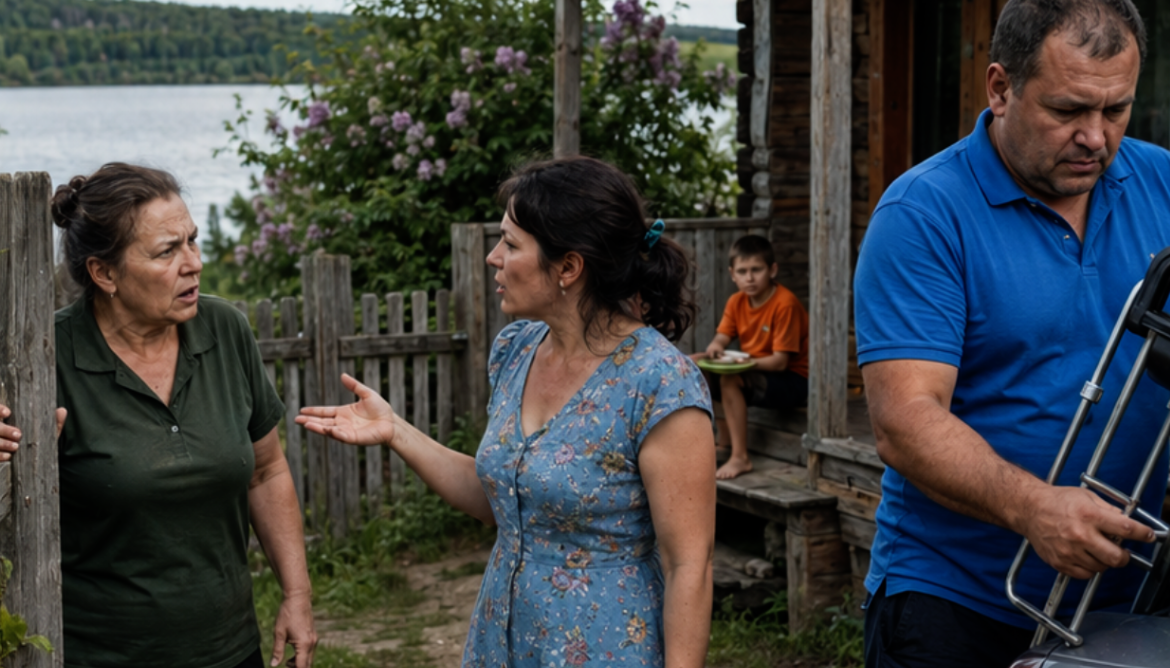
“Lena, why are you just standing frozen in the doorway? Take our bags into the big room—we’ve been on the road! It’s family who’s come to visit. Blood is sacred!”
Lena stood on the porch, holding a pair of garden shears. She had just cut the faded peonies by the gate—the only thing she had managed to do for herself all morning.
They were already unloading in the yard. Her brother-in-law’s gray car was parked nose-first toward the gate, the trunk wide open, and Vitya, her sister-in-law’s husband, without so much as a hello, was hauling a crate of beer and a grill rack toward the barbecue.
As if he owned the place.
Lena knew that grill rack well. It was hers, bought three summers ago. For some reason, he had always considered it communal property.
“Hello, Olya,” Lena said.
Her sister-in-law Olga was already crossing the yard toward her, arms spread wide, wearing a new sundress and large earrings. She hugged Lena, pressed her cheek to hers, then turned toward the neighboring fence, where Aunt Valya was busy working.
“Valentina, hello, dear! Look, we’ve come to visit our Lena, just like every summer! A family house by the water—what a beautiful place! Everyone here is our own, all family!”
Aunt Valya nodded, said nothing, and went back to weeding.
Lena set the shears down on the porch railing.
She and Kolya had bought this house eight years ago. They had sold their two-bedroom apartment in the city on Chkalov Street—sixty-two square meters, ninth floor. They were tired of elevators that never worked, the upstairs neighbors, and the endless drone of traffic beneath their windows.
They had wanted silence.
A garden.
Water just a few steps away.
A peaceful old age when there would be nowhere left to rush.
The house had become reality.
The silence never had.
“All right, I’ll put our things in the big room,” Olga announced as she climbed the porch steps. “Lena, you and Kolya move into the back room. It makes no difference to you—you live here. We need the room with the view of the water because of the children. You understand. The children.”
Move.
Lena said nothing.
Eight years of “move.”
For eight years, the best bedroom—the one overlooking the bay—became someone else’s for a month and a half.
And she and Kolya moved into the damp back room, where the only view was of the shed.
Olga was already making herself at home.
She went inside and pushed Lena’s armchair away from the window—the chair Lena loved to sit in during the evenings—and dragged it into a corner against the wall.
“Why is this thing standing here? It blocks the light,” she puffed. “Katya, bring our inflatable mattress in here. We’ll put it by the window so the kids can sleep close to the water.”
The chair scraped across the painted floorboards, leaving two pale streaks behind.
Lena watched from the doorway.
She said nothing.
“Lena, where do you keep your towels?” Olga was already opening the hallway cupboard—the one where Lena kept the clean linens she and Kolya used. “Oh, we’ll take these. And give us these floral sheets too. We’re city people; we need something softer.”
She pulled things out in stacks and placed them on her bed.
The bed that, one hour earlier, had been Lena’s.
“And Lena,” Olga said, turning from the cupboard, “go to the store. You’ve got that chain supermarket in the village. Buy some proper meat—not that stringy stuff. My kids are picky. And get charcoal for the grill. Vitya will cook. You’ve got money, don’t you? It’s not as though you’re poor, living in a house like this.”
“Money,” Lena repeated.
“Well, whose money else? We’re not exactly guests, are we? We’re family.”
Eight years of “family.”
Her family’s children ate her meat.
Her family’s adults burned her charcoal.
Her floral sheets were washed by the sackful.
And every bill came to her.
“Katya, don’t stick your hands in the cupboard!” Olga shouted somewhere into the house. “Lena, is there even anything decent in the refrigerator? We’re starving after the drive. You could cook something for everyone. Borscht, maybe. The kids hardly ate anything this morning.”
“Borscht,” Lena repeated.
“Yes, borscht. Why are you acting like a stranger?”
Without pausing, Olga tapped at something on her phone, then turned the screen toward Katya.
“Oh, look, I posted yesterday’s pictures from Svetka’s country house in the family chat. Already twenty likes. ‘Our house by the sea, the whole family together.’ It came out beautifully.”
Out of the corner of her eye, Lena saw the photograph.
Last year’s feast in her yard.
On her table.
Her meat on the platter.
Her barbecue grill.
The caption read: “Our house by the water, everything made with our own hands.”
Our own hands.
Likes.
Eight years of other people’s hands in photographs of her home.
Previous summers had been exactly the same.
Lena would wake at six because after the previous evening’s feast the yard would be covered in charcoal, bones, and empty bottles, and there was nobody except her to clean it all up.
Buying food for the crowd—her job.
Cooking three times a day for eight people—her job.
Washing sacks of bed linen—her job.
Electricity, water, gas for the grill—the bills came to her.
One summer alone could cost forty thousand rubles just for groceries, plus utility bills three times higher than normal.
“We’re family. Why are you counting?”
They had sold the apartment on Chkalov Street for a little over five million rubles, added the money they had saved over fifteen years, and bought this house by the water.
At the time, Kolya had said, “We’ll grow old here in peace. Just you and me, the garden and the bay.”
The peace lasted one summer.
The second summer, Olga arrived “for a week, to swim in the sea and visit family.”
The third summer, she stayed a month.
By the eighth, it was “as usual, the whole summer.”
And the sea—their own bay, only a few steps from the porch—Lena had seen perhaps five times in eight years.
The rest of the time, she saw only the kitchen, the window above the sink, and through that window the backs of other people lounging on her deck chairs.
Her nephew, Katya’s brother Dyoma, around twelve years old, had already come out of the house carrying a plate.
On it were Lena’s sliced cheese and the ham she had bought yesterday to last herself a week.
He chewed while looking at his phone and walked toward the water.
“Dyoma, I bought that for myself,” Lena said quietly.
“Mom, there’s nothing to eat here!” Dyoma shouted toward the house without turning around.
“Lena, he’s a child. Don’t be stingy,” Olga called from the window. “You can buy more. How much do you need when it’s just you?”
Just you.
Kolya came out of the house at that moment. He saw the plate. He saw Lena’s face.
He edged closer.
“Lena,” he whispered, glancing toward his sister at the window, “just put up with it, all right? A week or two and they’ll leave. She’s my sister. I can’t say anything to her—she’ll get offended. You know what she’s like.”
“So you can say things to me,” Lena replied. “It’s all right to hurt me.”
“But you don’t really get offended. You’re strong,” Kolya muttered, then retreated toward the doorway again, back toward his family.
Convenient.
You can always negotiate with the person who doesn’t shout.
The sister shouts, therefore she must be right.
The wife stays quiet, therefore she’ll endure it.
Lena lowered her eyes to the garden shears.
She paused.
Then looked up.
“You never had children of your own,” Olga added in a softer, almost affectionate voice as she leaned out of that same window overlooking the water. “So the house just stands empty. Who are you saving it for, Lena? It’ll be useful for us. At least there’ll be children’s laughter inside these walls.”
That did it.
Truly.
For a second, Lena set the house keys on the porch railing.
They clinked against the wood.
She stood looking toward the bay—the bay she would once again not be able to see from the back room, because that room faced only the shed.
You never had children of your own.
Eight years.
And this was what it had come to.
Then she picked the keys back up and said evenly:
“I’m not bringing the bags inside, Olya.”
Olga laughed as though Lena had made a particularly good joke.
“What?”
“The bags. I’m not bringing them in.”
Kolya came out of the house just then. He had arrived earlier that morning and now stood in the doorway wearing the guilty expression of a man who already knew things were going to become uncomfortable.
After all, they were his relatives.
His sister.
“Lena, come on,” he began, looking from his wife to his sister. “It’s Olya. Let them stay like always. It would be awkward otherwise. They’ve come all this way.”
Lena looked at her husband.
That spring, when she had been bedridden and unable to reach the bathroom without leaning against the wall, Kolya had spent two weeks away on his rotational work assignment.
And his precious sister—the one he now felt “awkward” offending—had not come even once.
Lena said nothing.
She merely looked at him.
Kolya lowered his eyes to the floor.
As usual, he became silent and inconspicuous, waiting for the storm to pass on its own.
“Kolya, tell her something,” Olga turned to her brother. “What nonsense has she come up with? We always spend the summer here. It’s a tradition.”
At that moment, Olga’s phone rang on the oilcloth-covered table in the yard.
She was holding two bags, so she tapped the screen with her little finger and put the call on speaker.
“Hello, Svetka! Yes, we made it, we made it, everything’s fine,” she said into the air as she squeezed past the porch with the bags. “We’ve settled in at my sister-in-law’s for the whole summer, like usual. The house is free, so it would be a sin not to take advantage. She may be practically crippled now after that hospital stay, can barely walk, but she’ll still cook for us. What else is she going to do? It’s not like she’ll throw us out…”
The yard fell silent.
Aunt Valya stopped weeding by the fence.
Vitya froze beside the barbecue grill, rack still in his hands.
Kolya stared at one fixed point.
Olga stopped mid-sentence.
Too late.
Her finger found the button and the screen went dark.
But everyone in the yard had already heard everything.
Lena did not raise her voice.
“A sin not to take advantage,” she repeated calmly, as though reading someone else’s note aloud. “A free house. A cripple, but she’ll cook.”
“Lena, I didn’t mean… Svetka misunderstood, she always…” Olga began speaking rapidly, and within the space of a single sentence her voice changed from the sugary tone she had used a minute earlier to something angry and unfamiliar. “Why are you listening to private conversations anyway?”
The mask had not had time to return.
One minute earlier: “Blood is sacred.”
On speakerphone: “The house is free” and “she’s practically crippled.”
The two voices collided in front of Aunt Valya, Kolya, and Olga’s own husband.
Olga was the first person in the yard to fall silent.
Then Lena added quietly.
No shouting.
It was not even an accusation.
Just a fact that needed to be spoken aloud once.
“This spring, I couldn’t get out of bed for two weeks, Olya. I injured my back, had surgery, and was lying here alone. I called you. I asked you to bring groceries and help me for a couple of days. You said you had plans.”
“We did have plans…”
“Plans,” Lena repeated. “I called everyone then. You. My own sister. The distant cousins who eat my food here every summer. Nobody came. Nobody even answered the phone. Aunt Valya helped me.”
Lena nodded toward the fence.
“For eight years, you’ve all told me, ‘We’re one family, one family.’ But the moment something happened to me, nobody was here. Not one person.”
Lena took out her phone.
Not because she needed to prove anything.
She simply opened the old conversation and turned the screen toward Olga.
There, in the messenger, was a message from Olga dated three months earlier:
“Lena, you understand, we’ve had plans for ages. We really can’t. You’re strong, you’ll rest up and recover.”
And beneath it, posted that same day, was a photograph from a water park—Olga, Vitya, and the children, all smiling.
“Plans,” Lena said for the third time. “I kept it. I reread it while I was lying in bed.”
Olga did not look at the screen.
The silence was so complete that the water could be heard.
Eight years of “blood is sacred.”
One spring had revealed everything.
A family that was only a family when sitting at her table and spending her money.
Olga set the bags down.
Her chin jerked upward.
“So what now?” she said loudly, using that second tone of voice now. “We’re already here! The children have been looking forward to the sea the whole way. I had to fight to get Vitya time off work! We’re not going to turn around now! Let us stay. It’s not forever. And as for spring—who knows what I had going on then? I have my own life, you know.”
She still did not understand the scale of what had happened.
After being told no, she immediately demanded more.
“I’m not letting you stay, Olya,” Lena said.
And that was when Olga finally exploded.
“What?!” She stepped forward, her earrings swinging. “So you were testing us?! You deliberately called us in spring so we’d refuse, and now you’re rubbing our noses in it?! You planned the whole thing, didn’t you?! You’re disgusting, Lenka! I come to you with an open heart because we’re family, and you set traps for us! Vitya, do you hear this? She was testing us!”
Vitya silently placed the grill rack on the table.
He set the crate of beer on the ground.
Then he sat on the bench and stared toward the water, making it clear with every part of his posture that he wanted everyone to pretend he was not there.
Meanwhile, Dyoma, oblivious to everything happening around him, calmly returned to the refrigerator in the summer kitchen and systematically removed what Lena had bought for herself for the week: yogurts, sausage, and the second piece of cheese.
He piled everything onto his plate.
The scandal in the yard did not concern him.
The food did.
“Dyoma, leave it,” his mother called to him while moving around—not because she cared about Lena’s groceries, but simply because she did not want him underfoot. “We’re leaving now.”
“Where are we going?” Dyoma asked through a mouthful of food.
“I wasn’t testing you, Olya,” Lena said. “Spring tested you. I was simply sick and asked for help. You didn’t come. That’s all that happened.”
Aunt Valya silently opened the gate in the fence, crossed the yard, and placed a jar of honey on the porch railing in front of Lena. Apparently, she had brought it before any of this began and had been holding it in her hands.
As she went back, she said quietly, to no one in particular:
“You’re doing the right thing, Lena. Stop feeding them. They’ve been taking advantage of you for eight years.”
And that was enough to make it clear who in the yard truly belonged.
Dyoma finished chewing Lena’s ham and glanced around, not understanding why everyone had gone quiet.
Then Lena’s phone rang.
The screen showed her sister’s name: Tanya.
Lena answered without moving away.
“Lena, what’s going on over there?” Tanya rattled off immediately. “Olya messaged me saying you shut the door in the family’s face! I’m actually on my way there with the girls right now. We’re already at the turnoff, we’ll be there in ten minutes. What have you done? You’ve got a house. It’s not a hotel. Are you really that stingy?”
A second front.
The same song, sung in a different voice.
The first group had not even finished packing their bags, and the next group was already arriving.
“Don’t come, Tanya,” Lena said evenly. “The house is closed. To everyone.”
“What do you mean closed?!” Tanya shrieked through the phone. “I promised the girls! We took time off work! Do you have a conscience? I’m your own sister!”
Twelve minutes later, a taxi really did pull up outside the gate.
Tanya and two of her friends got out carrying bags and beach umbrellas, all wearing hats, dressed and ready for a resort holiday.
Tanya walked up to the locked gate and yanked on it.
“Lena! Open up! Are you serious?”
“I’m serious, Tanya,” Lena replied through the gate without opening it. “The house isn’t a hotel. You said so yourself.”
“That’s not what I meant! I meant you shouldn’t mind!”
“Well, now I do mind,” Lena said. “For eight years, I didn’t. Now I do.”
One of the friends was already muttering about the money they had wasted on the taxi and saying that people ought to warn others in advance.
Tanya stood at the gate with an umbrella tucked under her arm, unable to understand how it had happened that she—Lena’s own sister—was being denied entry to a house she had always treated like her own.
“I’ll tell Mom,” Tanya finally said.
“Tell her,” Lena replied and walked away from the gate.
The taxi, which had not yet left, took them back.
The suburban train would have cost two hundred rubles and been cheaper, but they had arrived with beach umbrellas.
They had come for a resort holiday.
Olga stood in the middle of the yard with two bags at her feet, unsure whether to carry them back to the car or continue arguing.
Vitya was already loading the grill rack into the trunk.
Dyoma walked toward the gate.
“Kolya!” Olga turned to her brother one last time. “Are you the man of this house or what? Tell your wife!”
Kolya stood in the doorway.
He looked at his sister.
Then he looked at his wife, who had lain sick and alone in spring while he was away at work and his sister had been busy with her “plans.”
“Olya, well…” he managed. “Maybe… maybe you really could stay at the hotel in the village? It’s decent there. I can ask…”
While his sister had seemed to hold the advantage, he had mumbled, “Let them stay.”
Now that defeat was in the air, it had immediately become, “Maybe the hotel.”
“Traitor,” Olga said.
Then she carried the bags to the car.
Twenty minutes later, the gray car backed away from the gate.
Vitya drove in silence.
Dyoma stared at his phone.
Olga sat in the front passenger seat, looking straight ahead, never once glancing back toward the house.
Lena closed the gate.
She stood there for a moment.
A week later, Aunt Valya passed the news over the fence: Olga had been calling all the relatives and telling everyone about “that arrogant, vile Lenka who deliberately tested her own family and then threw them out of the house, showing off how sick she’d been.”
Her sister Tanya agreed with Olga and had complained to her girlfriends that their holiday had been ruined.
Apparently, the distant cousins had heard about it too and disapproved.
Lena spent exactly one sentence thinking about that.
Fine. Let her be vile.
For eight years, she had been convenient, so she had been considered good.
The moment she became inconvenient, she became vile.
Kolya now walked around looking guilty, caught between the sister who no longer spoke to him and the wife he had left alone when she was ill in spring.
That was his road to walk, not Lena’s.
Let him walk it.
They said Dyoma spent the entire summer complaining to his mother:
“So we’re never going to Aunt Lena’s again? But there was water there.”
There had been water.
There would not be anymore.
And on the very first evening after Lena locked the gate, she finally walked down to the bay.
Alone.
Without pots and pans.
Without a crowd behind her.
She stood on the little wooden pier and looked at the water she had spent eight years seeing only through the kitchen window.
Then she returned to the house and took the schedule off the refrigerator door.
It had been held there by a magnet for all those years—a timetable showing who was arriving when, divided by weeks, by families, with everyone taking turns getting the best bedroom.
Lena folded it into quarters.
And dropped it into the trash.