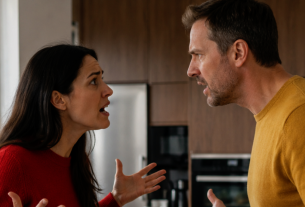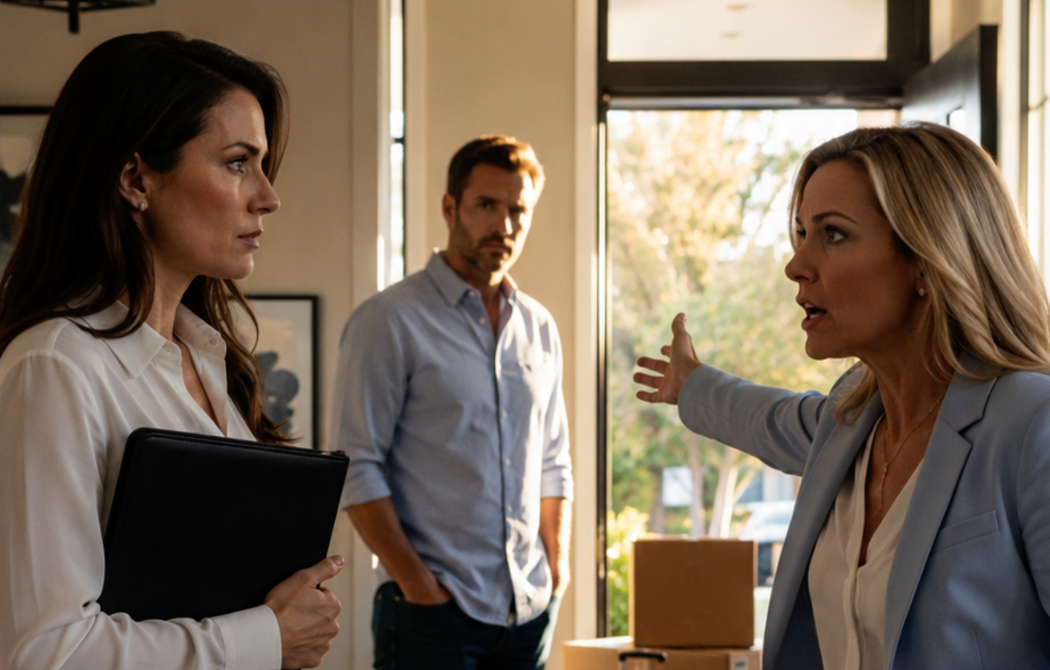
“Pack your bags. This apartment belongs to my family now,” Oksana announced as she walked into the living room with such confidence that it seemed as though she had arrived not at someone else’s home, but for a property viewing arranged in advance.
Polina looked up from her tablet. Through the open balcony door came the sounds of a summer courtyard: children kicking a ball around, a car door slamming somewhere nearby, the smell of roasted corn drifting in from a neighboring window. An ordinary July evening, sticky with heat and exhaustion, had been peaceful only a second ago. Now her sister-in-law stood in the middle of the living room with a large shoulder bag and the expression of someone who had already mentally arranged her belongings throughout the apartment.
“Say that again,” Polina said.
She did not ask because she had failed to hear. She did not express surprise. She deliberately asked Oksana to repeat herself.
Oksana did not even raise an eyebrow. She walked farther into the room, quickly glanced at the sofa, the bookshelf, and the desk beside the window, then turned toward the hallway where Dmitry stood hesitantly.
“I said it’s time for you to think about someone other than yourself. I’m in a difficult situation. My son is growing up. It’s cramped at Mom’s place. And you have two rooms here, a spacious kitchen, a good neighborhood. You’re at work all day, and so is Dima. The apartment practically sits empty.”
Polina slowly placed the tablet on the armrest of her chair. The budget for an exhibition she was preparing for August remained open on the screen. She worked as a curator at a private gallery and was accustomed to negotiating with stubborn owners, temperamental artists, and people who believed other people’s time was free. From Oksana’s very first words, she understood one thing: this was not a request. Someone was trying to present her with a fait accompli.
Dmitry stood in the doorway without saying anything. His white T-shirt clung to his back, and a drop of sweat glistened at his temple. He would not look at his wife. Instead, he carefully studied the floor beneath his feet.
That was enough for Polina.
“Dima,” she said calmly, “did you know your sister was coming here today to have this conversation?”
He lifted his head much too quickly.
“Polina, don’t turn this into an interrogation.”
“It isn’t an interrogation. It’s one question. Did you know?”
Oksana smirked.
“Of course he knew. We discussed everything. You’re just a difficult woman, so we needed the right approach with you.”
Polina looked at her. Her expression remained calm, but her fingers settled evenly on the armrest as though she were preparing to sign an important document.
“We?” she clarified.
“Well, yes. Me, Dima, and Mom. Mom said you’re not a stranger. We’ll stay for a year or two until I sort things out. What difference does it make to you? You can move in with your own mother. She lives alone anyway. Or you and Dima can clear out one of the rooms for now, and Romka and I will take the larger one.”
The room became so quiet that Polina heard the refrigerator relay click in the kitchen.
Dmitry grimaced as though Oksana had said too much. Not because the proposal itself was outrageous, but because she had revealed it too soon.
Polina rose from her chair. She was short, with her hair tied in a low ponytail and gray eyes that became almost transparent whenever she was angry.
She disliked shouting. Shouting too often allowed guilty people to pretend they were the victims.
Polina preferred to make sure that afterward no one could claim she had lost control or misunderstood what had happened.
“Oksana, you are standing in my apartment right now,” she said. “Not Dmitry’s family apartment. Not your mother’s apartment. Not some property that someone once promised to divide. Mine. I bought it before I got married. I am the sole owner. Dmitry lives here because I allowed him to live here as my husband. You are a guest—and an uninvited one.”
Oksana folded her arms across her chest.
“Here we go. Documents, ownership, mine and yours. Can’t you behave like a normal human being?”
“A normal human being would have called and asked for a meeting. She wouldn’t walk into my home and tell me to pack my bags.”
“I shouldn’t have to humiliate myself in front of you. I have a child.”
“Having a child does not make you the owner of someone else’s apartment.”
Oksana’s cheek twitched. She had clearly expected resistance, but not resistance this cold and precise.
She wanted a scandal so she could later slam the door and tell her mother how Polina had screamed at the poor divorced sister of her husband.
But Polina refused to give her anything useful.
“Dima, tell her,” Oksana demanded. “You promised you’d talk to her.”
Polina turned toward her husband.
“Promised?”
Dmitry rubbed his palm across his face.
“I didn’t promise. I said I’d try to discuss it.”
“No, you said you’d handle it,” Oksana interrupted sharply. “And you said Polina would boil over at first and then get used to it.”
For the first time, Polina smiled.
It was brief and unpleasant.
“Now that is interesting.”
Dmitry stepped toward her.
“Polina, that’s not how I said it.”
“How did you say it?”
“I said you would understand. That it would only be temporary. Oksana isn’t going to end up on the street.”
“Is she on the street now?”
“No, but it’s cramped at Mom’s. She has a one-room apartment. Oksana and Romka sleep on a folding chair, Mom sleeps on the sofa. You know that.”
“I do. I also know that after the divorce, Oksana gave up her share of the car in exchange for her ex leaving her alone faster, even though people advised her not to rush. I know she rented a room for two months but moved out after a week because she didn’t like the neighbor. I know she fought with the landlord of another apartment because she decided to get a dog without permission. And I know that none of this has anything to do with my home.”
Oksana lifted her chin.
“Have you been spying on me?”
“No. You told us yourself. Loudly, at length, and with details every single time. I know how to listen.”
Dmitry turned pale.
He disliked it when Polina spoke in that tone.
After four years of marriage, he had learned something very well: once his wife began arranging facts in order, pity could no longer stop her.
From the outside, their marriage had always seemed calm.
Dmitry was gentle and polite and knew how to make people like him. He worked as an equipment maintenance engineer, did not try to dominate, did not create scenes, and had courted Polina beautifully at the beginning of their relationship.
At the time, Polina had thought she had found a mature man who did not feel the need to compete with a woman over every trivial thing.
He moved in with her six months after their wedding. He had no home of his own. Before marriage he had lived with his mother and sister, then rented a room near his workplace, but left it immediately after they registered their marriage.
Polina had never been a romantic fool.
Before the wedding, she had explained everything clearly: the apartment was her personal property, purchased before the marriage. There would be no shares, registrations, or conversations about “our family nest.”
Dmitry had laughed, kissed her fingers, and said that he loved her, not her square footage.
Polina had not argued.
She simply placed the ownership documents in a bank safe-deposit box, kept copies in a separate folder, and trusted paperwork more than important conversations.
For the first two years, Dmitry’s relatives behaved politely.
His mother, Valentina Sergeyevna, rarely visited, brought berries from the market, and called Polina “our business girl.”
Oksana was married then and lived in her husband’s apartment. She looked down on Polina, as if to say, so what if you own an apartment—you don’t have children.
Then Oksana’s marriage collapsed.
Her ex-husband turned out not to be some villain from a cheap television drama, but simply an unpleasant man: he tried to save money on his own child, argued over property, and tried to negotiate arrangements that benefited himself.
Oksana became exhausted, argued constantly, cried in her mother’s kitchen, and began calling her brother more and more often.
At first Polina sympathized with her.
She gave Dmitry’s nephew good backpacks left over from gallery promotional events, helped Oksana prepare a list of court documents, and once paid for the boy to attend a summer camp at a museum because he genuinely enjoyed drawing.
But the help was soon treated as an obligation.
First Oksana asked Polina to pick Romka up after lessons because Polina “was passing that way anyway.”
Then she suggested storing her winter clothes at Polina’s apartment.
Then one day she casually remarked:
“If only Romka and I could stay with you for the summer. It’s cooler here, and the neighborhood is greener.”
Polina had answered:
“A weekend visit can be discussed. Moving in cannot.”
Oksana pretended not to hear the refusal.
And, as Polina had just discovered, she had simply continued discussing the matter with everyone else.
“I’m not trying to hurt you,” Oksana said, now sounding less confident. “But you live too comfortably and act as though you don’t notice that people around you are struggling.”
“I notice,” Polina replied. “That’s exactly why I don’t allow difficult people to move into my apartment.”
“Did you just call me difficult?”
“I called you a person who walked into someone else’s apartment and ordered the owner to pack her bags. Choose the definition yourself.”
Dmitry stepped between them.
“That’s enough. Let’s be calm. Oksana got carried away. But the problem still exists. Mom can’t handle everything. Romka needs his own little space. Maybe we could at least let them use the smaller room for a couple of months?”
Polina looked at her husband so intently that he faltered.
“We?”
“Well… I mean, you.”
“No. You mean ‘we’ when you want to divide responsibility. But when ownership comes up, you suddenly remember that the decision belongs to me. So here is my decision: no.”
Oksana snorted.
“Dima, I told you she was greedy. She can’t even spare a room for a child.”
Polina took two steps toward her sister-in-law.
Oksana was taller, yet she was the one who instinctively stepped backward.
“You are going to leave my apartment now. No discussion. If you are still here two minutes from now, I will call the police and report that an uninvited person is refusing to leave my property. Where is your son right now?”
“At Mom’s,” Oksana muttered.
“Excellent. So at least you didn’t drag the child into this scene. That is the only sensible decision you’ve made all evening.”
“You wouldn’t dare.”
Polina picked up her phone and unlocked the screen.
“Want to find out?”
Oksana looked at Dmitry.
“Are you just going to stand there and watch?”
Dmitry clenched his jaw.
“Oksana, go back to Mom’s for now. I’ll come over later.”
“So you’re throwing me out?”
“I said go.”
For the first time, irritation entered his voice.
Not irritation with his sister.
Irritation with a situation that had escaped his control.
He had counted on Polina’s usual rationality. He expected her to complain, create conditions, give them two weeks, clear a shelf—and once Oksana and her son were established there, removing them would become much harder.
But his wife had refused to negotiate.
She had closed the door before they could even put a foot across the threshold.
Oksana abruptly grabbed her bag.
“You’ll regret this. Especially you, Dima. Mom will never forgive you.”
“Maybe your mother should learn to ask the apartment owner first,” Polina said.
Oksana stormed into the hallway.
Polina followed her.
Her sister-in-law lingered by the door as though waiting for her brother to stop her after all, but Polina calmly opened the front door wider.
“Out.”
“You are such a—”
“Careful,” Polina interrupted. “The neighbors can hear insults in the hallway. And I always appreciate witnesses.”
Oksana snapped her mouth shut, stepped outside, and angrily struck the elevator button with her palm.
When the doors closed, Polina returned to the apartment, turned the lock, and removed the security chain from its hook, because from that moment on security was no longer a formality.
Dmitry stood in the living room.
Now he was finally looking at his wife.
“Are you satisfied?” he asked.
“No. I’m paying attention.”
“You humiliated my sister.”
“Your sister came here to throw me out of my own apartment.”
“Nobody was throwing you out! They were just suggesting an option.”
“I was the one told to pack my bags. That is not an option. That is arrogance.”
Dmitry strode sharply toward the window and back.
He did not shuffle or hesitate now. He moved quickly and angrily, like a man finding himself cramped inside his own lies.
“You always twist everything to your advantage.”
“I bought the apartment to my advantage before I even met you. Right now I’m simply preventing your family from taking it away.”
“Nobody was going to take it!”
Polina picked up a notebook from the coffee table, opened it to a blank page, and placed a pen beside it.
“Then explain the plan to me. Oksana and her son move into the small bedroom. Then it turns out the boy needs a schedule, while I come home late and disturb him. Then your mother starts coming over to help. Then my clothes get moved into boxes because Oksana needs closet space. Then I am told it would be cruel to throw out a woman with a child. And in the end, I’m living in my own apartment like a tenant while all of you decide who sleeps where. Did I miss anything?”
Dmitry’s face turned red.
Not from embarrassment.
From anger that she had so precisely described what he preferred to keep vague.
“You think you’re so clever.”
“I’ve always been clever. You just liked it better when it benefited you.”
He gave a bitter laugh.
“So that’s it? Because of one argument?”
Polina tilted her head.
“No. Not because of one argument. Because you discussed my home behind my back. Because you allowed your sister to come here and give me orders. Because you stayed silent while she divided up the rooms. And because right now you are defending not me, but your failed plan.”
Dmitry opened his mouth, but at that moment his phone rang.
The screen displayed: “Mom.”
Polina looked at the name and held out her hand.
“Put it on speaker.”
“Why should I?”
“Because the conversation concerns my apartment. Or go out onto the stairs and tell her there how badly you’ve been mistreated.”
Dmitry hesitated, then answered and turned on speakerphone.
“Dima!” Valentina Sergeyevna’s voice was sharp and tense. “Oksana is crying. What happened over there?”
Polina sat down in the chair she had risen from ten minutes earlier and calmly took her husband’s phone from his hand.
Dmitry had not expected it and did not react quickly enough to stop her.
“Good evening, Valentina Sergeyevna. This is Polina. Here is what happened: your daughter came into my apartment and told me to pack my bags because your family supposedly needs the apartment now. I asked her to leave. If she returns with the same intention, the next conversation will take place in the presence of the police.”
There was a pause at the other end.
“Polina, why are you being so harsh? Oksana is under a lot of stress.”
“Her stress does not give her rights to my property.”
“But you’re Dima’s wife.”
“Yes. For now, I am. I am not the owner of a dormitory for his relatives.”
Dmitry flinched.
“Polina, enough.”
She lifted one hand without looking at him.
“Valentina Sergeyevna, I am going to clarify this once. Dmitry has no ownership share in this apartment. He is not registered here. Neither his sister nor you have any connection to this property whatsoever. There are many ways to help Oksana: find a rental, negotiate with her former husband through the courts, divide expenses among the adult relatives. But nobody is moving into my apartment.”
“You’re speaking as if you’re a stranger,” her mother-in-law said quietly.
“Because right now you are treating me like an obstacle.”
Valentina Sergeyevna drew in a breath.
“Dima, do you hear how she is talking to your mother?”
Polina handed the phone back to her husband.
“Answer her.”
Dmitry looked at Polina, then at the screen.
“Mom, I’ll call you later.”
He ended the call.
Once again, only the summer heat and the hum from the courtyard remained in the room.
“Happy with your performance?” he asked.
“That wasn’t a performance. It was a clarification of positions.”
“What positions?”
“Mine. Everyone involved now knows the same thing: nobody is moving in.”
Dmitry lowered himself onto the sofa and rubbed the bridge of his nose.
“Polina, you can’t behave like this. They’re my family.”
“And what am I?”
He waved his hand wearily.
“You know what I mean.”
“No, Dima. Now I want to hear it in words.”
He remained silent for too long.
Polina looked at him and no longer saw the husband with whom she had once chosen funny postcards at a book market in St. Petersburg, or the man who brought her watermelon during hot weather and cut it badly, spilling juice all over the kitchen.
She saw a person who had decided that her boundaries could be bypassed if enough relatives applied pressure.
“You’re hard,” Dmitry finally said. “It’s impossible to behave like a family with you.”
“Behaving like a family means excluding me in advance from a decision about my apartment?”
“You make everything about the apartment.”
“Because today that is exactly what all of you came for.”
He stood abruptly.
“You know what? Maybe Oksana is right. You live as though you don’t need anyone. Everything is calculated, everything is under control. Documents, keys, rules. Normal people make compromises sometimes.”
Polina stood as well.
“Normal people ask first.”
She walked into the bedroom, opened the wardrobe, and took Dmitry’s small travel bag from the top shelf.
She placed it on the bed.
Then she opened his section of the wardrobe and calmly took out several T-shirts, jeans, underwear, and arranged them in neat piles.
Dmitry appeared in the doorway.
“What are you doing?”
“Helping you temporarily relocate to the family that urgently needs your support.”
“You’re throwing me out?”
“I am ending your residence in my apartment.”
“I’m your husband.”
“Exactly. Which is why I didn’t throw your belongings after Oksana. You have the evening to take what you need. You can collect the rest by arrangement.”
Dmitry stepped toward the bag and slammed one hand down on top of it.
“You have no right.”
Polina looked directly into his eyes.
“I have the right not to live with a man who brings his relatives into my home to divide my property. You are not registered here. You own no share. You had keys because I gave them to you. That trust ended today.”
He gave a short, unpleasant laugh.
“And what if I refuse to leave?”
Polina picked up her phone.
“Then I call the police because of a domestic conflict involving a person who refuses to leave my property after being told to do so by the owner. Yes, they won’t handle the divorce. But they will document the call. That is enough for me to begin. Afterward I’ll go to court not only for the divorce, but also to terminate your right to use the apartment if you decide to pretend you’re a tenant with ownership rights. If you want this long and ugly, I can do long and ugly. Just remember: my paperwork is in order, my nerves are strong, and I can find much more free time to protect my property than you think.”
Dmitry stared at her and seemed to understand for the first time that his wife was not threatening him.
She was simply describing the procedure.
“Did you plan all this in advance?”
“No. I didn’t marry someone I distrusted in advance. But I have always protected the documents relating to my apartment. There is a big difference.”
He sat on the edge of the bed.
His face had gone gray.
“Polina, let’s not destroy everything in one evening.”
“Nothing broke today. Today I saw the crack.”
“I’ll talk to Oksana. And Mom. They won’t do this again.”
“Of course they won’t. Because they won’t have access anymore.”
“Are you seriously prepared to get divorced?”
Polina zipped up his bag and placed it on the floor.
“I am seriously prepared not to wait for your sister to arrive next time with her child, bags, and your mother as backup.”
Dmitry ran his hand through his hair.
Fear, anger, and his habitual hope that Polina would eventually calm down fought inside him.
He knew how calculating she could be over practical matters, but he had underestimated her when it came to the important ones.
Polina did not threaten divorce for dramatic effect.
If she voiced a decision, it meant she had already closed the door inside herself.
An hour later, Dmitry left.
Not proudly. Not elegantly.
He took the travel bag, his laptop, documents, and a sports bag with shoes.
At the doorway, he stopped.
“I’ll come back tomorrow for the rest.”
“Message me with the time. I won’t be home alone.”
“Are you afraid?”
“No. I’m warning you.”
He wanted to say something, but when he looked at her face, he changed his mind.
At first he tried to keep the keys.
“I’m coming back tomorrow anyway.”
Polina held out her hand.
“The keys.”
“Polina…”
“Keys, Dima.”
Slowly, he removed them from the key ring.
His fingers lingered on the small metal keychain she had given him after their wedding.
Polina did not lower her hand.
Dmitry placed the keys in her palm and left.
After the door closed, Polina did not cry, rush to the window, or call a friend with a trembling voice.
She walked into the kitchen, opened her laptop, and made a list.
First: locksmith in the morning.
Not because she needed permission or paperwork, but because she was the owner and had the right to change the locks on her own door.
Second: consultation with a divorce lawyer.
Third: inventory of Dmitry’s remaining possessions so nobody could later accuse her of losing anything.
Fourth: motion-sensitive cameras in the entryway.
Not because of paranoia.
For order.
The next morning she called a locksmith.
A young man in a blue T-shirt arrived quickly, replaced the lock cylinder, and handed her a new set of keys.
Polina tested every one, paid him, and placed the spare key in the safe.
Then she photographed the boxes containing Dmitry’s belongings: clothes, books, tools, and a fishing reel he had bought and never used.
Everything was packed neatly and labeled.
Polina had no intention of taking petty revenge.
Petty revenge distracts from larger objectives.
Shortly before lunchtime, Dmitry sent a message:
“I’ll come at seven. Alone.”
Polina replied:
“Seven. My cousin Artyom will be in the apartment.”
Artyom was not some intimidating brute. He was a calm former bailiff who now worked in the security department of a shopping center.
He had the ability to stand quietly off to the side in such a way that people lost the desire to test boundaries.
When Polina called him that morning, he listened without jokes and said:
“I’ll be there. Just don’t argue with him unnecessarily. Let him collect his things and go.”
“I wasn’t planning to argue.”
“I know. You’re worse than people who argue.”
“Is that a compliment?”
“It’s a family characteristic.”
Dmitry arrived at exactly seven.
When he saw Artyom near the door, he tensed.
“Seriously?”
“Yes,” Polina answered. “Your things are in the boxes. Check them.”
He walked into the room, looked over the labeled boxes, and for some reason became even angrier.
“You’ve organized it like a warehouse.”
“So nothing gets lost.”
“Or so you can show everyone how perfect you are.”
Artyom, standing beside the window, calmly said:
“Take your things, man. Save the performance for later.”
Dmitry pressed his lips together but said nothing.
He checked his documents, electronics, and clothing.
Several times he tried to begin a conversation, but Polina answered briefly and only about practical matters.
When he noticed a new key in her hand, his expression changed.
“You changed the locks?”
“Yes.”
“That was fast.”
“It’s a convenient service.”
“So now I can’t even get inside?”
“Exactly.”
Dmitry smirked, but anger appeared in his eyes.
“You think it’s going to end that easily?”
Polina took a folder from the dresser and pulled out a sheet of paper.
“This is an inventory of your belongings. Sign to confirm you collected everything listed here. If you remember anything else later, we’ll arrange it separately.”
“I’m not signing that.”
“Then Artyom can confirm that I offered, and the camera recording can confirm it too.”
Dmitry sharply looked toward the hallway ceiling, noticed the small camera near the entrance, and cursed under his breath.
“You’re completely insane.”
“No. I’m finally behaving appropriately for the situation I’m in.”
He signed after all.
Not because he agreed.
Because he understood Polina had left him very little room to maneuver.
The next two weeks passed in a strange silence.
Dmitry’s messages alternated between cold, pleading, and irritated.
Valentina Sergeyevna called several times, but Polina did not answer. She sent only one message:
“Discuss all matters concerning Dmitry with him. My apartment is not up for discussion.”
Oksana initially sent a long accusatory message calling Polina heartless.
Then she deleted half of what she had written.
Then she sent:
“Romka loved you.”
Polina replied:
“Romka can see me in a neutral place if he wants, provided there are no conversations about housing.”
Oksana did not write again.
The lawyer Polina consulted listened carefully and explained that if Dmitry did not agree to go with her and calmly formalize the divorce, she would have to file in court.
They had no minor children together.
The apartment had belonged to Polina before the marriage.
Dmitry could argue about it as much as he wanted in his mother’s kitchen, but he had no legal grounds to claim a share.
Polina gathered the necessary documents, filed the petition, and for the first time in many days experienced almost physical relief.
Not happiness.
Not triumph.
Simply the feeling that chaos was being translated into procedures.
At first Dmitry did not believe she had really filed.
Then he became offended.
Then one day he came to the gallery where Polina worked.
It was a hot August afternoon. The pavement seemed to melt, tourists hid in the shade beside the building, and Polina had just finished a meeting with an artist when she walked outside and saw her husband waiting at the entrance.
He was holding a bouquet of sunflowers.
Bright, beautiful, almost cinematic.
At another time, perhaps she would have weakened.
“Polina, can we talk?”
“Talk.”
“Not here.”
“Here.”
He looked around.
There were plenty of people nearby, and he clearly disliked that.
“I was wrong. About Oksana. About Mom. I should have talked to you first.”
“You shouldn’t have discussed my apartment without me at all.”
“Yes. I agree. I’m an idiot.”
Polina looked at the sunflowers.
A tiny black insect sat on one of the petals.
“You’re not an idiot, Dima. And that’s worse.”
He frowned.
“What does that mean?”
“An idiot doesn’t understand the consequences. You did. You simply expected me to give in because I loved you.”
The bouquet lowered slightly in his hands.
“I really do love you.”
“Maybe. But you decided my love was worth less than the inconvenience of saying no to your sister.”
He took a step closer.
“Let’s start over. I’ll rent an apartment. We can live separately for a while, then…”
“No.”
“You didn’t even think about it.”
“I thought about it while you stood silently in the living room waiting for Oksana to pressure me on your behalf.”
Dmitry gripped the bouquet so tightly that the stems cracked.
“You’re cruel.”
“I’m precise.”
An elderly couple walked past them, the man supporting the woman gently by the arm.
Dmitry waited until they were farther away and lowered his voice.
“Mom isn’t feeling well because of all this.”
“Then perhaps she should participate less in attempts to seize other people’s homes.”
“You call that a seizure?”
“What else would you call trying to move an adult woman and her child into my apartment against my will?”
He had no answer.
Polina adjusted the strap of her bag.
“I have to go.”
“At least take the flowers.”
“Give them to Oksana. She needs help making peace with reality more than I do.”
Polina walked away without looking back.
Dmitry said something behind her, but the noise from the street swallowed his words.
It did not matter.
For the first time in a long time, she did not try to keep listening to someone who was not speaking about her anyway, but only about his own losses.
The court dissolved their marriage without drama.
Dmitry arrived looking gloomy, wearing a new shirt as though he wanted to appear like a man who still had everything under control.
He no longer pushed for reconciliation. Apparently, a lawyer had explained to him that fighting over the apartment was pointless and public scenes would do him no good.
Polina spoke calmly and answered every question clearly.
After the hearing, Dmitry caught up with her in the corridor.
“You’re still going to end up alone in your fortress,” he said.
Polina stopped.
“Better alone in a fortress than with a traitor in my living room.”
He took half a step backward.
Not from fear.
From surprise.
For the first time in months, she had described what had happened not in legal terms, not carefully, not point by point, but exactly as she felt it.
“I didn’t betray you.”
“You brought people to my door behind my back. For me, that is enough.”
She walked out of the courthouse into the bright sunlight.
A woman holding a folder of documents stood on the steps laughing into her phone.
Two men argued near the entrance.
A delivery driver pulled an order out of an insulated bag.
Life around Polina continued without the slightest interest in the fact that her marriage had just ended.
She found that strangely comforting.
The world had not collapsed.
A person who had treated other people’s boundaries far too casually had simply been removed from her life.
In autumn, once the heat had finally disappeared, Polina accidentally ran into Oksana outside a supermarket.
She looked tired, but the former arrogant confidence was gone.
Romka stood beside her, tall for a nine-year-old, with serious eyes, choosing a sticker from a vending machine by the entrance.
Oksana noticed Polina first.
Her face tightened.
“Don’t worry. I’m not moving into your place,” she said instead of greeting her.
“I wasn’t worried.”
Oksana smiled weakly.
“We rented a studio apartment. It’s small. But at least it’s ours for the duration of the lease. Mom helps with Romka.”
“Good.”
“Dima lives with Mom now. They argue every day. Apparently, when a grown man occupies half the room and demands silence, it’s inconvenient.”
Polina said nothing.
Oksana studied her more closely.
“You did the right thing back then, didn’t you?”
“Yes.”
“You don’t even doubt it?”
“No.”
Oksana looked away toward her son.
Romka finally chose a sticker featuring an astronaut and happily pressed it against his chest.
“If I were you, I wouldn’t have let us move in either,” Oksana said quietly. “The problem was, back then I wasn’t thinking from your position. I was thinking like someone who desperately wanted another person to solve everything for her.”
Polina had not expected to hear that.
She could have made a cutting remark.
She could have reminded Oksana of the bags, the commanding tone, the way she had divided up the rooms.
But the woman standing in front of her was no longer an invader carrying a bag.
She was someone whom life had finally forced to see herself from the outside.
“The important thing is that now you’re solving things yourself,” Polina said.
Oksana nodded.
Romka ran over, greeted Polina, and showed her the sticker.
She smiled at him sincerely.
Children were not responsible for adults’ plans.
“Cool,” she said. “That astronaut looks serious.”
“He isn’t afraid to fly alone,” the boy said importantly.
Oksana glanced at Polina, and suddenly both women understood the amusing coincidence.
Polina even smiled.
“That is a useful quality,” she said.
They parted without hugs, promises of friendship, or false warmth.
Simply and calmly.
Sometimes that is enough.
By winter, Polina had completely reclaimed her apartment.
Not legally—it had always legally been hers.
Internally.
She removed the men’s shaving supplies from the bathroom that she had initially overlooked.
She gave Artyom the set of tools Dmitry had left behind because her ex-husband never returned for them, despite Polina offering twice.
She cleared the bottom shelf of the wardrobe and did not put anything there.
Let it remain empty.
Empty space does not have to be filled immediately by someone else.
One evening, Polina sat in her armchair with her laptop open, working on the concept for a new exhibition.
On the screen were photographs of women from different cities: an artist in her studio, a tram driver in her cab, a conservator holding a fine brush, an elderly athlete with a medal around her neck.
The project was called “A Territory of One’s Own.”
Polina had invented the title before the divorce.
Now it sounded different.
Her phone lit up with a message from Dmitry:
“Can we talk? No accusations.”
Polina looked at the screen, thought for a few seconds, and typed:
“No. Everything important has already been said.”
She had not blocked him on principle.
She simply refused to open the door to a place where everything had already been put back in order.
Outside the window, the first snow was falling.
And yet that July evening still appeared clearly in her memory: Oksana with her bag, Dmitry standing in the doorway, the words about packing her suitcases, and Polina’s own silence before answering.
Everything could have gone differently that evening.
She could have become embarrassed.
She could have started explaining herself, asked them not to pressure her, requested a week to think, or agreed temporarily because refusing felt awkward.
And then she might have spent months removing other people’s belongings, other people’s demands, and other people’s certainty that the owner’s kindness was an invitation to take over her home.
But Polina had refused to let the first step become the beginning of an occupation.
She kept her home, her money, her nerves, and most importantly, her self-respect.
Not because she was heartless.
Because she had learned long ago that another person’s hardship should not become your eviction from your own life.
And if someone walks into your home and says, “Pack your bags,” the answer should be brief.
The person who packs their bags is the one who came through the wrong door.