Part One
The trunk sagged so low that the rear lights seemed to be staring at the asphalt, and Artyom was delighted about it. Twelve bags of construction mix, a box of tiles, two buckets of primer, and a metal profile that had barely fit diagonally. He was bringing all of it home the way other people brought presents for the holidays. Every bag was another piece of a wall he would build himself and paint himself.
The drive from the city to the settlement took forty minutes, and for all forty minutes he mentally planned out the next day. First the window slopes, then the corner in the far room, then finish the threshold. Polina had promised to choose the paint color. She always took forever to decide, but once she did, they never had to redo anything.
His phone vibrated at the seventh kilometer. The screen displayed one short name: “Polya.”
“Yeah, sunshine, I’m almost there. Can you believe it? We got the tiles at the old price. They forgot to change the price tag.”
“Artyom.” Her voice was as flat as glass, and the very flatness of it made him slow down. “My mother is here.”
“Okay. And?”
“That’s it. Just come home.”
She said nothing else. She didn’t need to. In five years, he had learned her intonations better than the multiplication table.
The gates opened with their usual squeak—the one Artyom kept meaning to oil and kept forgetting about. He drove into the yard, got out, stretched, and opened the trunk.
Half an acre of land stretched before him, level and freshly mowed, with young apple trees planted along the fence.
He had bought it two months earlier—or, more accurately, he had bought it together with his sister Yulia, who had called him at seven in the morning.
“Artyom, take it.”
“Take what? At least say hello first.”
“Hello. Take it. Half an acre, a house, the shell is finished, roof is on, windows installed, gas connected, electricity, pipes, boiler. Only the finishing work is left. The owner is moving abroad and needs to sell fast. Big discount.”
“Yul, I don’t have that kind of money.”
“You have five hundred thousand. Mine. Work out the rest.”
He had hung up and spent half an hour pacing in circles. Then he talked to Polina. Then he called Yulia again. After that, they put the two-room apartment up for sale—the one Artyom had inherited from his grandfather—added their savings, took out a loan, and signed the papers.
The finishing work swallowed money the way a stove swallowed firewood.
But the walls were theirs, and that outweighed everything.
Artyom hoisted a bag onto his shoulder and carried it toward the shed. On his third trip, a voice sounded behind him.
“Hello, Artyom.”
He turned around.
His mother-in-law stood by the gate in white trousers, dressed to perfection, surveying the property the way someone inspected merchandise in a showroom.
“Hello, Valentina Igorevna. What wind blew you our way? It’s all dust and construction here. Nothing beautiful to look at.”
“The winds of circumstance,” she replied with dignity.
“Circumstances are like that. They usually arrive uninvited and carrying a suitcase.”
From around the corner of the house appeared Zhanna, Polina’s sister. She was holding a large bag, and her expression was that of someone who had already mentally claimed the best bedroom.
Author: Vika Trel © 5583
Artyom set the bag of mix on the ground, brushed the dust from his shoulder, and realized that when his wife called, she had actually been trying to spare his nerves.
Part Two
The house smelled of fresh paint. A new coat had gone on yesterday and had not fully dried yet.
Polina stood in the passageway, arms folded, back straight. She looked at her husband, and her expression said everything at once: I’m sorry. Brace yourself. I’m with you.
“Tell me,” Artyom said quietly. “Fast and to the point.”
“She sold her apartment.”
“Okay. Keep going.”
“And bought a plot of land. Here, in our settlement. With an unfinished house.”
Artyom slowly removed his work gloves and placed them on the windowsill.
“Where in the settlement?”
“At the far end, after the bend. There’s a metal shed next to it.”
“Polya.” He rubbed his chin. “That isn’t a house. That’s a monument to someone else’s optimism. It’s a concrete shell with no roof, no rafters, no windows, and no electricity connected.”
“I know.”
“At least three million. And four months of nonstop work if the crew doesn’t spend half the time sleeping.”
Polina nodded. Her lips trembled, but she held herself together.
“They want to stay with us. While they’re building.”
“Who exactly ‘wants’ to? Who discussed this with me?”
“No one. I was informed. Like a weather forecast.”
Artyom exhaled slowly through his nose.
Numbers were already clicking through his head: two rooms finished, the third in the stage known as there’s a floor but not much else, and the storage room packed with tools.
“Polya, tell me honestly. Do you want them living here?”
She raised her eyes. There was no anger in them, only pleading.
“No. I don’t. But I won’t be able to say it out loud.”
“You don’t have to. We made an agreement.”
They really had, long ago, back when they still lived in the old two-room apartment.
He had told her then: if they ever come asking for money or making demands, step aside and let me deal with it.
Polina had agreed.
Until today, there had been no reason to use that arrangement.
Because Valentina Igorevna never visited them.
Not once.
She knew her son-in-law had sold his apartment and invested the money in land. She knew the address. She knew how to get there.
And still she never came.
The reason for their estrangement lay buried in the past like a nail in the sole of a shoe.
Polina’s grandfather had left a house to his two granddaughters, half each.
Polina had still been studying at the time.
Her mother came to her with a gentle expression and explained:
“Sign away your share. I’ll keep the money for you. You don’t need it right now. When you get married, I’ll give you every kopeck.”
Polina signed.
Polina got married.
She never saw the money.
Later, the older sister, Zhanna, also got married, had a child, divorced a year later, and returned to her mother—with no apartment, no belongings, and no plan.
“Artyom,” Polina whispered. “She’s about to come in.”
“Let her,” he said calmly. “I’m still in a productive mood.”
Part Three
His mother-in-law entered the house the way someone entered a reception office where they were entitled to be served.
She inspected the ceilings, assessed the width of the hallway, and paused to study the newly laid floor.
“Spacious,” she said. “You’ve done well for yourselves.”
“We’ve done well for ourselves on a fifteen-year payment plan,” Artyom replied. “Every board in this house practically has a passport and a repayment schedule.”
“Then you’ll manage. I’m here about something important. Zhanna and I are going to stay with you for a while. Not long. Until we finish the house.”
“How long is ‘not long’ in actual calendar days?”
“Oh, why do you have to start counting immediately?” She waved him off. “Until the cold weather. Maybe until New Year.”
“Valentina Igorevna, your place doesn’t have a roof. Not a roof that leaks. There is literally no roof. Do you understand that the rafters, battens, roofing layers, windows, wiring—that isn’t a ‘before New Year’ project? That’s a ‘next summer’ project.”
“Don’t scare me with numbers!”
“I’m not scaring you. I’m quoting the price list of reality. Unfortunately, reality doesn’t offer discounts.”
Zhanna appeared in the doorway.
“Artyom, are you serious? We’re family!”
“Being family isn’t a universal key to someone else’s locks,” Artyom said. “It’s more like an invitation to visit. Preferably with a return ticket.”
Valentina Igorevna would have turned scarlet if it weren’t for the powder on her face.
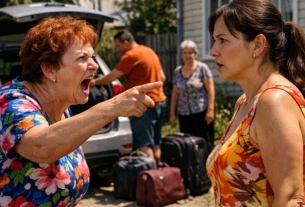
“Do you hear how he’s talking?! He’s throwing us out!”
“I haven’t even shown you out yet. You walked in on your own.”
“My daughter lives here! My daughter!”
“Your daughter lives here with her husband. That husband is me. And surprisingly enough, I also get a vote in my own hallway.”
She drew in a breath and began speaking louder and faster, her voice breaking.
“We are one family! We’re supposed to support each other! And you’re standing here painting walls and looking down your nose at us! Are you really going to begrudge us one corner? One corner?!”
“I resent your method. You’ve had the same method for thirty years: first you present people with a done deal, then you pressure them with guilt, and then you accuse them,” Artyom said.
“What done deal?! I’m her mother!”
“Wonderful. Then let’s talk like a mother and son-in-law. Family to family. Simple.”
He stepped forward calmly, without aggression.
“One question.”
“Where is the money from Grandfather’s house?”
The room went silent.
“What kind of interrogation is this?” she managed.
“Not an interrogation. A balance-sheet clarification. Polina gave up her share because you asked her to. You said, ‘When you get married, I’ll give it back.’ She got married. Five years ago. Where’s the money?”
“That’s none of your business!”
“It became my business on our wedding day. I’m that rare kind of son-in-law who reads not only the menu, but also the family agreements.”
“The money is long gone!” she shouted. “Life is expensive!”
“Excellent. Answer received. Although, to be fair, I didn’t actually need it. I already knew.”
Artyom raised one hand and calmly made the Russian “fig” gesture with his fingers.
“This is exactly how much Polina received from her inheritance. Exactly this much. Back then, you showed her this with words. I’m showing it to you visually now. Symmetry.”
Zhanna gasped.
“You… you’re giving us the fig?!”
“I’m displaying a family heirloom. Apparently, it gets passed down in your family more reliably than real estate.”
His mother-in-law lurched toward the table and planted both palms on it.
“You’re greedy! You’re cruel! You have a house and half an acre of land while your wife’s mother is going to live in a shed!”
“My wife’s mother is going to live wherever my wife’s mother chose to buy property. You’re an adult. You sold an apartment, chose a property, signed a contract—and not one of you, not one living soul, asked me, ‘Artyom, can you support two extra people for four months?’ I was added to this arrangement retroactively, without my signature and without anyone having the decency to ask.”
“We would pay for electricity!”
“Everyone pays for electricity. Even people who didn’t take their daughter’s money.”
Part Four
His mother-in-law looked around and suddenly realized that Polina was no longer in the room.
“Polya!” she called. “Polina! Come here immediately!”
Silence.
“Polina! Your mother is calling you!”
But Polina was standing behind the storage-room door, surrounded by buckets and paint rollers, one hand pressed to her mouth.
She understood that hiding was not exactly the noblest approach.
But she understood something else too: if she came out, the old game would begin again—the game where her mother spoke and the daughter somehow ended up guilty.
So she let her husband do exactly what he had once asked her to let him do.
Just once.
Calmly.
All the way through.
“She can’t hear you,” Artyom said. “Actually, she can. She’s just developed immunity. Acquired immunity. Five years in the making.”
“You turned her against me!”
“I protected her. Huge difference…” He smirked. “Actually, let me put it differently. I simply stopped pretending robbery is a family tradition.”
“How dare you!” Zhanna screamed. “We’re going to be left outside! We don’t have a roof!”
“Exactly. You don’t have a roof. And that, incidentally, is the most honest sentence anyone has spoken this evening.”
“You’re a monster! You’re heartless! Polina, can you hear what kind of man you married?!”
Zhanna drew in a huge breath and screamed so loudly that the glass in the newly installed window rattled.
Artyom picked up the pitcher of water from the table and poured it over her head.
Calmly, as though watering a flowerbed.
The screaming stopped.
Water ran through her hair, down her shoulders, and onto the bag she was holding.
“Calmer now?” he asked evenly. “People don’t scream in my house. People don’t make demands in my house. People don’t humiliate others in my house. Three rules, and you managed to break all three in ten minutes. Settlement record.”
“You… you…” Zhanna gasped for air.
“It’s summer. You’ll dry. Now get out. Not tomorrow morning. Not after dinner. Now.”
“We’re not going anywhere!” Valentina Igorevna shrieked.
“You are. You’re grown adults. You bought an unfinished house, which means you must have calculated everything. I wasn’t involved in those calculations with a single ruble, signature, or piece of advice. Good luck with the construction.”
He opened the door and held it for them.
“The gate is to the right. The road is straight, and the streetlights are on. If you need the number for a construction crew, I’ll give you one. Free of charge. That’s the only help I can offer.”
Valentina Igorevna walked past him with her chin raised.
At the threshold, she turned.
“You’ll reg—”
“I wouldn’t,” Artyom interrupted mildly. “I’ve heard that sentence three times in my life, and every single time it was followed by something good.”
The door closed.
Part Five
They walked the first hundred meters in silence.
Then Zhanna jerked her wet shoulder.
“How could he do that? He just threw us out! Like dogs!”
“He’s always been like that,” Valentina Igorevna hissed. “Calculating.”
“And Polina?! She didn’t even come out! She hid, can you imagine? Her own sister! Left us alone with that…”
“Spineless little thing. Coward. She’s always been like that.”
They reached the bend.
There, in the darkness, stood the gray shell of a building with no roof, the night sky visible through its openings.
Beside it was a metal shed with one door and one small window.
“We’re going to stay here?” Zhanna stopped. “There’s no water. No electricity!”
“It’s summer. We can manage.”
“And in winter?!”
“Don’t start.”
Zhanna turned sharply toward her mother.
“Listen. When are you going to give me my money from Grandpa’s house? I gave up my share too. I signed too. You promised me as well.”
“What money?!” Valentina Igorevna raised her voice. “It’s all gone! Living expenses, you, your ex-husband, renovations! There is no money! We need a loan, and they won’t give one to me at my age!”
“So you cheated both of us…”
“I raised both of you!”
She caught her breath, then suddenly spoke almost calmly.
“Polina has a house. Half an acre of land. That means she has money. She should give us some.”
“Artyom won’t let her.”
“Artyom won’t let her,” she agreed. “Greedy, cruel man. And Polina is the one who’s most at fault. Some daughter she is. Wouldn’t even defend her own mother and sister.”
They entered the shed and switched on the flashlight on a phone.
The beam illuminated a wall, a shovel, and a stack of bricks.
There were three months left until cold weather.
And three million rubles between them and a roof.
Artyom opened the storage-room door.
Polina stood among the buckets, upright and pale, her eyes dry.
“Are they gone?” she asked.
“They’re gone. Zhanna is slightly damp, but summer is long.”
“You poured water over her?”
“One pitcher. Exactly one pitcher. The fire department would have approved. I extinguished the source of combustion before it could spread.”
Polina snorted, then immediately covered her mouth.
“Artyom, I hid. I ran away from my own mother and stood in here like… like a paint roller in the corner.”
“You didn’t run away. You followed our agreement. We decided this before we even got married, remember? You step aside, I do the talking.”
“She’ll never forgive me.”
“She never forgave you for having an inheritance either.” He shrugged. “You know, some people have a one-way system for forgiveness. The only person they ever forgive is themselves.”
Polina stepped out of the storage room, hugged him, and rested her forehead against the shoulder that was still dusty from the construction mix.
“I was afraid you’d agree. Just to be polite.”
“Politeness is a wonderful thing. But it has a limit, and that limit runs exactly along my doorstep.”
“I was afraid you’d start yelling. Or that you’d do the opposite and just cave in.”
“Yelling is bad strategy,” Artyom said. “The one who starts shouting is already losing on points. And I’ve got nothing left to cave in with. I spent all of myself on primer.”
She raised her head.
“You didn’t actually refuse to help her. You refused to let them live here.”
“Exactly. And I refused to give them money. Let her build to her heart’s content. I’ll even recommend some contractors. But I’m not a sponsor for other people’s mistakes, and I don’t run the Family Inn.”
Polina took one step back and studied him carefully, as though checking something inside herself.
“I’m twenty-nine,” she said. “And I lost my inheritance.”
“You have a house, land, a loan, and me. Though, admittedly, I’m the only free item on that list.”
“You’re a rock.”
“A rock covered in tiles bought at the old price. Speaking of which…” He brightened. “I got porcelain tiles for the porch. The gray ones, with the veins. And primer for painting, and profiles for the window slopes. Tomorrow we’ll start with the far room.”
“Hold on,” Polina said. “Dinner first. I promised myself we were having a proper dinner tonight, no matter what happened.”
“Then let’s go. But fair warning: I’m cutting the vegetables, and you’re supervising. You’re better at that.”
They walked into the far end of the house, where boards and a stepladder stood beneath a hanging light.
Polina switched on the light, took out a pot, and Artyom began washing peppers.
“You know what’s strange?” she said a minute later. “All my life, I thought I didn’t know how to say no. Like maybe I just… didn’t have it in me.”
“You do. You just didn’t have a reason before. It’s not like you spent years deliberately enduring it. You were hoping the person would come to her senses.”
“She didn’t.”
“Then the hope is closed, the subject is exhausted. Forget it. Don’t carry around things that won’t fit in your pocket.”
Polina smiled and began chopping onions.
“Artyom.”
“Mm?”
“If she calls and asks for help finding a construction crew…”
“I’ll help. Phone numbers, advice, even my own hands on a weekend. No money and no keys.”
“And if she starts yelling?”
“I’ll let her finish, then hang up. We’re peaceful people. We just have clearly defined property boundaries. Half an acre, remember? Anything beyond the fence is not our territory.”
She nodded.
Outside the walls, the evening was warm. Somewhere down the street, a bicycle rolled past, and the house suddenly became very peaceful—the particular kind of peace that comes after an unpleasant conversation has finally happened and is no longer hanging over your head.
Half an hour later, they sat down to dinner among the half-painted walls.
Polina caught herself thinking that she had been lucky in a strange but very precise way: she had no inheritance, but she did have someone who didn’t raise his voice, didn’t abandon his own people, and knew how to stop someone else’s performance with a single pitcher of water.
And farther down the street, beyond the bend, a phone flashlight glowed inside a metal shed while two women calculated how much a roof would cost.