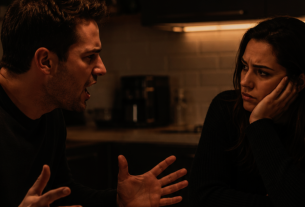
— Going off to another woman? Then take your mother with you too, — Lyudmila asked quietly, and the suitcase opened again.
The entrance door slammed shut behind her, the elevator gave a weary sigh and started upward, and all the way to the seventh floor Lyudmila smiled at her reflection in the metal wall. Three weeks traveling with a mobile planetarium through small towns, three weeks of collapsible domes, children whispering “wow!” in the darkness, and hotels with towels the size of handkerchiefs. At home, her own bed and her own peace and quiet were waiting for her. The key turned smoothly, as though the apartment had missed her too.
Tamara Ivanovna, the downstairs neighbor, was standing in the hallway, already wearing her coat and holding her bag.
— Lyudochka! You’re back! The two of us were just finishing that series — season four, can you imagine?
— Tamara Ivanovna, you’re my personal miracle, — Lyudmila said, setting her suitcase against the wall. — Keeping someone entertained for three weeks is a heroic feat. They should give medals for that. Here, take these. I brought them for you. Traditional printed gingerbread — there’s so much mint in them you’ll be breathing freely for a week.
— Oh, you shouldn’t have…
— I should. Kindness has to be repaid on time. Otherwise it spoils, like milk.
Tamara Ivanovna laughed and left, while Lyudmila’s mother-in-law, Nina Pavlovna, peered out from deeper inside the apartment. She was wearing a robe, her glasses pushed up onto her forehead, and she looked as though she had spent the entire time guarding the front door. She had been living there for two years now, in the back room with the balcony, and Lyudmila had never once made her feel like a guest. Not once — because Lyudmila didn’t know how to silently endure things and accumulate resentment. If something bothered her, she said so immediately, calmly, and completely.
— You’re back, Lyuda. Hungry? I’ll heat up dinner. There’s some stew.
— Hungry as a bear in spring. Just let me wash my hands and change first. I’ve been wearing this jacket so long, I think we’ve become related.
She pulled off her boots, rolled her shoulders, and went into the bedroom. Jeans into the laundry, a sweater over her shoulders, hair tied back into a ponytail. From deeper inside the apartment came the clatter of a pot lid and the low murmur of the television.
— So tell me, Nina Pavlovna, what’s new around here? — she called through the hallway. — The world hasn’t collapsed? The neighbors haven’t all married each other?
— Nothing new. It’s been quiet.
— And where’s Artyom? I texted him three times, and all I got back was a heart emoji and “busy.”
Nina Pavlovna fell silent.
For far too long for someone who had just said that “everything was quiet.”
— He brought groceries yesterday. Milk, eggs, that cheese you like, the one with the holes. Put everything down and left.
— Put everything down and left, — Lyudmila repeated as she stepped into the hallway. — Lovely. A delivery courier and a son all rolled into one.
— Lyuda, don’t be angry with him.
Continued in the comments.
The entrance door slammed shut behind her, the elevator sighed and started upward, and all the way to the seventh floor, Lyudmila smiled at her reflection in the metal wall. Three weeks traveling with a mobile planetarium through small towns—three weeks of collapsible domes, children whispering “wow!” in the darkness, and hotels with towels the size of handkerchiefs. At home, her own bed and her own quiet were waiting for her. The key turned smoothly, as though the apartment had missed her too.
Tamara Ivanovna, the downstairs neighbor, was standing in the hallway, already wearing her coat and holding her bag.
“Lyudochka! You’re back! The two of us were just finishing that series—the fourth season, can you imagine?”
image
“Tamara Ivanovna, you’re my personal miracle,” Lyudmila said, setting her suitcase against the wall. “Keeping someone entertained for three weeks is heroic. They should give medals for that. Here, I brought you something. Traditional gingerbread—there’s so much mint in it you’ll be breathing freely for a week.”
“Oh, you shouldn’t have…”
“I should. Kindness has to be repaid on time. Otherwise it goes bad, like milk.”
Tamara Ivanovna laughed and left. From deeper inside the apartment, Lyudmila’s mother-in-law, Nina Pavlovna, appeared in a bathrobe, her glasses pushed up onto her forehead. She looked as if she had spent the entire time keeping watch on the front door.
She had been living there for two years, in the back room with the balcony, and Lyudmila had never once made her feel like a guest. Not once—because Lyudmila didn’t know how to silently endure things and accumulate resentment. If something bothered her, she said so immediately, calmly, and completely.
“You’re back, Lyuda. Hungry? I’ll heat up dinner. There’s stew.”
“Hungry as a bear in spring. Let me wash my hands and change first. I’ve practically merged with this jacket.”
She pulled off her boots, rolled her shoulders, and headed for the bedroom. Jeans into the laundry, sweater on, hair tied back in a ponytail. From the depths of the apartment came the clatter of a pot lid and the murmur of the television.
“So tell me, Nina Pavlovna, what’s new around here?” she called through the hallway. “The world hasn’t collapsed? The neighbors haven’t all married each other?”
“Nothing new. It’s been quiet.”
“And where’s Artyom? I texted him three times. All I got was a heart and ‘busy.’”
Nina Pavlovna was silent.
Far too silent for someone who had just said everything was quiet.
“He brought groceries yesterday. Milk, eggs, that cheese you like, the one with the holes. Put everything down and left.”
“Put it down and left,” Lyudmila repeated as she came into the hallway. “Lovely. A delivery boy and a son all in one.”
“Lyuda, don’t be angry with him.”
“I’m not angry. I’m surprised.”
A key scraped in the lock, and Artyom came in—jacket hanging open, phone in hand, his gaze directed somewhere past them. He always entered like that when something was boiling inside him: broadly, noisily, as if claiming space in advance.
“Oh, you’re back. How was the business trip?”
“The dome didn’t blow away, no children got lost, and I’m alive. How are you?”
“Fine.” He glanced at his mother. “Could you… go to your room? We need to talk.”
Nina Pavlovna nodded silently and went away, closing the door behind her.
Lyudmila watched her leave, then turned to her husband.
“‘Talk’ is something two people do. ‘Talk’ after removing the audience sounds more like an announcement.”
“Lyuda, don’t start.”
“I haven’t started anything. I’ve barely taken my shoes off.”
The doorbell rang so cheerfully and at such a bad moment that both of them flinched.
Dina and her husband Slavik stood outside, their cheeks pink from the cold, carrying a box with a cake. Their faces gave away the news before they even spoke.
“We’re only here for three minutes!” Dina announced. “Slav, you tell her.”
“We’re expecting,” Slavik said solemnly. “Well, she’s expecting. I’m expecting beside her.”
Lyudmila shrieked so loudly that the glassware in the cabinet rattled, then threw her arms around her friend.
“Dina! Dinaaa! For twelve years you’ve been telling me children are noisy! And now?”
“And now I say noisy is wonderful,” Dina laughed, wiping her eyes. “Just don’t start crying or I will too.”
Artyom stood in the kitchen doorway, smiling politely and drumming his fingers against the frame. He congratulated them, shook Slavik’s hand, even made a joke about baby names.
And for the entire hour, he sat in the corner of the sofa, staring at the phone lying on his knee as its screen lit up again and again.
Dina and Slavik left shortly after eight, leaving a half-eaten cake streaked with raspberry filling on the table.
Lyudmila gathered the cups, straightened up, and headed toward the hallway.
“I’ll call Nina Pavlovna. I’ll cut her a piece. She loves raspberries.”
“Wait.” Artyom blocked her path. “We need to talk.”
“Again? You’re like a doorbell today: one button, one phrase.”
“Lyuda, sit down.”
She sat. Then, without taking her eyes off him, she reached toward the shelf beside the spices, where a little bottle stood—the calming drops Nina Pavlovna took every night, twenty drops at a time.
“All right, equipment prepared,” Lyudmila said, putting the bottle in the middle of the table. “Go ahead. But I’m warning you in advance: if you’re about to complain that you feel cramped, we have forty-two square meters. Everyone feels cramped here. I even sympathize with the refrigerator.”
“Stop clowning around!” His voice jumped upward. “I filed for divorce.”
The silence lasted only a moment.
Lyudmila didn’t gasp. She didn’t cry. She didn’t ask him to repeat himself.
She picked up her phone, opened the app, scrolled down—and there it was, displayed neatly in a white box.
The application.
Date filed: Tuesday.
Three days ago.
While she had been standing in the gymnasium of a provincial school, showing third-graders the rings of Saturn.
“You have to understand, I’ve been thinking about this for a long time,” Artyom was saying somewhere off to the side. “We’ve become strangers. You’re always traveling. I’m tired of living with someone who’s never here…”
She stared at the screen, but something entirely different was playing in her mind.
The two of them eight years ago, hauling a sofa up to the fifth floor in a building with no elevator and laughing on the landing between floors.
The way he used to get up at six in the morning to drive her to the train station.
The way they danced in the kitchen to the radio because back then the radio was practically the only piece of technology they owned.
“Are you even listening to me?” Artyom asked irritably, raising his voice.
“I am. I just had a movie playing in my head. A good old one. The credits have already started rolling.”
She wasn’t going to lie to herself: the cracks had been there for a long time.
Six months of short replies. Six months of “busy.” Six months of seeing his back instead of his face.
But this—a divorce application, a date, Tuesday—she hadn’t expected.
Nina Pavlovna appeared in the doorway. Her eyes found the cake first, then her son, then Lyudmila.
“You had guests? I heard voices. What was the occasion?”
“Two occasions, Nina Pavlovna. Dina is pregnant—that’s the first. And a minute ago your son announced that he filed for divorce. That’s the second.”
Her mother-in-law dropped onto a stool as though someone had cut the strength from her legs.
Artyom jerked.
“Lyuda, why would you tell her…”
Lyudmila put her phone on the table with the screen facing her husband.
Her finger slid across the button.
“Watch carefully. Here’s your application. And here’s my consent. I’m not going to beg you. You’re thirty-nine years old. It’s a considered decision. You’ve been sitting on it for three days like kombucha. That’s it. We’re getting divorced. Your suitcase is in the storage closet. The door is over there. Pull the handle toward you.”
“You…” Artyom choked. “You’re not even going to ask why?!”
“You’ve already answered me. Three times tonight: ‘talk,’ ‘talk,’ ‘talk.’ I heard you.”
She stood, turned on the stove, poured some milk into a saucepan, added a spoonful of cocoa, and while it heated, cut Nina Pavlovna a piece of cake—the biggest one, with the raspberry stripe.
“Eat. Today is a double celebration. I’m genuinely happy for Dina. As for Artyom, I’m happy out of politeness—but sincerely polite.”
“How…” Nina Pavlovna finally found her voice, looking from one to the other. “How did this happen? What have you done? Children, what have you done?”
“Mom, it’s better this way,” Artyom said quickly. “Better for everyone. We haven’t really been living for a long time. We’ve just been existing.”
“‘Existing’ is when you smile at your phone at midnight,” Lyudmila remarked. “By the way, I never once looked through it. Respect is inconvenient that way.”
“Don’t start!”
“Your gray suitcase is in the storage closet on the left, behind the vacuum cleaner. Don’t touch mine. I’ll still need it. I have three cities in April.”
Artyom stormed out of the kitchen.
Nina Pavlovna stared at her daughter-in-law, her lips moving soundlessly.
Two years—not one scandal, not one reproach. A separate room with a balcony. Medications purchased from a list. Doctors booked by appointment.
Lyudmila sat silently for about five minutes, growing angry.
Not at him.
At herself.
For six months she had seen his back and stayed silent, when she should have taken him by the shoulders and demanded a conversation. Maybe the man had been going through a crisis. Maybe something terrible had happened. Maybe he had been afraid.
She hadn’t demanded anything.
And then she had accepted the divorce in nine seconds.
From the bedroom came the creak of closet doors and the rustle of hangers.
Lyudmila stood, opened the cabinet beneath the sink, pulled out a roll of garbage bags—thick blue sixty-liter bags—and walked into the bedroom.
The bags landed softly on the bed, on top of a stack of his shirts.
“I’ll fit everything into the suitcase,” Artyom muttered without turning around. “I’ll get the rest later. Stop being rude.”
“They’re not for you. They’re for your mother’s things.”
He straightened so abruptly that a hanger clattered.
“What?..”
“You filed for divorce. Which means exactly ten minutes ago Nina Pavlovna became a stranger to me. A good, kind stranger, but a stranger nonetheless. Take her with you.”
Author: Vika Trel © 5527
“You… have you lost your mind?! She’s lived here for two years!”
“She lived with her son’s wife. Her son no longer has a wife. Position closed. The logic is as simple as a nail.”
The expression on his face was so extraordinary that Lyudmila couldn’t help snorting.
“What, did you seriously think you could leave your mother with me? You’d run off to another woman while I stayed here counting out her twenty drops every night? By the way, who is she? At least tell me her name so I can put it on the congratulations card.”
“None of your business!”
“Not anymore, I agree. But the bags are still blue.”
His phone chimed in his pocket. Artyom grabbed it like a drowning man grabbing a lifeline.
“There,” Lyudmila nodded. “The instructions have arrived. Read carefully. I’m sure it says something like, ‘Darling, I’ve taken care of everything.’ Just keep one thing in mind: your mother leaves here with you.”
“Will you shut up!” he shouted so loudly that the glass in the wardrobe door trembled.
The slap cracked sharply through the room.
Lyudmila lowered her hand and said in a perfectly even voice:
“Don’t shout. The neighbors have a one-and-a-half-year-old child behind that wall. If you want to yell, go into the stairwell. The acoustics are better there.”
Artyom stood with one hand pressed to his cheek and still didn’t look at his phone screen.
He already knew the message was from Veronika.
She was, after all, the reason this whole mess had started.
Lyudmila returned to the kitchen.
Nina Pavlovna sat with her head lowered, crumpling a napkin between her fingers.
Lyudmila felt sorry for her—truly sorry, without any theatrics.
Two years earlier, Nina Pavlovna had sold her apartment and given all the money to her daughter, Alisa, who had just given birth to twins. Alisa lived in another city and had sworn:
“Mom, two years, and we’ll buy you a little one-bedroom apartment. I promise.”
That was when Lyudmila had said:
“Let her live with us.”
Two years had passed.
The one-bedroom apartment didn’t even exist as a sketch on paper.
“Lyuda…” Nina Pavlovna looked up. “I understand everything. I’m nobody to you now.”
“You’re not nobody to me. You’re a person I shared a bathroom with for twenty-four months without us having a single argument. That’s rare. Medal-worthy.”
“Give me one day. Two. I’ll sort something out. I’ll call Alisa, I’ll…”
Artyom appeared in the doorway, suitcase in hand.
“My mother isn’t going anywhere! She’s staying here, period! She has a heart condition. She can’t be dragged from place to place!”
Nina Pavlovna stood.
She walked over to her son.
And slapped him across the face—short and sharp, hard enough that his shoulder struck the wall and his lip split, leaving a small red spot on his chin.
“Don’t you dare leave me somewhere I’m no longer wanted,” she said quietly. “Shameful.”
Then she returned to her room and carefully closed the door behind her.
Artyom wiped his lip with the back of his hand and stared at Lyudmila as though she had been the one who hit him.
“Happy now?”
“Not particularly. Sit down. Let’s calculate. Renting a one-bedroom apartment in your neighborhood costs thirty thousand. Add medication and food—another twenty. That’s fifty thousand a month. Three months in advance makes one hundred and fifty thousand. That’s for supporting your mother. After that, you handle it yourself. You’re a grown man. You’ve clearly got plans and inspiration.”
“You’re trying to milk me for money?!”
“I’m presenting you with a bill. For two years I fed her, drove her to doctors, bought her medicine, and never once asked you for a kopeck. Consider the charity foundation named after me officially closed as of today.”
Artyom yanked a bundle of cash from his inside pocket and threw it onto the table without counting it. The banknotes scattered into a fan.
“Choke on it!”
“Thank you. I’ll be careful.”
Lyudmila gathered the money into a neat stack and weighted it down with the salt shaker.
“And remember: today is Friday. By Monday at nine in the morning, your mother must no longer be living in this apartment. Otherwise on Tuesday I’ll personally deliver her to your girlfriend’s address. I’ll find the address. I’ve had three weeks of practice navigating unfamiliar towns.”
He opened his mouth, said nothing, grabbed the suitcase, and walked out, leaving the door wide open.
Lyudmila closed it herself and turned the lock.
Outside, it was cold and deserted.
Artyom put his suitcase down on the pavement, unlocked his phone, and finally read the message.
“Tyom, hi. I got carried away. My husband and I talked, and I’m staying with him. Please don’t be angry. This will be better for everyone. Let’s stop seeing each other. Veronika.”
He read it again.
For those words, he had filed for divorce on Tuesday.
For those words, he had sent his mother away from the table, raised his voice in his own apartment, and been slapped twice in one evening.
“One hour,” he whispered into the darkness. “You couldn’t have sent it one hour earlier. Just one hour!”
He cursed Veronika and her “better for everyone.”
He cursed his wife, who hadn’t cried, hadn’t grabbed his sleeve, hadn’t said, “Let’s think about this,” but had simply pressed the consent button and pointed him toward the storage closet.
He cursed himself—the idiot who had slammed the door in a fit of emotion.
His phone vibrated.
Alisa.
“Listen to me,” he began immediately. “I’m not bringing Mom to you. You’ve got the twins, I understand, but…”
“You understand correctly,” his sister cut him off. “I haven’t been saving any money for an apartment. We have a mortgage and renovations. You’re the one who decided to get divorced, so deal with it yourself. And you know what, Tyom? You should be ashamed.”
The line went dead.
So Lyudmila had already called her.
Of course she had.
She always did everything immediately, without hesitation, and right now it made him want to howl.
“Why did she have to get involved?” he thought, while understanding perfectly well how idiotic the question was.
He stood beneath the streetlamp with the suitcase beside his leg and took inventory.
No girlfriend—she had written, “Let’s stop seeing each other.”
No wife—there was only her consent in the app.
No sister—only a disconnected call.
And in his former wife’s apartment waited the mother he had suggested leaving behind like a piece of furniture.
For a moment he considered going back, ringing the bell, and saying, “I acted rashly.”
Then he remembered the sharp slap and the way Lyudmila’s voice had remained completely steady, without a single trembling note.
Go back, and you’ll probably be flying down the stairs along with your suitcase—and Lyudmila will politely hold the door open for you.
His phone chimed again.
Kostya, an old friend.
“Heard your wife threw you out. Come over. You can stay a couple of days, but the sofa squeaks.”
Artyom smiled despite his split lip.
It was the first and only piece of good news in that entire nightmarish evening. 🧳
And upstairs, in the seventh-floor apartment, Lyudmila cut another slice of cake, placed the plate outside the door of the back room, and said quietly:
“Nina Pavlovna, come out. We’ll figure out where you’re going to live. But it has to have a balcony—you’ve gotten used to the good life.”