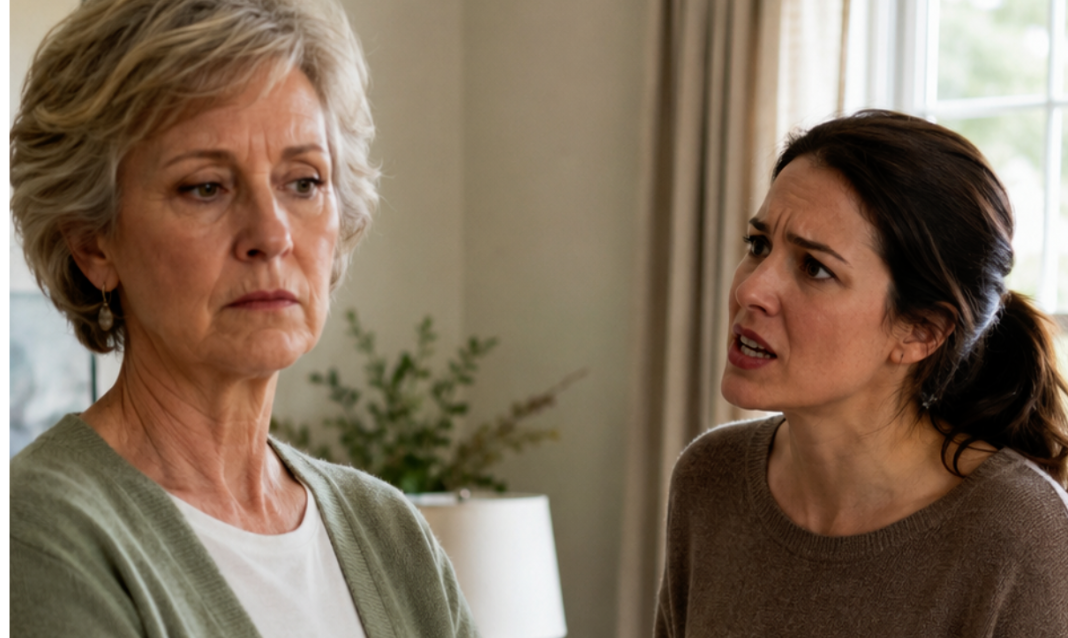
Do you even understand what you’ve done?! We already promised the children a trip to the seaside! They’ve been waiting for this all year!” her daughter-in-law shouted into the phone.
Valentina Petrovna moved the phone away from her ear and looked in bewilderment at the photograph of her husband standing on the dresser. Pyotr gazed calmly and slightly mockingly from the picture, as though saying, “See? I warned you.”
“Forgive me, Kristina, but what does this have to do with me?”
“Everything! Because without your money, we can’t go anywhere now! You’ve ruined our entire budget!”
Her voice rang with indignation—genuine and unclouded, like that of someone who truly believed she had been treated unfairly.
The woman slowly lowered herself onto a chair. She sat motionless, holding the phone in front of her while Kristina continued talking. The words seemed to come from somewhere far away and gradually lost their meaning. Apparently, her monthly financial help had long since stopped being a gratefully accepted gift and had turned into a mandatory source of income for someone else’s family.
For more than thirty years, Valentina Petrovna had worked as a neurologist at the city hospital. She loved her work with the quiet, familiar affection that required no explanation—the way people love their childhood home or the smell of old books.
After her husband died three years earlier, work had become her salvation as well. As long as there were patients, rounds, and night shifts, there was no time to think about the emptiness waiting for her at home. Her colleagues gently hinted that perhaps it was time for her to rest, but she always waved them off.
“Valentina Petrovna, how long can you keep doing this?” the head nurse, Nina Vasilyevna, once asked after finding her buried in paperwork at half past eight in the evening. “You didn’t even stay this late when you were young.”
“When I was young, I had less free time,” she joked.
Her son Maxim lived his own life. Seven years earlier, he had taken out a mortgage on a three-bedroom apartment in a newly developed district, and his mother herself had offered to help.
“Mom, that’s a lot of money,” he had said awkwardly at the time.
“It is. But I have it, and you have small children.”
At first, they were one-time transfers: money for the down payment, then for renovating the children’s room, then for a sofa and wardrobes. Later, almost without anyone noticing, her help became monthly—twenty thousand rubles every month, quietly and without discussion.
Whenever they met, Kristina would press a hand to her heart.
“Valentina Petrovna, we’re so grateful. As soon as we get back on our feet, we’ll pay you back.”
Valentina Petrovna would only smile and say there was no need to return anything. Seven years passed. Gradually, all talk of “getting back on their feet” disappeared on its own, the way promises disappear when no one ever intended to keep them.
Sometimes Valentina Petrovna noticed that Maxim had replaced his phone with an expensive new model. Kristina posted photographs from Turkish resorts online. The children wore fashionable branded sneakers. She kept telling herself that it was none of her business to count other people’s money. That she was helping her grandchildren. That it was the right thing to do.
Everything changed on an ordinary Tuesday in February.
After a night shift, as Valentina Petrovna was climbing the stairs to the doctors’ room, her vision suddenly went dark. She managed to grab the handrail before sinking onto a step. A young intern rushed over and called the others.
Her blood pressure was 200 over 110.
They laid her down on an examination couch and gave her medication. An hour later, Andrei Semyonovich arrived—a cardiologist who had worked alongside her for twenty years.
He sat down beside her, remained silent for a moment, and then spoke quietly but firmly.
“You’re sixty-five. You earned the right to live peacefully a long time ago. Why do you keep pushing yourself like this?”
“I’m not bored here,” she replied automatically.
“This isn’t about boredom, Valentina.” He looked at her over his glasses. “You only get one heart.”
At home, in the silence of her apartment, she took out a notebook and, for the first time, calculated everything honestly. Her pension, modest savings, and lack of debt meant she had more than enough to live on.
But only if she stopped giving away twenty thousand rubles every month.
For several weeks, she lived with that thought like a splinter under her skin. She felt ashamed. It frightened her to admit, even to herself, that she was tired—not of work, but of feeling that people saw her as a source of money rather than as a person.
In April, she called Maxim.
“I’ve decided to retire in the autumn,” she told him. “I wanted you to know in advance.”
Her son was silent for a second.
“Well, if it’s becoming difficult for you, then of course you should rest,” he said evenly, without any concern in his voice.
At the time, she thought the conversation had gone well.
At the beginning of June, Valentina Petrovna submitted her resignation papers. She left the chief physician’s office feeling unexpectedly light, as though she had finally taken something heavy and long familiar off her shoulders.
That same evening, her phone rang. The screen displayed: “Kristina.”
“Good evening, Valentina Petrovna.” Her daughter-in-law’s voice sounded deliberately polite, almost formal. “I heard you submitted your paperwork?”
“Yes. Today.”
“I see.” A pause. “And that means the transfers will stop too?”
“Yes, Kristina. I’ll have less money once I’m retired.”
The politeness disappeared from Kristina’s voice instantly.
It turned out that the family had already paid a deposit for their summer vacation back in March. The seaside, the hotel, excursions, an amusement park—they had already promised everything to the children. And, as Valentina Petrovna suddenly discovered, their household budget for the entire coming year had been drawn up on the assumption that her monthly transfers would continue.
“We were counting on that money!” Kristina protested. “Couldn’t you have warned us earlier?!”
“I warned Maxim several months ago,” Valentina Petrovna replied quietly.
“But we thought you would change your mind!”
She lowered the phone onto her knee and looked out the window. Beyond the glass, a quiet summer evening was fading away.
It was at that moment that everything finally fell into place.
Not suddenly, not like a blow, but slowly and inevitably, like a diagnosis she had suspected for a long time but had refused to say aloud.
Her help had never been treated as a gift.
It had become an obligation.
No one had simply bothered to tell her.
After her conversation with Kristina, Valentina Petrovna spent several days feeling unlike herself. Something kept troubling her—not resentment, but the desire to finally see the truth she had avoided for so long.
On Friday, she called her son and asked to meet.
“Maxim, I want you to show me your family expenses honestly.”
He hesitated.
“Why do you need to see them, Mom?”
“Because I’ve been transferring money to you for seven years, and I don’t know where it has been going.”
They met at his apartment. Kristina wasn’t there—she had gone to visit a friend with the children. Maxim opened his laptop and reluctantly turned the spreadsheet toward her. He remained silent while his mother studied the figures.
What she saw surprised her.
The mortgage had not been a burden for a long time. Both Maxim and Kristina earned good salaries, and they had been steadily paying the loan off ahead of schedule.
The twenty thousand rubles went toward other things: regular food deliveries, streaming subscriptions, new phones every year and a half, summer vacations and winter holidays.
Then she saw a separate line in the spreadsheet:
“Mom’s support — 20,000.”
Not “possible support.”
Not “gift.”
Simply income.
Permanent, planned, taken for granted.’
Maxim looked away.
Valentina Petrovna closed the laptop.
The room became very quiet.
“I helped you because I loved you,” she said calmly. “But I’m not going to finance the lifestyle you’ve become accustomed to anymore.”
Her son said nothing.
Perhaps that silence was the most eloquent answer of all.
The following weeks were tense.
Kristina almost stopped calling. On the rare occasions when Valentina Petrovna sent her a message, Kristina replied briefly and coldly, as though Valentina Petrovna were not her mother-in-law but a near-stranger who had accidentally offended her while standing in line somewhere.
Maxim called more often. One day, carefully choosing his words, he said:
“Mom, could you at least keep sending the money for another couple of months? Just until we adjust.”
“You’re a grown man with a good salary,” she replied gently but firmly. “You’ll manage.”
“But the children aren’t to blame.”
“The children will still have food and clothes. They simply won’t get a new amusement park this summer.”
He sighed and hung up.
Valentina Petrovna retired in September.
For the first time in her life, she spent money entirely on herself.
She booked a three-week stay at a health resort in Kislovodsk, complete with treatments and quiet evenings on the veranda. She replaced the collapsing sofa she had tolerated for nearly ten years. She bought a tour of Russia’s Golden Ring—Suzdal, Vladimir, Yaroslavl.
She expected to feel guilty.
Instead, she felt something else—quiet, unfamiliar, and very much like relief.
The young family revised their plans. Instead of going to the seaside, they spent their vacation at a country resort outside Moscow. Kristina grumbled, but they managed.
No catastrophe occurred.
Life simply became a little more modest—exactly as modest as it should have been.
A year later, Valentina Petrovna was sitting in the garden at the family dacha—the same one she and Pyotr had bought when they were young.
The apple tree was in bloom. Her grandchildren, who had come for the weekend, were playing in the grass.
She looked different now.
Former colleagues who occasionally ran into her were surprised by how much she had changed. The exhaustion that had lived in her eyes for years was gone.
Maxim came over and sat beside her on the bench.
They were silent for a while.
Then, without looking at her, he said:
“You know, Mom… back then, we really had started thinking of your money as ours. I understand now how wrong that was.”
Valentina Petrovna didn’t say that she had been right and they had been wrong.
She simply placed her hand over his.
“The important thing is that you understand now.”
Her grandson ran up carrying an apple-tree branch and demanded their attention, and the conversation dissolved into laughter and the sounds of summer.
That evening, as Valentina Petrovna locked up the dacha, she caught herself thinking something she had never quite allowed herself to believe before:
Her pension belonged to her alone.
And that wasn’t selfishness.
It was fairness.
The quiet, long-overdue kind of fairness she had finally given herself permission to accept.