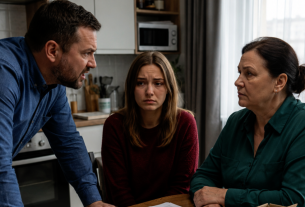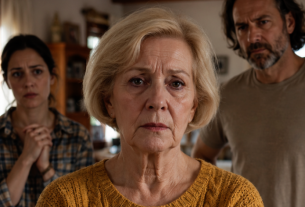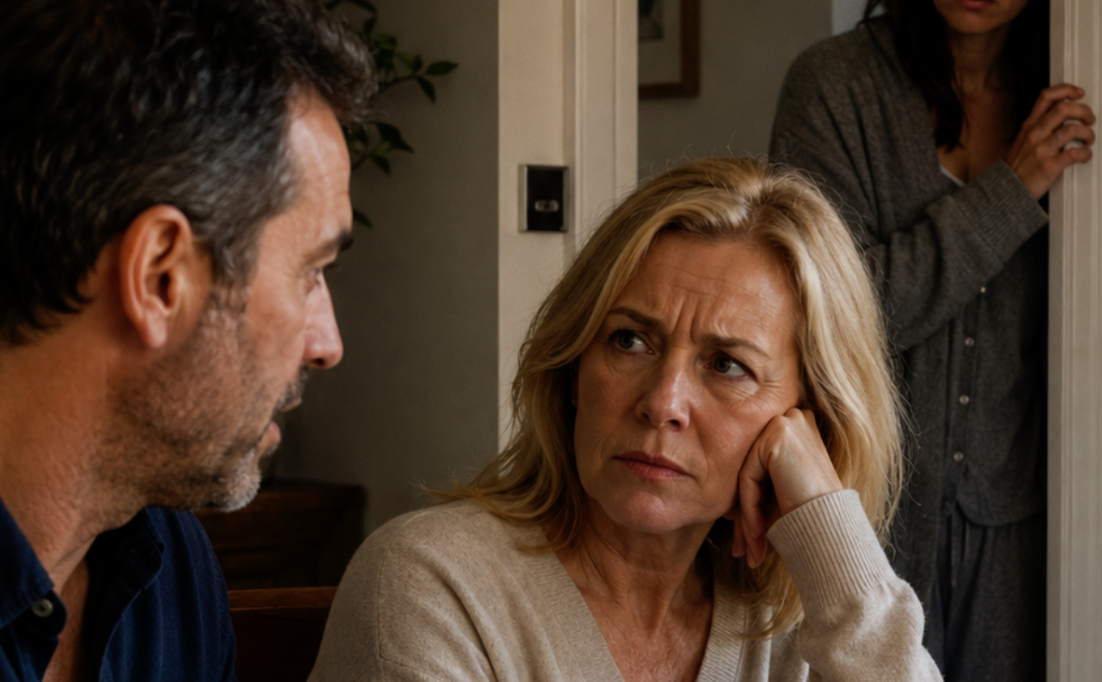
Yes, Mom, I’m still living there for now. What else can I do?” her husband’s voice drifted in from the kitchen. “The apartment is hers. But I’ve got nowhere else to move to right now. So I’m hanging on.”
Anna froze in the hallway with grocery bags in her hands. She had just come up the stairs instead of waiting for the elevator because she was in a hurry. Milk, bread, something for dinner. An ordinary Tuesday evening.
“Don’t worry,” Alexey continued, and there was laughter in his voice—light, casual, as though he were talking about something perfectly natural. “If it weren’t for the apartment, I would’ve left her a long time ago. You know that.”
Someone said something on the other end of the line. He laughed again.
The bag slipped from Anna’s hands and hit the floor with a dull thud. An apple rolled across the tiles. She didn’t move to pick it up.
For the first time in two years of marriage, she had heard something she was never supposed to hear.
Anna worked as a cost estimator for a construction company—calculating quantities, checking figures, and spotting things in projects that other people overlooked. Her colleagues respected her for her precision and because she never made the same mistake twice.
She had bought the apartment three years before meeting Alexey. It was a small two-room apartment in a newly built complex on the outskirts—not the most prestigious neighborhood, but it had fresh renovations and, most importantly, it was hers. She had spent her savings on it, money she had earned from evening side jobs, and part of the proceeds from selling her grandmother’s country house.
She met Alexey at a mutual friend’s birthday party. He was charming—he knew how to listen, how to make her laugh, and how to look at her as though she were the only person in the room. On their third date, he said:
“You know what I like most about you? You achieved everything on your own. That’s rare.”
Anna had felt something warm and genuine then. A year later, they got married.
After the wedding, Alexey registered his residence at her apartment. His explanation was simple:
“It’s more convenient—for work and for paperwork. You don’t mind, do you?”
She didn’t.
At first, they lived peacefully. Alexey worked, helped around the house, and seemed perfectly at home there.
But gradually, something began to change. Whenever she had the chance, her mother-in-law would say things like:
“An apartment is good. It gives you security. The important thing is that everything in the family is arranged properly. Lyosha is the kind of person who needs to feel that he has solid ground under his feet.”
Or:
“You already have everything—housing and stability. That’s rare these days. You have to protect it.”
Back then, Anna didn’t understand what was really behind those words. She only felt a faint uneasiness and pushed it away. At moments like that, Alexey would smile and say his mother simply liked using grand phrases.
Anna believed him.
Or desperately wanted to.
Anna didn’t sleep that night.
She lay beside her husband, listening to his steady breathing and going over the past few years in her mind, like rewatching an old movie when you already know how it ends.
Alexey had never invested any serious money in the apartment. The renovations, furniture, appliances—everything had either been bought before he came along or paid for with her money.
He always said he was saving for their future together, but that “future together” never materialized in the form of actual savings or concrete joint plans.
She remembered a conversation from the first year of their marriage. They had been sitting in the kitchen when Alexey, looking through some papers, suddenly asked:
“Listen, is the apartment definitely only yours? It isn’t considered joint property?”
“No. I bought it before we got married.”
He fell silent. Put the papers aside. He looked disappointed—not sad, but specifically disappointed, like someone who had just received unpleasant news.
“I see,” he had said.
Now Anna understood exactly what he had seen.
She kept replaying the words she had overheard: If it weren’t for the apartment, I would’ve left her a long time ago.
His voice had been quiet and matter-of-fact.
That casualness hurt more than anything else. There had been no guilt in it, no shame. Just a fact he was telling his mother as though it were completely normal.
Anna didn’t cry.
Inside her was something dense and cold—not hurt, not jealousy.
Humiliation.
She realized that all these years, to her husband, she might not have been a beloved woman at all.
She might simply have been a convenient solution.
On Friday evening, Alexey fell asleep earlier than usual.
Anna sat in the kitchen for a long time, listening to the silence of the apartment.
Her husband’s phone was lying on the table in the living room. He had forgotten to take it with him to charge it.
Anna stared at it for several minutes without moving.
Then she stood up.
She wasn’t looking for anything specific. She simply felt that she had to know the whole truth, no matter what it turned out to be.
The phone wasn’t locked. Alexey had never used a password, always saying that he had nothing to hide.
Anna opened the messenger app.
She found his chat with Dimka, an old friend he sometimes called. Standing by the window so the glow of the screen wouldn’t be visible from the bedroom, she silently scrolled through the messages.
She found what she was looking for quickly.
“She’s an okay woman, but honestly, I’m already tired of it. If the apartment were joint property, that would be a different story. But like this, I’m stuck either way.”
“Then why are you staying?” Dimka had asked.
“And where am I supposed to go? Rent somewhere? Have you seen the prices?”
Anna read the messages twice.
Then, without saying a word, she photographed the screen—one picture, then another, then a third.
She made sure the text was clearly visible.
Then she put the phone back exactly where it had been.
She returned to the kitchen and sat down.
Outside was a dark April street, a few scattered streetlights, and illuminated windows in the building across from hers.
She didn’t cry.
She simply sat there staring at one spot until everything she had never wanted to know finally fell into place.
On Friday, she called her friend Vika.
Vika was a lawyer and had always been straightforward.
They met in a small café near the metro station. Anna briefly told her everything.
Vika listened carefully without interrupting.
“The apartment is completely yours,” she finally said. “You bought it before the marriage, and it’s registered in your name. He has no claim to it, and apparently he understands that perfectly well himself. After the divorce, you can have his residence registration canceled through the court if he refuses to do it voluntarily.”
“And if he stalls?”
“You’re the owner,” Vika said, placing her hand over Anna’s. “The main thing is, don’t be afraid.”
Anna nodded.
She didn’t cry.
For the first time in several weeks, something inside her seemed to settle—not calm down exactly, but find solid ground.
They celebrated her mother-in-law’s birthday at her home.
There was a large table, plenty of food, and relatives from both sides of the family.
Anna sat quietly, barely touching the food on her plate.
A folder containing documents lay in her handbag.
After the toasts were over and everyone had settled into general conversation, her mother-in-law suddenly said with satisfaction:
“Alyosha, when are you and Anya finally going to do some proper renovations? The apartment is good, but it could be even better. Invest in it, invest in it—it belongs to both of you, after all.”
People around the table nodded approvingly. Someone added that young couples needed to build a proper home together.
Alexey smiled awkwardly.
Anna set her glass down on the table.
“May I say something?”
Her voice was even.
The table fell quiet.
Anna took out her phone, opened the photo gallery, and placed it in the middle of the table with the screen facing upward.
“You can read it yourselves,” she said calmly.
The screenshot was clear.
The relative sitting closest to her leaned over, read it, and passed the phone along.
The table became silent—not the kind of silence where people simply stop speaking, but the kind where everyone seems to stop breathing.
“That… that was just talk,” Alexey said.
His voice sounded uncertain.
“People write all kinds of things to their friends. I didn’t mean anything by it.”
Anna looked at him.
“There’s only one thing I want to understand,” she said quietly. “How much longer were you planning to lie to me?”
He opened his mouth and closed it.
Then opened it again.
There were no words.
The relatives stared at him—and for the first time, they saw a confused man who had absolutely nothing to s
ay in his defense.
Anna filed for divorce four days later.
First, she called Vika and asked the most important question directly:
“Can he do anything with the apartment?”
“No,” Vika replied briefly. “You bought it before the marriage, and it’s registered in your name. It isn’t considered marital property. You file for divorce, and after the court decision you have him deregistered as a former family member who has lost the right to live there. That’s it.”
Anna exhaled and went to file the paperwork.
At first, Alexey didn’t believe she would go through with it.
He came with flowers, said he had been wrong, and begged her to give him another chance.
Anna listened, shook her head, and never opened the door wider than the security chain allowed.
Then his tone changed.
“I lived here for two years,” he said more harshly during another visit, standing in the doorway. “That has to count for something. I can take this to court.”
“Go ahead,” Anna replied and closed the door.
He didn’t.
Apparently, he understood himself that he had no case.
When the divorce ruling became final, Anna filed the necessary application.
Alexey was deregistered without his consent as a former family member who no longer had the right to reside in the apartment.
He learned about it from the official notification.
He didn’t call.
He didn’t come over.
He simply remained silent.
A few days later, however, he did show up to collect the rest of his belongings.
As he was leaving, he paused in the doorway.
“Yeah, well, who needs you anyway? No one will even look in your direction.”
Anna didn’t answer.
She simply closed the door.
Her mother-in-law stopped calling too.
All the talk about shared property and about families sticking together somehow vanished—as though those conversations had never happened.
Alexey rented a one-room apartment in a distant neighborhood.
Vika once casually mentioned that she had heard from mutual acquaintances that he was constantly complaining about the high rent, couldn’t find anything cheaper, and couldn’t seem to get settled.
The very problems he had postponed for two years at someone else’s expense had finally become his own.
Anna listened without any sense of triumph.
She simply nodded and asked for another cup of coffee.
A year passed.
Anna sorted through the belongings Alexey had left behind on the shelves—books he had never read, boxes that had taken up space for years.
She threw them away without regret.
She moved the floor lamp into the corner where she had always wanted it.
She placed several pots of plants on the windowsill. Alexey had always complained that they got in the way when he wanted to open the windows.
Small things.
But the apartment had become different.
Quiet.
Peaceful.
Hers.
Vika came to visit one day and said the moment she stepped through the door:
“It feels completely different in here. Lighter.”
“Yes,” Anna agreed. “I think so too.”
Anna ran into Alexey by chance near a shopping center at the beginning of autumn.
He was walking toward her, saw her, and slowed down.
“Anya. How are you?”
“I’m doing well,” she replied evenly. “Good luck to you.”
She didn’t linger.
She simply kept walking.
On the way home, Anna looked up from the street at the windows of her apartment.
Warm light glowed behind the familiar panes.
Her mother had once told her that having a home of your own wasn’t a luxury.
It was freedom.
Back then, Anna hadn’t fully understood what she meant.
Now she did.
There was no longer anyone in her life who saw her as nothing more than square meters of living space.
There was something else instead—a silence she was no longer afraid of, and a future that, for the first time, belonged entirely to her.