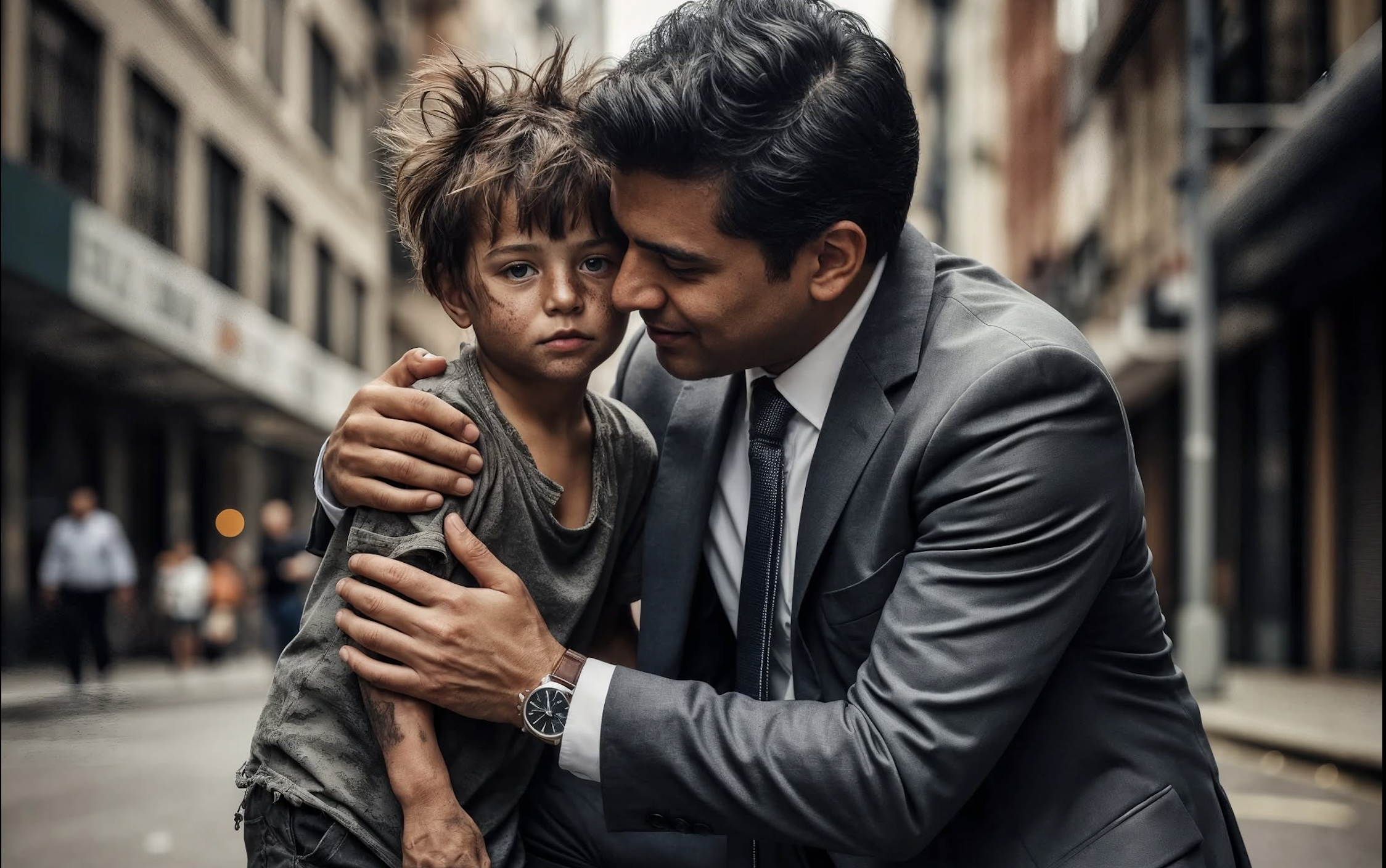
David Langford had built his life on numbers, contracts, and deals that made headlines. At forty-two, he was a self-made millionaire, possessing everything usually associated with success: a penthouse apartment, luxury cars, a personal driver, and a son, Ethan, who had been the center of his universe since his wife passed away. Yet, behind his polished appearance and imposing reputation, David carried a void that even his wealth could not fill.
One late autumn afternoon, after concluding a tense negotiation downtown, David stepped out of his black car and headed toward a small café. He needed a coffee: strong, black, and quick, before picking Ethan up from school. As he passed a narrow alley, he noticed a small silhouette sitting on the sidewalk.
A boy, maybe eight or nine years old, in torn shorts and a shirt covered in dirt and soot, was staring at the ground. His face was smudged, his hair messy, and his sneakers were falling apart. Passersby ignored him as if he didn’t exist. David slowed down at first, without stopping. He had been taught that giving money to street kids wasn’t always the solution.
But something stopped him. The boy looked up, and their eyes met. There was no hand outstretched in begging, no rehearsed plea: just an inner emptiness, deeper than simple hunger.
David turned back. “Hey, are you okay?”
The boy blinked, suspicious. “I’m okay.” His voice trembled.
“Are you hungry? I can buy you something.”
The boy hesitated, then shook his head. “I’m not hungry right now.”
David frowned. Most kids in his situation would jump at a sandwich. “Then… what do you need?”
The boy’s lips quivered. He looked at David’s tailored suit, the gold watch on his wrist, and then at the snapshot David had just taken out of his pocket: a smiling photo of Ethan. He whispered something David could barely hear:
“I don’t need money. I just need to be hugged like I’m your son.”
David froze.
The world around them faded away: the honking horns, the rush hour crowd, the indifferent pedestrians. Those words touched him more than any business deal ever had.
For a long moment, David remained silent. He knelt down to be at eye level with the boy. The child’s cheeks still glistened with old tear tracks beneath the grime.
“What is your name?” David asked softly.
“Leo,” the child whispered.
“Where is your family, Leo?”
“I don’t know.” He looked away. “Sometimes I sleep at the shelter, but it’s full most nights. People don’t like us hanging around there.”
David’s chest tightened. He thought of Ethan: a warm bed, bedtime stories, arms to comfort him after a nightmare. He imagined his own son wandering the streets alone; the thought choked him up.
“You shouldn’t be out here all alone,” he said quietly.
Leo shrugged. “I got used to it.”
David knew he couldn’t leave. He pulled out his phone to call someone—anyone—but Leo’s small hand grabbed his wrist.
“Please… don’t take me back to that shelter,” he whispered urgently. “They’re mean. They yell all the time. I’m better off here. I just wanted someone to take care of me for a moment.”
David swallowed hard. He had meetings, appointments, obligations. But suddenly, none of that mattered anymore.
He reached out, hesitant, then gently placed a hand on Leo’s shoulder. “Come here.”
Leo stiffened, then slowly let himself go as David pulled him into a careful embrace. The boy was so light, so fragile—like holding a bird that had forgotten what safety meant.
For a few seconds, Leo stood still. Then he buried his face in David’s suit and clung to him with surprising strength. David felt something wet soaking his jacket, but he didn’t care.
“It’s okay,” David whispered, just as he would with Ethan. “You’re safe now.”
Leo trembled. “No one has ever done that for me,” he murmured, his voice muffled.
David looked around, uncertain of what to do next. Passersby cast furtive glances or looked away. For them, it was easy to ignore this moment—but not for David.
“Leo, do you trust me?”
The boy hesitated, then nodded slightly.
“Let’s go get you something to eat. And we’ll figure out what comes next, okay?”
Leo pulled back a little to look at him. “You’re staying?”
David nodded. “I’m staying.”
David led Leo to the nearby café. Inside, the warmth and the smell of fresh bread enveloped them. Leo hesitated at the door, glancing around anxiously as if he doubted he was welcome.
“It’s okay,” David reassured him. “You’re with me.”
They sat at a small table in the corner. David ordered a hot meal: soup, bread, and a sandwich, and placed it in front of Leo. At first, the child sat motionless. Then hunger took over, and he ate cautiously, as if fearing the food might be suddenly taken away.
David watched him, feeling a mix of guilt and determination. How many children like him were wandering this city? And why did he have to ignore them until today?
When Leo had finished, David asked gently, “Where do you usually sleep?”
“Under the bridge by the river. Sometimes behind the bakery, it depends if they chase me off. It’s not so bad when it doesn’t rain.”
David felt a knot in his chest. “Leo, you are way too young to live like that.”
Leo shrugged again. “I have no choice.”
David thought of Ethan: his son would soon be getting out of school, skipping toward the car, talking about his day. Ethan had a home, toys, warmth—and a father to protect him. What if Leo had once had all of that too?
“Do you remember your parents?” David asked.
Leo looked down. “My mom left when I was little. My dad…” He hesitated. “I don’t know where he is.”
David took a deep breath. “Would you like to spend the night somewhere safer? Not the shelter you talked about—a different place.”
Leo’s shoulders tensed. “Like where?”
“My place. You’d have your own room, food, a real bed.”
Leo blinked, incredulous. “Why would you do that?”
David answered sincerely, “Because if my son were in your shoes, I would pray that someone would help him.”
Leo didn’t react immediately. He looked at the table, then whispered, “But I’m not your son.”
David leaned toward him. “No. But tonight, you don’t have to be a street kid.”
Later that evening, David’s driver pulled up to the private building. Leo pressed his forehead against the glass as they went up the floors, watching the lights turn on in the apartments. Upon their arrival, the concierge, surprised, said nothing when David ushered Leo inside.
In the penthouse, Leo stopped, open-mouthed. The space was bright, modern, filled with wonders he had never seen.
Ethan bounded into the room, full of excitement. “Dad! You’re here!” Then he spotted Leo. “Who is that?”
David knelt down next to his son. “Ethan, this is Leo. He is going to… spend the night with us.”
Ethan tilted his head. “Hi.” Without hesitating, he held out a toy car. “Do you want to play?”
Leo hesitated, then took it. “Thank you.”
David watched them, sensing a shift. It wasn’t pity; it was the conviction that fate had pushed him to this moment for a reason.
That night, after tucking Ethan in, David found Leo on the balcony, silent, gazing at the city.
“You okay?” he asked.
Leo nodded slowly. “I’ve never been this high up. The world looks different from here.”
“It is,” David confirmed.
Leo turned around. “You didn’t have to do all this. I’ll leave tomorrow.”
David shook his head. “You need stability. I can help you get back to school, get proper care, maybe even find your relatives.”
For the first time, Leo’s shell cracked. “Why do you care? You don’t even know me.”
David replied softly, “Because when you said, ‘I just need to be hugged like I’m your son,’ I realized that money doesn’t solve everything. Sometimes, what we need most is what I already have: time, safety, love.”
Leo’s eyes filled with tears, which he quickly wiped away. “Will I… will I ever have a dad again?”
David chose his words carefully. “I don’t know what the future holds. But for right now, you are not alone anymore. We’ll face this together.”
A few weeks later, that single night would change their lives. David arranged for legal guardianship while searching for any relatives. Leo started school, slowly adapting to a warm bed, regular meals, and someone to wish him goodnight.
One evening, as David was rocking Ethan, Leo stood in the doorway. David noticed him. “What’s up, Leo?”
The boy hesitated, then whispered, “Could I… could I have a hug, too?”
David opened his arms wide. “Always.”
Leo stepped forward and buried his face against David’s chest—just as he had done that first day on the street. They stood still for a long time. In that silence, David understood something essential: that day, he had left thinking about profits and deadlines. And he had found what wealth cannot buy: someone who simply needed to be loved.