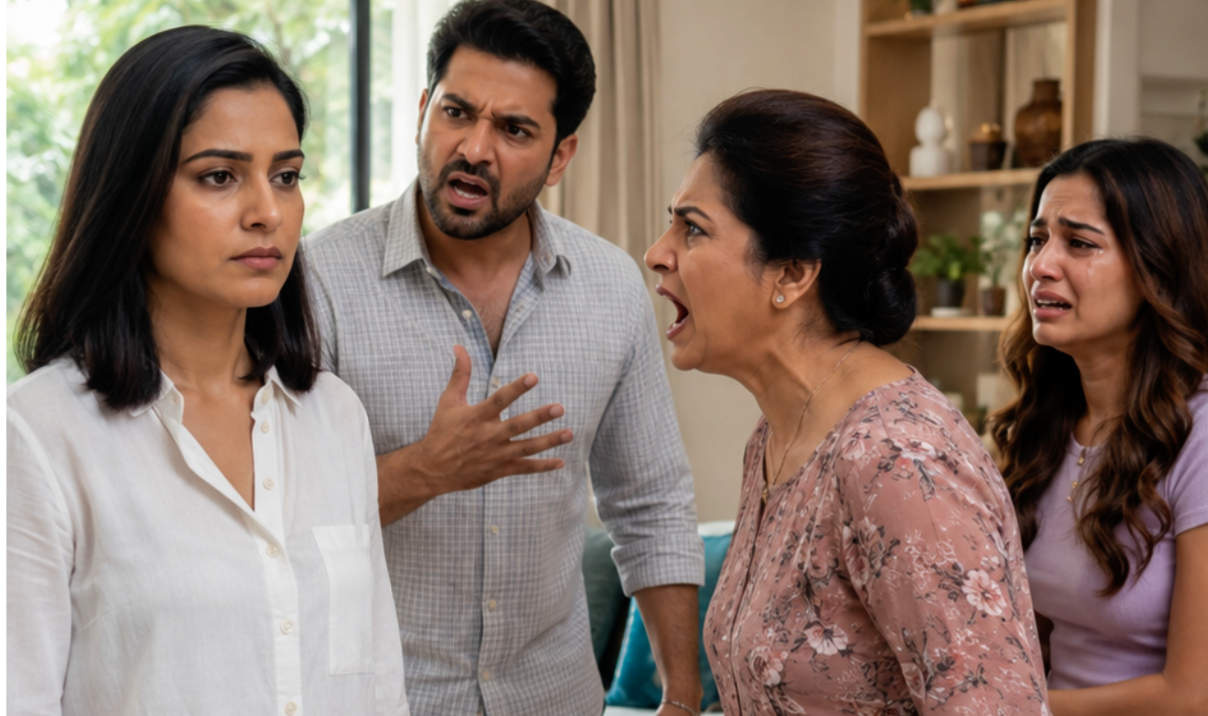
“Marina, stop pretending you can’t hear me!” Nina Vasilyevna spoke as though I were deaf or, worse, mentally deficient. “Katenka needs help, and you have to help her! She’s your family now, if you even understand what that means!”
I understood. I understood perfectly well.
For four years, I had understood it every time I transferred money from my salary card into our savings account. Every time I went without new boots, a trip to the seaside, or a decent sofa instead of the sagging monster Pasha and I slept on in our rented one-room apartment.
Nina Vasilyevna stood in the middle of our tiny kitchen and somehow filled the entire room—not so much with her body as with her voice and the confidence of someone who had never once doubted that she was right.
Katya sat beside her. Twenty-two years old, nails freshly painted, mascara strategically smeared beneath both eyes to make her look more convincing. Every so often she sniffled, then glanced down at her phone.
“Mom, explain it to her properly,” Pasha said.
There it was.
Explain it to her.
To me.
His wife.
I looked at him, and something inside me became very quiet and very cold.
Pasha stood by the window, staring somewhere into the dark September courtyard, obviously waiting for me to nod, say, “Fine,” and go transfer the money.
Because that was how it had always worked.
His mother spoke, Pasha nodded, and everyone expected the rest of the world to adjust accordingly.
The story hadn’t begun that evening.
It had begun much earlier—around the time Katya bought a car on credit.
And not just any car.
A premium hatchback costing two million rubles.
Katya worked…
No. Katya didn’t work.
Katya was finding herself.
First she found herself in nutrition courses. Then in makeup courses. Then, if I remember correctly, in some kind of femininity workshops.
She needed the car to look successful. So she could arrive at those courses looking like someone whose life was completely under control.
Of course, absolutely nothing in Katya’s life was under control.
She had started missing payments almost immediately. At first only occasionally, then she stopped paying altogether. The bank sent letters. They called. Eventually, they sent a repossession notice.
And now the three of them were sitting in our kitchen.
“With the penalties, it’s already almost eight hundred thousand,” Nina Vasilyevna announced in the same tone someone might use to read a restaurant menu. “If it isn’t paid now, they’ll take the car and all that money will have been thrown away. Pasha, you two have savings! Marina has the money in her account, so let her transfer it. You can buy your apartment next year. What’s the big deal?”
“Nina Vasilyevna,” I said slowly, “we’ve been saving that money for four years. It’s our down payment.”
“So what?” She spread her hands. “Your down payment can wait. Katya can’t. Her credit history will be ruined!”
At that, Katya sniffled again and tapped at her phone screen.
I looked at my husband.
Pasha stared at the floor.
“Pash,” I said. “What do you think?”
He looked up.
I knew that expression by heart by then: a mixture of guilt, helplessness, and the quiet hope that I would make the decision myself so he wouldn’t have to take responsibility for it.
“Well… she’s my sister, Marin. She’s family. We can help, can’t we?”
We can help.
Eight hundred thousand rubles.
“We can help.”
“We have just over a million in that account,” I said evenly. “After your ‘help,’ we’ll have two hundred thousand left. For a two-room apartment in Moscow. You understand that, right?”
“Oh, Marina, don’t exaggerate,” Nina Vasilyevna cut in. “If you can’t buy in Moscow, you’ll find something in the Moscow suburbs. You’re young, you’re healthy. You’ll earn more!”
I slowly breathed out through my nose.
September rustled outside the window. The linden trees in the courtyard were yellow and wet. It had rained the day before, and the asphalt beneath the streetlamp shone as though it had been varnished.
An ordinary late evening in an ordinary residential district.
Somewhere, the entrance door to the building slammed shut.
Life continued as usual, completely unaware that in our kitchen, four years of our lives were being decided.
“Marinka, you’re an intelligent woman,” Nina Vasilyevna said, changing tactics and softening her voice slightly.
Not much. Just a little.
“You understand that Katenka is having a hard time right now. She’s young, inexperienced. She made a mistake with the loan—who hasn’t made mistakes? But you’re experienced. You’ll figure something out. You and Pasha will manage. You’ll see. A year from now, you’ll buy something.”
Katya is having a hard time.
Apparently, that was an argument.
Katya was having a hard time because Katya had taken out a loan for a car she couldn’t afford and had spent a year and a half pretending the payments would somehow make themselves.
And now she had come into our kitchen with deliberately smeared mascara and was waiting for us to fix everything.
“Pasha,” I called again. “Pasha, look at me.”
He did.
“If we give away this money, we won’t have an apartment. Not next year. We don’t know when. Do you understand that?”
“Oh, enough with the apartment, apartment, apartment,” Nina Vasilyevna said irritably. “Are you living in an apartment now? Yes. Do you have a roof over your head?”
“A rented roof, Nina Vasilyevna.”
“So what? I lived in rented apartments my whole life and somehow survived!”
Pasha looked at me, and I could see him searching for words.
He searched for a long time.
He found the wrong ones.
“Marin, try to understand. She’s my sister. If I don’t help her now, what kind of brother does that make me?”
“And if you help her at my expense, what kind of husband does that make you?”
Silence.
Katya stopped looking at her phone.
Nina Vasilyevna drew in a breath.
“Well, would you look at that,” she said, as though I had said something monstrous. “Pasha, this is your wife. Do you see? Your sister is drowning, and she’s talking about ‘my expense’!”
Pasha rubbed his forehead.
He turned toward the window.
And then, quietly, without looking at me, he said something I hadn’t expected from him.
“Marina, either you help the family, or I don’t know what there is between us anymore.”
I blinked.
Nina Vasilyevna pursed her lips triumphantly.
Katya immediately went back to her phone. Apparently, the incident had been resolved and she could relax.
And I—
I stood up, took my handbag from the chair, and said very calmly:
“All right, Pasha. I’ll think about it.”
I walked into the hallway, put on my jacket and sneakers.
Nobody said anything.
They probably assumed I needed some fresh air. That I needed to calm down.
That half an hour later, I would return as a different person—the kind who would agree.
The door closed softly behind me.
I went downstairs, crossed the courtyard past the wet benches, and walked out onto the avenue.
I hailed a taxi and gave the driver an address.
As we drove, I stared through the window at the nighttime city—the traffic lights, the twenty-four-hour shops glowing yellow through their windows, the people walking somewhere on their own business, none of them knowing that inside my head, very quietly and very clearly, one specific plan was taking shape.
Pasha had said, either-or.
Well.
That happens.
The taxi stopped outside a shopping center on the other side of the district—the one with a twenty-four-hour café on the third floor, cheap coffee, and power outlets beside every table.
I had been there before when quarterly reports were due and I didn’t want to sit alone in the office until midnight.
The café was almost empty.
A couple of students sat in one corner. A man with a laptop sat near the window.
I ordered an Americano, found a table away from the entrance, and took out my phone.
My hands were perfectly steady.
That didn’t surprise me.
I had noticed long ago that when something was genuinely serious, I didn’t panic.
I thought.
Probably an occupational habit. Four years of working with numbers teaches you not to scream, but to calculate.
I opened my banking app.
The account was mine.
Mine alone.
I had opened it before the wedding, in my own name, and Pasha had no access to it.
We had agreed on that arrangement from the beginning: I kept the records, I saved the money, I managed the account.
Pasha transferred his share to me every month—honestly and on time, I have to give him that.
He was reliable about that.
About other things, not so much.
One million one hundred and twenty thousand rubles.
Four years reduced to a number on a screen.
I took a sip of coffee and opened the real-estate section.
Not the one where Pasha and I had looked at two-room apartments.
Another one.
Studios.
Small apartments in new developments on the outskirts. Unfinished, but with clean paperwork and reasonable sellers.
There was one property I had noticed about two months earlier. Just casually, out of the corner of my eye. I hadn’t seriously considered it.
A studio in a building under construction.
Completion in eight months.
Price: nine hundred and fifty thousand rubles.
At the time, it had seemed much too small. We wanted a proper two-room apartment, with an actual separate room and hallway, not twenty square meters divided into imaginary zones.
Now it seemed exactly right.
I found the listing.
Read it again.
Then I called.
The manager answered surprisingly quickly considering it was almost midnight, with the cheerful voice of someone working the night shift who was happy to receive any call at all.
“Yes, the studio is still available. You can reserve it online with a ten-thousand-ruble deposit. Tomorrow morning we can draw up the contract.”
“I want to register it in someone else’s name,” I said. “My mother’s. Is that possible?”
“Of course. We’ll need her passport and she’ll need to be present when the contract is signed. Or you’ll need a notarized power of attorney.”
I thanked him and put down the phone.
Mom.
I dialed her number.
She answered after the second ring. She was still awake, watching some movie.
“Marin? It’s late.”
“Mom,” I said. “I need your help. Not money. Just you. Tomorrow morning. Can you come?”
Mom was silent for a second.
“What happened?”
“I’ll tell you when we meet. Everything’s fine, don’t worry. I just need to put something in your name.”
She didn’t ask unnecessary questions.
That was one of the things I loved about her. She knew how to hear what was hidden in someone’s tone of voice and not bury them under words when what they needed was silence and a simple yes.
“All right,” Mom said. “What time?”
I got home at around one in the morning.
Nina Vasilyevna and Katya had already left. Their shoes were gone from the hallway, and the apartment was ours again—small and stuffy, with a strange lingering smell of someone else’s mascara still hanging in the air.
Pasha was sitting in the kitchen.
A mug of cold tea stood in front of him. Judging by its appearance, he hadn’t touched it.
He looked up when I walked in, and I saw exactly what I expected in his eyes.
Hope.
He thought I had come back ready to make peace.
“Well?” he asked quietly.
“I’ve thought about it,” I said. “Go to bed, Pash. We’ll talk tomorrow.”
“Marin, you can’t do this. I was worried.”
“I know.”
I went into the room without changing clothes, lay down on top of the bedspread, and stared at the ceiling.
Pasha sat in the kitchen for a while longer. I heard him moving his mug around the table.
Then he sighed and came into the room too.
He lay down.
He tried to take my hand.
I didn’t pull it away.
I simply lay there staring at the ceiling, thinking about how tomorrow at ten in the morning Mom and I would be going to the developer’s office.
In a few days, the agreement would be signed.
The studio was small, but it would exist.
It would stand there.
It would be built.
And neither Katya with her hatchback nor Nina Vasilyevna with her demands would be able to reach it.
Pasha fell asleep quickly.
He was always like that. He would worry, make some noise, and then fall asleep as though nothing had happened.
Not out of malice.
That was simply how he was built.
Mom had made a fuss, Mom had gone home, therefore everything was calm again.
I didn’t fall asleep until three.
In the morning, I got up before him.
I washed, drank coffee, packed my bag.
When Pasha came out of the bedroom—hair disheveled, wearing a T-shirt, looking like someone who wasn’t fully awake yet and expected a normal breakfast—I was already standing by the door in my jacket.
“Where are you going?” he asked, surprised.
“I have some things to take care of.”
“What things? It’s Saturday.” He rubbed his eyes. “Marin, we didn’t finish talking yesterday. About Katya…”
“We’ll finish tonight,” I said. “I’ll be back in about three hours.”
He looked at me the way people do when they sense something is wrong but can’t work out what it is.
He wanted to ask, but couldn’t find the right words.
I zipped up my jacket.
“Pash, eat something. There are eggs in the fridge.”
The door closed behind me.
Mom was waiting for me outside the metro station in a beige coat, a shoulder bag hanging at her side, calm and businesslike.
We hugged.
She looked at me closely, the way only mothers can—somehow looking at everything all at once.
“Will you tell me on the way?”
“I will.”
We walked through the September city, over wet pavement, past cafés that were just opening and a market where vendors were arranging apples and pumpkins.
I talked.
Briefly, without unnecessary details.
Mom listened without interrupting.
She asked only one question.
“Are you sure?”
“Yes,” I said.
“Then let’s go.”
The developer’s office was bright and smelled of fresh renovation.
The manager—the same one from the night before—turned out to be a young man in a blue shirt who seemed genuinely delighted to have actual customers.
We sat down at a table and spread out the documents.
Mom signed the papers carefully, without rushing.
I watched her hands and thought about how she hadn’t once asked why.
She hadn’t demanded explanations.
She hadn’t started lecturing me about how I should talk to my husband first.
She had simply come and signed.
When we stepped outside, she linked her arm through mine.
“The studio is small,” she said.
“Small.”
“But it’s yours.”
I nodded.
We walked toward the metro, September leaves rustling above us, a tram humming somewhere in the distance.
And I felt something strange.
Not happiness.
Not relief.
Something closer to solidity.
As though the ground beneath my feet had become a little firmer.
Pasha still knew nothing.
That evening, he would.
He was home when I returned.
He was sitting in the room with his phone, and from the way he quickly put it away, I understood that he had been talking to his mother.
Or she had been talking to him.
It didn’t matter.
“So, did you take care of your business?” he asked with the tone that meant: I was patient. I waited. Now let’s finally talk like normal people.
“I did,” I said.
I took off my jacket and hung it on the hook.
Then I went into the kitchen and poured myself some water.
Pasha followed me and stood in the doorway, hands in his pockets, shoulders slightly tense.
“Marin, I want to explain about yesterday. Mom, she… well, you know how she talks. She doesn’t mean any harm. She’s worried about Katya, so she puts pressure on people. But basically she’s right. My sister is in trouble, and we can help.”
“You can,” I agreed.
He blinked.
“What do you mean?”
I set down the glass and turned toward him.
“Pash, sit down.”
He sat—not at the table, but on the windowsill, the way he always did when a conversation was serious.
He looked at me and waited.
I took a printout from my bag.
It was the participation agreement for the apartment, freshly printed and dated that day. The manager had given us a copy.
I placed it on the table.
“What’s this?”
Pasha picked up the document and began to read.
I watched his eyes move down the page.
I watched him find the name.
Not mine.
My mother’s.
His eyes stopped.
“It’s a studio,” I said. “Twenty-two square meters. Completion in May. It’s registered in my mother’s name. The money was transferred this morning.”
The silence lasted a long time.
Pasha held the contract in both hands and stared at it, though he clearly wasn’t reading anymore.
“You…” he began.
He didn’t finish.
“Your share of the savings is exactly half,” I continued calmly. “I transferred it to your card an hour ago. You can check. That’s your money, Pash. Do whatever you want with it. Give it to Katya if you want. Keep it if you want.”
Finally, he looked up.
His expression was confused, almost childlike.
“Wait. You bought an apartment. Without me.”
“A studio. Yes.”
“And you put it in your mother’s name.”
“Yes.”
“Why your mother?”
I answered without hesitation.
“So that if we divide our property, you won’t have any claim to it.”
The words landed quietly.
Pasha slowly lowered the agreement onto the table.
“If we divide our property,” he repeated. “So you’re already thinking about splitting up.”
“Pasha, yesterday you were the one who said ‘either-or.’ I took note of that.”
He stood up from the windowsill.
He paced across the kitchen—two steps one way, two steps back. It was a small kitchen. There wasn’t much room for pacing.
Then he stopped.
“Marin, I didn’t mean… I was just angry. It wasn’t a real ultimatum.”
“I took it as a real one.”
“That’s not fair!”
“What isn’t fair is spending four years denying myself everything and then being asked to hand those four years over to pay somebody else’s car loan. That isn’t fair.”
He went silent.
He stared at the floor.
I could see that he was angry—not loudly, not the shouting kind of anger, but quietly, the way people get angry when someone holds them to their own words.
“You could have just talked to me,” he finally said. “Normally. Without all these… maneuvers.”
“Pash, I talked to you yesterday. You stood by the window saying, ‘But she’s my sister.’ Was that a conversation?”
He didn’t answer.
I picked my jacket up from the chair and moved it to the backrest.
Purely mechanically.
Just to give my hands something to do.
“Listen, I don’t want a fight,” I said. “Really. We just need to understand where we stand. You’re an adult, Pasha. You’re thirty-one years old. But every time your mother says, ‘This has to be done,’ you say yes. You don’t ask me. You don’t think about what it means for the two of us. You just say yes.”
“She’s my mother.”
“I’m your wife.”
Another pause.
The street murmured outside the window. A car drove past. Somewhere a door slammed shut.
“So what happens now?” he asked quietly.
“I don’t know,” I answered honestly. “That depends on you. The studio will be under construction for eight months. We can live those eight months in different ways. We can talk—really talk, not like yesterday. We can decide what matters more. But I’m not taking the money back, and I’m not canceling the contract. That part is done.”
Pasha stared at the contract on the table for a long time.
Then he picked it up, carefully folded it, and put it back down.
“Katya’s share will be on my card,” he said.
“I know.”
“I’ll probably give it to her.”
“That’s your right.”
He went into the other room.
Quietly.
No doors slammed.
I remained in the kitchen, looking out the window at the gray September courtyard, at the bench beneath the wet linden tree, at a cat walking along the curb.
And I thought:
Well, that’s it.
The hardest thing has been said.
After that, everything unfolded the way things usually do in real life—not quickly and not beautifully, but in an ordinary, everyday way.
Pasha transferred the money to Katya that same evening.
She managed to keep the car. The bank got its money, the penalties were paid, and the hatchback remained parked beneath Nina Vasilyevna’s windows.
Katya sent Pasha a three-minute voice message thanking him, calling him the best brother in the world, and promising to pay him back.
She didn’t specify when.
Nina Vasilyevna called two days later.
Somehow, through the family grapevine, she had learned about the studio.
The conversation was short and unpleasant.
She screamed into the phone that I was cunning, that I had deliberately registered the apartment in my mother’s name, that what I had done was illegal, and that she would “deal with it.”
What exactly she intended to deal with remained unclear.
The law was on my side. The account was mine. The contract had been signed voluntarily.
Pasha stood beside me during that conversation and said nothing.
His silence said more than any words could have.
We lived together for another two months in the same rented one-room apartment.
There were no fights.
There were barely any conversations.
And perhaps that was worse than fighting.
In the mornings, he went to work and I went to work.
In the evenings, he watched things on his phone while I read or worked with numbers. I had taken on an additional project by then. I needed to make up what I had spent on the deposit and initial payment.
Sometimes we drank tea together in the kitchen and talked about nothing—about the weather, the news, trivial things.
Like neighbors.
In November, he packed his things.
Not all at once.
In stages.
First he took his jackets.
Then his tools.
Then one day he came for everything else while I was at work.
He left the keys to the rented apartment on the table along with a note:
“I’m sorry. It didn’t work out.”
Three words.
Four years reduced to three words.
I read the note, put the keys in a drawer, and went into the kitchen to make dinner.
Not because it didn’t hurt.
It did.
It was simply that I had already calculated the pain and included it in the total that night in the café, sitting with an Americano beside a power outlet.
The studio was finished in April—a month ahead of schedule.
I accepted it myself.
I walked through all twenty-two square meters in the empty silence of the new building, which smelled of plaster and fresh wood.
The window overlooked a courtyard with young trees.
They had only recently been planted—thin, supported by stakes, but alive.
Mom helped with the renovation—with advice and by simply being there.
I didn’t take any money from her.
Three months later, I moved in.
Katya’s hatchback was repossessed in May.
Another missed payment.
More penalties.
The same story all over again.
As far as I knew, Pasha was living with his mother.
Nina Vasilyevna, people said, was pleased.
I didn’t gloat.
I simply knew.
On my first evening in my own apartment, I sat on the windowsill with a cup of coffee and watched the streetlights come on below.
Twenty-two square meters.
Mine.
People say small apartments feel oppressive.
That without enough space, a person starts shrinking too—becoming smaller, thinking in smaller terms.
I don’t know.
Maybe that happens to some people.
For me, it was the opposite.
Every morning when I woke up, the first thing I saw was my own window.
Not someone else’s.
Not a rental.
Not a window in an apartment whose landlady could call at any moment and tell me to move out.
Mine.
Outside it stood the same young trees in the courtyard.
By autumn they had grown stronger and no longer needed their supports.
I bought a proper sofa.
Not whatever I happened to find or whatever fit the budget, but the one I actually wanted.
I took my time choosing it.
I went to three different stores and probably tested twenty of them.
Eventually, I chose a gray one—firm, with wide armrests.
It arrived on a Saturday.
They put it against the wall, and immediately the apartment felt different.
Lived in.
Pasha wrote to me once.
It was December, shortly before New Year’s.
A short message:
How are you?
I replied:
Good.
He wrote:
Glad to hear it.
That was the end of the conversation.
No resentment.
No arguments.
Just two people who had realized they were walking in different directions and had gone their separate ways.
I occasionally heard things about Katya through mutual acquaintances.
She had “found herself” yet again.
Now she was selling something online—cosmetics, I think.
She no longer had a car.
Nina Vasilyevna still believed that the world owed her something.
But that was her right—to live with that belief.
I worked.
I took on new projects, improved my qualifications, and finally completed a course I had been postponing for three years.
Not because I wanted to prove anything to anyone.
There was simply time now.
And there was a reason.
In the evenings, I sometimes sat in my kitchen—small but comfortable, with exactly as much space as one person needed—and drank coffee in silence.
Not lonely.
Just quiet.
There’s a difference.
One day Mom came to visit and brought a pie.
We drank tea and talked about nothing in particular—her neighbors, the book she was reading, the fact that the courtyard outside my building had a nice playground even though I didn’t have children yet.
“Do you regret it?” she asked at one point.
I thought about it.
Honestly.
Without rushing.
“No,” I said.
Mom nodded and took another slice of pie.
Outside the window, it was October.
The trees in the courtyard were yellow—truly yellow, thick with color, as though someone had made a special effort.
I looked at them and thought that next year they would be taller.
Everything was growing.
And so was I.