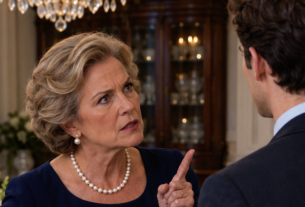
“Your salary comes in tomorrow, right? Perfect. Transfer it straight to me for the bathroom tiles,” Rimma Arkadyevna declared in a tone that brooked no argument, pulling the little bowl of apricot jam closer to herself. “Artyom has already sent his share. Now it’s your turn to contribute. The bathroom isn’t going to renovate itself, and prices at home improvement stores go up every day.”
Elena stopped stirring the soup on the stove and slowly turned toward her mother-in-law. A heavy silence settled over the tiny kitchen of their modest two-room apartment. Only the old refrigerator hummed monotonously in the corner, announcing its approaching death with a small puddle spreading across the linoleum.
Artyom sat at the table, hunched over after a grueling shift. He worked as an installer of video surveillance systems and security alarms. All day long he pulled cables through dusty attics, drilled into concrete walls, and configured equipment. Traces of construction dust still clung to his hands, and deep shadows of exhaustion lay beneath his eyes.
“Mom, Lena was actually planning to buy us a new refrigerator,” Artyom said uncertainly, staring into his plate. “Ours has been leaking for two weeks now, and the compressor is knocking. We agreed that I’d cover half the bathroom renovation, and you and Kirill would put in the rest.”
“What do you mean, Kirill, Tyomochka?” his mother exclaimed, throwing up her hands as her bracelets jingled melodically. “Your brother is searching for himself creatively! He’s an artist, a photographer, a sensitive soul. He can’t think about renovations right now. He has no commissions and can barely scrape together enough to pay the rent on his studio. But you two are hardworking, stable people. Lena sits in an office shuffling papers around all day. So what if your refrigerator leaks? Put a rag underneath it. It’s no big deal. My pipes are rotten, the enamel in my bathtub is worn away, and I’m disgusted to even wash in it. You’re young. You’ll earn more. We’re family. We’re supposed to help one another.”
Elena felt a dull irritation begin to boil inside her.
She was thirty-four years old and worked as a senior logistics coordinator for a major transportation company. Her supposed “paper shuffling” involved round-the-clock supervision of twenty enormous trucks traveling across the entire country. She dealt with flat tires outside Syzran, argued with warehouse loaders, rebuilt routes when highways were closed, and calmed drivers whose fuel card limits were running out.
Her job required nerves of steel, and every ruble she earned came at the cost of sleepless nights and premature gray hairs.
“Rimma Arkadyevna,” Elena replied, struggling to keep her voice calm, “I am not transferring my salary to you for bathroom tiles. We have our own budget and our own needs. We’ve been planning to buy that refrigerator for three months. If Kirill is twenty-eight years old and can’t earn enough money to help his own mother with renovations, that’s his problem, not mine.”
Her mother-in-law theatrically clutched her chest. Her face twisted into an expression of unbearable suffering. Rimma Arkadyevna behaved exactly like Margarita Pavlovna from the film Pokrovsky Gates, sincerely convinced that the entire world should revolve around her wishes and that everyone else was obligated to fulfill them with enthusiasm.
“So that’s how it is!” she exclaimed dramatically. “Your husband’s mother is a complete stranger to you! I raised my son, stayed awake all night with him, and now I can’t even get a glass of water from you! You begrudge me a few miserable tiles!”
“Mom, don’t start,” Artyom winced. He had always found conflict difficult. He was used to smoothing things over and giving in. “Lena’s right. We need a refrigerator. I’ll try to take on a couple of extra jobs this weekend, do some side work, and send you the rest of the money. Just please don’t argue.”
Elena pressed her lips together.
More concessions.
Again Artyom would work without days off, come home late at night, swallow painkillers for his aching lower back, all to pay for his mother’s comfort.
And all the while his younger brother Kirill would casually post photographs from conceptual art exhibitions on social media while sipping oat-milk raf coffee.
The next day at work was especially brutal.
From early morning, Elena’s phone never stopped ringing. Petrovich, one of the drivers, had gotten stuck at a weigh station because the customer had filled out the freight paperwork incorrectly. Another truck had broken down near Voronezh, and she urgently had to find a tractor unit to transfer pallets of frozen meat.
Elena sat in front of three monitors, entering data into the logistics software while simultaneously yelling into the phone at an incompetent freight forwarder and drinking cold instant coffee.
By lunchtime, her head was pounding as though the very truck loaded with meat had driven over it.
That evening, on her way home, Elena stopped by a pharmacy.
Rimma Arkadyevna had called her son that morning in a weak voice and announced that she had run out of blood pressure medication and was supposedly too unwell to walk to the pharmacy herself. Artyom was working on a complicated installation job on the other side of the city, so the mission fell to his wife.
Her mother-in-law’s apartment greeted Elena with the persistent smell of Corvalol and old belongings.
Rimma Arkadyevna sat in an armchair in front of the television, looking perfectly energetic as she watched yet another talk show.
“Did you bring them? Put them on the side table,” her mother-in-law ordered without taking her eyes off the screen. “Listen, since you’re already here, take a look at my phone. The stupid thing has completely lost its mind. It says the memory is full, nothing opens. I can’t even pay the utility bill through the banking app. Delete something. You understand all this computer stuff.”
Without saying anything, Elena picked up her mother-in-law’s old smartphone, sat on a stool in the hallway, and got to work.
She deleted dozens of greeting-card images, several blurry videos, and cleared the caches of the messaging apps. The phone began working faster.
“It’s done, Rimma Arkadyevna,” Elena called. “I’ll just check whether the banking app opens.”
She tapped the green icon of the financial app.
The program loaded and asked for the owner’s fingerprint. Elena walked over to her mother-in-law.
Rimma Arkadyevna carelessly pressed her thumb against the scanner, and the main screen appeared, displaying the latest transactions.
Elena only intended to make sure that the application wasn’t freezing, but her eyes involuntarily caught on the top line.
Her heart suddenly skipped a beat.
Her breath caught in her throat.
Yesterday’s date.
Incoming transfer from Artyom: plus fifty thousand rubles.
Comment: “Mommy, this is for the pipes and tiles, like I promised.”
And exactly three minutes later—an outgoing transfer.
Minus fifty thousand rubles.
Recipient: Kirill Viktorovich.
Comment: “Sweetheart, for the new lens, like we agreed. Kisses!”
Elena froze.
She could not believe what she was seeing.
Her hands trembled slightly.
She quickly swiped down the screen, looking through the transactions from the previous month.
The twentieth.
Incoming transfer from Artyom: plus forty thousand rubles.
Comment: “For new radiators in the bedroom.”
The same day, half an hour later.
Outgoing transfer to Kirill: minus forty thousand rubles.
Comment: “Sonny, for the loft rent. Don’t be sad.”
Further down.
The fifteenth of the previous month.
Incoming transfer from Artyom for medication and physiotherapy.
Outgoing transfer to Kirill with the note: “For your trip to the mountains.”
The situation became terrifyingly clear.
There was no renovation.
There were no bad knees requiring expensive Spanish tiles, no burst pipes, no freezing radiators.
For months, Rimma Arkadyevna had cynically and systematically been draining money from her eldest son, exploiting his guilt and sense of filial duty.
Artyom took on additional jobs, returned home with an injured back, and he and Elena deprived themselves of vacations and household appliances—all so that thirty-year-old freeloader Kirill could buy expensive camera lenses and take trips to the mountains.
Elena took out her own phone and, with cold calculation, photographed the screen of her mother-in-law’s smartphone.
She took five clear pictures showing the dates, amounts, and comments.
Then she calmly closed the banking app, placed the phone on the table, and headed for the door.
“Where are you going? Aren’t you staying for tea?” Rimma Arkadyevna called after her in surprise.
“I have things to do. Logistics never waits,” Elena replied and shut the door behind her.
The drive home passed in a blur.
A storm was raging inside her, but Elena forced herself to calm down.
She did not need emotions.
She needed facts.
She knew that Artyom genuinely trusted his mother. He wasn’t an accomplice in the deception.
He was its main victim.
Her husband simply could not allow himself to believe that his own mother was capable of such betrayal.
Elena was going to have to open his eyes, and she needed to do it with surgical precision.
Artyom came home late that evening.
He looked exhausted, and his clothes smelled of cement dust and metal.
He silently washed his hands, sat at the kitchen table, and began eating the reheated dinner.
Elena poured him some tea and sat opposite him.
“Tired?” she asked gently.
“Very,” Artyom exhaled, rubbing his neck. “We had to cut channels into a load-bearing wall today. But the client promised to add a bonus. Tomorrow I’ll send Mom another fifteen thousand so she can order the cast-iron bathtub. She says acrylic ones don’t work for her because they’re too slippery.”
Elena placed her hands on the table and looked her husband directly in the eyes.
“Tyoma, can you show me the transfer you made to your mother yesterday for the tiles? I just want to see which bank she uses so I won’t have to pay a commission if I ever need to transfer something.”
Without suspecting anything, Artyom took out his battered smartphone, opened the app, and turned the screen toward his wife.
“Here. Look. Fifty thousand. Just like we agreed. I promised I’d help her.”
Elena nodded.
Then she unlocked her own phone, opened the photo gallery, and placed it on the table beside her husband’s phone.
The photograph of her mother-in-law’s banking history glowed on the screen.
“Now look at this, Artyom,” Elena said quietly. “Look carefully at the times and the comments.”
Her husband frowned, not understanding what she wanted from him.
He narrowed his eyes and stared at the screen.
At first his face showed only mild confusion.
Then he picked up Elena’s phone and zoomed in on the image.
He read the first line.
Then the second.
Then he swiped to the next photograph.
Silence swallowed the kitchen, broken only by the soft humming of their faulty refrigerator.
Artyom’s face began to change.
Exhaustion gave way to confusion.
Confusion turned to disbelief.
Then his jaw tightened until the skin around it went pale.
He read his mother’s comments to Kirill.
“For the new lens.”
“For the loft rent.”
“For your trip to the mountains.”
Slowly, he lowered the phone onto the table.
His gaze settled on his own hands—the scraped knuckles, the calluses from the rotary hammer.
The hands with which he had earned that money.
“Where did you get this?” he asked hoarsely, his voice trembling.
“Rimma Arkadyevna asked me to clear some memory on her phone. I opened the banking app to make sure it worked, and this was right there on the main screen. Artyom, she isn’t renovating anything. She doesn’t have rotten pipes. She’s just acting as a transfer station between your broken back and Kirill’s comfortable lifestyle. And yesterday she demanded that I hand over my salary for exactly the same thing.”
Artyom remained silent for several minutes.
Inside him, an entire world of illusions was collapsing—the world in which he had been a good son helping his aging mother.
Now he realized that he had simply been used.
For years.
His sense of responsibility had been used.
His inability to say no had been used.
But what hurt most was the realization that because of this deception, he had also deprived his own wife, forcing Elena to live under strict financial restrictions.
The man rose from the table.
There was no longer softness or willingness to compromise in his eyes.
A cold anger burned there instead.
“Tomorrow is Saturday,” Artyom said firmly. “We’re going to Mom’s. I want to see those rotten pipes.”
The next morning, they stood outside his mother’s apartment.
Artyom rang the bell.
The door opened, and a sleepy Kirill appeared on the threshold wearing expensive silk pajamas.
Apparently, he had spent the night at his mother’s place.
“Oh, hey, bro,” the younger brother yawned. “Why are you here so early?”
“We came to inspect the renovation,” Artyom said through clenched teeth, pushing past his brother and striding confidently into the apartment.
Elena followed.
Rimma Arkadyevna was bustling around the kitchen making syrniki.
When she saw her eldest son and daughter-in-law, she joyfully threw up her hands.
“Tyomochka! Lenochka! I’m making syrniki. Kiryusha just dropped by. Sit down and have breakfast!”
Artyom walked past the table and went straight into the bathroom.
He opened the door and switched on the light.
Old but perfectly clean tiles.
Dry, intact pipes.
No signs of demolition.
No building materials.
Everything looked exactly the same as it had five years earlier.
He returned to the kitchen, pulled several color printouts of the bank transactions from his pocket, and threw them onto the table beside the plate of hot syrniki.
“Where are the tiles, Mom?” Artyom asked in an icy voice. “Where’s the cast-iron bathtub? Where are the new radiators I gave you money for last month?”
Rimma Arkadyevna glanced at the papers.
Red blotches spread across her face.
The spatula in her hand began to tremble.
Kirill approached the table, looked at the printouts, and swallowed nervously.
“Tyomochka… son… this… the tiles are delayed at the warehouse,” his mother began stammering as she backed toward the window. “The suppliers let me down!”
“Don’t lie,” Artyom cut her off, slamming his fist on the table hard enough to make the cups rattle. “Stop lying! I work twelve-hour days! I barely see daylight! Lena and I are living with a leaking refrigerator because I keep giving you all my money for your ‘medicine’ and ‘renovations’! And you’re transferring it to this parasite for lenses and entertainment!”
“So what?!” Kirill suddenly shrieked, finally finding his voice. “Are you really that stingy?! You have a stable job, a profession, and a wife who earns money! I’m a creative person! I need a start! Mom is just helping me develop my talent! We’re family—you’re supposed to support me!”
Elena looked at the overgrown dependent and felt nothing but disgust.
“Support you?” Elena stepped forward, standing beside her husband. “Develop your talent? You’re buying toys at the expense of your brother’s health. You live in a loft while we save money on groceries. Rimma Arkadyevna, yesterday you tried to take my bonus. You wanted me to pay for your younger son’s entertainment.”
“You don’t understand anything!” Rimma Arkadyevna started playing her favorite routine.
She clutched her chest, began breathing heavily, and lowered herself onto a stool, pretending she was about to faint.
“You’re cruel! Materialistic! Kiryusha is struggling! He’s young and inexperienced! I’m his mother—I have to help the weaker child! You’ll give me a heart attack with these papers!”
“Call an ambulance, Lena,” Artyom said absolutely calmly as he watched his mother’s theatrical suffering. “If it’s a heart attack, the doctors should handle it.”
His mother-in-law immediately stopped gasping and straightened her back when she realized the manipulation no longer worked.
Her eyes narrowed with anger.
“So that’s how you want to play it! You’ve decided to count my money! Dig through my phone!” she shouted, pointing at Elena. “She’s turned you against me, Artyom! That logistics woman of yours! Before her, you were a normal, obedient son!”
“Before her, I was a convenient ATM,” Artyom snapped.
He walked over to Kirill, grabbed the collar of his expensive silk pajamas, and pulled him closer.
“Listen carefully, creative genius. By the end of the year, you’re paying back every ruble. Every last kopeck. One hundred and forty thousand rubles. Sell your lenses, unload freight cars, get a job as a courier—I don’t care. If you don’t pay me back, I’ll come to your studio and take the equipment myself. Understand?”
Kirill nodded fearfully, trying to pull away.
Artyom released his brother, turned to his mother, and said the words Elena had waited so long to hear.
“My family is my wife. Lena works herself to exhaustion, and not one ruble from her salary—not one ruble from my income—is ever coming into this apartment again. Fix your own pipes.”
They left the apartment to the sound of Rimma Arkadyevna’s curses and screams.
She promised to cut them out of her will, ban them from her home, and erase them from her life.
Artyom silently closed the door behind them, cutting off the toxic stream.
Outside, a light drizzle was falling.
Artyom stopped beside the car, took a deep breath, and looked at Elena.
There was so much guilt and regret in his eyes that Elena’s heart tightened.
“Forgive me, Lenka,” he said quietly, wrapping his arms around his wife. “I was such an idiot. Forgive me for making you put up with all of this.”
“Everything is finally where it belongs, Tyoma,” Elena replied, pressing her face against his cement-scented jacket. “Things will be different now.”
Six months passed.
Elena and Artyom’s lives changed dramatically.
Without the constant financial drain of supporting relatives, their budget recovered quickly.
They bought not only the huge modern refrigerator they had dreamed about for so long, but also completely replaced their kitchen cabinets.
Artyom stopped taking weekend jobs.
Now, on Saturdays, they slept until noon, walked through autumn parks, went to the movies, and simply enjoyed being together.
The color returned to Artyom’s face.
The dark circles under his eyes disappeared, along with the constant pain in his back.
He finally understood that his worth was not measured by how much money he gave his mother.
Rimma Arkadyevna tried to restore things to the way they had been.
She worked through neighbors, called from unfamiliar numbers, and told terrifying stories about imaginary illnesses and leaking roofs.
But Artyom had learned to set firm boundaries.
He hung up at the first sign of manipulation.
Kirill, deprived of financial sponsorship, quickly abandoned his “creative search.”
He had to give up the expensive studio and sell his lenses to repay his older brother.
According to rumors passed along through distant relatives, the “sensitive soul” now worked as a manager in a mobile phone store and was extremely unhappy with his nine-to-nine schedule.
Elena sat in her office, looking at the monitor where her trucks moved across the map of the country like green dots.
The job was still just as stressful.
The phones still rang constantly.
Drivers still complained about the weather.
But now, whenever she received a notification that her salary had been deposited, she knew exactly where that money was going.
It was going toward a seaside vacation for her and Artyom.
And Rimma Arkadyevna’s rotten pipes remained exactly what they had always been—a myth that no longer had any power over their family.