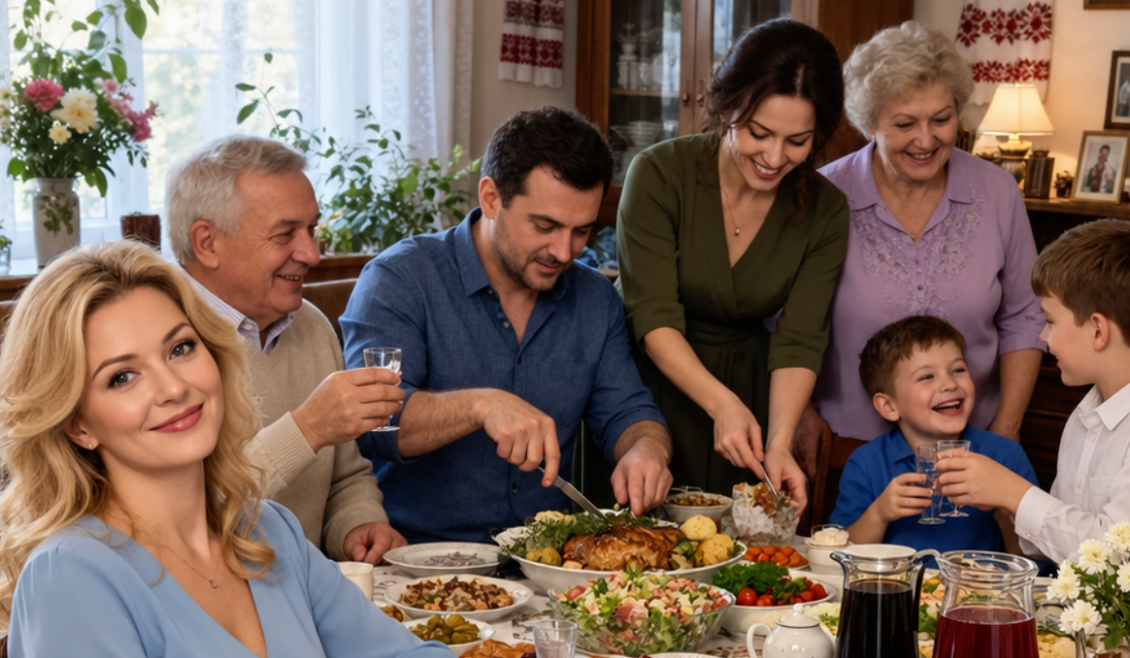
“To Edik! To a man who knows how to throw a proper celebration! Thank you, son, for putting together such a wonderful table!”
Her mother-in-law raised her shot glass, and the hand wearing a heavy gold ring froze above the salads. At that very moment, Yanina was placing the third set of clean plates for the hot course at the edge of the table. A towel hung over her shoulder, her hands were covered in flour up to the elbows, and her face was flushed from the heat of the stove.
The room erupted with voices and the clinking of glasses. Someone shouted, “No ‘bitter!’ this time—cheers to the birthday man!”
Edik stood up, placed a hand over his chest, and bowed.
Like an actor taking an encore.
Yanina straightened.
Twenty-five people were sitting around a table she had spent three days preparing for. She had cooked the aspic overnight so it would set by morning. She had assembled the three-tiered cake until three in the morning, whipping the cream while standing because she knew that if she sat down, she would never get back up.
And now here she was, standing with a towel over her shoulder while everyone thanked Edik.
“My son certainly knows how to host guests,” her mother-in-law said, surveying the table with a radiant expression. “That’s what it means to have a real master of the house.”
The master of the house sat back down and reached for the aspic.
The very same aspic.
Serpukhov, late July. A fourth-floor apartment in a building without an elevator, where Yanina had spent three days hauling grocery bags up from Lenta.
The occasion: Edik’s fifty-fifth birthday.
The guests: Edik’s relatives and three neighboring couples.
From Yanina’s side—no one.
In this city, the only place where she truly belonged was the kitchen.
Her mother-in-law, Raisa Pavlovna, was simply called “Mom” by everyone in the family. Even Yanina called her that—twenty years of habit.
She was a large woman with a tall, carefully teased hairstyle dyed dark chestnut, though gray roots were already showing. She wasn’t wearing some old-fashioned synthetic blouse. Hers was silk, expensive, fastened with a brooch.
Raisa Pavlovna took care of herself.
“There could have been a few more salads,” she remarked quietly, but loudly enough for the people nearby to hear. “Still, never mind. What matters is that the table was prepared with love.”
Yanina went back into the kitchen.
She took the roasting pot out of the oven and lifted the lid slightly. The meat had been slowly cooking since morning, exactly as it should.
The door slammed behind her.
“How much longer are you going to be?” her mother-in-law asked, peering inside. “People are waiting. And another thing—serve the fish on the large platter, not on those little plates of yours. This is a celebration, not a cafeteria.”
“All right,” Yanina said.
“And take off your apron when you come out. It looks improper. We have guests.”
Yanina looked at her.
She did take the apron off. And then put it back on again, because after twenty trips between the kitchen and the table, there were twenty chances to stain her clothes.
“I’ll take it off,” she said.
Yanina had been married once before.
A long time ago, in another life, in another city.
Her first husband had left her for a younger woman. He had left her a one-room apartment in Kashira, which she later sold for 3.2 million rubles before moving here to live with Edik.
That money had long since dissolved into this household: renovations, appliances, the car Edik drove on his fishing trips.
The only things Yanina could truly call her own in this apartment were her pastry-making equipment and her name attached to a couple of orders each week.
That was how she earned her living.
She carried the fish out on the large platter.
Raisa Pavlovna inspected it and nodded graciously.
“There. Much better. Learn while I’m still alive, dear.”
The guests ate.
They praised the food.
They praised Edik.
“Edik, you really went all out! Who would have thought you could pull off something like this?”
“Well, what can you do?” the birthday man said with a shrug. “I like things done properly.”
He didn’t say, “My wife went all out.”
He didn’t say, “Yanina worked for three days.”
He simply shrugged and poured another drink for the neighbor.
Yanina stood by the doorway holding an empty serving tray.
Apparently, in this house, the position of “banquet cook” did not qualify for recognition.
Lyuba, the neighbor sitting on the right, touched Yanina lightly on the elbow.
“Yan, at least sit down and eat something. You look exhausted.”
“In a minute,” Yanina said. “I just have to bring out the hot course.”
She headed toward the kitchen.
And then, from across the entire table, above all the heads and the music, came her mother-in-law’s loud, commanding voice:
“Yanina! Bring the hot food! It’s going to get cold! What are you doing in there? Everyone’s sitting here hungry!”
Like she was calling a waitress.
Across twenty-five people.
In front of neighbors.
In front of relatives.
In front of Yanina’s husband.
The table went quiet for a second.
Someone chuckled.
Edik didn’t even look up. He was helping himself to a second serving of aspic.
“Come on, bring it,” Raisa Pavlovna continued, warming to her role. “And bring the extra portions right away so you don’t have to run back twice.”
That was when Yanina finally had enough.
It wasn’t the shouting that did it.
It was the pause afterward.
She stood in the kitchen doorway with an oven mitt in her hand, and the phrase “bring it” seemed to hang in the hot air.
Bring it.
She placed the oven mitt on the table.
Slowly.
“Yan?” Lyuba called.
Yanina took the towel off her shoulder.
Then she untied her apron, loosening the strings behind her back with a practiced movement.
She pulled it over her head.
Hung it on the kitchen door handle.
Carefully smoothed it so it wouldn’t wrinkle.
Then she fixed her hair with both hands.
She walked into the room.
Moved along the length of the table, past the roasting pot that she had never brought out, and reached the only empty chair at the far end.
She pulled it out.
Sat down.
Picked up the pitcher.
Poured herself a full glass of fruit drink.
Everyone at the table stared at her.
Twenty-five people.
And Raisa Pavlovna at the head of the table.
“What are you doing sitting down?” her mother-in-law blinked. “Where’s the hot food?”
“The hot food is in the oven,” Yanina replied calmly and took a sip. “Edik made the table—you said so yourself. A man who knows how to throw a celebration. So ask him for the hot food. And for seconds. Apparently, I’m a guest today.”
Silence.
“What are you…” her mother-in-law began.
“I’m going to be a guest,” Yanina said. “I haven’t been one for twenty years. Let me try it once.”
Edik finally raised his head from his plate.
“Yan, come on. What are you doing? Mom just praised me, that’s all. Come on, bring it out before it gets cold,” he muttered. “There are people here.”
The cowardly peacemaker in all his glory.
Never contradict his mother.
Never defend his wife.
Just wait until everyone calms down so he can finish his aspic.
“There are people here,” Yanina agreed. “Go bring it, Edik. You’re the master of the house. Everyone was applauding you a minute ago.”
Someone at the table snorted into his fist.
Lyuba hid a smile behind her napkin.
Edik’s uncle, Pyotr Kuzmich, a large, silent man who had spent the whole evening eating salted wild mushrooms and staying out of the conversation, suddenly pushed his glass aside and said toward the table:
“Well, why not? Sounds fair to me. Let the master of the house bring it.”
Raisa Pavlovna turned crimson.
“What kind of performance is this?!” Her voice jumped from commanding to shrill. “I raised my son! I got him on his feet! And you! You came here twenty years ago with everything already prepared for you, moved into my son’s apartment, and now you’re showing attitude! A guest, she says!”
“Everything already prepared for me,” Yanina repeated.
Not even as a question.
Calmly.
“Raisa Pavlovna, whose money paid for the renovations in this apartment?”
“Edik’s!” her mother-in-law snapped.
“Mine. I sold my one-room apartment for 3.2 million and put the money into this place. The bathroom tiles, the kitchen, the windows. The car Edik drives to the fishing pond—half of that came from my money. We financed the other half, and I paid off the loan. Want me to show you the statements? They’re in the banking app. I’m not sitting here without proof.”
She took out her phone.
Not because she intended to show anything.
She simply placed it on the tablecloth.
But Raisa Pavlovna stared at the phone as if it had fired a shot.
“You’re lying,” her mother-in-law said.
More quietly now.
“Ask Edik,” Yanina said, nodding toward her husband. “He’ll confirm it. Won’t you, Edik?”
Edik remained silent.
He stared into his aspic.
Everyone around the table understood everything.
“Well,” Raisa Pavlovna said, getting to her feet. “So now you’re going to throw every kopek you spent in our faces?”
“I’m not throwing anything in anyone’s face,” Yanina replied, taking another sip of her drink. “For twenty years, you’ve been telling me I came here with everything handed to me. For twenty years, I’ve stayed quiet and cooked. Today’s a birthday, everyone’s in a good mood, so I thought I’d clarify whose ‘everything’ it actually was.”
The guests fell silent.
Someone among the distant relatives became deeply interested in the tablecloth.
Lyuba was openly smiling now.
“Edya,” Raisa Pavlovna turned to her son. “At least you say something to her!”
Edik looked up.
Opened his mouth.
Closed it.
Opened it again.
“Mom… Yan… come on,” he finally managed. “Why don’t I just bring out the hot food? Then we’ll all sit down and have a normal meal.”
The timeless male strategy of waiting out the storm while pretending to be part of the furniture failed today.
The furniture had been told to stand up and serve the table.
Edik got up.
He went into the kitchen.
There was a loud clatter as he grabbed the roasting pot—the one Yanina had spent three hours slow-cooking.
Then came a hiss.
Then a muffled:
“Ah! Damn, that’s hot!”
Then the sound of a lid hitting the floor.
Pyotr Kuzmich coughed into his fist to hide his amusement.
Lyuba no longer bothered hiding hers.
The uncle’s wife whispered to the woman next to her:
“Well, look at that. The master of the house has finally appeared.”
Edik came out carrying the roasting pot with two oven mitts.
He was red-faced and sweating, with a strand of hair stuck to his forehead.
He placed it on the trivet.
Then he began serving everyone, awkwardly using a ladle and dripping gravy onto the tablecloth.
“Why are you giving them so much?” Raisa Pavlovna couldn’t resist. “Be more careful!”
“Mom, you’re the one who wanted the hot food,” Edik suddenly snapped, wiping his forehead with his shirt sleeve. “So here I am… serving it…”
Raisa Pavlovna sat back down.
She had been halfway toward the door in a fit of outrage, but now she simply returned to her chair.
And for the first time all evening, she was the one who fell silent.
The shot glass between her gold-ringed fingers remained untouched.
Yanina ate calmly.
For the first time in three days, she was eating while sitting down.
The salad was good.
She had made it herself.
“Yan,” Lyuba said quietly from across the table. “What about the cake? Whose is that?”
“Mine,” Yanina smiled. “Three tiers. I assembled it last night. Anyone who wants to praise it is welcome to direct their compliments to me. I work according to a price list.”
The neighbors burst out laughing.
This time, they were laughing with her.
Not at her.
Three weeks passed.
Through Lyuba—who lived in the same building as Raisa Pavlovna and often ran into her near the elevator—Yanina heard that her mother-in-law no longer told anyone about that evening.
Before, she had loved saying:
“My Edik is such a wonderful host.”
Now she kept quiet.
And at a family lunch at Edik’s sister’s home, where Yanina was invited for the first time not as the cook, Raisa Pavlovna made a toast.
A short one.
For the first time in twenty years, two words appeared next to each other in one of her speeches:
“daughter-in-law” and “golden.”
She practically had to force them down her throat—but she said them.
Since then, Edik has carried out the hot food himself.
Not because he suddenly understood everything.
Simply because Yanina is no longer the first person to go near the stove on family celebration days.
If you want a banquet, organize it.
She serves her cake.
Then she sits down.
As a guest.
Pyotr Kuzmich—the uncle who spent that birthday eating salted mushrooms—now greets Yanina first whenever they meet and does so with obvious respect.
And once, while out fishing with Edik, he reportedly told him in a fatherly tone:
“Ed, take care of your woman. No one else will ever make aspic like that.”
They say Edik sulked.
But he kept quiet.
And since that evening, Lyuba has been bringing Yanina orders from the entire apartment building—birthday cakes, christening cakes, celebration cakes.
Most importantly, three of the women at that birthday party took Yanina’s business cards.
One needed a cake for her granddaughter’s graduation.
Another wanted one for an anniversary.
The third wanted one for a bachelorette party.
Paid orders.
According to the price list.
The business cards had been sitting in the pocket of the apron hanging from the kitchen door handle.
Yanina wrote all three orders into her notebook.
The deposit for the first one arrived on her card that same evening.
She opened the banking app.
Saw the amount.
Nodded.
Put the phone back in her pocket.
And zipped it shut.