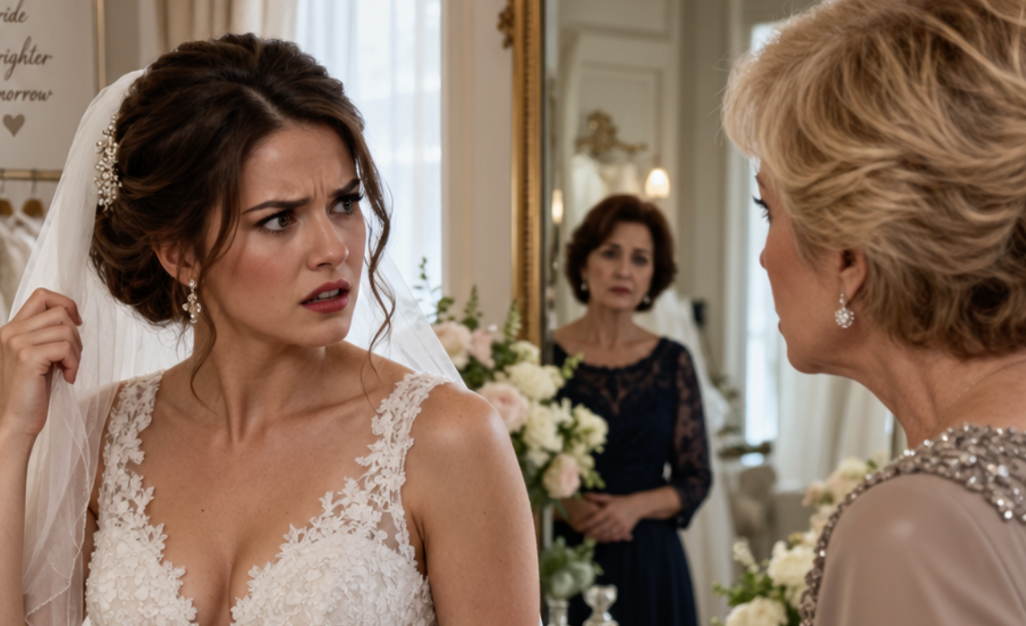
“Since when did our wedding turn into a bill with my name on it?” I asked, holding the veil with one hand. Just a minute earlier, its soft white netting had covered my eyes.
The veil smelled new, with a faint hint of powder. Tiny beads glittered along the delicate headband, and suddenly I saw myself from the outside: a thirty-one-year-old woman, with a folder of mortgage papers tucked into the bottom drawer of her desk at home, wearing fitting shoes that pinched slightly at the bone, and sitting across from her future mother-in-law as though we weren’t choosing a dress but dividing up a life that was somehow already theirs instead of mine.
Svetlana Borisovna sat on a pale sofa beside the mirror, her hands folded over her handbag. She always looked as if she had come not for a visit but for an inspection. Every hair was perfectly in place, her lips were pursed, and her eyes swept over me quickly, as though I were something in a shop window.
“Alina, don’t pretend you don’t understand,” she said calmly. “You have money saved. You only get married once. We can’t exactly have you sign the papers in some office with a bare lightbulb hanging from the ceiling.”
I slowly removed the veil and placed it on my lap.
Nearby, behind a counter covered with catalogs, Mila, the owner of the bridal salon, had gone still. She had been leafing through a folder of contracts without looking up, but in the mirror I could see that she was listening.
“We agreed on a civil ceremony and dinner with close family,” I said. “That was the decision Yegor and I made.”
“It was,” Svetlana Borisovna nodded. “But now we’ve thought about it like adults. A hundred guests. An MC. A proper banquet hall. Music. People should come and see that our son is getting married properly.”
“People should see?”
“What surprises you about that?” She tilted her head slightly. “You’re not a little girl, and neither is Yegor. It should be done beautifully, not thrown together at the last minute. Thank goodness you have some money put aside. You weren’t saving it just to let it sit there.”
I wanted to ask exactly when the down payment for my apartment had become part of the wedding decorations, but the words seemed to burn on my tongue. Behind me, the fabric of a dress rustled, a steamer hummed softly in the fitting room, and the whole situation felt so absurd that my first thought was almost comforting: this had to be a misunderstanding.
She had simply blurted it out.
Yegor would come in, laugh, and tell his mother she had gotten carried away.
Yegor was standing near the salon entrance, talking on the phone. I could see him through the glass door. He was smiling at someone with that familiar gentle smile that usually made my tension disappear.
This time it didn’t.
“Does Yegor know about this?” I asked.
Svetlana Borisovna didn’t even blink.
“Of course. We discussed everything yesterday.”
Something inside me dropped, cold and silent.
It didn’t collapse or crack.
It simply became heavy.
Mila lifted her head.
“Alina, could I have you for a second? I need to check something about the hem length.”
I stood up too quickly, and the veil slipped to the floor. Svetlana Borisovna looked at it as though she were already imagining herself as the hostess of a celebration she wasn’t paying for but intended to organize entirely according to her own wishes.
Inside the fitting room, Mila closed the curtain and quietly asked,
“You haven’t authorized anyone else to make changes to your order, have you?”
“What changes?”
“This morning someone asked me to add another veil, a second dress for the latter half of the evening, and an at-home fitting. They said you would approve everything and pay for it together with the main package.”
I stared at her.
“Who said that?”
“A man. He introduced himself as the groom. Then a woman called. She sounded very confident and said she was family and that everything had already been decided. I didn’t add anything. I thought I should wait for you.”
I sat down on the little ottoman beside the mirror. The warm ivory hem rustled around my feet. A small box of pins sat on the table, and suddenly what frightened me wasn’t the amount of money or even the wedding.
It was how easily they had already moved me from the category of “person” into the category of “expense account.”
“Thank you,” I said. “Don’t add anything. Nothing at all.”
Mila nodded.
“And one more thing. Your deposit on the dress can remain on your account even if you postpone the date. Don’t rush into anything today.”
That simple sentence felt like a hand being offered to someone standing on slippery ground.
When I came out of the fitting room, Yegor was already standing beside his mother. He smiled, but his eyes were wary.
“What took you so long?” he asked. “Mom and I were looking at which style would suit you best.”
For some reason, the word “Mom” cut deeper than his calm tone.
“Svetlana Borisovna says we’re having a wedding for a hundred people,” I said. “And apparently I’m supposed to pay for it. Did you discuss this?”
His gaze shifted toward the mannequin in the corner as though the answer might be written there.
“Alina, not in front of everyone.”
“There aren’t any strangers here. Just people who have already tried to add services to my account without asking me.”
Yegor grimaced.
“Why do you have to put it like that? We were just considering options. Mom is right about one thing: it’s too late to do something small now. The hall is reserved, and the guest list is almost finished.”
“What guest list?”
“Guests. Dad’s colleagues, family friends, the guys I know from the salon, Dasha’s friends…”
“Dasha’s friends?”
Svetlana Borisovna interrupted gently, using that particular tone that always sent a chill over my skin.
“Dasha’s social circle has become much smaller since her divorce. The girl needs to get out and meet people. A good wedding isn’t only for the bride and groom, Alina. It’s an event for the whole family.”
I looked at Yegor.
“And you think this is normal?”
He sighed as if I were throwing a tantrum over the color of the ribbons on the tables.
“You’re getting hung up on wording. We’re getting married once. You have savings sitting there, and my money is tied up in the business right now. Later, we’ll balance everything out.”
Later.
A word that usually means nothing except the hope that the other person won’t start keeping track.
I picked up the veil again and squeezed it between my fingers. Suddenly, I realized I didn’t want to continue trying on the dress.
The white netting looked like something foreign that had somehow ended up in my hands.
“Mila, I’m done with the fitting for today,” I said.
Svetlana Borisovna stood up.
“What is this performance?”
“It’s not a performance. It’s a pause.”
“Alina, stop it,” Yegor said through clenched teeth. “Don’t put me in an embarrassing position.”
And that was the moment I finally took off the veil.
Not just from my head.
I took it off the idea that he was somehow the one who should feel embarrassed here instead of me.
At home, everything was quiet.
I had been renting my one-bedroom apartment for three years, and everything in it had been chosen to suit me: a gray sofa by the window, a narrow white table, a green throw over the armrest, a box of documents beneath the shelving unit.
A sheet of paper with an estimate of my apartment down payment was attached to the refrigerator with a magnet.
The amount I had saved over four years hadn’t appeared through miracles. It had been built out of things I had denied myself: spontaneous trips, a new car, endless purchases postponed with, “I’ll buy it later.”
I loved that number almost physically.
It wasn’t greed.
It was security.
Yegor arrived an hour later.
No flowers. No warning.
He simply unlocked the door with the key I had given him the previous autumn and walked in as though he already half lived there.
“Did you deliberately ruin everything?” he asked from the doorway.
I was standing by the sink washing strawberries. Water ran over my fingers, and the berries tapped against the glass bowl.
“Did I ruin something? Or did I stop things at the point where people were trying to appoint me as the sponsor of someone else’s party?”
He gave a nervous little laugh.
“You’re exaggerating again. Nobody appointed you anything. It just makes sense for you to contribute more right now.”
“Makes sense to whom?”
“Alina, you have the money. Our wedding is right around the corner. You’re not a child. Weddings cost money.”
“My money?”
“Our money. But since you have money available right now, it’s easier to start with yours.”
“Available.”
I turned off the water and faced him.
“That money isn’t available. It’s already allocated. I’ve been looking for an apartment. You know that.”
“We’ll buy an apartment together later.”
“We?”
“What bothers you so much about that?” He raised his hands. “After the wedding, there won’t be such a strict division between yours and mine anyway.”
That was the first moment I genuinely felt sick.
Not even because of the audacity.
Because of how casually he said it.
No hesitation.
No embarrassment.
As though we were talking about towels.
“Did you come up with that yourself, or did someone help you?” I asked.
He jerked one shoulder irritably.
“You’re talking about the wrong thing. Mom is just worried about the standard of the wedding. That’s all.”
“No. Your mother is worried about how she’ll look in front of other people. Dasha wants to bring her acquaintances. You want me to quietly sign everything so that by the time I object, it’ll already be too late to change anything.”
“You only see the bad side.”
“I see the bill you’ve brought to me.”
He sat down at the table and tapped his fingers against the surface.
“Listen. The venue has already been chosen. It’s a very nice place by the river. They’ve been holding the date for a month. We just need to sign the contract in your name because you have an officially declared salary and it’s easier to arrange payment through you. I’ll contribute my share later.”
For a moment, I couldn’t even decide which part bothered me more.
“In your name.”
Or “later.”
“You’ve already decided everything?”
“I found an option. The important thing now is not to create a scandal.”
“You’ll see a scandal when I start behaving with the same confidence your family uses when deciding what to do with my money.”
He stood up.
“Don’t say ‘your family’ in that tone.”
“What tone am I supposed to use when, in this arrangement, I’m not the bride? I’m the wallet.”
Yegor pressed his lips together. He always did that when he had nothing left to argue with but still didn’t want to give in.
“Tomorrow evening we’ll go to my parents’ place. We’ll discuss everything calmly.”
I didn’t want to go.
But moments like this were exactly when my own upbringing betrayed me.
I thought you shouldn’t slam the door too soon. That you had to hear people out. Maybe I really was making a mountain out of a molehill. Maybe these were just badly chosen words, pre-wedding family chaos, someone else’s lack of tact.
For years I had been proud of my ability to talk things through instead of making rash decisions.
And suddenly that quality I had valued so much felt like a rope people were using to pull me along.
The following evening, Yegor’s parents’ house greeted me with the smell of freshly ironed laundry and fish baking in the oven.
Svetlana Borisovna loved presenting everything as a picture of prosperity. There was a glass salad bowl on the table, the napkins had been arranged in fans, and wineglasses sparkled inside the cabinet.
Valery Sergeyevich fiddled with the television remote as though none of this concerned him.
Dasha sat near the window in a fitted beige dress, scrolling through her phone.
“And here comes our beautiful girl,” Svetlana Borisovna said. “Come in, Alina. I was just explaining which MC would be best for us.”
Not “for you.”
Not “maybe.”
Already “for us.”
I sat down, placing my handbag on my lap.
“I haven’t agreed to an MC or a hundred guests.”
Dasha looked up sharply.
“Well, a hundred isn’t really that many. We have quite a lot of our own people already. Besides, you can make useful connections at a good wedding.”
Svetlana Borisovna gave her daughter a quick look but didn’t correct her.
So apparently this was part of the plan too, rather than some random comment.
“Let’s take this one step at a time,” I said. “Who reserved the venue?”
Yegor cleared his throat.
“I did. With Mom.”
“Under what terms?”
“Preliminary terms. We only need to confirm it and pay the main amount.”
“And where is that money supposed to come from?”
Svetlana Borisovna actually smiled.
“Alina, you make it sound as though someone has robbed you. We’re talking about your wedding. You’re investing in your own life.”
“I invest in my life when I save money for a home.”
“You’ll have plenty of time for an apartment,” she waved dismissively. “People remember a wedding.”
I looked at Valery Sergeyevich.
He remained silent, rubbing the edge of his fork with his thumb.
I could almost physically feel how badly he wanted to stay out of it.
And somehow his silence made everything more painful.
When one person in a room goes too far and everyone else pretends nothing serious is happening, the person standing opposite them starts questioning whether they are the unreasonable one.
“Yegor,” I said. “Can you answer me directly? How much money do you personally have for this wedding right now?”
His expression changed.
“What does that have to do with anything?”
“It has everything to do with it. How much?”
“Don’t interrogate me.”
“This isn’t an interrogation. It’s the first clear question anyone has asked in the last two days.”
Svetlana Borisovna put her cup down sharply on its saucer.
“Very nice, Alina. So my son has to report his finances to you now?”
“Not to me, necessarily. But to the woman whose name you intend to put on the contract? Yes.”
Dasha smirked.
“Seriously, if you’re going to count every ruble like this, why have a wedding at all?”
I turned toward her.
“You seem to have your own interest in this celebration.”
“So what?” She shrugged. “It’s a normal event. People, music, respectable guests. We can’t exactly sit in some café over three bowls of salad.”
And in that second, everything fell into place.
Not suspicions.
Not hurt feelings.
Just a simple, naked arrangement.
In their minds, my savings account was already sitting in the center of the table, waiting to be opened.
Yegor pushed a folder containing the restaurant brochures toward me.
“At least look at it. Once you see the hall, you’ll calm down.”
I didn’t open it.
“Have you already started thinking of my savings as ours?”
“Don’t get hung up on words.”
“I’m getting hung up on a future all of you are arranging without me.”
Svetlana Borisovna leaned back in her chair.
“You want the truth? Something else worries me. If a woman clings this tightly to her own money while she’s married, she’s going to have a hard time building a family.”
That shook me.
Not because I was afraid of her.
Because of how skillfully she turned the meaning upside down.
As though having boundaries were a flaw.
As though generosity was supposed to flow in one direction and never ask questions.
Suddenly, I heard myself from the outside.
Maybe I really did look petty.
Maybe you weren’t supposed to count money so carefully when it came to a wedding.
Maybe people really did do this only once and later laugh about how worried they had been.
Thoughts like that don’t come because you’re wrong.
They come when several people are staring at you at once, all behaving as though normality is somewhere on their side of the room instead of yours.
“Let’s go to the restaurant,” Yegor said quietly. “Just look at the hall. No decision.”
I agreed.
To this day, I don’t know whether I agreed out of pride or because I still hoped I would see something there that could reconcile me with what was happening.
Sometimes a woman doesn’t need the truth.
She needs one last chance to make sure she hasn’t reached the wrong conclusion too soon.
The restaurant stood beside the river.
Large windows, beige tablecloths, heavy chairs with tall backs, mirrors in bronze frames. Spring sunlight lay across the floor in rectangular patches.
The hall was empty, which somehow made it look even more expensive and cold.
Svetlana Borisovna walked ahead of us as if she were already receiving congratulations there.
Dasha checked herself in the mirrors and adjusted her hair.
Yegor talked about the menu, the dessert table, the photo area, as though all of it had already been purchased.
I walked behind them and felt nothing except growing exhaustion.
“The head table will be here,” Svetlana Borisovna said, pointing. “We could put fresh flowers over there. Not those modest little branches—proper arrangements. And we need a screen so we can show a video about Yegor’s childhood.”
“Will there be something about my childhood too?” I asked.
She didn’t even catch the sarcasm.
“Of course. We can include you too, if you gather some photographs.”
I stopped beside the window.
The river was gray. The ice had only recently melted, and dark sand stretched along the bank.
I looked at the water but heard nothing except numbers.
This much for the hall.
This much for the menu.
This much for decorations.
The MC separately.
The music separately.
The lighting separately.
And they were attaching every one of those costs to me with such confidence that you would have thought I had already agreed.
“Alina,” Valery Sergeyevich called quietly.
I was surprised.
Until then, he had hardly spoken.
We moved a little to the side, toward a narrow alcove near a mirror.
He cleared his throat without looking me in the eye.
“I’ll keep this short. We don’t have the money. Yegor doesn’t have any available right now either. Sveta wants a celebration for other people. Not for the two of you. You can see that yourself.”
I said nothing.
“I’m not defending it,” he added. “I just want you to understand where all this is coming from. She decided that because you’re practical and have savings, you could pay for a beautiful wedding. Then, according to her, you’d sort it all out later.”
“When exactly is ‘later’?”
He gave a humorless smile.
“When it’s already too late to argue.”
His honesty didn’t make me feel better.
Quite the opposite.
Until that moment, a small part of me had still believed the whole thing might be exaggerated by emotion.
After his words, the emotion disappeared.
Only the structure remained.
I returned to the hall.
Svetlana Borisovna was explaining to Yegor where the gift table should go.
“I’m not paying for this,” I said.
Nobody asked me to repeat myself.
Everyone heard me the first time.
“Don’t get worked up,” Yegor replied sharply. “We haven’t even sat down and discussed it properly yet.”
“You’ve already discussed everything without me.”
“We were planning.”
“You were distributing my money.”
Svetlana Borisovna gave a thin smile.
“It’s embarrassing even listening to you. You make it sound as though my son picked you up off the street and now you’re doing him some enormous favor.”
“No. I became embarrassed when the veil hadn’t even settled on my head yet and you had already divided up my bank account.”
Yegor stepped closer to me.
His mouth twitched the way it did when he wanted to speak more harshly but remembered there were other people around.
“You’re making me look like an idiot.”
“You put yourself in that position.”
“Alina!”
“What?”
“Sign the contract. Just sign it. We’re not haggling at a market.”
And that was when something ended.
Not my patience.
My habit of smoothing things over.
“I’m not participating in this,” I said. “A banquet for a hundred people, an MC, a limousine, networking opportunities for Dasha, your mother’s need to impress people—all of that can happen without me. If you want a party, pay for it yourselves. If you want a wedding, then let’s go back to what we agreed on in the beginning: the civil ceremony and dinner with close family. Without touching my savings.”
Dasha snorted.
“God, you make it sound like we’re talking about millions.”
I looked at her.
“When you’ve spent four years saving for something yourself, no amount feels like ‘just money.’”
For the first time, Svetlana Borisovna raised her voice.
“Yegor, do you hear this? She’s already showing you before the wedding how she intends to divide your home into square meters!”
I didn’t answer.
Arguing with someone who sees your caution as a personal insult is almost useless.
They don’t want a conversation.
They want someone who will obediently nod.
I turned around and left.
Outside, the air was bright and damp.
Kaluga in April smells of the river, dust, and something metallic drifting from the bridges.
I stood by the curb gripping my phone and watched the reflections tremble in the restaurant windows.
My hands weren’t shaking from the cold.
Yegor didn’t come outside immediately.
First he called.
I didn’t answer.
Then he called again.
Then a message arrived:
“You’re going too far…”
I didn’t even finish reading it before deleting it.
The next one was longer:
“You ruined everything over a matter of principle.”
Then another:
“Stop making a scene.”
I got into my car and drove back to Mila’s bridal salon.
She was alone, sorting boxes of shoes.
“You don’t really have the face of a bride anymore,” she said without unnecessary sympathy.
“Good,” I replied.
I told her briefly what had happened.
The venue.
The contract.
What Valery Sergeyevich had told me.
Mila listened carefully without interrupting.
“The deposit on the dress is still yours,” she reminded me. “You can either postpone the order, or I can refund the portion that hasn’t already gone into the work. I’ll calculate everything fairly. But most importantly, don’t sign anything right now, not even something they tell you is ‘just to look at.’ And check who has access to your personal information.”
“They’ve already tried to order half the salon under my name.”
“Then I’ll add a note to your account. Changes can only be made by you personally, with your passport, while you’re here.”
I nodded and suddenly felt so grateful to this almost complete stranger that I wanted to sit down and cry right there between the wedding dresses.
But there were no tears.
There was clarity.
From the salon, I called the restaurant.
I didn’t give them a long explanation.
I simply said that I would not consent to any contract in my name and that any negotiations conducted without my personal presence should be considered unauthorized.
The person on the other end answered briefly and professionally.
Oddly enough, that dry response calmed me.
The world hadn’t collapsed.
One door had simply closed.
Yegor came to my apartment two days later.
Again, without warning.
I was arranging papers on the table: bank statements, apartment listings, a sheet showing the mortgage interest rate, a pen, and a calculator.
A light spring rain drizzled outside the window, and a thin trail of water slowly ran down the glass.
He came inside, looked at the table, and immediately understood that I was no longer thinking about the wedding.
“You don’t even answer me anymore,” he said.
“What am I supposed to say?”
“That you’ve calmed down. That we can talk without all this drama.”
I silently moved the calculator aside.
He sat opposite me.
“Mom got carried away.”
“So did you.”
“I wanted what was best.”
“For whom?”
Yegor rubbed a hand across his face.
“For everyone. So everything would be respectable. So my parents wouldn’t feel inferior to other people. So we’d have proper guests instead of ten people sitting around a table.”
“And so I could pay for everything ‘respectably.’”
“There you go again.”
“No, Yegor. There you go again. You’re just saying the same things she said, only more gently.”
He leaned back irritably in the chair.
“You don’t understand how this looks from the outside. My fiancée is digging her heels in over money.”
“From the perspective of my life, this is how it looks: the man I was going to marry never asked whether I was willing to give up my savings. He simply decided that because I know how to save money, he could lean on me. Not during a difficult time. During a glamorous one. For appearances.”
He stood up abruptly.
“So you’re throwing everything away over one argument?”
I stood up too.
“Not because of the argument. Because of how quickly all of you decided that my money already belonged to you.”
“That isn’t only what I think.”
“I can see that. That’s exactly the problem.”
He came closer.
Once, that distance between us had meant something entirely different.
Now all I felt was pressure.
“We could get through this,” he said more quietly. “You just needed to compromise a little. Everything would settle down afterward.”
And that was when I understood the most important thing.
He hadn’t come to apologize.
He hadn’t come to understand.
He hadn’t come to offer another way forward.
He had come to see whether he could press once more on the place where I had always softened before.
“Do you hear yourself?” I asked. “‘You just needed to compromise.’ So peace in our future family was supposed to depend on me staying silent whenever something hurt me or put me at risk.”
“At risk?” He actually laughed. “It’s a wedding, not a catastrophe.”
“You’re wrong. Catastrophes don’t always start loudly. Sometimes they start with a sentence like, ‘Just sign it. We’ll sort everything out later.’”
He stared at me for a long time, as though he were seeing for the first time that I wasn’t the same Alina he had always found easy to negotiate with.
“So what happens now?” he asked.
I looked toward the table.
At the apartment listings.
At the folder.
At my life, which had suddenly become mine alone again.
“Now I’m not getting married.”
He flinched as though he had expected anything except a direct answer.
“Because of money?”
“Because of the way you treat money. And the way you treat me.”
“Do you regret us?”
The question was unexpectedly sincere.
For a second, I even felt sorry for him.
Not as my fiancé.
As an adult man who had somehow never noticed the moment when he stopped distinguishing love from convenience.
“I regret that I didn’t understand it sooner,” I said.
He stood there a little longer, then nodded to himself, as though he had decided my decision was nothing more than a stubborn mistake.
He didn’t apologize.
He didn’t ask me to give him time.
He simply left, and the door closed without a slam.
The silence after him wasn’t empty.
It was dense.
I sat on the floor beside the table, leaned my back against the sofa, and for the first time in days, breathed all the way out.
I didn’t feel good.
I didn’t feel bad.
I felt clear.
I remembered the veil in the salon.
The white netting in my hands.
At the time, I thought I was giving up the wedding.
Now I understood that I had given up something else.
A marriage in which my wallet had already been declared a family resource and my caution had been labeled a character flaw.
A week later, I received a notification from the bank.
The mortgage interest rate had changed.
I opened the message, sat down at the table, and started calculating again.
Outside, below my window near the entrance to the building, a lilac bush was beginning to bud.
There were only tight green tips so far, no color and no scent.
Just a promise that the season changes eventually, even when you never asked it to.
The veil remained at the salon.
I placed the ring in a little box and put it in a drawer.
I didn’t throw it away.
Not because I treasured it.
I simply didn’t want to turn my life into a dramatic scene for someone else’s relief.
Sometimes my phone still lit up with Yegor’s name.
I watched the screen go dark on its own and didn’t answer.
Eventually, it stopped feeling like a struggle.
It became a habit of protecting what I had.
And then I went to look at an apartment.
It was small, with a narrow kitchen and a strange hallway, but there was an enormous window in the main room.
The owner was talking about the plumbing and the upstairs neighbors while I stood beside the windowsill thinking about only one thing:
How quietly a story can end when you stop paying for someone else’s comfort with your own life.