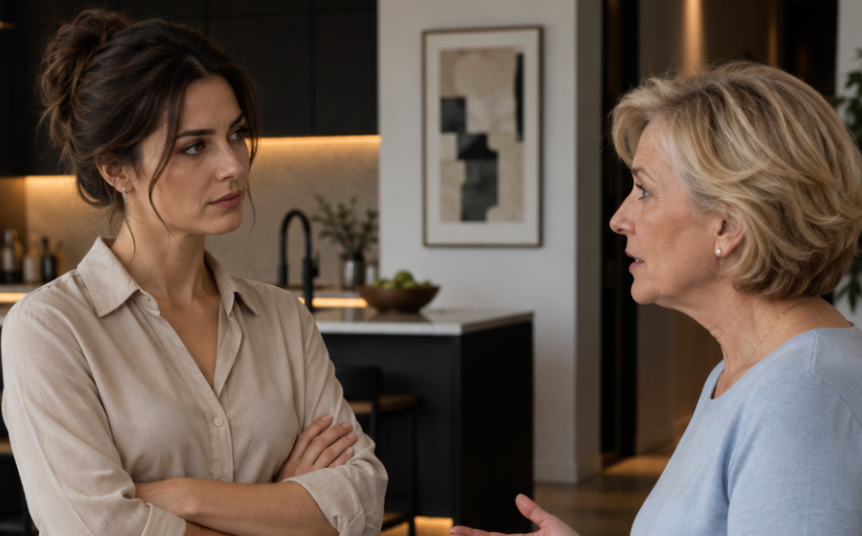
Larisa, please clear out the large wardrobe in the back room. Sveta has a lot of things—two suitcases of clothes alone—and another box will be delivered later,” Tamara Stepanovna announced in such a casual tone that it sounded as though she were asking Larisa to move a bag off the sofa.
Larisa slowly looked first at her mother-in-law and then at the young woman standing in the hallway beside two enormous suitcases.
Sveta smiled awkwardly.
“Hello again.”
“Hello,” Larisa replied. “Why should I clear out the wardrobe?”
Tamara Stepanovna was already taking off her sandals.
“I just told you. We need somewhere to put Sveta’s things.”
“I heard you. I’m asking why her things are supposed to go in my wardrobe.”
Her mother-in-law looked up.
For a moment, she appeared confused, as if she had never expected that she would have to explain herself.
“Because Sveta is going to stay here.”
Larisa looked at Vadim.
Her husband stood near the living-room doorway and was clearly in no hurry to intervene.
Outside the open window, a car was humming in the courtyard. The refrigerator was running in the kitchen, and the muffled sound of a television came from the neighboring apartment. In a matter of seconds, an ordinary August Sunday had ceased to be ordinary.
“Vadim?”
He rubbed the bridge of his nose.
“Lar, Mom told me about it.”
“Told whom?”
“Me.”
“And?”
“Well… I didn’t think it would be a problem. The room is empty anyway.”
Larisa tilted her head slightly.
“You didn’t think it would be a problem?”
Vadim understood the question without further explanation.
“I was going to discuss it with you.”
“When? After the suitcases had been unpacked?”
Tamara Stepanovna exhaled noisily.
“My goodness, why are you turning such a simple matter into a major event? Someone needs a place to stay for a few months. The apartment is large, and the room is sitting empty. I don’t understand what the problem is.”
Larisa said nothing.
She walked into the living room, opened the bottom drawer of the dresser, and took out a thick folder of documents.
Tamara Stepanovna followed her with her eyes.
“Where are you going?”
“I’ll be right back.”
Larisa placed the folder on the table and only then looked again at the people standing in the hallway.
She was forty-one. She had bought this three-bedroom apartment almost nine years earlier, when Vadim did not yet exist in her life.
At thirty-two, Larisa had decided that she no longer wanted to depend on landlords. By then, she had moved several times. Sometimes the owners had suddenly decided to sell the apartment, sometimes their grown son had returned, and sometimes they had raised the rent.
Her last move had exhausted her completely.
She worked as a purchasing manager for a medical-equipment company. The job required concentration, patience, and the ability to keep dozens of arrangements in mind at once. After a busy day, she wanted to return to a place where no one could suddenly announce that she had to move out within a month.
Larisa spent a long time looking for an apartment.
There were all kinds of options: cramped apartments, properties located too far away, homes with questionable paperwork, ground-floor apartments, and buildings beside noisy highways.
Finally, she found a three-bedroom apartment in a good neighborhood. It was not new, but it had a convenient layout, a decent kitchen, and two separate bedrooms in addition to the living room.
Larisa took out a mortgage.
During the first few years, most of her spare money went to the bank. She did not complain or tell her acquaintances how difficult things were. She simply planned her expenses, avoided unnecessary purchases, and tried to repay the debt as quickly as possible.
Every early repayment gave her far more satisfaction than a new handbag or an expensive phone ever could.
Several years later, the mortgage was finally paid off.
Larisa still remembered the evening she opened her banking app and saw a zero beside the outstanding balance. She walked around the apartment, looked into every room, and truly understood for the first time that it was over.
She owed nothing to anyone.
The apartment belonged entirely to her.
Not to the bank. Not to relatives. Not to temporary landlords.
To her.
She met Vadim much later, at a mutual friend’s birthday party. He worked as a ventilation systems specialist and traveled frequently to different job sites. What Larisa remembered about him that first evening was not any flattering speech, but the fact that he calmly helped the host repair a jammed balcony door, then returned to the table and never mentioned it again.
Vadim was easy to talk to. He did not try to appear more interesting than he was, did not question Larisa about her past relationships on their second date, and did not make plans ten years into the future.
Seven months later, they decided to live together.
Vadim himself said:
“Since you have a proper apartment and I’m renting, moving in with me doesn’t sound very logical.”
Larisa laughed.
“Indeed.”
He moved his belongings gradually—first his clothes, then his computer, tools, and books.
At the same time, Vadim never behaved as though bringing his boxes into the apartment had given him any ownership rights.
He contributed to the utility bills, bought groceries, and took care of household chores. If he wanted to purchase something for the apartment, he asked Larisa first.
Within a few months, she had even stopped noticing that she had once lived there alone.
About a year after they met, they officially registered their marriage.
There were never any discussions about transferring ownership of the apartment. Vadim knew perfectly well that Larisa had bought the property long before they met.
“It’s your apartment. What is there to discuss?” he once said when the subject of property arose by chance.
At the time, Larisa was sure that the matter would never become a source of conflict.
The first difficulties arose not with Vadim but with his mother.
Tamara Stepanovna lived alone in another part of the city. Her son visited her regularly, so at first she made little effort to visit the newlyweds.
Then she began dropping by more often.
First once a month.
Then twice.
Soon she could call on a Saturday morning and announce:
“I’ll be nearby, so I’ll stop in.”
Larisa took it calmly. She treated her guest well, offered her lunch, and talked with her. Sometimes they even went to the nearby shopping center together.
At first, Tamara Stepanovna also behaved properly.
But after a few months, she began paying closer attention to how her daughter-in-law lived.
“Why do you need a second set of bedding for the guest room? The old one is still perfectly good.”
At first, Larisa assumed it was merely a casual remark.
“Because I wanted to buy it.”
“You need to watch your spending.”
“I do.”
That ended the conversation.
During her next visit, her mother-in-law noticed a new coffee grinder.
“The old one still worked.”
“The old one broke.”
“You could have had it repaired.”
Larisa smiled.
“Tamara Stepanovna, I’ll manage somehow.”
A week later, her mother-in-law was commenting on the groceries.
“Why are you buying such expensive fish? Buy the ordinary frozen kind.”
“Because we like this kind.”
“What a waste of money.”
Larisa looked at her husband.
Vadim pretended to be extremely busy with his phone.
After his mother left, Larisa asked:
“Do you seriously not hear her commenting on every single thing we buy?”
“I hear her.”
“And?”
“What do you want me to say? It’s a habit of hers.”
“She should leave that habit in her own home.”
Vadim put an arm around his wife’s shoulders.
“Don’t pay attention to her. She’ll talk for a while and then settle down.”
But Tamara Stepanovna did not settle down.
On the contrary, she became convinced that her comments carried no consequences.
One Friday, Larisa returned from work and found two unfamiliar women in her living room.
One was sitting on the sofa, while the other was examining the photographs on the shelf.
Tamara Stepanovna came out of the kitchen.
“And here comes the lady of the house! Larisa, meet my cousin Nina and her friend Valentina.”
Larisa placed her bag on the bench.
“Good evening.”
Nina smiled warmly.
“Tamara has told us so much about your apartment. She said it was very spacious.”
Larisa looked at her mother-in-law.
“Where is Vadim?”
“At work.”
“I see.”
She did not start an argument in front of strangers. The women stayed for about another hour and then left.
Larisa closed the door behind them and immediately turned to Tamara Stepanovna.
“Why did you bring those people here?”
“What’s wrong with that?”
“I don’t even know them.”
“Now you do.”
“This is my apartment. Before inviting your acquaintances here, you need to ask either me or Vadim.”
Her mother-in-law grimaced.
“What unnecessary formalities.”
“It isn’t a formality.”
“We didn’t stay for a week. We sat here for a while and then left.”
“This isn’t about how long you stayed.”
Tamara Stepanovna picked up her handbag.
“Fine, I understand.”
As it later turned out, she had understood nothing.
A few weeks later, Larisa learned from her husband that Tamara Stepanovna’s cousin and her family were coming over on Sunday.
“When did we invite them?”
Vadim looked away.
“Mom invited them.”
Larisa placed her phone on the table.
“She decided how our apartment would be used again?”
“Lar, they’ll only be here for a couple of hours.”
“Vadim, I’m not asking how long they’ll stay. Why is your mother inviting people into a home where she doesn’t live?”
“She doesn’t think it’s a big deal.”
“And what do you think?”
Vadim was silent for a moment.
“It’s easier for me to put up with them for two hours than listen to Mom feeling offended for an entire week.”
Larisa looked at him carefully.
“So it’s supposed to be easier for me?”
“That isn’t what I meant.”
“That’s exactly what you meant.”
Larisa agreed to tolerate the Sunday visit, but afterward she spoke separately to Tamara Stepanovna.
Calmly.
Without shouting.
“Do not invite anyone here again. If you want to see your relatives, invite them to your own home.”
Her mother-in-law nodded.
“Fine.”
Even then, Larisa noticed an unpleasant characteristic: Tamara Stepanovna agreed merely to end the conversation. After a while, everything would begin again.
Vadim continued to take the convenient position.
If his mother arrived without warning, he said:
“Well, she’s already here.”
If she brought a relative:
“It isn’t that person’s fault.”
If she began advising Larisa how to manage her own purchases:
“Just don’t react.”
One day, Larisa could no longer tolerate it.
“Why am I constantly expected to overlook everything?”
Vadim looked surprised.
“What do you want from me?”
“I want you to tell your mother that she cannot do whatever she wants here.”
“I’ve told her.”
“When?”
Vadim paused to think.
Larisa gave a short laugh.
“Exactly.”
The most astonishing incident happened in August.
On Saturday evening, Tamara Stepanovna called her son. Vadim went into the kitchen to speak with her while Larisa read in the living room without listening to their conversation.
The call lasted about ten minutes.
When Vadim returned, he looked thoughtful.
“What happened?”
“Nothing.”
“I can tell something happened.”
“Mom was telling me about Svetka.”
Svetlana was Tamara Stepanovna’s niece. Larisa had seen her twice at family gatherings. The woman was around thirty and had recently found a job in their city. For the time being, she was staying at a hotel provided by her employer.
“What about Sveta?”
“She’s looking for somewhere to live.”
“She’ll find something.”
Vadim seemed about to add something, but changed his mind.
Larisa did not try to drag the words out of him.
The following morning, she intended to enjoy a quiet day off. The August heat had persisted for two weeks, so she did not feel like leaving the apartment. Larisa planned to sort through some documents, make lunch, and take a walk with her husband along the embankment that evening.
At around eleven, the doorbell rang.
Vadim went to answer it.
A few seconds later, Larisa heard Tamara Stepanovna’s voice.
“Be careful with that suitcase! One of the wheels is coming off!”
Then she heard a woman laughing.
Larisa stepped into the hallway.
Svetlana stood near the door. Beside her were two suitcases so large that she clearly had not come for a casual visit—she was actually moving in.
“Hello,” Larisa said.
“Hi,” Sveta answered, slightly embarrassed. “Thank you so much.”
Larisa frowned.
“For what?”
The young woman looked at Tamara Stepanovna.
Her aunt took charge.
“Don’t stand in the hallway. Sveta is exhausted from carrying these suitcases. Vadim, take the large one into the room.”
Larisa raised her hand.
“Don’t take anything anywhere yet.”
Vadim stopped.
Tamara Stepanovna frowned.
“What is it now?”
“I want to understand what is happening.”
“Sveta is moving in.”
“Where?”
Her mother-in-law actually laughed.
“Larisa, you’re asking strange questions today. Here.”
Svetlana stopped smiling.
“Aunt Tamara told me that I could stay until December. If something is wrong…”
“Until which December?” Larisa asked.
“Well, at least until December,” Tamara Stepanovna interjected. “She may find somewhere sooner. But renting is difficult right now, as you know.”
Larisa turned toward her husband.
“Vadim?”
He immediately looked away.
That was something Larisa had not expected.
Not from her mother-in-law—she had understood her for a long time.
From her husband.
“Mom mentioned it yesterday,” he said quietly.
“And what did you tell her?”
“That we could think about it.”
“Svetlana has arrived with two suitcases. It appears someone has already done the thinking.”
Tamara Stepanovna waved her hand irritably.
“My goodness, what difference does it make who suggested it first? No one is using the room anyway.”
“I decide whether anyone uses that room.”
“Vadim lives here too.”
“So?”
“That means he has the right to invite a relative.”
Larisa looked at her husband again.
“Did you invite her?”
Vadim slowly shook his head.
“Not exactly.”
“How do you ‘not exactly’ invite someone?”
Svetlana blushed and took hold of her suitcase handle.
“Perhaps I should leave for now? I genuinely thought both of you had agreed.”
Tamara Stepanovna immediately stopped her.
“You’re not going anywhere. We’ll settle everything now.”
Then she turned toward Larisa.
“There’s a large wardrobe in the back room. Clear out one half of it. The upper shelves should be enough for Sveta. You can put the winter clothes into boxes for now. It would also be better to remove the desk so that the suitcases aren’t in the way.”
Larisa stared at her mother-in-law for several seconds.
In her mind, Tamara Stepanovna had already moved someone into another person’s apartment, assigned the shelves, and decided which furniture was inconvenient.
“Are you finished?”
“I’m explaining how to arrange everything conveniently.”
“I understand perfectly.”
Larisa walked into the living room.
She opened the bottom drawer of the dresser and removed a folder.
She kept the main documents for the apartment there: the property extract, the purchase agreement, and the old mortgage documents.
When she returned, Larisa placed the folder on the table.
Her mother-in-law looked at it unhappily.
“What is that?”
Larisa removed the purchase agreement and opened it to the page bearing the date.
“Look.”
“Why?”
“So that we don’t have to waste the next five minutes discussing fantasies.”
Tamara Stepanovna took the document.
Larisa pointed at the date.
“I bought this apartment long before I met your son. Therefore, no one is going to tell me what to do here.”
Her mother-in-law returned the agreement to the table.
“So what? You’re married now.”
“And?”
“That means it’s family property.”
Larisa actually smiled.
“No, it doesn’t.”
“Vadim acquired rights after the wedding too.”
“Rights to what, exactly?”
“To the home. He’s your husband, and he’s registered here.”
Larisa turned to Vadim.
“Explain it to your mother.”
“Explain what?”
“The difference between living in your wife’s apartment and being entitled to dispose of her property. While you’re at it, explain whether being registered here gives you the right to move relatives in.”
Vadim grimaced.
“Larisa…”
“No. Explain it now.”
The room fell silent.
Svetlana stood beside her suitcases, staring exclusively at the floor.
Tamara Stepanovna waited for her son’s support.
Finally, Vadim spoke.
“Mom, the apartment really does belong to Larisa.”
“I know it’s registered in her name.”
“It isn’t merely registered in her name. She bought it before we were married.”
“So what?”
“It means you cannot decide who is going to live here.”
Tamara Stepanovna raised her chin.
“And can you?”
Vadim looked at his wife.
“Not without Larisa’s consent.”
His mother fell silent.
Svetlana was the first to break the pause.
“That’s enough. There’s no need to argue anymore.”
She picked up the smaller suitcase.
“Sveta, put that down!” her aunt ordered.
“I won’t.”
“Where will you go?”
“I’ll find a room.”
“You’ve been offered perfectly good accommodation!”
The young woman looked at her wearily.
“I was offered someone else’s apartment without its owner being consulted. Those are two different things.”
Larisa unexpectedly felt respect for Svetlana. Unlike her aunt, she had quickly understood the situation and had no intention of clinging to an offer that had originally been made without permission.
“I truly didn’t know anything about this,” Sveta told Larisa. “I was told the room was vacant and that you’d agreed to let me stay until winter.”
“I believe you.”
“I’m sorry about coming here like this.”
“You have nothing to apologize for.”
Vadim picked up the second suitcase.
“I’ll help carry it to the car.”
But Larisa stopped him.
“Wait.”
He turned around.
“You and I aren’t finished yet.”
Tamara Stepanovna looked indignantly at her daughter-in-law.
“Are you going to stage a confrontation in front of Sveta?”
“Svetlana has already been drawn into your scheme. She isn’t going to hear anything new.”
Larisa turned to her husband.
“Why did you allow your mother to promise someone several months in my apartment?”
“I didn’t promise anything.”
“You remained silent.”
“Mom said Sveta had nowhere to live.”
“And?”
“I thought I could persuade you.”
Larisa did not answer immediately.
She blinked several times, as though checking whether she had heard him correctly.
“Repeat that.”
Vadim frowned.
“Why?”
“Because I want to understand exactly what you said.”
“I didn’t want to argue with Mom. I thought that once Sveta arrived and you saw the situation, you would agree.”
Larisa slowly nodded.
Now everything fell into place.
Her mother-in-law was not becoming increasingly presumptuous because she considered Larisa weak.
She simply knew that her son would never stop her in time.
Tamara Stepanovna could make a decision first and present everyone with a fait accompli. Vadim would then have to persuade his wife to agree because it would be awkward to turn away someone who had already arrived with suitcases.
It was an extraordinarily convenient arrangement.
Just not for Larisa.
“So you deliberately decided not to tell me?”
“Not deliberately.”
“You knew yesterday?”
“Yes.”
“You understood that Svetlana might arrive today with her belongings?”
“Mom said she might come.”
“And you went to bed, had breakfast with me this morning, and said nothing.”
Vadim frowned even more.
“I was going to.”
“You were going to again?”
“Larisa, it was my fault. Yes. I simply didn’t want an argument with Mom.”
Larisa pointed toward the suitcases.
“So you decided to arrange an argument with me instead?”
“I hoped there wouldn’t be one at all.”
“Because you expected to persuade me.”
Vadim did not answer.
That was answer enough.
Tamara Stepanovna tried to intervene.
“You’re turning an ordinary act of helping a relative into a tragedy.”
Larisa turned sharply toward her.
“No. You promised a woman a room that does not belong to you.”
“Do you resent giving up an empty room?”
“This isn’t about resentment.”
“Then what is it about?”
“It’s about the fact that you cannot dispose of my apartment.”
“It’s always ‘mine, mine, mine’ with you!”
“Because it is mine.”
Tamara Stepanovna flushed.
“Is Vadim a husband here or a tenant?”
Larisa looked at her husband.
He answered for himself.
“A husband. But that doesn’t make me the owner of the apartment.”
His mother stared at him.
“So you’ve finally decided to speak.”
“Mom, that’s enough.”
For the first time, Vadim said it without his usual attempt to smile or turn the conversation into a joke.
“You really shouldn’t have invited Sveta to live here.”
“You didn’t object yesterday.”
“That was my mistake.”
“So now your wife has given you an order and you’ve immediately changed your mind?”
“No one has given me an order.”
“Of course.”
Svetlana pulled at her suitcase again.
“Aunt Tamara, let’s go.”
“I’m not leaving until I’m finished.”
“But I am finished,” Larisa said.
Her mother-in-law turned around.
“What else?”
“From now on, you do not come here without being invited.”
Tamara Stepanovna smirked.
“Are you forbidding me from visiting my son?”
“Your son can meet you anywhere he wishes. This is my apartment. Before coming here, you call and ask whether it’s convenient for us to receive you.”
“Us?”
“Yes, because Vadim lives here. But the important word is ‘ask.’”
Her mother-in-law tightened her grip on her handbag.
“What if he invites me?”
“Then he tells me beforehand. In exactly the same way, I tell him beforehand when I’m inviting guests. That is a normal arrangement between people who live together.”
Tamara Stepanovna did not reply.
Meanwhile, Svetlana had already opened the front door.
“I’ll call a taxi.”
“Don’t call anything. I’ll drive you,” her aunt said angrily.
“Fine.”
Vadim tried to take the suitcase again.
This time, Larisa did not stop him.
He helped Svetlana carry her belongings to the elevator.
Tamara Stepanovna lingered in the hallway.
“Do you think you’ve won?”
Larisa looked at her in surprise.
“We aren’t playing a game.”
“It must be difficult to live with your personality.”
“Vadim is managing so far.”
“We’ll see how long that lasts.”
“We will.”
Her mother-in-law had expected something else—perhaps excuses or an attempt to prove that Larisa was a good wife. But Larisa simply opened the door wider.
“Goodbye, Tamara Stepanovna.”
She stepped out into the hallway.
A few minutes later, the elevator doors slammed shut.
Larisa closed the apartment door and returned to the living room.
The documents were still lying on the table.
She carefully placed them back in the folder.
Vadim returned approximately ten minutes later.
“They’ve left.”
“I see.”
He sat opposite her.
“Larisa…”
“I’m listening.”
“It really was my fault.”
“You’ve already said that.”
“I want to explain.”
“All right.”
Vadim clasped his hands together.
“Mom called yesterday and said that Sveta urgently needed somewhere to live. I immediately said the apartment was yours and that we needed to ask you.”
“And then?”
“She started saying that the room was empty, that Sveta was family, and that it would only be temporary. I didn’t want to argue.”
“So you agreed?”
“I didn’t directly say yes.”
Larisa shook her head.
“Vadim, you’re forty-four years old. If you don’t tell your mother no when she promises my room to someone else, she takes that as agreement.”
“I understand that now.”
“You understood it yesterday.”
“Not completely.”
“No. You expected to transfer the responsibility to me. Svetlana arrives with her suitcases, your mother announces that everything has been settled, and I become the person who has to throw your relative out.”
Vadim frowned.
“I didn’t think of it that way.”
“But your mother certainly did.”
He appeared ready to object, but changed his mind.
Larisa continued:
“What would have happened if I had agreed today?”
“Sveta would have stayed for a while.”
“Until December.”
“Possibly.”
“Then another reason would have arisen. Someone else would have needed somewhere to sleep for a week. Then someone would have decided to hold a celebration here. Then your mother would have told me which room to clear out for whom.”
Vadim remained silent.
“And each time, you would have said, ‘Just put up with it for a couple of hours.’ Or a couple of months.”
“I wouldn’t.”
“You’ve been doing it for more than a year.”
It was difficult to argue with that.
Vadim leaned back in his chair.
“What do you want from me now?”
“Not promises.”
“Then what?”
“I want there to be no next time.”
“There won’t be.”
Larisa looked at him intently.
“If your mother proposes something involving this apartment, you do not discuss it behind my back. You do not promise to persuade me. You do not leave the conversation unfinished so that someone later arrives with their belongings. You answer immediately: Larisa and I will make that decision together.”
“All right.”
“And if I say no, there will be no second round of negotiations involving Tamara Stepanovna.”
“I agree.”
“Because I’m not going to prove repeatedly that I am the owner of my own home.”
Vadim nodded.
That evening, Tamara Stepanovna called him three times.
He ignored the first two calls. On the third, he went out onto the balcony.
Larisa did not listen, but about five minutes later, her husband returned looking irritated.
“She thinks you humiliated her.”
“How?”
“With the documents.”
“I showed her the agreement after she claimed that the apartment became your joint property after the wedding.”
“I told her the same thing.”
Larisa looked at him.
“Really?”
“Yes.”
“And?”
“She hung up.”
“She’ll survive.”
Svetlana wrote to Vadim the following day. She had found a room near her workplace and asked him to pass on another apology to Larisa.
Larisa replied herself:
“You have nothing to apologize for. Good luck in your new home.”
That settled the matter with Sveta.
Tamara Stepanovna proved more difficult.
For two weeks, she did not visit and barely spoke to her son. Then she called Vadim and suggested coming over.
For the first time, he did not give his usual reply of, “Come over.”
“We’re busy on Saturday.”
“Doing what?”
“It doesn’t matter.”
“Then Sunday.”
“I’ll ask Larisa what plans we have.”
Afterward, Vadim told his wife about the conversation himself.
“She was silent for about ten seconds.”
“A useful pause.”
“Then she asked whether she now needed to obtain your permission.”
“What did you say?”
“That it wasn’t about obtaining permission. It was about arranging a convenient time with the people she intended to visit.”
Larisa smiled.
“Not bad.”
Her mother-in-law did not visit until a week later.
She called in advance.
She came alone.
She did not bring anyone with her.
She silently looked around the apartment and, for the first time in a long while, did not comment on the groceries, their purchases, or the things on the shelves.
She stayed for about an hour.
Just before leaving, she unexpectedly said:
“Sveta found a good room.”
“I know.”
“The landlady seems reasonable.”
“That’s good.”
Tamara Stepanovna fastened her handbag.
“We still could have handled the situation without the documents.”
Larisa answered calmly:
“We could have handled it without the suitcases.”
Her mother-in-law looked at her and never raised the subject again.
Vadim did not change in a single day either, but he clearly remembered that Sunday conversation.
A month later, his mother suggested celebrating her birthday at her son and Larisa’s apartment.
“You have more room,” she said over the phone.
Vadim replied:
“I’ll discuss it with Larisa and let you know.”
Not “Of course.”
Not “Come over.”
Not “I’ll persuade her.”
Later, the couple discussed it privately and agreed to host a small gathering.
Tamara Stepanovna personally called Larisa to confirm the number of guests.
No one announced their arrival an hour beforehand.
No one decided which room belonged to whom.
No one brought suitcases.
After that incident, Larisa did not turn the apartment into a constant battleground. She did not remind Vadim every week whose name appeared on the property documents, forbid her mother-in-law from visiting, or remove her husband’s relatives from their lives.
None of that was necessary.
She needed only one thing: for people to stop treating her consent as a minor formality that could be obtained after they had already made a decision on her behalf.
Vadim himself later admitted:
“Do you know what the worst part is? I really did understand that Mom was behaving improperly. It was simply more convenient for me to hope that you would give in.”
Larisa closed her laptop and looked at her husband.
“It’s good that you understand now.”
“If you had allowed Sveta to stay that day, I would have continued behaving the same way.”
“I know.”
“Were you very angry with me?”
Larisa thought about it.
“I was more surprised than angry. I believed you were a man capable of saying the simple word ‘no’ without holding a family council first.”
Vadim smiled.
“I’ve learned.”
“Time will tell.”
He really had learned.
By the end of August, Tamara Stepanovna’s visits had become ordinary again. The only difference was that she now called first. If Larisa and Vadim were busy, she calmly postponed her visit. She brought relatives only after discussing it with them in advance.
And she never again said anything like, “The room is empty anyway.”
The empty room remained empty.
Larisa turned it into a workspace, placed a comfortable reading chair there, and occasionally allowed her sister to stay overnight when she visited from a neighboring city. Larisa discussed each such visit with her husband in advance—not because she needed permission to use her own apartment, but because she respected the person who lived beside her.
She expected the same consideration in return.
One day, as Tamara Stepanovna was preparing to leave, she paused near the door.
“Larisa, may I bring Nina with me next Saturday? She hasn’t seen Vadim for a long time.”
Larisa looked at her husband.
He shrugged.
“I don’t mind.”
“Then come after three,” Larisa said.
Her mother-in-law nodded.
That was all.
No days of resentment.
No surprises in the hallway.
It turned out that all Larisa had needed to do was stop fixing the consequences of other people’s decisions and make her relatives ask before promising anything to someone else.
Larisa had never considered property the most important thing in a marriage. Vadim remained her husband, and in an everyday sense the apartment was their shared home. No one counted how many times each of them took out the trash or bought groceries.
But words had precise meanings.
Living in his wife’s apartment did not mean that Vadim owned it.
Being her husband’s mother did not entitle Tamara Stepanovna to decide how its rooms would be used.
And possessing a key to someone else’s home could never turn a guest into its owner.
After that August Sunday, everyone finally understood this.
The final decision about who crossed the apartment’s threshold with a bag for a couple of hours—and who arrived with suitcases intending to remain for several months—belonged to the woman whose name appeared on the ownership documents.