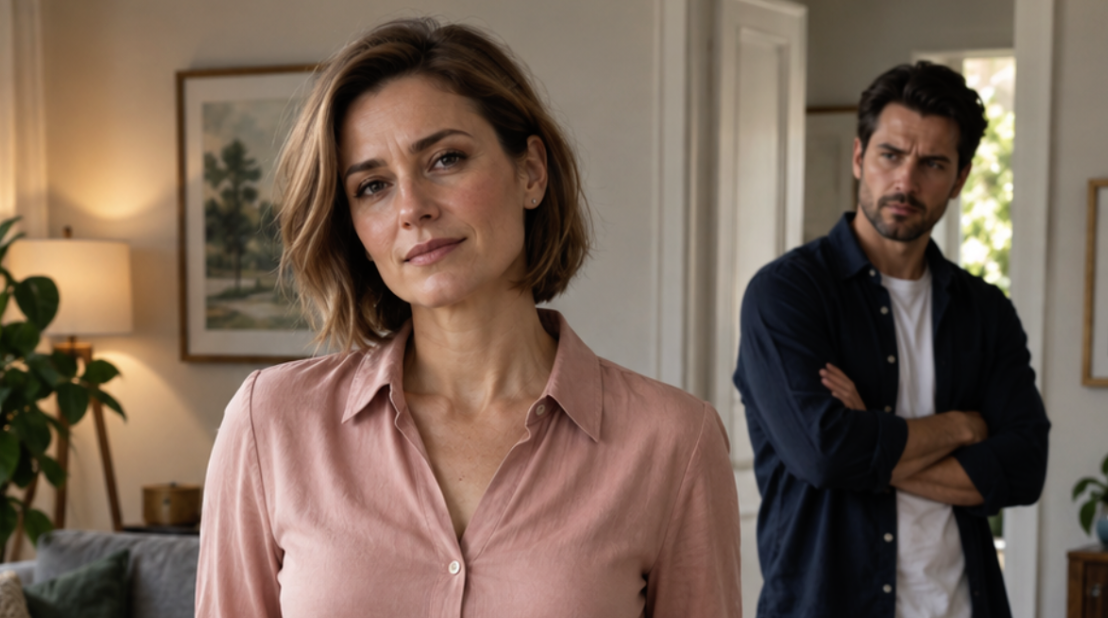
Alena returned from the theater around eleven, hoarse after arguing with the director throughout the rehearsal. She was a lighting designer, and since her promotion, the entire lighting department had rested on her shoulders: equipment, shifts, schedules—and the premiere was only two weeks away. Igor was waiting for her at home, as usual, sitting in an armchair with a laptop on his knees and the expression of a man who believed everyone owed him something.
“Sit down. We need to talk,” he said. “Mom sold her house. She has the money, but she has nowhere to live. She’s moving in with us.”
“What do you mean, with us?” Alena had not even had time to take off her coat. “Into our two-bedroom apartment, where we have my office and our bedroom? You discussed this with her, and you’re only telling me after everything has already been decided?”
“What is there to discuss?” Igor finally looked at her, boredom in his eyes. “She’s my mother. She’s sixty-two. You can stay with your mother, Nina Sergeyevna, for a while. She has plenty of room. Mom and I will sort things out here and get settled.”
Alena slowly hung her coat on the hook. Anger rose inside her, heavy and humming like an overloaded transformer. She had supported this family for seven years. She paid the mortgage, the bills, and the utilities. Igor worked freelance, drawing illustrations for publishing houses, and earned just enough to cover his coffee and his inflated ego.
“Please say that again,” she asked in an unnaturally calm voice. “You’re suggesting that I move out of my own apartment—the apartment whose down payment came from my savings and whose mortgage is paid from my salary—to make room for your mother.”
“Don’t start talking about money,” he said with a grimace. “I’ve told you a hundred times: in a family, it doesn’t matter who earns how much. We share everything equally—the joys and the hardships. This is a hardship, and we need to share it.”
“Equally?” Alena gave a bitter laugh. “The only thing we share equally is your surname appearing on my bills. I’m not moving out, Igor. This is my home, and I will decide who lives here.”
He snapped his laptop shut and stood up. His face filled with injured indignation—the carefully rehearsed kind he usually displayed when begging her for money for a new tablet. But this time, something new had been added to it: arrogance, brazenness, something almost alien.
“Even if the apartment belongs to you, my mother is still going to live here,” he enunciated. “I’ve made the decision. You’re my wife, not some landlady. If you resist, you’ll only make yourself look like a selfish woman throwing an old lady out onto the street.”
“An old lady with the money from the house she sold,” Alena clarified. “Enough to rent a perfectly good apartment or buy a studio. But why spend her own money when she can squeeze her daughter-in-law out and move into a fully furnished home, right?”
“You’re cynical,” he snapped before walking into the bedroom.
Alena remained in the hallway. She stood there listening as her husband called his mother to report that “that woman” was being stubborn. And suddenly, everything became perfectly clear: she had spent seven years building a home while someone beside her had been digging a tunnel underneath it the entire time.
Tamara Ivanovna arrived two days later, on Saturday at ten in the morning. She brought two suitcases, three plaid bags, and the triumphant expression of a conqueror entering a captured city. Igor fussed around her, taking her luggage and gazing eagerly into her eyes.
“Well, hello, dear Alenochka,” her mother-in-law said, entering the room like an inspector. “Don’t make a scene. Behave with dignity. My son and I have already settled everything. I’m no longer young, and I’m unwell, so I need the larger room. You’ll clear out your office. Why does a woman even need an office? It’s ridiculous.”
“Good morning, Tamara Ivanovna,” Alena said without moving. “Who settled it? Please name those people, because the owner of this apartment made no such decision.”
“Oh, here we go,” her mother-in-law said, rolling her eyes as she lowered herself onto the sofa and adjusted a cushion like the lady of the house. “Listen to her, Igor! ‘The owner.’ My dear, decent families don’t wave property deeds in each other’s faces. Everything belongs to everyone in a family. That’s what my late husband taught me, and that’s how my mother lived.”
“A wonderful principle,” Alena said with a nod. “Then let’s begin with you. Where is the money from the sale of your house? If everything is shared, put it on the table, and we’ll discuss how the family should use it.”
Tamara Ivanovna choked. Igor froze with a bag in his hands, looking back and forth between his mother and his wife. The silence that followed was long and extremely revealing.
“My money belongs to me,” her mother-in-law said sharply. “It’s for my old age, my medical treatment, and my funeral, God forgive me. Don’t start drooling over other people’s property. Look at you, quick off the mark!”
“There.” Alena raised one finger. “Remember that phrase, Tamara Ivanovna: ‘What is mine belongs to me.’ Now it’s my turn.”
She left the room and returned with a transparent document folder. She laid the purchase agreement, property-register extract, and mortgage contract on the table, sheet by sheet, just as she arranged lighting scores before a premiere—calmly, methodically, without a single unnecessary movement.
“Let’s read. I am the sole owner. The down payment came from my savings; here is the bank statement. The mortgage payments came from my account for eighty-four consecutive months. Your son’s name does not appear anywhere in these documents except under ‘registered place of residence.’ Your name does not appear at all.”
“She’s shoving pieces of paper in my face!” Tamara Ivanovna raised her voice. “Using paperwork against her own family! I’ve lived for forty years, and I know this much: once people start pulling out documents, there is no family left! It isn’t decent to divide things into ‘mine’ and ‘yours’!”
“Who is dividing anything, Tamara Ivanovna?” Alena leaned forward slightly. “I live in my apartment and don’t bother anyone. You’re the one who arrived with suitcases to divide up my living space. You’re the one who decided to evict the owner from her own home. I suggest you take a good look in the mirror.”
“Igor!” His mother turned toward him. “Do you hear how she’s speaking to your mother? Are you a man or a piece of furniture? Say something to her!”
Igor’s face turned purple, and he stepped toward the table. He would have swept the documents onto the floor if Alena had not covered them with her hand. The look in her eyes made his arm freeze in midair.
“I wouldn’t advise it,” she said quietly. “These are copies. Now both of you listen to me. Tamara Ivanovna, you will not live in this apartment—not temporarily, not permanently, and not ‘until you find something else.’ You have the money from your house. Rent or buy somewhere—it is your right. Igor, you are still registered here and still my husband, so you may stay for now. But I’ve said ‘still’ twice, and neither time was accidental.”
“Are you threatening me?” Igor gasped indignantly. “Me? In my own home?”
“In mine,” Alena corrected him. “In my home, Igor. You’ve confused those pronouns for seven years, and I’ve kept silent for seven years. That’s enough.”
Tamara Ivanovna rose from the sofa, angrily tugged her cardigan straight, and demanded that Igor take her to “decent people.” He drove his mother to a rental apartment that had to be found hastily through acquaintances—at his expense, or rather, with an advance he had begged from a publishing house. He carried her suitcases in silence, and for some reason, his anger was directed not at the mother who had created the entire circus, but at the wife who had refused to be its audience.
He returned alone that evening. Alena was sitting in her office, revising the lighting score for the second act. Work kept her from wanting to smash something, and she had no intention of breaking anything on principle. Igor stood in the doorway, his arms folded across his chest, bristling with injured pride.
“Happy now?” he began. “You humiliated my mother in front of me. You humiliated me in front of her. Do you understand what kind of choice you forced me to make? Mother or wife? Decent people don’t do that.”
“You made the choice,” Alena said without turning away from the monitor. “The day before yesterday. When you told me that your mother would live here even if the apartment belonged to me. At that moment, you chose your mother’s convenience over respect for your wife. I merely announced the score.”
“You’ve changed,” he said bitterly. “You used to be gentle and homely. Now it’s paperwork, spreadsheets, ‘mine and yours.’ Your career has ruined you. Mom was right about you from the very beginning.”
“I haven’t changed, Igor.” She finally turned around in her chair. “I’ve simply stopped keeping quiet. I wasn’t the one who was soft—your life was soft because I paid for it. Commissions whenever you ‘felt inspired,’ vacations paid for with my bonuses, and the mortgage—‘Darling, you understand, my income is unstable.’ I understood. I understood for seven years. Not anymore.”
“And what now?” He gave a crooked smile. “You’ll divorce me? Don’t make me laugh. What will you do without me?”
“Did you seriously just ask me that?” Alena stood up. “What will I do without a man who eats the food I buy and tells me to move in with my mother? Probably the same things I’ve always done: go to work, make the mortgage payment, and come home. Only without the dead weight. I’ll file the papers tomorrow at lunchtime, between the technical setup and the rehearsal. I’ll have time.”
He did not believe her.
He continued not to believe her for another two weeks—when she filed for divorce, when she placed his belongings in neat piles in the hallway, and when she changed the lock the day after the divorce became final. He called, made demands, appealed first to her pity, then to her conscience, and finally to their “seven years together.”
Alena always gave the same answer:
“Everything has been said. Any property-related questions must be submitted in writing.”
There were no property-related questions, however. The lawyer Igor visited for a free consultation listened to him for five minutes and spread his hands helplessly. The apartment had been purchased during the marriage, but the down payment had come from his wife’s premarital savings, all the mortgage payments were documented as coming from her accounts, and the husband’s contribution to the household budget was a figure approaching zero. He could sue, but he could not win.
“Can’t I at least claim a share?” Igor persisted.
“You may claim anything you like,” the lawyer said with a yawn. “Obtaining it is where things become more difficult. Go home, young man. Oh, that’s right—you don’t have one anymore.”
Author: Vika Trel © 5651
Igor arrived home—that is, at the rented apartment where Tamara Ivanovna had settled—as furious as a wasp trapped inside a glass. His mother greeted him with complaints about her blood pressure and her ungrateful daughter-in-law, but for the first time in his life, her son interrupted her before she could finish her second sentence.
“Enough!” he roared. “Do you understand what you’ve done? I had a wife. I had an apartment where I lived without paying a single penny. I had everything! Then you arrived with your suitcases, and one month later I’m divorced, homeless, and paying twenty-eight thousand for this dump!”
“Me?” Tamara Ivanovna pressed her hands to her chest. “I went to live with my son, my own flesh and blood! She destroyed everything—that snake of yours! A normal wife would have welcomed her mother-in-law and bowed at her feet!”
“At your feet?” Igor laughed angrily, the sound harsh and barking. “For what, Mom? For teaching me since childhood that ‘a woman should work herself to death while a man should have character’? Well, now I have character—and no wife and nowhere to live! You know what? You have the money from your house. More than four million. Buy an apartment here and put half of it in my name.”
“What?” His mother almost jumped to her feet. “Half? For you? Why on earth would I do that?”
“Because I lost everything because of you!” He slammed his palm against the table. “You owe me, Mom! You arrived, and my entire life fell apart! Give me half the apartment, and perhaps I’ll agree to forget who was responsible!”
“You insolent bastard.” Tamara Ivanovna narrowed her eyes, and at that moment, it became obvious exactly where Igor had inherited his grasping nature. “He wants half! Then you’ll marry some woman, and she’ll force me out of my own half? Absolutely not, dear son. The money is mine. What is mine belongs to me.”
“Your own school of thought!” Igor shouted. “Your own words! ‘Everything is shared in a family,’ remember? A month ago, when you were in someone else’s apartment, you sang about everything being shared. But the moment your own pocket is involved, it becomes ‘mine’?”
“That was someone else’s apartment, but this is my hard-earned money!” his mother snapped. “And don’t shout at me. I’m not your patient Alena! A share, indeed! Fifty percent! Get a job, you freeloader. You’re a thirty-nine-year-old man!”
The resulting argument was appalling and included a detailed inventory of grievances dating back to 1993. Igor reminded his mother how she had broken him up with his first girlfriend while he was still at university. Tamara Ivanovna reminded her son that she had supported him until he was thirty and that he had “squandered” her pension money on drawing courses.
They retreated to separate rooms as enemies. The next morning, they pretended that nothing had happened—until the following evening, when the whole thing began again.
It continued for three weeks. Igor methodically pressured her, sometimes gently—“Mom, just think about it; we’ll live together”—and sometimes harshly—“If you don’t give me a share, I’ll put you in a nursing home.”
As Tamara Ivanovna endured this emotional seesaw, she drew her own conclusions. Her conclusions were always swift and ruthless.
She secretly called a real estate agent named Svetlana Arkadyevna after finding her advertisement. She called from a pharmacy so Igor would not hear. On weekdays, she viewed studio apartments while her son slept until noon after spending his nights playing tank games.
A month later, the transaction was completed: twenty-six square meters on the third floor, with Kuznetsova Tamara Ivanovna listed as the sole owner.
“Should we register it only in your name?” Svetlana Arkadyevna asked, placing the documents in front of her. “We’re not adding or registering anyone else?”
“Only in my name.” Tamara Ivanovna pressed the pen so hard against the paper that she nearly tore it. “No sons and no shared ownership. I’ve learned my lesson.”
She moved out on Thursday while Igor was meeting with a client—a phenomenon as rare as an eclipse. She packed the same two suitcases and three plaid bags, called a cargo taxi, and left a note on the table:
“The rent has been paid until the end of the month. After that, you’re on your own. Mom.”
She silenced her phone the moment the door closed behind her.
Igor returned to the empty rented apartment that evening and spent five minutes trying to understand what had happened. Then he saw the note, read it at least five times, and dialed his mother’s number. The ringing disappeared into silence—one call, then another, then ten, then twenty.
“She ran away,” he said aloud, his voice breaking. “My own mother. She ran away like a tenant escaping her debts.”
He paced around the room, kicking a bag of his belongings. The rent was twenty-eight thousand, the utilities another six, and the commission he had traveled across the entire city to discuss that day had fallen through.
Then an idea came to him—one that seemed brilliant. With his mother gone, the source of the conflict was gone too. That meant he could return to Alena, repent, blame everything on the old woman, and start living like a normal human being again.
In other words, at Alena’s expense.
He bought a cheap bouquet on the way and appeared at his ex-wife’s apartment at nine that evening. He spent a long time rehearsing his expression in the elevator: sorrowful but manly. He rang the doorbell—his former door, now fitted with a new, unfamiliar lock.
Alena opened it as far as the security chain allowed. She looked at him, at the bouquet, and at his sorrowful yet manly expression. Her own face did not change by a fraction.
“What do you want?” she asked.
“Alena, I understand everything now,” he blurted out. “Mom left. I’ve cut her out of my life. She’s a monster, and you were right about everything. Let’s talk. Let me in for five minutes, I—”
“Go away,” Alena said, and closed the door.
That was all.
No argument, no explanations, no opening for negotiation. Igor stood on the landing holding his bouquet and listened as the lock clicked behind the door and her footsteps receded. He rang the bell again—silence. He knocked, and Alena’s calm voice came from behind the door:
“I’ll call the police.”
He left because even his self-confidence was not strong enough to continue.
That night, he sat alone in the empty rented apartment and cursed everyone in turn. He cursed his mother for arriving with her suitcases and crushing his family like the treads of a tractor. He cursed his wife for divorcing him and “throwing him out onto the street,” even though the street was actually a perfectly serviceable apartment—he simply had to pay for it himself now.
He did not curse himself. In his view of the world, there was not a single reason to do so.
“Twenty-eight thousand,” he muttered while scrolling through job vacancies on his phone. “I can’t manage that alone. Maybe I should work as a courier… Look how far I’ve fallen. Thank you, Mommy. Thank you, wifey. You’ve both cornered me.”
Twenty minutes away, in her brand-new studio apartment, Tamara Ivanovna was arranging cups on a shelf and delivering her own accusatory monologue. She had no audience, but that had never stopped her.
“He wants a share,” she grumbled, dragging a stool noisily across the floor. “Fifty percent! Look what I raised—a business partner. My own son trying to shake his mother down for a share of her apartment. Who has ever heard of such a thing? He’s just like his father. That man divided everything too, until he finally divided himself from the world with a bottle.”
She sat down on the stool in the middle of her twenty-six-square-meter kingdom and surveyed it: the kitchen two steps from the bed and a bathroom too cramped to turn around in. This was not how she had imagined her grand city adventure. In her dreams, she had occupied the large room in her daughter-in-law’s apartment, enjoyed meals served on schedule, and raised grandchildren properly—not the way “those people” would have.
“And she’s no better,” Tamara Ivanovna continued, turning her attention to her daughter-in-law. “That snake with her documents. What would it have cost her to make a little room for me? She could have stayed with her own mother for a while. It wouldn’t have killed her. But no—‘owner,’ ‘property register.’ She divorced my fool and is probably celebrating now. I hope… I hope her premiere is a disaster.”
The premiere was not a disaster.
It was brilliant.
A critic from the city newspaper described the lighting in the second act—the same lighting Alena had been revising on the evening of her decisive conversation with Igor—as “a character in its own right.”
After the curtain call, Oksana, the assistant director and the only person at the theater who knew the entire story, approached her.
“Well, Madam Homeowner,” Oksana said, handing her a cup of juice from the refreshment stand. “Have you heard the news? Apparently, your ex came to see you with flowers. The entire courtyard is talking about it.”
“He did,” Alena said with a nod. “I asked what he wanted, told him to leave, and closed the door. The whole conversation lasted seven seconds. The most meaningful seven seconds of our seven years together, by the way.”
“And you didn’t feel even the slightest tug at your heart?” Oksana asked, narrowing her eyes.
“I did,” Alena admitted. “Anger. That man seriously believed he could return to a ready-made life simply by changing whom he blamed. Now his mother is the monster, can you imagine? A month ago, I was the monster because I refused to surrender my office to her.”
On Sunday, Nina Sergeyevna arrived—Alena’s small, energetic mother, carrying a jar of pickles and an opinion about everything in the world. She walked around the apartment, looked into the former bedroom that had become a guest room, and inspected the office, which now held two monitors and a drafting table.
“It’s much better now,” she pronounced. “Spacious. You can breathe. And he told you to come and live with me, remember? When I found out, I was furious for an entire week. Imagine coming up with something like that: throw out the wife and put Mommy in her place. What a strategist.”
“A strategist without a support base,” Alena said with a smile as she divided the pickles among smaller jars. “His mother moved out secretly, and I wouldn’t let him back inside. Now he’s sitting there, calculating the rent. You know, Mom, I spent a long time wondering whether I was cruel or right. I finally decided that I was right—and that I had finally become angry. It turns out that’s a very effective combination.”
“The most effective combination there is.” Nina Sergeyevna wiped her hands on a towel. “Being kind and silent—that’s the fatal combination. I wasted half my life that way with your father. And don’t worry about family. You have a family: me, your work, and your home. Everything else will come if you want it to. And if you don’t, life is perfectly good as it is.”
That evening, Alena remained alone in the spacious two-bedroom apartment—hers, down to the very last nail.
She spread the lighting plan for a new production across the drafting table and switched on the lamp. Somewhere in the city, her ex-husband was calculating other people’s money and cursing two women who had refused to support him. Somewhere in a studio apartment, her former mother-in-law was berating her son and daughter-in-law while carefully avoiding her own reflection in the dark television screen.
But here, everything was quiet and right.
Alena drew the first line with her pencil—a beam of light falling sharply onto the stage from the left, honest and free of shadows or ambiguity. That was the kind of light she now preferred, both onstage and in life.
And she did not regret a single second of those seven seconds that had made up her final conversation with Igor.
THE END