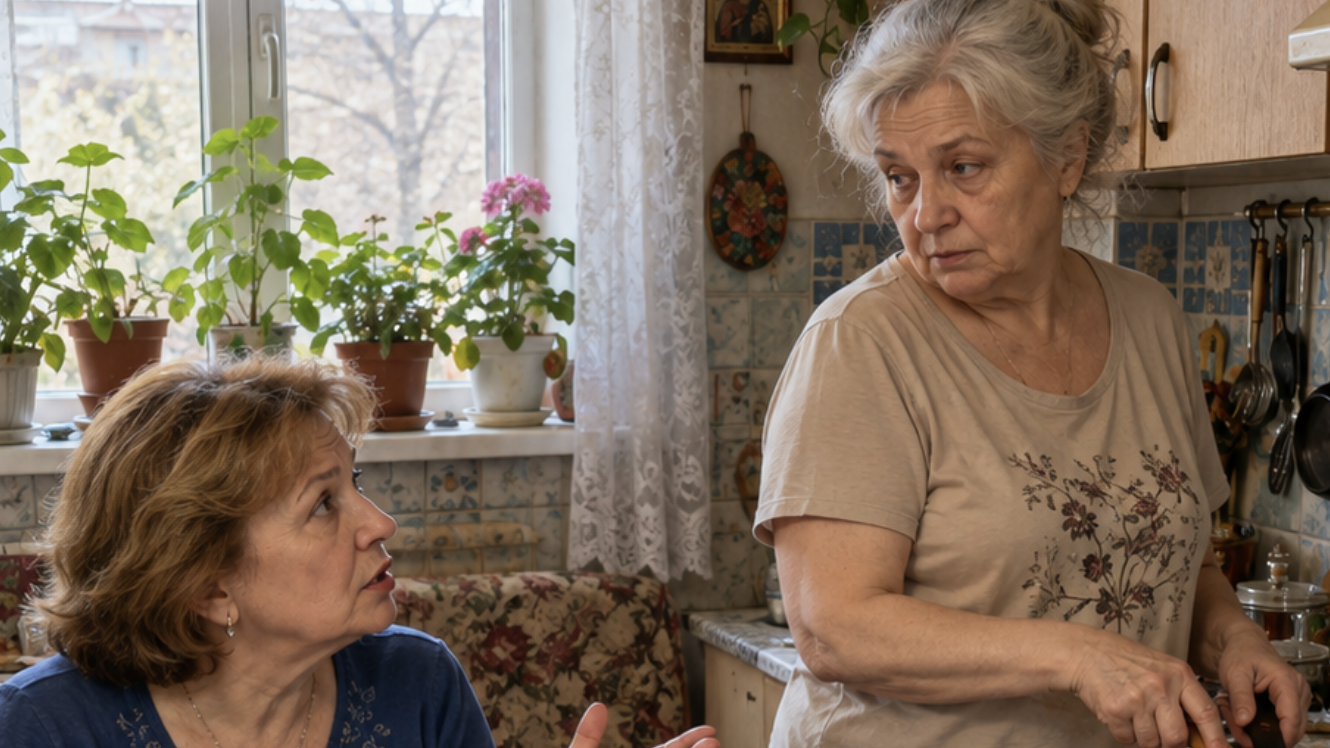
Olga Vasylivna counted the money in the envelope marked “Electricity, Gas” for the third time. The numbers still did not add up. She smoothed each banknote with her palm, as though that might somehow make the money multiply, and put it back into the envelope.
Four hundred hryvnias.
There were still nine days until her pension arrived. And in the refrigerator was half a chicken she had been saving for tomorrow’s lunch for the guests.
Just a week earlier, that envelope had been thick. Just a week earlier, their one-room apartment in Podil had been quiet, and Olga’s biggest concern had been whether she had enough jars for the lecho.
That evening, she was sealing the last jar.
The kitchen smelled of peppers and garlic, the window had fogged up, and Stepan was dozing in an armchair with the evening news playing in the background.
The doorbell suddenly rang, long and insistently, as though someone had leaned an elbow against the button.
“Styopa, are you expecting someone?” Olga asked, wiping her hands on a towel.
“No…” He jumped up, squinting sleepily. “Maybe it’s the downstairs neighbor complaining about the radiator again.”
But it wasn’t the neighbor.
Standing in the doorway was Vika, Stepan’s cousin from a small settlement near Lubny, wearing a wide-brimmed red hat. Behind her towered a wheeled suitcase large enough for a month-long seaside vacation. A little farther back stood her husband, Vadym, shifting from foot to foot with two plaid travel bags.
“We’ve come to see you!” Vika exclaimed, already throwing her arms around Olga and surrounding her with the scent of sweet perfume. “You weren’t expecting us? Even better! It’s more exciting that way!”
“Vika! Vadym!” Stepan spread his arms. “Why didn’t you tell us? I would’ve come to the station.”
“What do you mean, we didn’t tell you?” Vika raised her eyebrows indignantly. “I called you on Sunday! I said, ‘Styopa, we’re getting ready, expect us.’ What did you think I meant?”
“I thought you were joking,” Stepan said, scratching the back of his head. “Who leaves their vegetable garden in August?”
Olga silently looked at the suitcase.
Then at her husband.
For some reason, he was staring at the floor.
It was ten at night, but you couldn’t send guests to bed hungry after a long journey. Olga took out some eggs, sliced bread, and opened a jar of pickles she had been saving for a special occasion.
“Sit down. Tell us what brings you here.”
“Oh, Olga, you make it sound like an interrogation already,” Vika laughed, taking up half the kitchen. “We missed you. We’re family. You only live once, and we see each other once every five years.”
“That may be true,” Olga said, placing the frying pan on a wooden board. “But we only have one room. Where am I supposed to put you?”
“We just need a little corner!”
“I’m not making you sleep on the floor. We’ll unfold the sofa here in the kitchen. It’ll be cramped, but we’ll manage. You’re only staying for a few days, right?”
“Three,” Vika nodded, exchanging a strange glance with Vadym.
That night, Olga lay awake for a long time.
The refrigerator hummed behind the wall. Vadym’s snoring drifted in from the kitchen.
“Styopa,” she whispered. “People don’t travel with a suitcase like that for three days.”
“Don’t invent things. They wanted to spend some time in the city.”
He turned toward the wall far too quickly.
Olga had known her husband for forty-two years.
She knew exactly how he turned away when he was hiding something.
He had done the same when he borrowed money from his godfather for a “profitable business” involving the resale of spare parts.
And again when it turned out there had never been any business at all.
Ever since Stepan retired from the motor depot, he had struggled to accept that every hryvnia now had to be counted. He kept believing that sooner or later some miraculous opportunity would appear and restore the life they used to have.
But the only things that kept appearing were new debts.
Olga got up at six in the morning, as always, and stopped in the hallway.
She couldn’t get into the kitchen because the guests were sleeping there.
She stood for a moment, listening, then quietly returned to the room.
They’re country people, she thought. Surely they’ll be up with the sunrise.
Vika finally appeared at half past eleven, wearing a robe and with her hair sticking out in every direction.
“What wonderful sleep you get here! No rooster, no cow, no neighbor banging buckets around at five in the morning. Now this is life.”
Olga silently placed a plate of omelet and sandwiches in front of her.
“That’s it?” Vika poked at the food with her fork. “Olga, you’re a city hostess. I thought you’d treat us to something special. Some meat, some salads, something proper.”
“We live simply, Vika.”
“I can see that,” Vika said, grimacing. “Never mind. You’ll make an effort for lunch.”
Olga felt her cheeks burning.
Should she tell her that they barely had anything left until the pension came?
That Stepan owed money to half the garage cooperative?
She couldn’t bring herself to say it.
As soon as the guests left to walk in the park, Olga threw on a cardigan and knocked on the door of her neighbor on the third floor.
Raisa Ivanivna opened the door wearing glasses, a crossword newspaper in her hand.
“Raisa Ivanivna, I’m so embarrassed… Could you lend me some money until my pension comes? We have guests. Stepan’s relatives. They want everything done properly.”
Without saying a word, the neighbor walked to the display cabinet, took a wallet from underneath a porcelain ballerina, and counted out some money.
Then she held Olga’s hand for a moment.
“I’ll lend it to you, dear. But listen to an old foolish woman. People who show up unannounced with suitcases and then start ordering from the menu didn’t come just to visit. Tell them the truth.”
“I can’t. I’m ashamed.”
“You’re not the one who should be ashamed,” Raisa Ivanivna sighed. “Fine. But keep your eyes open.”
That evening, the table was overflowing with food.
Olga roasted pork with prunes, made Olivier salad, dressed herring under a fur coat, and prepared a liver salad.
Vika ate, praised everything, and helped herself to seconds.
Then she leaned back in her chair and sighed dreamily.
“Everything is delicious, Olga. But with tea, I’d really love a Kyiv cake. A real one, with nuts. We are in the city, after all.”
The following day, Olga went to Raisa Ivanivna again.
Then to the store.
The cake cost as much as Olga normally spent on groceries for an entire week.
She carried the box home by its string handle and thought about the winter boots she had been saving for since spring.
The boots would have to wait.
That evening, Stepan announced with a glowing smile:
“Vika and Vadym are staying another week! Isn’t that wonderful?”
Olga leaned against the doorframe.
“Styopa dear,” Vika said, already holding her cousin by the arm, “my back is killing me from that kitchen sofa. Maybe Vadym and I could sleep in the bedroom, and you two could take the kitchen? They say even the walls help you when you’re at home.”
“Of course!” Stepan replied without even looking at his wife.
Silently, Olga took clean sheets out of the wardrobe and made up her own bed for the guests.
The bed she had slept in for forty years.
The kitchen sofa really did sag in the middle.
Olga lay on her side, a spring pressing directly into her ribs.
“Styopa, when are they leaving?” she whispered. “We barely have money left for bread. I’ve already borrowed from Raisa twice.”
“Olga, don’t start. Let them eat properly for once in their lives.”
She was about to answer when voices came from the bedroom.
The door there had never closed properly ever since the building settled.
“Just a little longer,” Vika whispered. “On Thursday Styopa will sign everything, and the apartment will be ours. We’ll sell it and move to Kyiv.”
“What about Olga?” Vadym muttered.
“What about her? Olga has kept quiet her whole life. She’ll keep quiet this time too.”
The spring no longer bothered her.
Olga stopped feeling anything at all except a coldness rising from her feet all the way to her throat.
So that was why they had brought the suitcase.
The next morning, as soon as the guests left for the market, Olga locked the door with both locks and sat across from her husband.
“What are you supposed to sign on Thursday?”
At first, Stepan put on a confused expression.
Then he looked at her.
And deflated like a punctured ball.
His explanation was long and confused.
Vika had called him in the spring and proposed a “profitable exchange”: their apartment in exchange for her house in the settlement, with a garden, plus an additional payment.
That extra money was supposed to cover all his debts.
“A house with a garden, Olga,” he muttered. “Fresh air. I thought you’d like it…”
“And you didn’t think to ask me?”
He said nothing.
“They want to throw us out of our own apartment, Stepan. Do you understand that?”
He covered his face with his hands.
Olga looked at the gray crown of his head and couldn’t decide what she felt more strongly—anger or pity.
“Where is the notary?”
The notary’s office was on the ground floor of a five-story building on Sobornosti Street.
Olga arrived by minibus half an hour early.
Vika and Vadym were already sitting in the corridor on faux-leather chairs.
“Oh, Olga!” Vika jumped up. “We’re just here dealing with some business of our own…”
The office door opened.
A young female notary wearing glasses smiled pleasantly.
“Come in. Everything is ready. All that’s left is to sign.”
Olga entered first.
She sat down.
Then asked to see the documents.
The notary looked slightly surprised but handed her the folder.
Olga read slowly, tracing each line with her finger the way she had once taught her grandchildren to read.
The apartment in Podil.
To be exchanged for a residential house in the settlement.
Olga knew that house. She had been there for Vika’s wedding. The roof had leaked even then, and after all these years, there were probably little more than walls left.
And beneath the documents was the wife’s consent to the disposal of jointly owned property.
With Olga’s surname.
With Olga’s signature.
Except she had never signed it.
“Interesting,” Olga said, raising her eyes.
Her voice was so calm that even she was surprised.
“I didn’t sign this. And this is the first time I’ve ever seen it.”
The notary went pale and reached for the phone.
“Olga, we were only trying to do what was best…” Vika was already standing in the doorway, the color draining from her face. “We were doing it for you…”
“That’s enough, Vika,” Olga said, standing up. “Listen carefully. You are leaving today. Otherwise, right now, together with the notary, I’ll file a report with the police about this piece of paper.”
Vadym was the first to head for the exit.
Vika opened her mouth as though she wanted to say something else, but then looked at the notary, who was already dialing a number, and hurried after him.
When Olga returned home, the red hat was gone from the hallway.
So was the suitcase.
Half of the Kyiv cake sat unfinished on the kitchen table, and on top of the refrigerator lay the key Stepan had given Vika.
Stepan sat on a stool by the window.
Hunched over in his old shirt, he seemed smaller than he really was.
“Olga… forgive me. I’m a fool.”
She remained silent for a long time.
Then she placed a hand on his shoulder.
“You are. But you’re my fool. The important thing is that we’re still in our home. We’ll fix the rest somehow.”
Olga made an arrangement with a young family from the first floor: three times a week, she would pick up their son from kindergarten and stay with him until evening.
The little boy called her Grandma Olga and was teaching her how to play checkers.
And to Stepan, she said only once, calmly, over dinner:
“No more profitable business schemes. No more loans behind my back. We live on what we have.”
“I promise,” he said.
And for the first time in a long while, he didn’t turn away.
Olga repaid Raisa Ivanivna along with a jar of lecho.
The two women sat in the neighbor’s kitchen drinking mint tea.
“You were right,” Olga said. “Relatives aren’t always your own people. You shouldn’t look at how many hugs they bring with them. You should look at how many suitcases.”
Outside the window, the lights of Poltava were coming on.
Life went on—quieter, more modest, but honest.