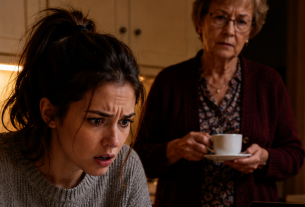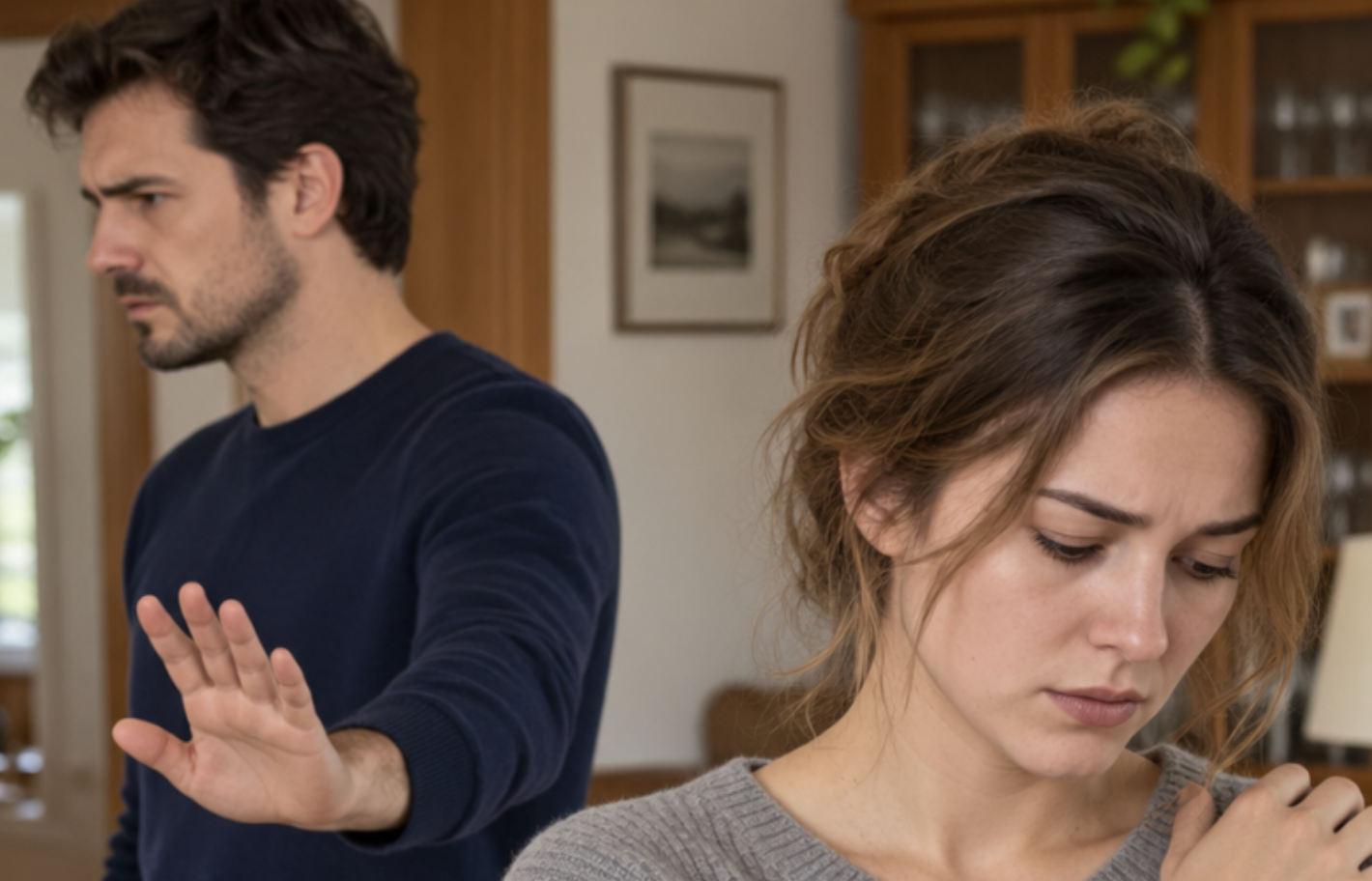
— Veronika, why are you sitting there like a stranger? — Tamara Igorevna set a plate of aspic in front of her. — Eat. We’re not going to poison you.
— Thank you, I’m eating, — Veronika smiled gently, the way people smile in someone else’s home when they want everyone to be comfortable. — It’s really delicious.
— Oh, sure it is, — Alina snorted from the other end of the table. — She eats like a little bird. Peck at a blade of grass and she’s full.
Artyom sat beside Veronika, shoulder to shoulder, folding his napkin into a tiny accordion. He always did that when tension began crackling through the room. Veronika lightly touched his knee under the table, as if to say, It’s fine. I can handle it.
— Tamara Igorevna, congratulations again, — she said. — I hope everything in your life will be peaceful and joyful.
— Peaceful, — the woman pursed her lips. — I’ll have peace when my children are settled. Alinka and Rodion are drifting from one rented place to another, giving half their earnings to God knows who. Meanwhile, you have two rooms sitting empty.
— They’re not empty, — Veronika set down her fork. — We live there.
— The two of you live there, — Alina snapped. — While the two of us live in a room with mold. Do you see the difference?
— Alina, I do see the difference, — Veronika spoke evenly, gently, almost affectionately. — But my apartment isn’t made of rubber. And it isn’t a hotel.
— Yours, — Tamara Igorevna repeated the word slowly, as though testing its strength. — Artyom, did you hear that? Your wife says “my apartment.” What are you there, a tenant?
Artyom jerked his neck, cleared his throat, and reached for the salad. Veronika waited. She waited for one single word, something simple and short, something for which she could forgive everything afterward.
— Mom, come on, enough. It’s a celebration, — he mumbled.
— A celebration, — Tamara Igorevna agreed. — That’s exactly what I’m talking about. At my age, I’d like to know that my son lives in his own home instead of being there on someone else’s terms.
— He lives in our home, — Veronika said. — I brought him there, gave him a key, and I’ve never taken away any of his rights.
— Brought him! — Alina slapped her palm on the table. — Did you hear that, Rodion? She brought him in. Like a puppy she picked up off the street.
— That’s not what I said.
— That is exactly what you said, — Tamara Igorevna narrowed her eyes. — None of us here are deaf.
Veronika looked at her husband. He was poking through his salad with his fork, picking out peas one at a time, his face looking as though he were solving a complicated math problem about trains.
— Artyom, — she called quietly.
— What? — he asked without looking up.
— Tell them.
— Tell them what?
— The truth. Any truth at all.
At last he lifted his head, looked around the table, and said the words that made everything inside Veronika turn cold and very quiet.
— Guys, come on. Why are you making such a big deal out of this? We’ll figure it out. We’re family.
— You’ll figure it out, — Tamara Igorevna nodded with satisfaction and turned to Veronika. — So figure it out. Just remember: in our family, we believe in fairness. One for all.
— Fairness means not reaching for what belongs to someone else, — Veronika said.
— Ah, so it belongs to someone else, — the woman slowly set down her shot glass. — Rodion, remember this: you get married, and suddenly you’re a stranger. That’s the new fashion.
— I’m not talking about people, — Veronika breathed evenly and patiently, the way people are taught to breathe when they want to stand up and leave. — I’m talking about square meters. You aren’t strangers to me. But those square meters are mine.
— Your grandmother’s, — Alina corrected her. — Everything was handed to you on a silver platter, and now you’re acting superior.
— Yes, I inherited it. And I’m still grateful to my grandmother for it. I visited her every day during her final years, brought her medicine, painted the walls myself. Where were you then, Alina?
— I was a child!
— You were an adult, — Veronika said calmly. — You were simply busy.
Her mother-in-law slowly and ceremoniously wiped her lips with a napkin.
— Artyom, — she said. — Are you really going to sit there and listen while your wife drags your mother and sister through the mud?
Veronika turned toward her husband. One sentence. Just say: “Nobody is attacking anyone. Leave her alone.”
— Mom, seriously, — Artyom said. — Veronika, you too… why do you have to say things like that?
That was it.
She carefully folded her napkin, placed it to the left of her plate, and gave her husband a long, very attentive look.
— I understand, — she said.
They drove in silence through two intersections. Artyom was behind the wheel, tapping his thumb against it, until finally he couldn’t stand it anymore.
— Why are you sulking?
— I’m not sulking. I’m thinking.
— About what?
— About you, — Veronika answered honestly. — For the second hour in a row.
— Listen, they didn’t mean anything bad. You just answer too sharply, and Mom doesn’t like that.
— What does she like? For me to nod while people treat me like a tenant in my own home?
— Nobody called you that.
— They called me greedy, an outsider, and an unwanted stray, Artyom. They used different words, but the meaning was the same. And where were you while all that was happening?
He turned into the courtyard, switched off the engine, and leaned his head back against the headrest.
— You’re exagge… — he stopped when he caught her gaze. — You take everything too personally.
— I take it personally because it’s mine, not yours.
— Nicely put, — he smirked. — Straight out of a movie.
— I’m not laughing, — Veronika turned fully toward him. — Answer one question. Why did you stay silent?
— I didn’t stay silent.
— You said, “Guys, come on.” That isn’t defending someone. That’s a sheep bleating.
— Watch your words.
— You should have watched your words at that table, — her voice hardened now, short, dry notes appearing in it. — That was where you needed to be careful. With my name. With our marriage. With what was happening inside me while I sat there smiling at your family.
— You don’t understand, — he rubbed the steering wheel with both palms. — My mother is difficult. If I contradict her, she’ll be sick for a week. Then she’ll call at two in the morning. Then she’ll sob over the phone.
— So I’m the one who’s supposed to suffer instead? Quietly and without making phone calls?
— You’re strong. You can handle it.
— Ah, so that’s it. Strong, — Veronika repeated. — What a convenient word. You can put it over someone else’s patience like a lid.
— Veronika, enough, — Artyom suddenly raised his voice. — Do you want me to choose?
— I want you to be a husband. I don’t want you to choose. I want you to act like a man.
— That’s the same thing!
— No, — she shook her head. — Being a husband means standing up and saying, “Leave my wife alone.” That’s it. That isn’t choosing. That’s normal.
— Normal for you. In our family, Mom is the one in charge.
— Then live in the family where your mother is in charge, — Veronika said quietly. — I live in a family where two people are equal. Or at least I hoped we were.
For several seconds he stared straight ahead, his jaw muscles moving under the skin. Then he said, clearly and firmly, as though hammering in a nail:
— Understand this: my mother means more to me, and this conversation is over.
Veronika nodded.
Slowly, the way people nod when they finally hear aloud what has been hanging in the air for a very long time.
— Thank you, — she said.
— For what?
— For being honest. For the first time since we’ve been together, you actually said it directly. Without “we’ll figure it out.”
— Don’t twist my words… don’t start that, — he grimaced. — I said it like it is. My mother gave birth to me, raised me, put me through school. And you—you came later.
— I came later, — she agreed. — And I can disappear just as easily.
— Here we go.
— No, — Veronika opened the door. — This isn’t the beginning. It’s the conclusion.
For three days, the apartment was filled with a steady, polite frost.
They talked about bread, water pipes, and whose turn it was to take out the trash. Veronika sat over her drawings of herbs, refining the finest veins in the leaves, and the lines came out angrier than usual.
On Thursday evening, a key scraped in the lock.
Veronika walked into the hallway and stopped.
Alina and Rodion were standing there with two enormous plaid duffel bags. Behind them, towering like a monument to herself, stood Tamara Igorevna.
— Hello, — Veronika said. — Interesting visit.
— Hello, — Tamara Igorevna unbuttoned her coat. — We won’t be staying long. Well, actually, we’ll be staying for a while, but temporarily.
— How does that work?
— Alinochka and Rodion will stay with you until they get settled.
— Who let them in?
— Artyom gave us a key, — Alina dropped one bag onto the floor. — He is the owner here too, you know.
Veronika slowly turned her gaze toward her husband.
Artyom was standing in the doorway to the room, hands in his pockets, looking somewhere off to the side.
— You made a duplicate key? — she asked.
— So what? — he muttered. — This is my home too.
— You made a copy of the key to an apartment that was gifted to me before our marriage and gave it to other people without asking me.
— Not “other people.” My sister!
— Artyom, — Veronika spoke quietly. — Do you understand what you just did?
— I helped my family.
— You reached into my pocket and pulled out a key. Do you see the difference?
— Do you hear the way she talks? — his mother threw up her hands. — Son, you married a block of stone. No pity, no heart.
— Tamara Igorevna, — Veronika turned toward her. — You are in my home. Please discuss me in the third person somewhere else.
— Ah, your home.
— My home. The documents are in the top drawer. I can show them to you right now.
— I don’t need your little papers, — the woman waved her hand dismissively. — Papers mean nothing. Here today, gone tomorrow. Blood is forever.
— What exactly are you talking about?
— I’m explaining how life works, — Tamara Igorevna smiled. — Is Artyom officially registered here?
— No.
— Then register him. That way everything will be fair. And you’ll give the back room to Alinochka. She’ll be having a baby soon. She’ll need it.
— I’m not pregnant, — Alina interrupted.
— You will be when you decide to be, — her mother snapped. — You have to plan ahead.
Veronika stared at the scene.
— Artyom, — she said. — Come here.
He approached reluctantly, slouching the way teenagers approach their parents.
— Tell them to take their bags and leave, — she asked. — Right now. This is the last time I’m asking you.
— Veronika, come on…
— “Come on” isn’t an answer.
— They’ve already come all this way! Where are they supposed to go at this hour?
— Home. Your mother has a room. Alina grew up there.
— It’s being renovated! — Alina protested.
— Then rent somewhere for a week. The world is big. There are plenty of listings.
— We don’t have money, — Alina hissed. — We’re saving.
— For what?
— Our wedding.
— Excellent, — Veronika nodded. — So you’re saving for a party, while I’m supposed to pay for your accommodation with my walls. Beautiful mathematics.
— She’s making us sound like beggars! — Alina turned toward her brother. — Artyom, are you even a man or what?
— Everyone, quiet! — he roared, then immediately lowered his voice after glancing at his mother. — Veronika, just let them stay one night. One night. We’ll decide in the morning.
— In the morning, — Veronika repeated. — And in the morning, the wardrobe arrives. Then the washing machine. Then your mother arrives with heart medicine and another speech about blood.
— Why are you being rude? — her mother-in-law bristled.
— I’m not being rude, — Veronika took her jacket from the hook and pulled out her phone. — I’m warning you. Think of it as an instruction manual.
— Who are you calling? — Artyom asked suspiciously.
— A locksmith.
— What locksmith?
— The one who will be here in forty minutes to replace my lock cylinder, — she dialed a number. — Good evening, Pyotr Sergeyevich. This is Veronika. Yes, I’m calling about your advertisement. I need it done today. Yes, urgently. I’m willing to pay the emergency fee. Write down the address.
The hallway became very quiet.
Rodion awkwardly shifted from one foot to the other and began studying the coat rack.
— Are you serious? — Artyom asked after she put down the phone.
— Completely.
— Because of the bags?
— Because of you, — Veronika said. — Because of the husband you pretend to be. You’re not a husband—you’re a sheep. The bags are only the consequence.
Pyotr Sergeyevich arrived thirty-five minutes later carrying a small toolbox and wearing the calm expression of a man who had seen everything.
He worked silently and carefully, raising an eyebrow only once when Tamara Igorevna hovered over him.
— Ma’am, please step back. You might bump my hand.
— I live here!
— You’re standing here, — the locksmith corrected her. — Ma’am, do you want two sets of keys or three?
— Two, — Veronika said. — Two will be enough for me.
Artyom stood in the doorway and watched something click quietly inside his former lock and cease to be his lock.
By that point, Alina’s bags had moved out onto the landing.
Veronika had carried them out herself, both at once, without asking anyone.
— You threw us out onto the street, — Alina said dully.
— I sent you back to where you came from. That isn’t the street. That’s your previous life.
— Veronika, — Tamara Igorevna suddenly changed her tone. It became thick and sugary. — Oh, come on. We argued. We’re family.
— We’re relatives, — Veronika corrected her. — Family means people stand up for you. Not one of you has ever stood up for me.
— Artyom did!
— Artyom folded a napkin, — she said. — A very neat little accordion. I remember. And instead of speaking, he bleated. It suits him.
After the locksmith left, only the two of them remained in the apartment.
Artyom walked into the room, sat on the edge of the sofa, and stared at his hands.
— Fine, — he said. — You won. They’re gone. Are you happy now?
— No.
— What do you mean?
— Pack your things, — Veronika pulled his travel bag out of the wardrobe and put it on the floor. — There’s a large plastic bag in the storage room if everything doesn’t fit.
He slowly raised his head as if his neck had gone stiff.
— You’re throwing me out?
— I’m letting you go. To the person who means more to you. That was how you phrased it yourself. I’m merely following through. Go on. Act on your decision.
— Those were just words!
— Words are how people communicate their decisions. You communicated yours. I heard you.
— We’re married!
— That can be fixed, — Veronika took some documents from the desk drawer and placed them neatly on the table. — Gift deed. Ownership record. Everything is in my name, everything predates the marriage. You’re officially registered at your mother’s place, so there won’t be any problems there either.
— What, you prepared all this in advance? — he stared at the papers with almost childlike amazement.
— I simply know where everything is, — she shrugged. — That’s normal in your own home.
— Veronika, — he stood and stepped toward her. — Come on, let’s talk like normal people. I lost my temper, you lost yours.
— Stop whining! I didn’t lose my temper. I spent three days being ice-cold and polite. You saw it yourself.
— My mother pressured me! You don’t understand what she’s like. She calls twenty times. She cries. She says her heart hurts.
— And you got scared.
— Yes! — he shouted. — Yes, I got scared! Happy now?
— No, — Veronika looked at him without triumph, almost with sympathy. — I’m not happy. I’m disgusted. Sickened. I thought you were a husband, but you’re a spineless rag. You were afraid of her tears and sacrificed me instead. You chose whoever shouted louder instead of the person who sleeps beside you.
— I’ll fix everything.
— How? The key has already passed through strangers’ hands. My name was already dragged across that table.
— You just don’t know how to forgive!
— I know perfectly well how to forgive, — she said. — I forgave your sister when she called me a little bird. I forgave your family when they decided where some stranger’s wardrobe would stand in my apartment. I kept forgiving until you said those words to me in the car.
— I said them in anger!
— You told the truth, — Veronika pushed the bag toward him. — You don’t forgive the truth. You simply take it into account.
He grabbed the bag, yanked open the zipper, and began throwing in clothes—shirts, his charger, his razor.
Then he stopped.
— What if I come back tomorrow and tell you I choose you?
— Then I’ll tell you that you should have done that at the table. Last Sunday. Out loud.
He left around midnight with the travel bag and the large plastic bag.
At the door, he turned around.
— Should I leave the key?
— Leave it, — Veronika nodded. — It doesn’t open anything anymore anyway.
Artyom placed the key on the shelf near the door.
Carefully, as though he were afraid to make a sound.
— You’ll call me, — he said. — In a week. You’ll cool down and call.
— I’ll call, — she agreed. — Once. To tell you when you can pick up your remaining boxes.
The door closed.
Veronika turned the new lock and stood in the silence for a moment.
Then she went back to the table, to her drawings, and worked until three in the morning. The lines came out clean, thin, and extremely precise.
Ksenia called the next morning.
— Veronik, I know everything. Alina messaged me.
— Why did she message you?
— She wants me to influence you. She says you destroyed the family because of two duffel bags.
— Tell her I didn’t destroy the family. I unplugged it because it was sparking.
— That’s a good one, — Ksenia chuckled. — How are you?
— Angry. Calm. Both at the same time.
— He’ll come back. You know that.
— Let him come back, — Veronika said. — Just not to me. There are plenty of doors in this city.
He came back four days later.
He stood on the landing holding a shopping bag whose contents clinked softly.
— Let me in so we can talk.
— Talk from there.
— Veronik, don’t humiliate me in front of the neighbors.
— The neighbors don’t care. They have their own lives.
— Mom moved me into the walk-through room, — he said suddenly. — Alina took mine. Rodion snores like a tractor. I have to leave early in the morning, and I can’t sleep.
— That’s unfortunate.
— Is that all you have to say?
— What did you expect? — Veronika folded her fingers around the door handle. — That I would cry over your walk-through room? You chose it yourself. You said she mattered more. I simply delivered you there.
— She’s driving me insane, — Artyom lowered his voice. — Every evening. “Get your wife back. Get the apartment back. Are you a man or a spineless rag?” Now apparently it’s my fault I lost you.
— How nice, — Veronika nodded. — So now I’m needed again. Not me, of course. The square meters and the peace and quiet.
— I need you!
— Artyom, — she sighed. — At that table, you could have said eight words. Eight. “Leave my wife alone, she’s the only one I have.” You chose silence. It turns out silence has a price too.
— And what’s the price?
— This, — she gestured toward the landing. — You’re outside. I’m inside. Completely fair.
He placed the bag on the floor.
— I won’t sign the divorce papers, — he said defiantly.
— You will. We don’t have children, we’re not dividing property. It’s as simple as a door hinge. And if you don’t sign, you can keep living in that walk-through room listening to Rodion snore. For a very long time. Years, if you like.
Artyom slowly lowered his shoulders.
— You’ve changed.
— No, — Veronika shook her head. — I simply stopped begging. I used to beg you to be a husband. I begged for three weeks, three months, all the years we were together. Then I realized: if you have to beg someone to stand up for you, they never will.
— My mother will call you.
— Let her call. I’m polite. I’ll listen to two sentences and say goodbye.
— She’ll say you abandoned all of us.
— Let her say it, — Veronika shrugged. — I didn’t abandon anyone. I returned everyone to where they belong. Her—her son. You—your mother. Me—my home.
He picked up his bag, stood there for another second, and started down the stairs, descending heavily, skipping every other step.
At the turn of the staircase, he stopped.
— Veronika.
— What?
— What if I had said it back then? You know, those eight words.
— We would be eating dinner right now, — she answered simply. — And laughing about those plaid duffel bags.
He didn’t ask anything else.
His footsteps faded downward, and the building’s entrance door slammed shut.
Veronika closed her own door—the new one, stiff and solid, clicking into place.
She walked into the room, switched on the lamp over the table, and spread out her sheets of paper.
There was plenty of work to do, the evening was only beginning, and at last there were exactly as many people in the apartment as she herself allowed.
A month and a half later, the marriage was dissolved.
Artyom arrived fifteen minutes late in a wrinkled shirt and kept glancing around as though he expected her to say something to him one last time.
She didn’t.
She simply put the documents into her bag, nodded to him, and stepped outside, where it was bright, noisy, and completely free.