The kettle clicked off, and in the sudden silence Dasha’s phone screamed as if someone were cutting it open. The screen showed “Tamara Viktorovna.” Kristina, sitting opposite her with a cup in her hand, raised an eyebrow and slowly set it down on the saucer.
“Your mother-in-law?” she asked.
“My mother-in-law,” Dasha said, rubbing her forehead. “Second time this year.”
“The first was New Year’s?”
“The first was when Nastya ended up in the hospital. And even then, she only called to ask whether it was contagious.”
Dasha finally answered.
The voice on the other end was as sweet as expired syrup, and the sweetness immediately made Dasha’s jaw tighten.
“Dashenka! What is this, sweetheart? Have you completely forgotten about us? I was just thinking I might drop by tomorrow. We could have a family lunch.”
“Tomorrow?” Dasha looked at the calendar as though it might save her. “Tamara Viktorovna, Stepan works until seven.”
“I’m coming to see you,” her mother-in-law snapped, and the syrup vanished. “You’re home all day anyway. Around two. Don’t bother baking a pie. I’m not coming for pie.”
She hung up before Dasha could even exhale.
Kristina leaned back in her chair and whistled.
“‘I’m not coming for pie,’” she repeated. “Dasha, that’s not a visit. That’s a confrontation.”
“But what for? In three years I’ve never said a single word against her.”
“For breathing. Listen, want me to stay? I’m very good at sitting there with a stone face and ruining people’s plans.”
“No.” Dasha slipped the phone into the pocket of her robe. “If something happens, it should stay between us. No spectators.”
“Fine.” Kristina finished her tea in one gulp and stood. “Just remember: women like that don’t come to visit. They come for property.”
That evening, Stepan was eating borscht and listening to his wife, his spoon frozen halfway to his mouth. He looked at her as if she had just announced that a bear had moved into their apartment building.
“My mother? Coming to my house?” He gave a crooked laugh. “The last time she came here was when Nastya turned one. She stayed twenty minutes and left because it was ‘too stuffy.’”
“She said she’s coming to see me.”
“I can’t make it home, Dash. We’ve got a shipment going out. There’s no way I’ll get away before seven.”
“I’m not asking you to. I’m just telling you.”
Stepan finished eating, pushed his plate away, and stared at the wall. Dasha knew that expression. He was calculating something in his head, and he didn’t like the result.
“It’s been seven months,” he finally said.
“Since what?”
“Since Aunt Nadya’s funeral. That’s what.”
Aunt Nadezhda had died in February, on a wet gray day, and only six people had come to the cemetery.
She had been the kind of woman who made her neighbors’ eyes twitch. She shouted at mail carriers, fought with the clinic staff, and cursed the children in the courtyard whenever their ball came too close.
When her health finally collapsed, the relatives disappeared into their own lives and suddenly remembered all the urgent things they had to do.
“Mother hated her,” Stepan said. “All her life. Because of some man. When they were girls, they nearly killed each other over him.”
“I know.”
“Aunt Nadya cursed her when Mother got married. Then she lived alone like an owl. She had men, but they’d run away after a month because only a deaf person could put up with her.”
“I put up with her,” Dasha said quietly.
Stepan looked at her and said nothing.
He knew what it had cost her: an entire year of walking two blocks every single day, child in hand, dealing with bedpans, pharmacies, and insults screamed after her.
He also knew about the deed of gift, and he had deliberately kept quiet about it around his mother, the way people keep quiet about matches beside a can of gasoline.
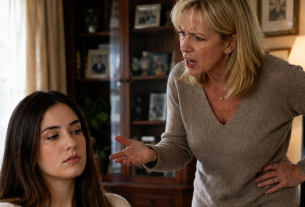
Her mother-in-law arrived exactly at two, walked into the living room, and sat in an armchair like a judge taking her place at the bench. She placed her handbag on her lap and clutched it tightly with both hands.
“Tea?” Dasha asked.
“Sit down,” Tamara Viktorovna said. “People have told me that my sister’s apartment was transferred into your name a year ago. Is that true?”
“Yes.”
Her mother-in-law slowly straightened, and red blotches began spreading upward from her neck.
“How did you persuade her?” she hissed. “How? She hated everyone! She once spat at my doorstep!”
“She offered it herself,” Dasha replied evenly, although anger was trembling inside her. “A deed of gift with her lifetime right of residence. And a separate notarized agreement stating that I was obligated to care for her. Every day. For a year.”
“An agreement!” Her mother-in-law spat the word. “You tricked a dying old woman and shoved some agreement under her nose!”
“Her notary prepared it. Not mine. And she signed it while fully competent, in front of witnesses, with a medical certificate confirming her condition.”
“She was my sister! My own sister! Blood!”
“Blood,” Dasha repeated, and felt something dark and furious rising inside her. “Where was that blood when she needed to be washed? Where were all of you when she was howling in pain at four in the morning?”
“Don’t you dare speak to me like that!”
“I’m speaking normally. You’re the one shouting in my home.”
Her mother-in-law jumped to her feet, and the handbag fell to the floor. She stood in the middle of the room, short and solid, radiating enough hatred to make the flowers on the windowsill wilt.
“That apartment was supposed to go to me. By law. I’m her closest relative.”
“It went to me. Under another law. The one involving a deed of gift.”
“You’ll sell it and live comfortably on the money!”
“I’m not selling it,” Dasha said. “And I’m not giving it away. I earned it, Tamara Viktorovna. Every single day. Three hundred and sixty-five times.”
Her mother-in-law picked up her handbag, brushed it off, and headed for the door. At the threshold, she turned around.
“You’ll regret this,” she said. “You’ll regret it badly.”
The door slammed.
Dasha stood in the hallway, counted to ten, and went to wash the untouched cups.
Stepan answered his mother’s call at work, stepping away toward the factory gates, and regretted it immediately.
“Your wife deceived Nadezhda!” the phone screamed. “She tricked a sick woman out of her apartment!”
“Mom.”
“I gave you my whole life, and now she’s left us with nothing!”
“Mom!” Stepan raised his voice. “I know about the apartment. I’ve known for a year.”
The silence was long and thick.
He could almost hear the gears in his mother’s head turning.
“You knew?” she finally breathed. “And you said nothing?”
“I said nothing because I knew exactly how it would end. And it ended exactly like this.”
“You’re a traitor.”
“I’m a husband,” Stepan said and hung up.
Then he called his wife. His voice was almost tender, in a way Dasha rarely heard on ordinary weekdays.
“Dash, you did the right thing. Don’t give them anything. It’s yours. You earned it with your blood.”
“She threatened me.”
“Let her threaten you. I’ll come home tonight and we’ll talk.”
He had barely lowered the phone when the screen lit up again.
“Galya.”
Stepan closed his eyes and answered.
“Styopa, what kind of injustice is this?” his sister began in the middle of a scream, as usual. “She was our aunt! You were her nephew, I was her niece! And the apartment went to some strange woman off the street!”
“Dasha is my wife. She isn’t some strange woman.”
“She’s a stranger to us! Talk to her nicely. Tell her to give us half and keep the other half as payment for being a caregiver. That would be fair!”
“Fair?” Stepan felt his jaw tighten. “Galya, where were you that entire year?”
“I was going through a divorce!”
“You always have something going on. You always have circumstances. Dasha had a child to take care of and our aunt with her vicious personality.”
“So you’re taking her side?” His sister’s voice shot so high it made his ear ring. “Against your own mother and sister?”
“I’m on the side of fairness,” Stepan said.
It was the last reasonable thing he would say that entire week.
That evening, Nastya was building a tower from blocks in the middle of the room and knocking it over with delighted squeals.
Stepan sat on the floor with his back against the sofa, looking like someone who had been kicked around all day.
“They’ve both turned against me,” he said. “Mother says I’m a traitor. Galka says I’m henpecked.”
“I didn’t want a scandal.” Dasha sat beside him. “I didn’t even want that apartment. Aunt Nadya called me herself. It was all her idea.”
“I know.”
“Nastya and I went there every single day. In rain, in freezing weather, with runny noses. And not once did I get a kind word. ‘Here comes the beggar.’ ‘You oversalted the soup.’ ‘Get out.’”
“I know, Dash.”
“Well, I’m not giving it away,” she said. “Not all of it, not half of it, not even one corner.”
“And you shouldn’t.” Stepan caught a falling block. “They can choke on it.”
Four days later, he came home looking gray, took off his shoes, sat on the stool in the hallway, and remained silent for a long time.
“I went to see Mother,” he finally said. “There’s a war going on. Galka’s screaming, Mother’s screaming, the neighbors are banging on the walls.”
“About what?”
“Everything. Mother is begging her to leave. Says she can’t take it anymore. Says she has no strength left.”
“Galina is hysterical,” Dasha said. “I’m not surprised her husband ran away from her. I’d have run away on the second day.”
“Dash.” Stepan looked up at her, and she immediately understood what was coming. “Let’s take Mother in.”
“No.”
“She’s my mother.”
“And I’m your wife.” Dasha crossed her arms. “We have a one-room apartment. And a child. Where are you going to put her? On the balcony?”
“We’ll figure something out.”
“No, Styopa. No. A woman who stood in this room three days ago screaming at me is not going to live here.”
The next morning, he called his mother from the stairwell, and Dasha could hear everything through the thin door.
She heard him mumbling, making excuses, and heard the voice on the other end explode into shouting.
“She refused, Mom.”
“She refused?! Since when do you obey your wife? Why the hell should I listen to your wife? I’m coming over today, and we’ll settle everything.”
“Mom, don’t come.”
“I’m coming!”
Stepan called Dasha immediately afterward, and his voice had changed. It was hard now, edged with steel that, for some reason, was directed at her.
“Mother is coming tonight.”
“I understand.”
“I told her you were against it.”
“Fine,” Dasha said and hung up.
She didn’t delay.
She took Nastya to her parents, left her pajamas and favorite stuffed rabbit there, returned to the empty apartment, and pulled the travel bags out from under the bed.
She packed methodically, without tears.
The child’s things separately.
Her own things separately.
Documents into a folder.
The folder into a backpack.
Stepan had earned the one-room apartment himself, and during the first few years it had been more than enough.
Then Nastya outgrew her crib, and conversations about a mortgage became part of their regular evening routine.
Then Aunt Nadezhda appeared with her three-room apartment, and everyone froze in anticipation—everyone except Dasha, who simply went there every day and washed the floors.
Stepan burst in at seven, agitated, heart pounding, and immediately began speaking without even looking at what his wife was doing.
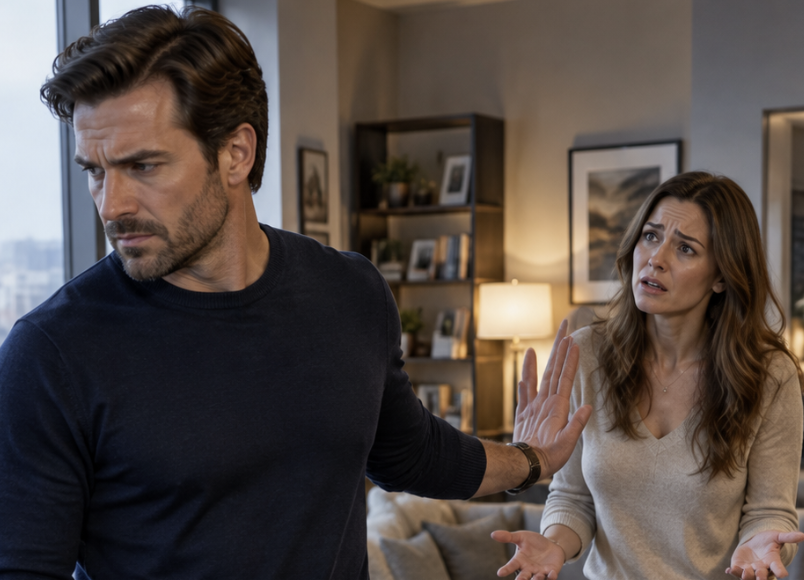
“That’s it. Enough of this circus. She was my aunt, not yours. That means I have rights too.”
“Hello to you too.”
“We’re selling the three-room apartment. We’ll buy Mother a one-room place. The rest will be a down payment, we’ll take out a mortgage, and buy ourselves a proper apartment. That’s it. I’m not interested in your opinion.”
“No,” Dasha said.
“What do you mean, ‘no’?”
“No. For the hundredth time, no. The apartment is mine. I’m not selling it, and I’m not letting your mother live there.”
Only then did he finally notice the bags against the wall, the stacks of children’s clothes, and the open wardrobe.
His face jerked as if someone had struck him on the back of the head.
“What are you doing?”
“Packing.” Dasha straightened. “I’ve had enough of all of you and this apartment. Nobody wanted to wash her, feed her, or listen to her screaming. But the moment the funeral was over, everyone suddenly remembered the square meters.”
“You’re not going anywhere!”
“I already am.”
The door opened without anyone ringing the bell.
His mother had her own key, and she used it.
Tamara Viktorovna stormed into the room, saw the bags, and instantly understood everything.
“You bitch!” She grabbed the top bag and emptied it onto the floor. “So she’s leaving! Leaving with our belongings!”
Nastya’s tights, sweaters, and books scattered across the carpet.
Her mother-in-law kicked one stack, sending it flying in all directions.
Dasha looked at her husband calmly, almost curiously.
“Styopa. What are you going to do?”
“It’s your own fault,” he said.
“Fine.” Dasha nodded. “Looks like I have to be the man again. In this family, apparently I’m the man and you’re the woman.”
She stepped forward and slapped her mother-in-law across the face.
The sound was sharp and short.
Tamara Viktorovna staggered toward the wall, gasping for air.
Stepan lunged toward his wife and immediately received a slap so hard that his ear began ringing.
“Don’t come near me,” Dasha said. “Ever again.”
Half an hour later, the bags began appearing on the landing.
One.
Then another.
Then a third.
Dasha worked silently while mother and son stood in the hallway, watching the thing they had believed permanent collapse in front of them.
“Dash,” Stepan said hoarsely. “Dasha, wait.”
“Wait for what?”
“Are you really leaving?”
“One more word and I’m filing for divorce. Literally. Tomorrow.”
“Then let her file!” his mother snapped. “Let her get out, but the apartment still needs to be sold. There’s money tied up in it, there’s—”
“Shut up!” Stepan demanded.
“What?!”
“Shut up, Mom. Just shut up.”
Dasha didn’t stay to hear the rest.
She grabbed the first bag, went down one flight, and called up from below.
“I’ll come for the rest tomorrow. I’ll leave the keys to this apartment in the mailbox.”
When they were alone, Stepan turned toward his mother, and there was nothing filial left in him.
“Why the hell do you keep interfering in my family?”
“Me?!”
“You. You and your hysterical daughter. Because of the two of you, I almost lost my wife. Maybe I already have.”
“I’m your mother!”
“You’re my mother,” he said, breathing heavily. “And you sold your two-room apartment yourself. Nobody forced you. You gave half the money to Galya, and I told you back then not to do it.”
“She was getting divorced!”
“She always has something going on! She blew through that money in a year, and I don’t give a damn anymore. If you want, throw her out onto the street and let her rent a place. If you want, keep living with her and tearing each other apart. But stay out of my family.”
Tamara Viktorovna fell silent, adjusted her hair, and when she spoke again, her voice had become calm and businesslike, the way people negotiate at a market.
“Fine. Then go live with your wife in the three-room apartment and give me this one. Or give it to Galya.”
“No.”
“What?”
“No,” Stepan repeated. “This is my apartment. I worked myself to death for seven years to pay for it. Leave.”
“Styopa!”
“Leave, Mother. The door is right there.”
She went down the stairs muttering under her breath.
Dasha would have had no difficulty understanding the words: “snake,” “thief,” “may you…,” “we could have settled this like decent people.”
After all, the apartment had belonged to her sister, and therefore, in Tamara Viktorovna’s mind, it should have been divided among the relatives.
That was how she saw it, and she recognized no other point of view.
Stepan remained alone among the scattered children’s clothes.
His cheek burned, his ear ached, and his head felt hollow and full of ringing.
He sat on the floor, picked up Nastya’s book with its torn cover, and suddenly became even angrier.
He remembered Dasha slapping his mother.
He remembered Dasha slapping him.
He remembered how calmly, without shouting, she had carried out the bags, as if she weren’t leaving her home but simply quitting a job she had grown tired of.
And most of all, he thought about the three-room apartment.
The aunt had been his aunt—his blood relative—yet the apartment had gone to his wife.
And now she would live there with his daughter while he stayed behind in the one-room apartment with an empty wardrobe.
The thought made his vision darken.
Dasha opened the new door with her new key.
She had changed the lock the previous day. Her mother-in-law had keys to the old one, and leaving them in someone else’s hands would have been the height of stupidity.
The apartment smelled clean.
Dasha had tidied it up back in the spring, after the traditional forty-day mourning period. She had thrown away the medications, scrubbed the kitchen, and donated the clothes to the church.
Her aunt was gone, but her presence still seemed to hang in the corners like the dry smell of old furniture.
Dasha dragged the bags into the room and thought about Stepan.
Only a week ago, he had told her:
“Don’t give them anything. It’s yours. You earned it with your blood.”
And today he had demanded that she sell it and divide the money.
And his face had looked exactly like his mother’s, with the same red blotches rising from his neck.
She remembered Aunt Nadezhda.
How she had screamed at Dasha during the first month.
How she had thrown a spoon.
How she had once said:
“You’re a fool for coming here. All the smart ones ran away.”
Nadezhda had been an unhappy woman.
She had lived her entire life with hatred instead of bread, and perhaps until her very last day she had still loved the man over whom the two sisters had once grabbed each other by the hair.
The phone rang while Dasha was arranging clothes on the shelves.
“Dashunya,” her mother said. “Nastya played outside, ate dinner, and fell asleep. She didn’t even fuss.”
“Thank you, Mom.”
“How are you?”
“Alive. I’ll come get her tomorrow.”
“Just don’t rush into making any decisions.”
“I won’t,” Dasha said. “I’m going to take a shower and go to sleep. Everything else can wait until tomorrow.”
She put down the phone and looked around the room one last time.
On the upper storage shelf, where she hadn’t gotten around to cleaning in the spring, stood an old metal cookie tin tied with string.
Dasha took it down.
As she lifted the lid, an envelope slipped out.
There was only one word written across it in her aunt’s crooked handwriting:
“Darya.”