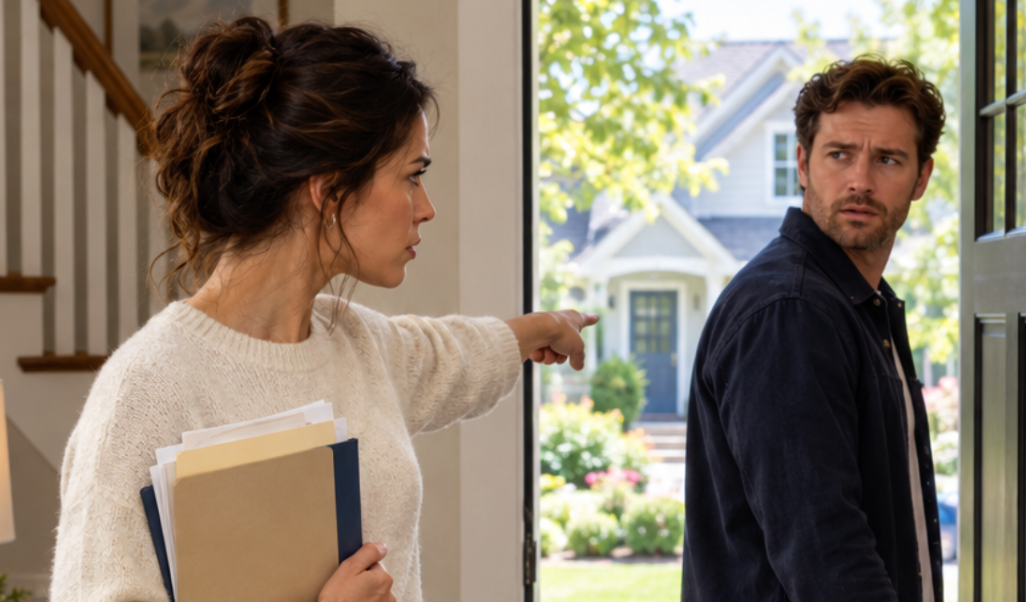
“Either you pay off Mom’s loan, or you can move out of this house!”
Boris said this without getting up from the table. He was still in his work jacket, even though the kitchen was hot from the radiators, and his phone was lying in front of him, screen down. That’s how he always leaves it when he’s done talking to his mother, but he isn’t finished with me yet.
I was standing by the fridge with a shopping bag in my hand and it took me a second to realize I should put it down. We’d only been talking for about three minutes when he said that phrase.
I came home a little before nine, after doing inventory at the warehouse. I barely had time to mention that we’d get the mandarins a week later this year. But Boris cut me off: Mom was laid off. Back in August. The coat check at the clinic was closed, staff were let go, and for a month and a half she kept quiet and paid the bank from her ‘funeral’ savings. By October she was out of money to make the payments.
I knew about the loan. Two years ago, Angelina Sergeyevna’s upstairs neighbors broke a valve and the water leaked through both of her rooms, down to the concrete, so she took out a loan from the bank for repairs. Boris said he’d give her eight thousand a month, and she’d cover the rest with her pension and salary. I thought that was reasonable and stayed out of it. His mother, his decision.
“How much is left?” I asked.
“A little over four hundred. The monthly payment is almost twenty. Her pension is twenty-one.”
“And your eight thousand?”
“My eight is my eight. I’m already stretched.” He looked up at me, and I realized he was about to say the thing he’d been gearing up for in that jacket. “You can either pay it all off now or make the monthly payments. Whatever works for you, it’s your choice.”
“Borya, all my money is tied up in inventory right now. It’s October, we’re stocking up for New Year, and all of our suppliers require prepayment…”
“You have a business,” he said. “Mom only has her pension.”
I wanted to explain that ‘business’ really means a warehouse, two vehicles, twelve employees who get paid on the 10th, and Tamara, with whom I split every ruble of profit. And the profits come quarterly and are never as big as they look when you see a semi-truck at the gate. I’ve explained this to him more than once. He always listens, nods, but never changes his mind: if the trucks are running, there must be money.
That’s when he said the thing about the house.
I set the bag down. The first thing I felt wasn’t hurt, but something like pity: he was scared. His mother had called him, crying, and he didn’t know what to do, so he lashed out with whatever was at hand. Men of his generation slam doors in moments like this. Boris slammed words.
“Let’s talk tomorrow,” I said. “Calmly. With the numbers.”
“I already gave you the numbers.”
He got up and went out into the yard to the workshop. A minute later, the air compressor started up: whenever Boris is angry, he finds something to blow out with compressed air.
I unpacked my shopping. I put the cheese on the wrong shelf at first, then moved it. The word ‘house’ stuck inside me like a splinter you can’t see, but your finger can’t bend.
I bought the house back in 2014, four years before Boris came into my life. Two stories, sits on nine acres, twenty-five minutes from the city and fifteen from our warehouse. The money came from selling my mom’s apartment and my own savings from the early days of the business—back when Tamara and I unloaded boxes ourselves at night. The house has never had a single day of debt.
Boris moved in back in 2018 with nothing but a bag of clothes and a toolbox. He had spent nine years living in his first wife’s apartment, and when he left, as he used to say, he walked out with only what he had on. After he settled in here, he once confessed that for all those years he felt like a tenant: his wife would say «my place» in front of guests, and he would just keep quiet. I told him something that both of us would remember many times: «Live here like you’re the owner.» I said it deliberately. I wanted the man beside me to feel confident, not shrink away.
And he truly lived that way. He put windows on the veranda, turned a rotten shed in the yard into a workshop, replaced our boiler, set up deals with the gas company and even talked to our neighbor about the fence. On the phone, he told colleagues, «I’m at home, I’ll call back,» and to friends, «Come over to my place on Saturday.» I liked all that. Every summer, he gave his spare keys to Angelina Sergeyevna, and she would stay with us for three or four weeks, plant marigolds by the front porch, and cook jam from our black currants. I thought that was the right thing too. After all, a husband has only one mother, and the city is stifling in the summer.
But Boris never changed his official residence—he was still registered at his mother’s place. I suggested he do the paperwork to register here, but he waved me off, saying there was no need for documents when everything was already clear.
At that time, I really believed everything was clear.
That morning, he left earlier than usual and skipped breakfast. All day, my mind wasn’t on the money itself, but on how I could make sure money didn’t become the main concern.
Between two phone calls to suppliers, I opened up my personal account. It had the money I’d been saving since spring to fix the roof: the southern slope had leaked twice, and the roofer warned the old covering might not survive another winter. If I used up three payments from there, the roof repairs would have to wait a year. Unpleasant, but manageable. Three months—that’s time for Angelina Sergeyevna to find a side job, for someone to go with her to the bank and ask about a deferral, for all of us to stop shouting at each other. I never planned to take money from the business. That wasn’t just mine—it belonged to Tamara too, and half of it had already been sent to our tangerine supplier.
That evening, I waited until Boris finished eating.
«I can cover three months. From the roof fund. I’ll pay the bank directly, under the agreement. Show me the contract, and on Saturday let’s go see your mom together and figure out the next steps.»
He pushed his plate aside.
«Three months?»
«Until she finds a job. Until…»
«I don’t need your handout for three months.» His voice was calm, and that hurt more than yesterday’s shouting. «In three months, we’ll be right back here. You’ll be paying till the end.»
«Till the end means four years, Borya.»
«So what? You paid for my mom’s teeth—you didn’t go broke.»
That dental work was last fall, for her seventy-fifth birthday. I was the one who suggested paying for dentures instead of yet another dinner set. Angelina Sergeyevna cried from happiness right there at the clinic, and Boris was extra affectionate with me the whole evening. It never occurred to me he’d use that gift as a benchmark.
«That was a gift.»
«Then give another one. For four years.»
«And the agreement?»
He looked at me like I had just asked him to show a pass to get into his own building.
«You’re going to check up on my mother?»
«I want to know where my money is going.»
«You live in this house,» he said slowly, «like it’s some kind of storage. You come, stay the night, then leave. I handle everything here. But when my mom needed help, all you gave me was talk about the contract.»
He carried his plate to the sink but didn’t bother to wash it. That was new—he’s done his own dishes for eight years. Then he went to sleep in the living room, on the couch.
I sat alone in the kitchen. «In this house.» He said it as if the house belongs to whoever spends more time in it, like the air in a room belongs to the one who breathes it most. I decided to give him a couple of days. I felt like beneath all his stubbornness was shame: he’s ashamed that he can’t manage his mother on his own, and he’s angry at the one person who might actually succeed. You can’t argue with shame. You just let it cool down.
On Wednesday, I stayed at work until nine—we were finalizing a contract for New Year’s gift sets for a retail chain. When I got home, there were boxes in the hallway. Flat, folded ones with a blue label about compressors. Boris brings those from work when there’s something that needs to be moved. I counted them automatically: nine. That’s how I work at the warehouse: count first, then ask questions.
Upstairs, the lights were on.
The small room on the second floor was mine. Not a bedroom but more of an office: a desk by the window, a shelf with folders, a closet for my winter clothes and boxes full of documents from previous years. Every evening I’d sit there, going over reports, statements, correspondence. Boris almost never came in, said my setup felt too much like an accountant’s office.
Now the desk was pushed right up against the window, the shelf taken down, and all my folders stacked in the hallway. In the middle of the room was the old sofa from the attic I’d planned to dump back in the spring. There was a measuring tape lying on the windowsill.
Boris was standing on a step ladder, taking down the curtain rod.
«What are you doing?»
«Tidying up. You only come up here at night anyway.»
«I work here every evening.»
«You’ll work in the kitchen. There’s enough space there.»
He climbed down, folded up the ladder and walked past me, heading downstairs. I was left standing among my folders.
That was when I first really got scared, though not for the reasons you’d think. I figured he was setting up the room for himself. Since he’s sleeping on the couch, maybe he wants his own room upstairs, with a door he can close—showing he can live under the same roof with me but not with me. Immature, but I understood. I actually felt sorry for him: fifty-two years old, but sulking like he’s fifteen.
Only the nine boxes didn’t fit the picture. He’d only need three for his stuff. I took another look as I went downstairs and told myself he was just being thorough. That night I lay awake for hours, listening to the creaking of the sofa downstairs.
Angelina Sergeyevna called on Thursday, just before half past eleven. I was sitting in the little office at the warehouse with a stack of invoices.
«Alla, are you busy? Just need a minute. It’s about the wardrobe.»
Her voice was cheerful but slightly apologetic, like someone tasked with something awkward.
«What wardrobe?»
«Well, in the small room. Borya says you know yourself where everything goes, but he gets lost in your paperwork. He told me to sort things out with you. I really don’t need much, just two shelves and a place to hang my things. I’m not bringing my own furniture—the guys and I agreed that the apartment comes with everything we need.»
I pulled the invoice closer, needing something for my hands to hold onto.
«Which guys, Angelina Sergeevna?»
«The tenants. They seem nice—she’s a nurse and he works at the factory. They’re moving in on Saturday. I’ve already taken a deposit. It’s twenty-eight a month, just enough to cover the payment and leave me a little for medicine. It was Borya’s clever idea—I never would’ve thought of it myself. He said you two discussed this: since you’re short on money right now, I should stay with you instead of going to the bank. He’s coming to get me and my things tomorrow night.»
She waited for my answer and, when I didn’t reply, added in a cautious, softer tone:
«Please don’t be upset. He said you basically live at work anyway, and the house is his responsibility—he’s the man of the house, so he decides. I’m not staying for good. Just until the loan is paid off.»
And «just until the loan is paid off» means four years.
«I’ll call you back,» I said. «Tonight.»
She kept talking about how the marigolds by the porch needed to be pulled up, but all I could see on the invoice in front of me was the final total.
That room wasn’t meant for him. He’d taken down the curtain rod because every summer Angelina Sergeevna brings her own curtains with little flowers and hangs them herself. The sofa—that’s for her. Nine boxes—for my things from the closet and my folders, nine exactly if I pack everything tightly. And for me—the kitchen. «You’ll work from the kitchen.»
And when he said «get out of the house by Monday,» it wasn’t in anger. It was a term, and there was already a backup plan. If I can’t pay—his mother moves in, and her apartment brings in money. If I don’t like it—the door is right there. He wasn’t planning to throw me out. He wanted to leave me with space in the kitchen, in my own home, and force me to choose between that or leaving.
For eight years, I’d hear «come over on Saturday,» and would always smile. For eight years, Angelina Sergeevna visited at his invitation, and I never thought about why it was always him inviting. I myself had handed him that «head of the house» title. Now he’s put it to use.
I stepped out of the office into the cold warehouse, where I could smell cardboard and orange peels, and walked the length of the aisles and back again. That’s how I think things through when there’s no room for mistakes.
I could wait until evening and talk to Boris. He’d say, «I told you everything on Monday.» And in his logic, he’d be right. I could hold my tongue and see if he’d really go through with bringing his mother over on Friday. He would. And by Saturday, strangers would move into her apartment. If I said «no» after that, a seventy-six-year-old woman would be stuck between a rented-out apartment and a home where she wasn’t welcome. I couldn’t let that happen. She’d been deceived just like me—only for her, there was something real at stake, and she’d lose it all the day after tomorrow.
So, I had to start with her.
I called at three o’clock, from my car in the warehouse lot.
«Angelina Sergeevna, don’t rent out the apartment. Give the deposit back to the tenants.»
A pause.
«What do you mean? But Borya said…»
We never had any agreement with Borya. I offered to pay three months out of my own pocket, but he refused. I only found out you were moving out from you, just three hours ago.
So… are you not going to let me in?
She asked not with anger, but with confusion, like someone asking for directions.
Live here? No. This is my house, Angelina Sergeyevna. I bought it before Borya, and I decide who gets to live here. You’re not moving into the small room.
And what about the bank? Am I supposed to expect debt collectors now?
That’s something you’ll have to sort out with your son. He figured out how to pay before, let him come up with a new solution—just not with my house involved.
She was silent for a long time. Then she spoke quietly and flatly:
That’s not how families treat each other, Alla.
Then she hung up. I sat there, still holding the phone, realizing that now she would call Boris, and the evening would start before I even got home.
I got home at seven. His car wasn’t in the yard. I went upstairs and found a blue folder labeled ‘House’ in a pile on the floor. It was third from the bottom, under reports from 2022—Boris just stacked things without looking. Inside the folder were the purchase agreement from June 2014, a statement, the tax receipts I paid each year, and a warranty for the boiler he installed. I went downstairs, put the folder on the kitchen table, and set the kettle to boil—just to have something to do with my hands, but I never actually made myself any tea.
Boris walked in at twenty to eight, not bothering to take off his shoes, and stopped in the kitchen doorway—the same place I stood last Monday.
What did you say to Mom?
The truth. That I never agreed to anything.
She spent twenty minutes sobbing on the phone to me! Now we have to return the deposit, turn people down, and everyone in the building will know. Do you realize what you’ve done?
Yes. I made sure she wouldn’t end up without an apartment on Saturday.
Without what apartment?—he was nearly shouting.—She would have lived here!
No, she wouldn’t have.
He cut himself off and looked at me like he’d just noticed I was sitting, not standing.
I told you on Monday—either you pay, or you’re out. You’re not paying. That means Mom lives here. And if you don’t like it, there’s the door. You made your choice.
Yes, I did. I chose the latter.
He didn’t get it right away. Then, for a moment, his face softened, like someone who’s been carrying something heavy and finally lets it go.
Fine, then go.
Just remember, the house is mine, Borya.
I pushed the folder toward him. He didn’t open it. He already knew what was inside. All these years, he knew, but that knowledge was buried somewhere in the bottom of a pile, under reports, and he never pulled it out.
Bought in 2014, four years before you. You got to run things here because I let you. I gave you permission. Now I’m taking it back. You’re the one who has to leave.
Eight years, he said, his voice hoarse. For eight years I… Who put the windows in the veranda? Who replaced the boiler? I rebuilt the workshop from a rotten shed with my own hands!
Yes, with your own hands. Thank you. We both drank tea on that veranda; I paid for the glass, you installed it. The tools are yours, the compressor is yours, the machine is yours—take it all with you. Leave the boiler, it’s attached to the pipes.
You’re kicking me out over twenty thousand?
«I offered you twenty thousand on Tuesday. Three times twenty. You refused.» I paused. «You gave my room to your mother and told her I agreed. And to me, you said, ‘you’ll work in the kitchen.’ Money has nothing to do with this.»
«And what if I don’t leave?» He pressed his palms into the table. «What will you do? Call the police? Go ahead, try to kick me out.»
I’d been expecting this question since lunch, but even so, it was hard to answer calmly.
«I won’t try. On Monday, I’ll file for divorce. You’re registered at your mother’s. If you’re not packed by Sunday, then it’ll go to court, and until then, we’ll live just as we’ve been since Monday: you on the couch, me in the kitchen, your mother in her room. Only longer. Is that what you want?»
He stared at me for a long time. It seemed like he was calculating something, though not money. Maybe how many trips it would take to move his things to his mom’s apartment. Maybe he was picturing what he’d say at work. Maybe, for the first time, he was realizing who he made this ultimatum to on Monday.
«You’ll regret this,» he said, without any conviction, and walked out into the yard.
That evening, the compressor was silent.
On Friday, he came home from work at six and started packing without a word. Nine boxes came in handy. He loaded them with sweaters, work jackets, winter boots, his razor, a folder of warranties for everything he’d ever bought. I neither helped nor interfered. I sat in the kitchen with my laptop, checking numbers, and could hear the old couch moving upstairs in the small room—he was dragging it back to the attic. I never did figure out why. Maybe he just didn’t want any trace of his plan left in that room.
On Saturday morning, Angelina Sergeyevna called. She returned the deposit. The nurse had told her that decent people don’t act like this, and Angelina Sergeyevna repeated those exact words to me, as if I needed to sign for them.
«Borya will stay with me for a while,» she added. «I’m clearing out his room for him. There’s a sewing machine and some jars, we’ll sort it all out.»
«Alright,» I said.
«And as for the payment, we’ll figure it out together.» She paused. «He really told me you both agreed.»
«I know.»
She didn’t say anything else, and neither did I.
On Sunday, Boris arrived with a trolley he’d borrowed from someone at work, and in two trips he moved out the lathe, compressor, boxes of tools, and winter tires from the workshop. The tires wouldn’t fit in the trunk, so he left them in the garage, saying he’d pick them up later. He left one set of keys on the shelf in the entryway.
«And your mom’s keys,» I said.
«My mom has her own. I’ll get them from her and bring them.»
«No need to bring them. I’m changing the lock.»
He shrugged like he didn’t care and went out. The trolley clattered over the tiles to the gate.
On Monday at eight in the morning, the locksmith arrived. He replaced the lock cylinder in twenty minutes and charged three and a half thousand. There were three new keys, and I put them all on one ring. At lunch, I filed the paperwork. I only told Tamara that I’d be leaving early on Friday, and she didn’t ask why.
In the evening, I went up to the small room. The desk was by the window – Boris had moved it there – and I thought it was actually better this way: the light came from the left, just right for paperwork. The shelf needed to go back up. There was no drill left in the house anymore; for all eight years, the drill had been his. On Wednesday, I bought my own, my very first, and on Saturday I put up the shelf myself. It came out a little crooked, the left side a finger’s width lower than the right. I didn’t bother fixing it. The folders are standing on it, and “Home” is at the edge, easy to grab.
Three weeks later, Boris messaged me: could he pick up the tires on Saturday? I replied: ten o’clock.
He arrived five minutes early. I opened the garage and stood by the gate while he loaded the wheels into his trunk. He looked thinner, wearing a new jacket, not the old work one. He said he was taking Saturday shifts now, that his mom had gotten a part-time job as a security guard at the nearby school, and that the payment had been made on time this month. He told me all this like he was reporting in, and I nodded, like you do at a check-in when the numbers add up.
‘Maybe we shouldn’t have done this, Alla,’ he said as he closed the trunk.
‘Count the wheels,’ I said. ‘So you don’t have to come back.’
He looked in the trunk, said ‘four,’ and got behind the wheel.
I locked the gate behind him with the new key. Then I picked up a bucket by the porch and pulled out the blackened marigolds. Angelina Sergeyevna had been right: it was long overdue.