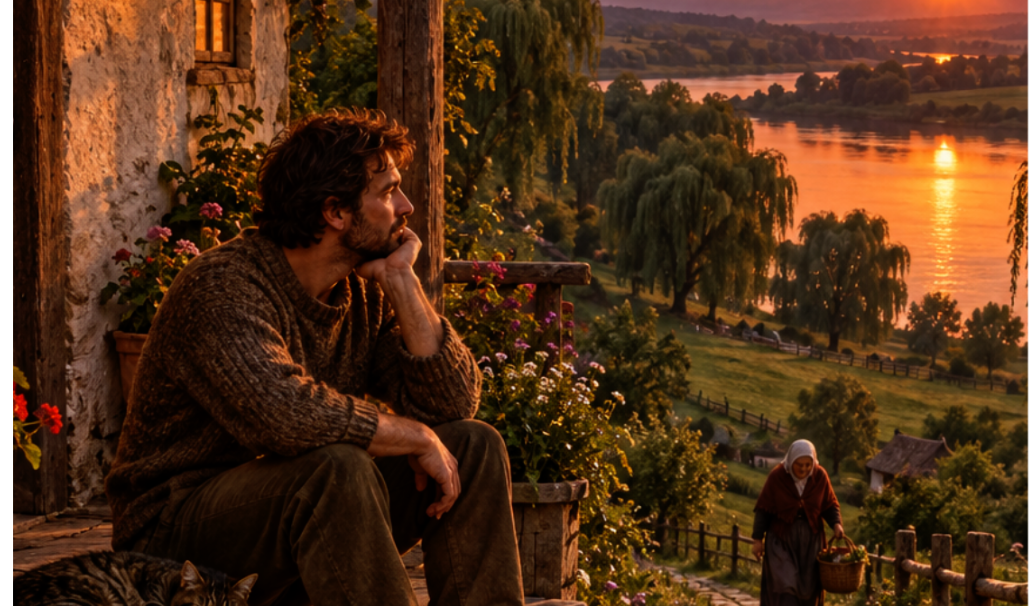
Near the turn to Roskholka, Andriy switched off the car engine and sat there for about ten minutes, lost in thought. Across the river, on the hill, was the same electric pylon that, as a kid, he used to call the ‘iron stork.’ The stork was still there. It seemed like the only thing missing was himself.
Fifteen years. He did the math yesterday evening, standing on the balcony of his Kyiv apartment, phone in hand. As always, his mom called at seven o’clock on Friday. She asked if he had eaten, if he was warm enough, if he wasn’t working too much. Then, as always, she carefully, as if touching a hot pan, asked:
«Maybe you’ll come visit this summer?»
«Mom, you know we have a big project deadline. Next summer, for sure.»
«I understand, son.»
She said it every time. That same calm voice, never a hint of blame. Andriy used to feel grateful that his mom was so understanding. But yesterday, he suddenly heard something different in that ‘I understand.’ The tiredness of someone who stopped expecting an answer long ago, but asks because not asking would be even worse.
He didn’t say a word. In the morning, he got in his car and left. He didn’t call, didn’t warn her. He wanted to see the way her eyes would light up when he just appeared on her doorstep.
* * *
Over the years, he did a lot. He managed a department at a company that built residential complexes near Kyiv, sold homes with forest views, and told people at presentations how important a warm home was. Every month, he sent his mom money, money he suspected she just saved in the wardrobe.
He sent care packages: dishes, new boots, a down comforter, even a multi-cooker once. On a video call, she showed him the multi-cooker, still wrapped in plastic, saying she was saving it for a special occasion.
Several times he offered to renovate the house: new windows, heating, replace the summer shower behind the barn with a real bathroom. Mom would wave him off: «Come visit, then we’ll see what needs to be done.» He never came, so nothing ever happened.
Every time, there was a reason. A meeting. A business trip. A vacation friends planned months ahead—too awkward to back out. One year, he really did get ready to go; he even bought his mom a warm woolen shawl as a gift.
But Friday night, the boss called, and the shawl stayed in the dresser drawer. Andriy remembered it only when he was already on the highway near Lubny, realizing it was still lying there.
* * *
The gate was the same, still green, though someone had given the paint a fresh coat. The latch, just like before, needed to be lifted a bit to open. His hands remembered this even before his head did.
The yard was silent. No footsteps, no clatter of buckets. On the clothesline, two towels and a small floral apron were drying. Near the porch, in the shade, a cat lay watching Andriy as if he had come in without permission—which, honestly, he had.
«Mom!»
No one answered. The door to the entryway was open, and from inside wafted a smell that made Andriy catch his breath. This scent existed only here, and only on Saturdays. Fresh bread, a hint of burnt flour on the baking sheet, the warm oven.
He stepped onto the porch and stopped.
Under the railing sat a small table—the very same one where he used to do his homework as a child, because the house would get too stuffy in the summer. On the table rested a loaf of bread, wrapped in a linen towel embroidered with red viburnum berries. Nearby lay a plate, a knife, and a jar of honey covered with a saucer.
Andriy touched the towel. The bread beneath it was still warm.
He looked around. The house wasn’t locked, the stove was still warm, the bread was fresh from the oven—and yet, his mother was nowhere to be seen. The worrying thought came first: had something happened? He was already reaching for his phone when a voice called out from behind the fence:
«Sir, who are you here for?»
A white headscarf and glasses on a string appeared over the picket fence. It was their neighbor, Aunt Raya. She squinted, then took off her glasses, and then put them on again.
«Andriyko? Lida’s Andriyko?»
«Yes, Aunt Raya. Good afternoon. Where’s Mom? The house is open, there’s bread on the table…»
Raїsa Hryhorivna put her bucket down and slowly approached the gate, as if checking to make sure she wasn’t imagining things.
«Well, would you look at that,» she said. «He really did come.»
«Where’s Mom?»
«She’s at Vera’s, in Kovalyvka. She goes to her sister’s every Saturday, along the path by the river—it’s about three kilometers. She’ll be back by evening.»
«And the bread?»
Aunt Raya glanced at the table, then back at him. It seemed like she was considering whether or not to say something.
«That bread is for you, dear.»
She explained it all plainly, without pause or even a hint of sadness in her voice, just like talking about the weather. Every Saturday, for as long as she could remember, Lidia Stepanivna would get up before dawn and knead the dough. By noon, the bread would be ready. She would wrap one loaf in a towel and leave it out on this very table on the porch. And the house, she never locked it.
«I asked her once: Lida, why do you do this? And she said: So that if Andriyko comes home, he can eat right away. He’ll be hungry from the road, and I might not be home.»
Andriy stayed silent.
«And in the evening, if no one’s come, she gives the bread away,» Aunt Raya continued. «To me, to our postwoman Halia, to Uncle Stepan across the road. We’re used to it now. Everyone on the street calls it Andriy’s bread on Saturdays. Even Halia’s grandkids know about it. All these years I’ve been eating it, dear, but today is the first time I see you myself.»
She said it without reproach. Just as a simple fact. But to Andriy, it felt like the whole neighborhood had just caught him in the middle of something shameful.
«Sit here awhile,» Aunt Raya said more gently now. «She’ll come. She always comes home before dark.»
* * *
He sat down on the chair by the wall. The chair creaked familiarly on its left leg. He’d once hammered that leg back in himself at around age twelve, and he’d been really proud of his work.
From here, he could see it all: the vegetable patch sloping down to the river, patches of reeds, the neighbor’s rooftop, with the sun setting behind it. And the crane on the hill. Years ago, walking home from school, Andriy would spot it first and know he was fifteen minutes from home. His mom would already be standing here, on the porch, shading her eyes with her hand.
His phone vibrated. The deputy’s name lit up on the screen. Andriy looked at it for a few seconds, then put his phone on silent. After another moment, he turned it off completely. For the first time in years, maybe.
He pulled back the edge of the towel. The loaf was round and tall, with a slice cut along the crust just as mom always did with her knife—»so the bread could breathe.» Andriy broke off an end piece. The crust crackled, and steam from the tender crumb rose up right into his face.
He always had the crust. His mom would slice the loaf of bread, and the very first, crispiest piece, she’d silently place on his plate. Even when he started studying at the technical school, she kept doing it. One day, he told her, «Mom, I’m not a kid anymore.» She just smiled, but the next day she did it again.
He ate that bread with honey, no plate, just catching the crumbs in his hand so they wouldn’t fall on the floorboards, and before he noticed, he’d eaten half of it.
Then he went back inside the house to get some water. On the wall near the stove was a calendar, a different page for each month. Andriy glanced at it in passing—and couldn’t look away. Every Saturday was circled in pencil. Not just one day, not a holiday, not a birthday. Every Saturday. In September, he could see the pencil had dulled, the circles looking thick and uneven. Today’s Saturday was circled too.
He stood in front of that calendar for a long time. Then he stepped out onto the porch and didn’t go back into the house again.
* * *
The sun slipped behind the neighbor’s roof, and the sky above the river went from yellow to pink to gray. The meadow sent a chill into the air. The cat moved from the grass to the steps and curled up by Andriy’s shoes, as if they’d known each other for a hundred years.
Above the door hung a lantern in a metal frame. Andriy flicked the switch in the entryway, not expecting much, but the lantern glowed warm yellow. He’d fixed this wiring back in ninth grade. His mom had said then that now she could see the path all the way to the river.
He sat and looked at that path. Thinking about what he’d say. The apologies formed in his mind—long, proper, and they all sounded like notes to a client about a project delay. He pushed them aside and started over, again and again.
She appeared when it was almost dark.
At first, he saw only a light headscarf moving between the willows. Then her figure, slightly stooped, carrying a bag. His mom walked slowly, the way people do when there’s no need to hurry. At the gate, she lifted her head, noticed the porch light, and saw the man waiting on the chair.
And she stopped.
Andriy stood up. All the words he’d prepared vanished. He thought she’d cry, shout, rush over to him. He didn’t even know what he expected.
His mom slid the latch back, lifting it gently, just like he had a few hours earlier. She walked across the yard. Set her bag on the step. Adjusted her headscarf. And only then did she look up at him.
«I knew it would be today,» she said.
Her voice was calm—the same voice she used when she’d say, «I understand, son.»
«How did you know, Mom?»
She nodded toward the little table—the open towel and the broken bread loaf.
«I knew every Saturday.»
And only now did Andriy notice her hands shaking, her lips pressed tight the way people do when they’re afraid to spoil something with a word. He stepped down two steps and hugged her. She seemed so small. He remembered her being taller.
«You did eat the bread, right?» she asked into his shoulder. «With honey? I left the honey out on the table.»
«I did, Mom. Ate half of it.»
«See!» she said. «I told Raya it wouldn’t go to waste.»
* * *
They had dinner on the porch under the lantern. Mom brought out some milk, sliced bacon, and pickled cucumbers, all while apologizing that she hadn’t prepared anything special—she said she just didn’t know he was coming. Andriy laughed, «But you just said you knew!» She waved her hand and said, «That’s different.»
He talked about his job, his apartment, and how he finally wanted to get proper heating and new windows for the house—and how this time he’d arrange everything with the workers himself and personally make sure it was done right. Mom listened and nodded, and he could see that the renovations didn’t really interest her. She just enjoyed listening to him talk.
The scarf from the drawer was still lying in Kyiv. Andriy promised himself he’d bring it next time. He was surprised by how easy it felt to say “next time” now—because this time, he knew exactly when that would be.
On Sunday morning, before he left, Mom wrapped up half a loaf of bread, some bacon, and a jar of honey for his trip. Andriy was already at the car when he looked back at the porch. The little table beneath the railing was empty, and the towel with the viburnum berries was neatly folded on the edge.
“Mom,” he said, “maybe you don’t have to do this every Saturday anymore? I’ll be coming to visit now.”
She looked at the path to the river for a long while, as if she was weighing something in her mind.
“Of course I still have to,” she finally said. “You’ll leave, and then you’ll come again. There has to be something for you to eat on your way.”
Since then, Andriy visits Roskholka every month. Aunt Raya complains there’s less Saturday bread on the street—because now Lidiya Stepanivna bakes the second loaf for her son to take on the road. But every Saturday, she still comes out onto the porch. Just in case.