I bought forty-nine candles on Wednesday at the little kiosk near the post office. They were thin, striped, ten hryvnias a pack. The cashier even asked if it wasn’t too many, but I just laughed: «It’s exactly right.»
But that evening, no one ended up lighting them.
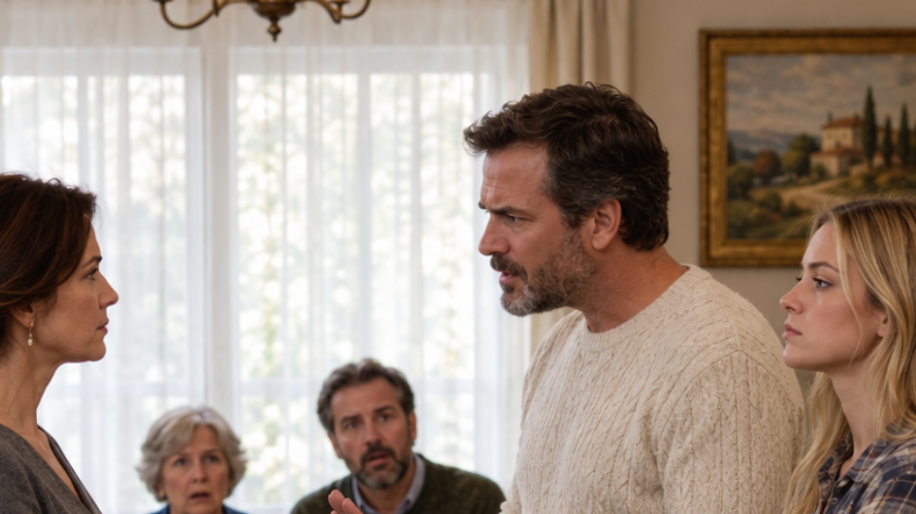
Because just half an hour before the cake, my husband’s eighteen-year-old daughter looked straight at me across the festive table and told me that in this house, I’m just the maid.
* * *
I started cooking early in the morning. Stuffed cabbage in the cast iron roasting pan I inherited from my mother. Potato pancakes. Herring under a fur coat, three kinds of canapés, crab salad—because Anna can’t imagine any celebration without it. And a Napoleon cake—I baked the layers the night before so they’d have time to soak through. Outside, the November snow was coming down wet, the radiators barely warm, and it was cozier by the stove in the kitchen than in the living room.
My sister and Valeriy were the first to arrive. Anna immediately took off her coat, rolled up her sleeves and got to slicing bread. She always does that, as if the table can’t feel festive without her hands. Valeriy sat by the TV and turned on the football with the sound off.
Nazar came straight from the workshop. He’s a carpenter, and he always smells of pine shavings, even after he changes clothes. My daughter-in-law stayed home with Valyusha—the little one is two now and goes to sleep by eight. My son kissed me on the cheek and put a bag in the corner:
«This is for you, Mom. Just don’t open it till everyone’s gone.»
Yevhen was slicing the meat. He loved that job: head of the family at the table, big knife in hand, making sure everyone got a piece.
Yulia was an hour late.
She walked in, phone to her ear, tossed her wet jacket on the pouf in the hall, right on top of Valeriy’s hat, and while still talking, waved at us. She finished her call already sitting at the table. Then she glanced at the plates:
«Oh, everything’s fried again. Dad, you said there would be something normal this time.»
Yevhen smiled:
«Come on, sunshine, there’s enough for everyone.»
I kept silent. Back then I let a lot go in one ear and out the other. Like the fridge humming: it annoys you at first, but then you just stop hearing it.
* * *
I met Yevhen three years ago at my coworker’s anniversary party. He was friends with her husband—cheerful, talkative, one of those people who can make everyone at the table laugh. He ran a small renovation company: a team of five men and a pickup always splattered with paint. That evening, he said something to me that stuck with me for a long time:
«You’re the first woman I’ve met who never complains. You just get up and do what needs to be done.»
That felt nice. Because that’s really how I lived. Nazar was six when his father left us, and since then, I handled everything myself. I worked as the chief at the grain elevator, and in the evenings I did reports for small businesses. For twelve years I saved up, and finally bought a three-room apartment on the third floor, with a balcony overlooking a quiet courtyard. I put up every single piece of wallpaper with my own hands.
After the wedding, Yevhen moved in with me. He had a daughter. Yulia’s mom passed away when she was eleven, and ever since, whenever she said “I want,” he’d always answer the same word:
«We’ll see.»
The first time Yulia came over, she stayed fifteen minutes. Didn’t take off her headphones, ate two cabbage rolls and asked her dad if he’d give her money for a concert.
«We’ll see,» he said.
Last summer, Yulia started university in the regional center. She didn’t make it on a scholarship, so it was a paid contract. She flatly refused to live in the dorm: «I’m not going there, they only have one shower per floor.» So we found a one-bedroom apartment near the university for nine thousand a month.
At that time, Yevhen’s money was «hanging.» A major client was supposed to pay him soon for renovating an entire office floor.
«Rita, can you cover us for a while? Just for a month. As soon as they pay, I’ll give it all back to the last penny.»
I covered the expenses.
First, I paid the rent. Then the first installment of the contract. Then Yulia’s phone number was transferred to my family plan. Then the gym, because «she’s going there with her friends, she needs to unwind.» Then her pocket money.
The client never paid up. And over time, Yevhen stopped bringing him up.
Yulia never thanked me. Yevhen thanked me—for her.
«She’s very grateful to you, she’s just shy to say it.»
«She’s got finals now, she’s busy.»
But when it came to asking for something, Yulia was a pro. Her messages were short, no “good afternoon” or “please”:
«Send two thousand, my classmate’s birthday.»
«The landlord’s asking when the rent will be paid.»
«Dad said you have access to my university account, I need to top it up.»
I really did have access. Yulia gave me her login and password herself when the first payment was due—just to make things easier.
On weekends she would come home, and the apartment turned into a hotel—with an unhappy guest. Wet towels were left on the bathroom floor. Mugs half-full of cocoa under her bed. One time she opened the fridge, stood there, then called out from the other room:
«Dad, is there really no normal food here?»
I was standing at the stove, just a couple steps away from her.
«You could ask me too, Yulia.»
She turned around like I’d just appeared out of thin air.
«I’m talking to Dad.»
Afterward, Yevhen put his arm around my shoulders:
«Don’t pay attention. She didn’t mean anything by it.»
I heard that phrase more often than «good night.»
* * *
Hanna raised her glass.
«To you, Rita. You know, I’m always amazed at how cozy your place is. You’ve really turned this apartment into a little gem.»
Yulia snorted—for everyone to hear.
Nazar turned to her:
«Is something wrong?»
«No, everything’s fine.» She leaned back in her chair. «It’s just funny how everyone praises her. She actually likes it—cooking, laundry, counting other people’s pennies. It’s basically her job.»
I put down my fork.
«My job?»
«What else?» Yulia smiled. «Dad basically hired his own maid. He just forgot to pay her a salary.»
It got so quiet you could hear the kitchen faucet drip. Hanna froze with her glass in hand. Valeriy looked up from the TV.
Yevhen kept cutting his meat. I looked Yulia straight in the eyes.
«Yulia. Never talk to me like that again.»
She rolled her eyes.
«Oh, here we go. That’s exactly what I mean. You all keep lecturing me as if you’re the ones who raised me.»
«I don’t need to be your mom to expect some basic respect from you. Especially at my table.»
That’s when Yevhen finally looked up. I was sure: now he’d tell his daughter she’d crossed the line. At least he’d apologize for her.
Instead, he put down his knife with irritation.
«Rita, she’s not your child. Stop trying to teach her manners.»
Nazar stood up so quickly that his chair banged against the sideboard.
«She just called Mom a maid. On Mom’s birthday.»
«It was a joke,» Yevhen waved his hand. «Don’t you guys have any sense of humor at all?»
I sat there staring at my hands. There was still a bit of flour on my ring finger from the morning—I hadn’t noticed even when I washed them.
And suddenly I understood something simple. Yulia hadn’t made anything up. She just voiced the rule her father had set long ago. My money—it’s for everyone. My work—nobody questions it. My right to respect—that’s just unnecessary.
I could pay for her life. But to ask not to be humiliated—no, that I couldn’t do.
I smiled.
«Alright.»
Yevhen sighed and picked up his knife again. He decided everything had blown over.
I brought out the cake myself. Cut it up, laid the pieces out on plates. The pack of candles stayed in the drawer under the towels. No one asked where they were.
* * *
When the guests were leaving, Nazar struggled for a long time to get his arm into his jacket sleeve. Then he hugged me—tighter than usual—and said quietly, just so I could hear:
«Mom, you don’t have to put up with this.»
«I know, son.»
I opened his gift late that night. Inside was a small walnut box, smooth as a river stone. On the lid, he’d burned the words: «To Mom. For what’s important.»
I held it on my lap for a long time.
Yevhen fell asleep right away. He always did—once I used to joke that only people with a clear conscience sleep that quickly. That night, I lay next to him and listened to the sound of wet snow rustling against the windowsill.
«She’s not your child.»
Somewhere around four in the morning, the pain of the insult suddenly turned into a question. Simple and quiet. If she’s not my child, why am I paying for her life?
* * *
I went into the kitchen, turned on only the lamp above the stove, made coffee in a cezve, and took my old checkered notebook out of the cupboard. For twenty years, I’ve counted other people’s money at work. Turns out, I never counted my own at all.
Rent—nine thousand.
Phone and internet—four hundred and fifty.
Gym—nine hundred.
Pocket money—three to four thousand, depending.
Contract—forty-two thousand a year, paid in two installments.
And then there were the urgent transfers I made to Yevhen’s card. The list didn’t even fit on one page.
I wasn’t planning to put the girl out on the street. I wasn’t going to take her education away. I just finally decided to stop being the ATM that switches on at the first «we’ll figure it out» from her dad.
I opened the banking app. Found the regular payments. «Cancel.»
The gym disappeared from the list. Then the pocket money, which used to automatically land on Yulia’s card every Friday.
I handled the rent differently. November was paid, and there were two weeks left in the month. I wrote to the apartment owner, Vira Ostapivna, briefly: starting December, the payment will be made by the girl’s father, here is his number, thank you for understanding.
I didn’t disconnect Yulia’s number right away. I paid another month in advance so the kid wouldn’t lose service during her finals. And made a note for myself: «Transfer it to Yevhen.»
The second half of the contract was due in January. There was not a single piece of paper obligating me to pay it. I had simply once said, “alright.”
Then, just to make sure I didn’t miss anything, I decided to look over all my money transfers for the past year and a half. Trying to make everything add up. And after an hour, nothing added up anymore.
Three transfers with the same note: ‘For Yulia’s contract.’ Fourteen thousand in March. Eleven thousand in May. Eighteen thousand in September.
The recipient wasn’t the university. The money went to Yevhen’s card. Every time he would come to me looking anxious: ‘Rita, there’s another extra payment, prices went up again. If we don’t cover it, she won’t be allowed to take her exams. Send it to me—I’ll pay myself, it’s faster this way.’
I logged into Yulia’s account on the university website. Her login and password are still saved on my phone. Payment history. Last September—I paid. February—me again. This September—again, me.
March, May, September—there were no ‘extra payments.’ No price increases. Not a single forty-three thousand. The microwave clock read 5:52. The coffee in the cezve was long cold. I sat there and realized my late-night audit wasn’t about Yulia at all.
* * *
Yevhen came into the kitchen at 7:30. In his house pants, phone in hand, his face flushed.
‘Rita! What did you do?’
‘Good morning,’ I said.
He shoved his phone right in my face. A message from Yulia, with three exclamation marks: ‘Dad!!! I didn’t get my allowance, and my landlady says you’ve been paying since December. What is going on???’
‘Yes. That’s right.’
‘Did you cut her off?’
‘I stopped paying for your daughter’s adult life out of my own pocket.’
‘Because of yesterday? Because of one joke?’
‘No. Because of what you said yesterday.’
He scowled.
‘And what exactly did I say?’
‘That she’s not my child and I have no right to raise her.’ I set down my cup. ‘I agreed with you, Yevhen. If I can’t even ask her not to insult me at my own table, I definitely don’t have to feed, dress, or educate her.’
‘Don’t twist my words!’
‘I’m not twisting your words. I’m quoting you.’
He paced the kitchen, from the window to the door and back. Then he changed his tone—the way he always did when pushing didn’t work.
‘Rita. She’s still a kid. Eighteen. She lost her mother, you know.’
‘I know. I’ve never downplayed that. But pain doesn’t give you the right to walk all over others.’
‘You don’t understand.’
‘Maybe not. But I’m not going to pay for it anymore.’
He was silent for a long time. Then he said the thing that made it impossible for me to go back:
‘You knew who you were marrying. You knew I had a child. You should have thought about it earlier.’
I nodded.
‘You’re right. I should have.’
He exhaled in relief:
‘See?’
‘That’s why I did. At four in the morning.’
I didn’t say a word about the money transfers then. I wanted to double-check everything with a clear head. And I wanted to give him a chance to come clean on his own.
* * *
He didn’t come clean. He spent the entire day walking around the apartment with his phone, slamming doors, calling Yulia several times. I could catch bits and pieces:
‘Sweetie, calm down…’
‘We’ll sort it out, I said we would…’
‘No, she has no right to treat you like that…’
In the evening, Yulia showed up on her own. Last bus, no warning. She came in without saying hello or taking off her shoes, snow on her hood.
‘Margarita, we need to talk.’
I was sitting in the living room, knitting—finishing Nazar’s scarf.
‘Good evening, Yulia.’
— Let’s not go there.
— Not go where?
— Let’s skip your fake politeness.
I put down my knitting needles.
— I’m listening.
— Are you serious? After just one evening? So I’m supposed to live on the street now?
— No. November is paid for. The phone bill too, for another month. After that, you and your father will need to figure things out.
— Dad doesn’t have any money right now!
These words slipped out of her mouth before she could even think. I saw her fall silent for a moment, surprised by herself.
— Then maybe it’s time to consider a side job, I said calmly. — A lot of students work.
— So you want me to work? Instead of studying?
— Alongside your studies. You always seem to find time for coffee dates with your friends and weekend trips.
She flared up.
— Are you spying on me or something?
— No. You tell us about all that at every dinner.
Just then, Yevhen appeared in the living room doorway.
— What’s going on here?
— Dad, she’s trying to force me to get a job!
— Rita…
I raised my hand, and he fell silent.
— I’m not forcing anyone to do anything. Yulia can study, work, travel—whatever she wants. It’s her life. I’m just not going to pay for it anymore.
Yulia gave a short laugh:
— Of course. You just love having everyone dependent on your money.
— If I enjoyed that, I’d keep paying and demand obedience. I’m doing the opposite, Yulia. I’m letting you go.
She didn’t have a response. Yevhen hugged her shoulders:
— Come on, sweetheart. We’ll figure something out.
In the hallway, Yulia turned around. She looked at me over her father’s shoulder and said the thing meant to hit where it hurt most:
— No wonder your first husband left you.
The apartment fell silent. Only the cuckoo clock was ticking in the entryway—the one Nazar fixed back in seventh grade.
Yevhen didn’t even move. I got up.
— Leave my apartment, Yulia.
— What?
— You heard me.
— Rita, don’t, Yevhen said quietly.
I turned to him.
— If you’re about to say she didn’t mean it, then you and I have nothing more to discuss.
He started to say something, then stopped. Yulia grabbed her bag.
— Fine then! I don’t even want to be here!
The door slammed. Yevhen rushed after her, pulling on his jacket as he went. I was left standing in the living room. And for the first time in three years, I didn’t run after them. I didn’t apologize. I didn’t rush to the kitchen to put the kettle on and make peace.
I simply sat down and finished my knitting row.
* * *
The next morning, Hanna called.
— Nazar told me everything.
— He’s worried.
— And rightfully so. Rita, listen. Do you remember how we used to share candy as kids?
I smiled. Of course I remembered. Dad would bring a little bag of «Chamomile» candies from the city and I’d split them: two for me, three for you, because you were younger. And then I’d hand you my two as well, the moment Hanna started to pout.
— Mom used to say, «Rita, if you give everything away, what will you have left for yourself?» And you’d answer: «I don’t need anything.» Hanna was silent for a moment. «You never needed anything. People get used to that, you know? Not because they’re bad—it just makes things easier for them.»
I looked out the window. The snow had melted overnight, and the courtyard was gray, wet, full of puddles.
— You can love a man, my sister said, — and not be a servant to his adult daughter. The two don’t have to go together.
— I know, Hanna.
— So don’t forget that.
* * *
That evening, Yevhen came home late. I was waiting in the kitchen. In front of me were two sheets of paper: a printout of my money transfers and a screenshot of the payment history from the university account.
«Sit down, Zhenya.»
He tensed up, but sat down.
«What now?»
«March. Fourteen thousand. You told me it was extra payment for the contract because it got more expensive. Where did it actually go?»
«To tuition, where else would it go?»
I slid the second sheet toward him.
«Here are all the payments for Yulia’s tuition since she started. There are three. All three are mine. There was never any extra payment in March. Not in May, not in September.»
He looked at the paper. Then at me.
«Are you checking up on me?»
«I want to know where my money went.»
«I’m your husband!»
«That’s exactly why I thought you’d tell me the truth.»
He jumped up, walked to the window. He stood with his back to me for a long time, staring at the streetlamp in the yard. Then, without turning around, he said:
«The client didn’t pay.»
«I know. You already said that.»
«No. You don’t understand. He didn’t pay at all. And he won’t pay. His company shut down last year, and I’d already bought materials, paid the guys upfront…» He rubbed his face with his hands. «I borrowed. From friends. From Tolia, my brother, a supplier. I thought I could get by, land a new job and cover everything.»
«How much?»
He was silent.
«Zhenya. How much?»
«One hundred eighty thousand. About that much.»
I felt cold, even though the radiator under the window was finally warm.
«So all year you were taking my money for ‘Yulia’s tuition’ just to pay off your debts.»
«It wasn’t for me!» He finally turned around. «I was paying people back! I would have paid you back!»
«You could have just told me the truth. Maybe I would’ve helped. You know I can handle numbers. We could have sat down and figured something out together.»
«I was ashamed.»
«Ashamed to tell your wife. But not ashamed to hide behind your own child?»
He lowered his head.
I looked at him. At the man I’d shared a table, evenings, and retirement plans with for three years. The one who brought me coffee in bed on Sundays and remembered I drink it without sugar. Suddenly I realized why he was so scared yesterday when he saw Yulia’s message.
It wasn’t about his daughter. I had simply turned off the tap he silently used to patch his problems. And Yulia was a convenient excuse. Who would say no to a child who lost her mom?
«And after all that,» I said, my voice trembling for the first time that evening, «you just sat there cutting meat while your daughter called me the maid.»
«Rita…»
«No. Now you listen. I am not your wallet. I’m not your bookkeeper. I’m not the person who silently fixes your mistakes and is supposed to be grateful for being allowed to.»
He reached out his hand to me. I stepped back.
«Tonight I’m sleeping in another room.»
* * *
Nazar arrived the next day, as soon as I called him. Not in the evening, as I asked, but in forty minutes, still in his work jacket.
I told him everything. About the money, the ‘tuition’ transfers, the one hundred eighty thousand. He listened quietly, turning his car keys between his fingers.
«Mom, do you want him to leave?»
I didn’t answer for a long time.
«I think so.»
He nodded, as if that’s what he was expecting all along.
«Then I’m with you.»
«Son, I don’t want to drag you into this…»
«Mom.» He took my hands in his—rough, nicked from the planer. «Remember what you told me when Dad left? I was six. You sat me down on the stool and said, ‘Nazar, in this house, no one humiliates anyone. Not me to you, not you to me. Not even strangers.’ I didn’t understand back then. But I remembered it my whole life.»
I felt tears welling up, about to spill over.
«So why do you think I’d ever let anyone treat you like that?»
I leaned against his shoulder. And for the first time in days, I allowed myself to just cry.
* * *
A week later, I put Yevhen’s suitcase in the middle of the kitchen. Empty—he’d have to pack it himself.
At first he laughed.
«Rita, come on. So we argued. It happens to everyone.»
«It happens.»
«Then why throw it all away?»
«Because I’m tired, Yevhen. I can’t keep living with someone whose every word I need to double-check. I need to be alone for a while.»
He sat down across from me.
«I’ll pay back every hryvnia, you hear?»
«Alright. You’ll pay it back.»
He was silent. Then he asked something that made something twist painfully inside me:
«But what about Yulia?»
Even now, as everything we’d built for years was falling apart, with an empty suitcase in front of him, his first thought was about who’d pay for his daughter now.
«Yulia has a father,» I said. «And she’s eighteen. She’ll manage. Maybe even better than you think.»
«You’ve gotten tough, Rita.»
I smiled sadly.
«No. I’ve just stopped being convenient.»
He left the keys on the table, right beside the sugar bowl. Moved in with his brother, across the city.
He really is paying the money back. Still. Three thousand every month, on the tenth. And on each payment, all he writes is one word: «Debt.» No «sorry,» no «thanks.» But every month, without missing once.
I think, for Yevhen, that’s his way of apologizing.
* * *
Winter passed quietly. I ran into Yevhen in May at the market. He was standing by the potato stand, counting small change in his palm. He used to have no idea how much a kilo of potatoes cost. Now he was picking through coins and asking the vendor if she’d give him a discount for buying a whole sack.
He saw me—and froze.
«Hi, Rita.»
«Hello.»
His hair was gray now. New wrinkles had formed near his mouth.
«Yulia’s working,» he said suddenly, like he was answering a question I hadn’t asked. «At the café by the university. Three evenings a week and Saturday.»
«That’s good.»
«You know…» He turned a coin between his fingers. «I thought I was protecting her. But all I taught her was that someone else would do everything for her. Because that’s the way I lived myself.»
I stayed quiet.
«Forgive me.»
«I don’t hold anything against you, Yevhen.»
He looked up, and I saw hope appear in his eyes.
«But I won’t ask you to come back,» I added.
The hope faded.
«I know.»
We went separate ways. I bought strawberries for my granddaughter and walked home through the park, even though I could have taken the minibus.
* * *
A year passed. November again, wet snow again, cabbage rolls in Mom’s old goose pot again. Only now I was turning fifty, and Hanna insisted we had to do it «properly.»
It was just family. Hanna and Valeriy, Nazar and Maryana, my granddaughter in a new dress with a white collar, asking all evening when we’d have cake.
At eight o’clock, someone rang the doorbell.
Yulia was standing at the door. No phone pressed to her ear. Wearing a jacket dripping with water, carrying a small cardboard box in her hands.
«I won’t stay long,» she said instead of a greeting. Then she stopped herself and started over: «Good evening, Margarita. May I come in?»
Nazar tensed up behind me. I could feel it without even turning around.
«Come in.»
She didn’t go to the table. She stood in the hallway, holding the box with both hands as if she was afraid to let it drop.
«It’s a cake. Not a big one. We baked it with the girls at the coffee shop, I made the frosting. It probably turned out a little crooked.»
She opened the box. The cake really was leaning to one side a bit. And beside it, under the ribbon, was a pack of candles.
«There are fifty,» Yulia said quietly. «I counted. Dad told me last time you never got to light them. Because of me.»
I couldn’t say anything back. I just stood there.
«I’m paying for my own phone now. And half the rent. Dad covers the rest for now.» She gave a nervous smile. «I used to think nine thousand was nothing. Now I know how many cups of coffee you have to make to earn that. And how many times you need to wipe the tables.»
She fell silent. Then she looked me in the eye—for the first time since we’ve known each other, directly and without challenge.
«You were never the help. I just didn’t know what to call someone who fed me, paid for me, and never asked for anything in return. I haven’t had someone like that in a long time. And I got angry. At you. Even though it wasn’t you I should have been angry with.»
«Yulia…»
«Are you angry at me?»
I thought about it. I really did, because she deserved an honest answer.
«No. But trust isn’t something you rebuild in one evening.»
She nodded.
«I understand.»
«Take your shoes off,» I said. «The slippers are where they always are.»
Yulia glanced down at her wet sneakers. Then, suddenly, she smiled.
* * *
Fifty candles wouldn’t fit on the small cake. Valyushka was sticking them in wherever there was space, Yulia helped her, Maryana laughed that the fire alarm was about to go off, and Valeriy opened the window just in case.
My granddaughter and I blew out the candles together. Half the cake was full of candle holes, the kitchen smelled of wax and vanilla, and everyone was talking at once.
Before leaving to catch the bus, Yulia lingered in the hallway.
«Margarita… Can I someday just come over for no reason? Just because?»
«Of course. Just let me know so I can prepare something.»
Late at night, after everyone had left, I washed the dishes, wiped down the table, and opened Nazar’s wooden box. I put one half-burned candle inside. And the box with the photo, where all the guests were at the table, with Yulia.
A year ago, I said «okay,» and it meant I was giving up. That I wouldn’t argue anymore with people who didn’t want to hear me.
Now I say «okay» only when I truly mean it.
I still cook for the whole family. I still make Napoleon cake by my mom’s recipe, and I still know how to manage money. But now I do it because it’s what I want. And no one at my table confuses caring with obligation anymore.