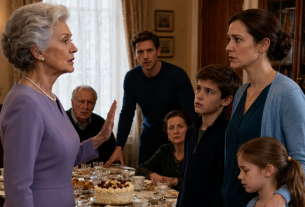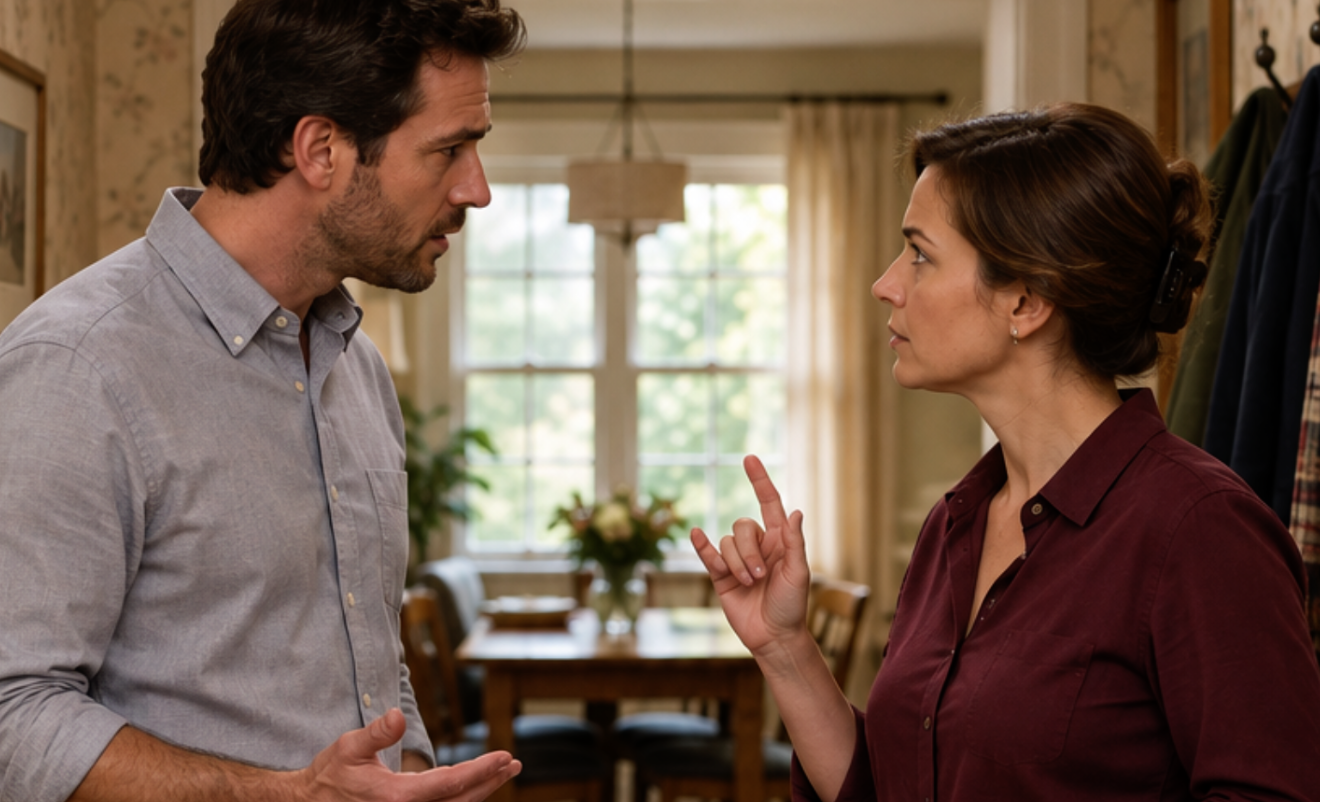
«Your inheritance will go towards paying off my father’s debts!» Oleg announced as he slapped a printout of the apartment listing onto the table. «I’ve already called the realtor; they’re coming on Saturday to take a look.»
Silently, I got up, opened the hallway closet, and pulled his travel bag down from the top shelf—a dark green one with a worn zipper. He’d been taking it fishing for twenty years. Oleg laughed:
«Is that a hint? Are you kicking me out?»
«This is your bag,» I said. «On Friday, you’ll go to your father’s in Torzhok. You’ll check his paperwork yourself, talk to the bank yourself. Then we’ll discuss things.»
He shrugged and agreed so easily that I remembered how effortless it seemed.
Mom’s two-room apartment on Sovetskaya was forty years old. Floral wallpaper, a balcony my father had once glazed with his own hands, and a scent that hadn’t faded even after six months. Mom passed away on March fourteenth. A week later, I went to the notary and filed to accept the inheritance. There were no other heirs: Dad had been gone a long time, no brother either. I received the certificate on October first, and before I could even register the apartment in my name, Oleg had already found a buyer for it.
Thirty-one years of marriage. I was used to him making the decisions. When he quit the auto shop and spent six months at home, I picked up extra work—doing accounting for two stores. When his father needed a new boiler, we gave up our vacation money. I thought that was how normal families lived: whoever needs help gets it. And saying «no» in our house was the start of a fight.
Oleg first brought up his father’s debts back in July.
«Dad took out a loan,» he said over dinner, staring into his plate. «Fixed the roof, then paid for treatment. Now the interest is piling up and collectors keep calling.»
«How much?»
«A lot. One million four hundred thousand.»
I almost dropped my fork. Pyotr Semyonovich, seventy-eight years old, lived alone in his house on the outskirts of Torzhok, got a pension, and had always railed against any kind of loan. «A bank is just a loan shark in a tie,» he used to say.
«Let me call him,» I offered.
«Don’t!» Oleg looked up too quickly. «He’s ashamed. If he finds out I told you, it’ll send his blood pressure soaring.»
So I didn’t call. I loved my father-in-law—quiet, grouchy, once taught our son Mitya how to make birdhouses. I didn’t want to embarrass him.
In August, Oleg started taking calls on the balcony. Phone calls came at eleven at night and even at eight on Sunday mornings. He closed the door behind him, and through the glass, all I could see was his back as he rubbed his neck.
«Collectors again?» I asked one time.
«Again. They have Dad’s number, but he won’t pick up, so now they’re calling me.»
It sounded believable. I’d heard about situations like this myself—when they call relatives, neighbors, even work.
In September, while sorting the mail, I found an envelope from the bank addressed to Oleg. Not his father, but to him—Oleg Petrovich Karpov, at our address. He snatched the envelope from my hands right in the hallway.
«It’s about Dad’s loan,» he said. «I’m a co-borrower, didn’t you know? Had to sign, or they wouldn’t have given it to him.»
«You never told me.»
«You would’ve made a scene. That’s why I didn’t say anything.»
He went into his room, and I was left standing there with all the other receipts. Co-borrower. That means he’s just as responsible for the debt as his father. So, if the father doesn’t pay, they’ll come after us. For a moment, I actually felt sorry for him: here’s a guy who got tangled up in someone else’s loan out of love for his dad, and now he has no idea how to get out.
That same week, his sister Larisa stopped by. She sat down in the kitchen, took off her shoes, and stretched out her legs.
«Vera, you understand,» she started bluntly. «Dad’s alone, I have a mortgage, Oleg’s salary—you know what it is. And you, you got an apartment dropped straight from the sky.»
«Larisa, my mother died. Nothing dropped from the sky.»
«That’s not what I meant.» She waved her hand dismissively. «I just mean, you’re not going to live there anyway. Dad needs help. We’re family, after all.»
I poured her some tea and didn’t say anything. Larisa finished her cup, said the cookies were good, and left. Afterward, I spent a long time washing that same cup over and over.
After her visit, Oleg stopped saying, «We should think about it,» and started saying, «When we sell.» He brought printouts showing prices for similar apartments and had already calculated how much would go to taxes.
«You won’t have to pay taxes if you’ve owned the apartment for more than three years,» he said. «But you only just got it. So, you’ll have to give up thirteen percent. It’s a shame, but we can’t wait.»
«Oleg, the tax is counted from the date of my mother’s passing. The notary explained that.»
«All the more reason,» he said. «So, we sell now.»
That «all the more» made no sense, and suddenly I realized he wasn’t listening. He didn’t care what I was saying. All he cared about was the timing.
Then Mitya called. He was living in St. Petersburg, working at a design bureau, and he usually called on Sundays.
«Mom, Dad said you’re selling Grandma’s apartment. Is that true?»
«Dad got ahead of himself.»
«He says Grandpa’s got debts. Mom, if you need, I can help. I have a little saved up.»
«You don’t have to for now, son. I’ll handle it.»
After that conversation, I started to feel honestly anxious. Oleg was already talking to our son about selling my apartment as if the decision was made. And I suddenly wondered: why hadn’t Mitya ever heard about Grandpa’s debts before? Pyotr Semyonovich called his grandson for every holiday and bragged about his cucumbers or his new TV.
The television. In the spring, my father-in-law bought himself a huge TV, and Oleg was the one who drove him to the store. Someone with a million in debt wouldn’t go out and buy a 40,000 ruble television.
I pushed that thought away. Older people can be impractical. Maybe the boiler, the TV, the roof—all of it’s on credit, and that’s why the debt got so big.
On Monday, I went to the multifunctional center to file the documents for the ownership registration. Oleg came along with me.
«It’ll be faster together,» he said.
While we were waiting, he held my folder of documents like it was his own. At the window, he leaned forward to the clerk:
«Can we file the sale agreement right away? We already have a buyer.»
«Register the ownership first,» the young woman replied without looking up. «Then you can sell as much as you want.»
On the way home, Oleg was irritated about the line, about the office, about the weather.
«A week,» he grumbled. «Another week! Do you realize each day means more interest?»
«Whose interest, Oleg?»
He looked at me like I was a stranger.
«Dad’s, who else’s.»
In the evening, I sat in the kitchen staring at the listing he’d posted using my photos: mom’s balcony, mom’s curtains. ‘Urgent sale, negotiation possible.’ He set the price half a million below market value.
That’s when he brought up the inheritance and my father’s debts, loud and final like a verdict. And I grabbed my bag.
On Friday morning, Oleg left. He tossed a sweater, his razor, and a charger into his bag.
‘I’ll be at dad’s by evening,’ he said. ‘I’ll sort things out with his banks. You think it over in the meantime. The realtor’s coming Saturday anyway, I’ve arranged it, you have the keys.’
He kissed me on the cheek, as usual, and slammed the door behind him.
I wandered around the apartment all morning, unable to do anything. At two, I called my father-in-law—no answer, just long rings. At three, I tried again—still nothing. Then I called the realtor and canceled the Saturday showing. He wasn’t happy and said Oleg Petrovich had promised him a commission upfront, in cash. I double-checked. He repeated: ‘Yes, he said he needs the money urgently, asked me to find a buyer fast, even at a loss.’
On Saturday at seven in the morning, I took the suburban train to Torzhok. For a little over an hour I watched the woods and wet fields drift by. In my bag was a cabbage pie—Pyotr Semyonovich liked it.
I walked from the station. My father-in-law’s house stood at the end of the street behind a green fence. The roof was old, spots of roofing felt were swollen. It had never been replaced. Not once.
Oleg’s car wasn’t at the gate.
Pyotr Semyonovich answered the door in his quilted jacket, pruning shears in hand.
‘Verochka? You’re alone? Why didn’t you call ahead?’
‘I did call.’
‘The phone’s inside—I’ve been in the garden all morning. Come in, come in.’
We sat out on the veranda. He cut the pie and poured tea into glasses with holders.
‘Oleg didn’t come here yesterday, did he?’ I asked.
‘Oleg?’ He looked surprised. ‘He hasn’t been here in a month. Sometimes he calls.’
I set my glass down on the saucer.
‘Pyotr Semyonovich. Tell me honestly. Did you take out a loan? For the roof, for treatment?’
He looked at me over his glasses for a long moment, as if checking to see if I was joking.
‘Me? A loan? Vera, are you serious? I’ve never borrowed a kopeck from a bank in my life. Oleg told me himself back in June that you were having a hard time, after your mom…’ He paused, then went inside and came back with a worn bankbook. ‘Here. I had two hundred thousand set aside for funeral expenses. I gave them to Oleg in June. He said it was for your medicine, that you were sick, and you were too proud to ask.’
I looked at the last entry. Withdrawal. Two hundred thousand. June sixteenth.
The phone calls on the balcony, the letter from the bank in his name, ‘co-borrower,’ and the price in the listing half a million lower, the cash commission for the realtor in advance—all of it was about Oleg, and only about him.
‘I’m not sick,’ I said. ‘And nobody’s ever bought me any medicine.’
Pyotr Semyonovich sat down slowly. He placed the bankbook on the oilcloth and smoothed it with his hand.
‘Idiot,’ he said quietly. ‘Again, then.’
‘Again what?’
‘Back in ninety-eight, he and his buddy Grishka tried a business, too. Shipping cars. I sold my garage to get him out of that mess. He swore he’d never do it again. You didn’t know, you’d just gotten married then, he was ashamed.’
I called Oleg. He picked up after five rings, sounding cheerful:
‘So, have you thought it over?’
«I’m at your father’s,» I said. «We’re having tea. Where are you?»
The line went silent. Then I heard a car door slam somewhere near him.
«Vera, I can explain…»
«You’ll explain. At home. Monday at seven in the evening. And bring all the contracts, every single one.»
I hung up and, for the first time in thirty-one years, I didn’t wait for him to call me back.
My father-in-law walked me to the station. On the platform, he suddenly took my hand.
«Don’t sell your mother’s apartment,» he said. «It’s yours. Not his, not mine.»
On Sunday I did something I’d never done before: sat down at Oleg’s computer. His password was the same as his email, Mitya’s birthday. In his banking app, which he hadn’t bothered to close, there were three loans. A consumer loan for nine hundred thousand, taken out in May. A credit card maxed out. And another loan, for three hundred thousand, from July. Payments on all three were overdue. In his messages with that Grisha guy, I found photos of a truck and messages like: «Oleg, the goods are delayed, hang on until fall,» and «Oleg, I’ll pay it all back.» The last one was from August. After that, Grisha stopped replying.
There was no father’s loan. No co-borrower. One million four hundred thousand—it was his own debt for a shipment that never arrived. The money he was planning to get from selling my mother’s apartment was supposed to cover his hole before I found out.
On Monday morning I went to a lawyer my colleague recommended. She listened and looked at the printouts.
«The apartment came to you as an inheritance,» she said. «It’s your personal property. Your husband has no claim in a split. His loans were taken without your consent and not for family needs; if that’s confirmed, he’ll be responsible for them himself. Keep the printouts. If you file for divorce, they’ll come in handy.»
In the evening, I put a dark green bag in the hallway. It wasn’t empty anymore—sweaters, shirts, razor, phone charger, his fishing magazines. Next to it, a bag with his boots.’
Oleg came home a bit before eight. He stopped in the doorway when he saw the bag and package.
«What’s this?»
«These are your things.»
«Vera, are you really going to throw me out over nothing…»
«One million four hundred thousand is nothing?» I put the banking printout on the table. «Nine hundred thousand in May. The card. Three hundred in July. The two hundred thousand you took from your dad for his funeral, telling him I was sick.»
He turned pale and started talking fast, stumbling over words:
«Grisha promised to pay it back! It was a real project, I would’ve given it all back—you wouldn’t have even known! I was doing it for us!»
«For us,» I repeated. «That’s why you were selling my mother’s apartment for half a million less and taking the realtor’s commission in advance.»
«What do you know!» he raised his voice. «Collectors are hounding me at work! Do you want me to get fired?»
«I want you to take responsibility for your own debts. And talk to your father.»
He kept glancing from me to the bag. I could see he was waiting for me to cry, soften, or say, ‘let’s figure something out.’ That’s how it had been for thirty years.
«The apartment’s ours—this one,» he finally said, quieter. «You can’t kick me out.»
«I can’t,» I agreed. «The place is co-owned by the two of us. That’s why I’m filing for divorce and division of property. In the meantime, you can stay with Larisa or your father. He said he’d let you in—but be ready for him to ask about those two hundred thousand.»
Oleg stood in the hallway for a long time. Then he grabbed his bag by the handles, awkwardly, like it had suddenly gotten heavier.
«You’ll regret this,» he started to say, but then stopped, waved his hand dismissively, and walked out.
Larisa called an hour later, shouting into the phone that I was abandoning my husband in his time of need. I listened until she finished and only said one thing:
«Ask your brother whose loan it is. Then call me back.»
She never called again.
Oleg paid his father back the money bit by bit—Pyotr Semenovich told me so himself in December. Oleg is covering his loans with his salary and by picking up extra work at the tire shop. We divided our two-bedroom on Zavodskaya in court. Mitya came to the hearing and sat next to me.
I moved into my mom’s apartment at the end of October. I hung new curtains on the balcony, but kept the floral wallpaper in the hallway. My father-in-law gave me a birdhouse that he and Mitya built years ago, which had been hanging in his shed all this time. I put it up on the balcony window frame. Every morning, a titmouse visits, I sip my coffee by the window, and don’t hurry anywhere.
Sometimes, the hardest part isn’t leaving—it’s asking for the first time, “Whose interest is this, anyway?” If you know the feeling, stay tuned to the channel.
continued in the comments