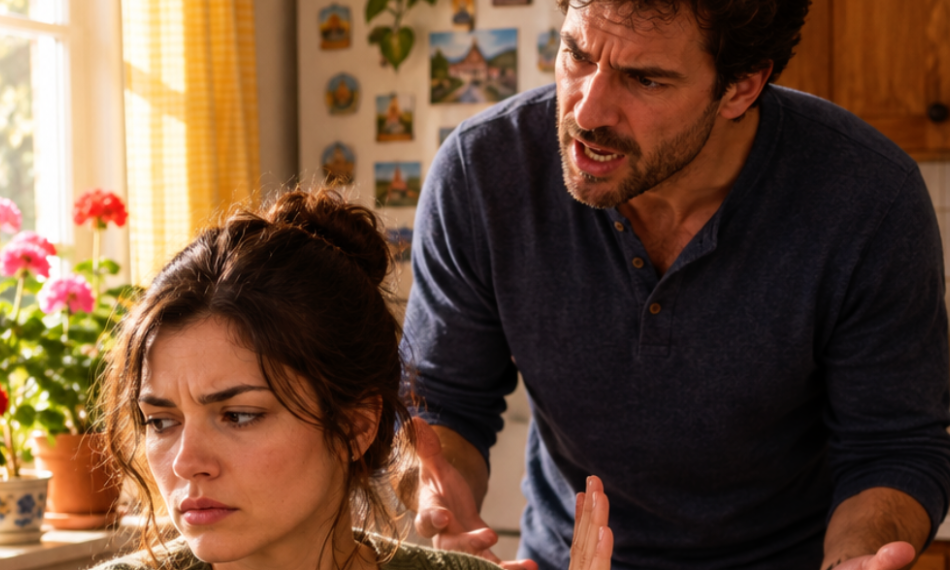
«We’ll spend two million on the restaurant, dress, and host, the rest is yours,» Andrey said, placing a printout from a real estate site in front of me. «Olechka, it’s Vika’s wedding. You only live once.»
I looked at a photo of grandma’s kitchen with its yellow curtains. Someone had taken it for an ad about a neighboring apartment in the same building, and my husband had already estimated its value. We buried grandma forty days ago.
«For Vika, this is the third time,» I replied. «We only live once, but apparently we get married on a schedule.»
Andrey winced as if I’d said something inappropriate. He always did that whenever the conversation was about his sister. Vika was the youngest, the favorite, always feeling hard done by at thirty-four, and in the Solovyov family, everyone was responsible for her—except her.
«You don’t understand,» he sat down across from me and rubbed his nose bridge. «Her first two weddings were thrown together, just a quick registry and a café. That’s probably why things didn’t work out. But now Semyon is a serious guy, his family is coming in from Kostroma, one hundred and twenty guests. We can’t embarrass ourselves.»
«So, we have to sell the apartment where I spent my entire childhood because of this?»
«An apartment you don’t actually live in.»
He said it calmly, without anger, which somehow made it feel even worse. Soup was cooling on the stove, Dasha was doing homework in her room and humming a song from a cartoon. Just an ordinary Tuesday.
Grandma Nina Pavlovna received the one-bedroom on Chkalova Street from the factory back in the 1980s, then she made it her own, and ten years ago she wrote me into her will. Thirty-two square meters, fifth floor with no elevator, a balcony looking out over poplar trees. Market value, according to the real estate agent neighbor, is about three million eight hundred. For some, just a number—but for me, it’s the one place where no one ever raised their voice at me.
Andrey and I have been together for twelve years. We’ve lived in his two-room apartment, bought with a mortgage before we even married, and we paid off that mortgage together—mostly from my salary. I work as a senior administrator at a dental clinic, he’s a manager at a window-selling company. When his company had tough months, I never kept track of who paid what. I thought that’s how marriage should be.
«I’ll think about it,» I said, just to end the conversation.
The next morning, my mother-in-law called.
«Olyushka, Andryusha said you’re unsure,» Tamara Viktorovna’s voice was soft, almost gentle—the same tone she used to persuade shop assistants to give discounts. «I understand, memories and all that. But let’s be honest. You got the apartment for free. You didn’t pay a penny for it. And right now, Vika needs the family’s support.»
«I took care of grandma for two years, Tamara Viktorovna. I took her to doctors, bathed her, fed her.»
«Well, any granddaughter would have done that. That’s not work, it’s a duty.»
I was standing by the clinic window, watching patients park below. I wanted to answer sharply, but there was a woman with a child waiting at the reception desk.
«I have to go,» I said.
«Think about it, dear. We’re not strangers, after all.»
That evening, I spent a long time thinking about why I’d always given in. When Andrey took my bonus to help Vika with her first mortgage—and she abandoned it—I stayed silent. When my mother-in-law lived with us for three months after her surgery, I made her pureed soups and listened to her complain the buckwheat was too salty. When Vika was going through her second divorce, she spent six months sleeping on our fold-out bed and using my makeup. I never protested, because Andrey would say, “It’s just for a little while, they’re family.” And deep down, I wanted Dasha to have a big family—not like me, with just a grandmother.
On Friday, the Solovyovs gathered at my mother-in-law’s place. They came up with an excuse right away: to try on a dress. Vika was spinning in front of the hallway mirror in something white with bare shoulders.
“One hundred and forty thousand,” she announced without turning around. “But I said I’d think about it. If the budget allows, I’ll take it.”
At the table, no one asked if I agreed. They spoke as if everything was already decided.
“Volzhskaya Gavan restaurant, there’s a hall for one hundred fifty,” Tamara Viktorovna listed off, ticking her fingers. “A host from Moscow—Andryusha found him. Fireworks by the river embankment.”
“I haven’t agreed to this yet,” I said.
Everything went quiet. Vika put down her fork.
“Olya, what is this about?” she said, drawing out her words. “I thought we were friends.”
Right then, I noticed something odd. Vika was embarrassed. Not upset or sulky, like she usually got, but actually embarrassed—turning red and looking over at her mother. Like she was waiting for a hint.
“Olya was just joking,” Andrey said quickly, squeezing my knee under the table—hard.
We were silent on the way home. Outside our building, he finally spoke up:
“You made me look like an idiot in front of my family.”
“You embarrassed yourself when you made decisions for me.”
“I’m your husband. I have the right to make decisions.”
“About your own apartment. Not mine.”
He slammed the car door. By the way, the car wasn’t even his. His Skoda had been in the shop since March for transmission repair, and ever since, he’d been driving the company Lada. The repair shop had dragged things out for three months already. When I asked, he’d brush me off: parts from abroad, waiting list.
On Sunday, I finally spoke out loud what I’d been thinking all week. We were in the kitchen, Dasha had gone to her friend’s.
“Andrey, I’m not going to sell my grandmother’s apartment. My inheritance isn’t going to pay for your sister’s third wedding. I can give Vika money, the same any sister-in-law would. Thirty thousand. But not the apartment.”
He looked at me for a long time, then got up, poured water from the filter, and drank it down in one gulp.
“Fine,” he said. “I understand.”
That “I understand” felt worse than if he’d yelled.
The next week, he got a bunch of calls from unfamiliar numbers. He’d dismiss them, go out on the balcony, and speak in a low voice. Once, I overheard: “By the end of the month, I told you.” I figured it was work related—they had a problem with a shipment of profiles, he’d complained. I even felt bad for him: the guy was stressed, and then there was me, being stubborn.
On Thursday, I was let out of work early and stopped by Chkalova to pick up my grandmother’s photo albums. The door was locked with just one turn of the key, even though I always locked it twice.
The room smelled of unfamiliar perfume. On my grandmother’s vinyl-covered table was a business card: “New Address Agency. Marina Kravtsova, Sales Specialist.” On the back, handwritten: “Photos taken, going on the market in a week, to be approved with the owner.”
I sat on the sofa for a long time, unable to dial the number. Eventually, I called.
«Yes, Andrey Sergeyevich brought me by on Tuesday,» Marina replied cheerfully. «He said you were aware, just busy at work. We took photos, estimated the price. He said you’d be providing the power of attorney in a few days.»
«There won’t be one,» I said. «I’m the owner. And I am not selling anything.»
Marina fell silent.
«I’m sorry. Honestly, I thought you agreed. He sounded so confident. He even asked if it was possible to sell quickly, within one or two weeks, at a discount.»
At a discount. I repeated that word to myself. The wedding was set for August, just three and a half months away. Why rush to sell in two weeks and for less money?
The spare key to my grandmother’s apartment was kept at our place, in a jewelry box in the hallway. I checked that evening. The jewelry box was there, and the key as well. Only, it had been placed differently, with the keychain facing down.
I decided not to argue with Andrey that night. First, I called Sveta, a classmate who works as a family lawyer.
«The inheritance is your personal property,» she said immediately. «If you get divorced, it won’t be divided. He can’t sell anything without you. No power of attorney can exist without your signature at the notary. And you should change the locks. That’s your right, you’re the owner.»
On Saturday morning, a locksmith installed a new cylinder in my grandmother’s door. I left the old key in the jewelry box, just as it was.
The conversation happened anyway. Andrey came back from his mother’s on Sunday, angry, and went straight to the kitchen.
«You changed the locks.»
«How did you find out?»
He hesitated for a second.
«Marina called. She said buyers wanted to look at the apartment, but the key didn’t fit.»
«Buyers,» I repeated. «For an apartment that I am not selling.»
«Olya,» he said, sitting down, his face oddly gray. «Listen to me carefully. If you dig in your heels now, I’ll file for divorce. I’m not kidding. And this apartment, by the way, could be considered joint property. You invested money in it, changed the pipes. The court will decide.»
That’s when my hands started shaking. Not from fear of court—Sveta had explained everything. It was how easily he said it. Twelve years, Dasha, our mortgage that I was paying off, and he was ready to threaten me with divorce over Vika’s restaurant.
«I changed the pipes with my own bonus,» I answered. «Go ahead and file.»
He spent the night at his mother’s. He told Dasha that grandma had a leaky faucet.
We barely spoke for a week. My mother-in-law called every night, sometimes crying, sometimes scolding. One day she said:
«You’re destroying the family over a concrete box. Andryusha isn’t himself. Don’t you feel sorry for him at all?»
I did feel sorry. But I didn’t understand. Andrey had never acted like this because of his sister. He would help, sure, but always grumbling, rolling his eyes. Now it was like his whole life depended on that restaurant.
I started doubting myself. Maybe I really am being greedy? Maybe my grandmother would have wanted me to sell her place and help people? I sifted through her things in the empty apartment and found notes on the fridge, recipes, electricity bills neatly clipped together. Grandma always saved a little, and never lent out more than she could afford to lose. “Olya, if someone asks for everything at once, they’re not asking—they’re just taking,” she used to say.
On Wednesday after work, there was a tall man in a light jacket standing outside my building. At first, I didn’t recognize him. It was Semyon, Vika’s fiancé. We’d only met once, at her birthday.
“Olga, sorry for dropping by unannounced,” he shifted from foot to foot. “Can I have five minutes? I feel awkward, but I don’t know who else I can talk to.”
We sat down on a bench by the playground. Dasha was on the swings, waving at me.
“Andrey called me yesterday,” Semyon began. “He said you’re selling your apartment and giving us two million as a wedding gift. He asked me to confirm, if you ever brought it up, that we’d booked ‘Gavan’ for 120 people. Said it was just for your peace of mind, so you wouldn’t worry that the money would go to waste.”
I stayed silent.
“But we never booked ‘Gavan’ at all,” Semyon shrugged. “Our wedding is at the ‘Topol’ cafe on Sovetskaya, thirty guests. I’ve already paid for it, one hundred sixty thousand. My family from Kostroma? Just my mom and my brother with his wife. Vika told me herself she wants something quiet, no circus. After two balloon-filled weddings, she’s had enough. She’s renting her dress.”
“Does Vika know you came to see me?”
“No. But I can’t take money from someone who isn’t giving it. And I don’t like being dishonest. If Andrey has problems, he should solve them himself. I don’t want to start a family by being someone’s cover story.”
So that’s it. Not a wedding—just a cover.
I thanked him, took Dasha home, and made dinner. My hands went through the motions: dishes, sponge, math homework. But in my mind, all the things I didn’t want to see were falling into place. Calls from unknown numbers. ‘By the end of the month, I told you.’ Sell in two weeks, at a discount. The Skoda stuck in the service center for the third month. Vika blushing and avoiding her mother’s eyes.
The next day, I got a call from an unknown number myself.
“Olga Nikolaevna? This is the collections department at ‘Financial Resource’ company. Your number was listed as a contact for the borrower, Andrey Sergeevich Solovyev. Could you let him know his debt has been sent for processing, and the deadline is the thirtieth?”
“What debt?” I asked, but my voice didn’t even sound like mine.
“I can only disclose the amount to the borrower. Please let him know.”
I left work early and didn’t go home—I went to my mother-in-law’s. Andrey had been living there for ten days. Tamara Viktorovna opened the door in her robe, looking lost.
“Andryusha’s not here, he’s at work.”
“I came to see you.”
On the hallway table was a stack of mail. On top, an envelope from the bank addressed to Tamara Viktorovna: “Notification to the guarantor.” She caught my eye and quickly covered the envelope with a newspaper. Too late.
“How much does he owe?” I asked.
My mother-in-law sank down onto the ottoman in the entryway. She stayed silent for a minute, then started to cry—not the way she does on the phone, with dramatic sobs for effect, but quietly, messily, like an old lady truly overwhelmed.
«One million nine hundred,» she said. «The bank wants one million two hundred, and I’m a guarantor. And there are other loans, something like that. He and Grisha Lapin invested in a car wash last fall. Grisha promised he’d return double in a year. But Grisha vanished. The car wash closed down. Andre sold his car in March to keep up with payments. It wasn’t enough.»
«And the wedding?»
«I made up the wedding,» she wiped her face with her sleeve. «Andre said you’d never give him money for his debts. You’d say it was his own fault. But you’d give it to Vika, you always felt sorry for her. We told Vika to just go along and not ask questions, that we’re helping her brother and she’d understand later. If the bank had come after me, I would’ve lost my apartment, Olya. I’m seventy-one years old.»
I stood in the entryway in my jacket, not knowing what to say. The person who called my apartment a concrete box just last week was now petrified of losing her own home.
«You could have just told me the truth,» I finally said.
«Would you have given it to us, though?»
I didn’t answer. Honestly, I don’t know. Maybe I would have helped with some of it, taken out a loan myself, tried to figure it out with him—like I always do. But I didn’t even get the choice. They decided to trick me because it was easier.
In the evening, I called Sveta.
«If he took out those loans without your agreement and the money wasn’t for your family but for his business,» she said, «then the debt is his alone. We can prove it with the bank statements, right? Your salary card is separate? Good. Keep everything. Any calls from collectors, realtors’ business cards, or conversations with Semyon if he’s willing to testify—save it all.»
Semyon was willing. He forwarded me a message from Andrey: “Syom, if Olya asks, tell her ‘Gavan’ is booked for 120, and an advance is paid. It’s for business, I’ll explain later.”
On Saturday, Andrey himself invited me to his mother’s place to “have an adult conversation.” I showed up carrying Dasha’s backpack—I’d left my daughter with the neighbor for two hours. All three of them were at the table. Vika was nervously spinning her ring. Tamara Viktorovna was avoiding my gaze, which meant she hadn’t told her son anything yet.
“Olya,” Andrey began in a conciliatory tone. “Let’s put an end to this war. I overreacted with the divorce. But Vika really needs the money—just three months left. Here’s what I suggest: we sell, half goes to Vika, half for our car. That way Dasha can get to school comfortably.”
I put my phone on the table and opened the chat history.
“‘Syom, if Olya asks, tell her Gavan is booked for one hundred and twenty, advance paid,’” I read out loud. “Semyon came to see me, Andrey. Their café ‘Topol’ has thirty people, everything’s paid.”
Vika turned pale and stared at her brother.
“You texted him? Andrey, you told me mom just wanted something fancy…”
“Be quiet,” he snapped at his sister—and for the first time in twelve years, I heard him raise his voice at her.
“And on Thursday I got a call from ‘Financial Resources,’” I continued. “My number’s listed as your contact. The deadline is the 30th. And I know about the car wash, about Lapin, and about the Škoda that’s not in the repair shop.”
He looked at his mother. Tamara Viktorovna stared into her bowl.
«Mom, did you tell her?»
«She saw the letter,» my mother-in-law said quietly. «That’s enough, Andrei. Stop lying.»
Andrei slumped back in his chair, like all the air had gone out of him. The confident husband who called realtors and threatened with court was gone. Now, in front of me, sat a frightened forty-year-old man who had hidden a huge one million nine hundred thousand gap for six months and tried to cover it up with something that never belonged to him.
«I just wanted to do the right thing,» he said. «I would have paid it all back. Eventually.»
«With what?» I asked. «You lied to me for nine months about your business. You took the key from the jewelry box and brought strangers into grandma’s apartment. You promised buyers a discount, just to sell it faster. You dragged your sister and her fiancé into this. And you threatened to take half of something that was never yours.»
«Olya…»
«I’m not selling the apartment. The debt is yours; the lawyer confirmed it, and I have the documents. I filed for divorce yesterday, through the state services portal.»
Vika suddenly stood up, came over to me, and awkwardly hugged my shoulders.
«I’m sorry,» she said. «I really didn’t know about the loans. Mom said you didn’t mind, you were just too shy to say so.»
Tamara Viktorovna looked at her son in a way she probably never had before. There was no admiration, only fear for herself.
I left, not waiting for tea.
What happened next wasn’t pretty, but at least there were no more lies. Andrei moved in with his mother for good. Two months later, he put his own pre-marriage two-bedroom apartment up for sale because he had no other way to pay off the debt, and the bank started sending letters to the guarantor. He sold it with the same discount he wanted for my apartment. What was left was just enough for a room in a dorm on the edge of town. Tamara Viktorovna managed to keep her apartment, but now she was sharing it with her adult son and his resentments.
The court decided Dasha would live with me. Andrei sees her on weekends and, for the first time in a long while, seems to really try—taking her to the park, helping with English. I hardly feel any anger toward him anymore. There’s just tiredness and a strange relief, like when you’ve been carrying heavy bags for too long and finally set them down.
In August, Vika and Semyon got married. They even invited me. There were thirty guests at the ‘Topol’ café, a rented milky-white dress, and a cake topped with fresh berries. Vika never once looked to her mother for approval. During Semyon’s toast, she laughed and cried, and I thought that maybe, just maybe, a third wedding has a real shot.
In September, Dasha and I moved to Chkalova. Over the summer, I renovated everything with my own money: I put up new wallpaper, put a bed for my daughter by the window, and bought myself a fold-out sofa. It’s small, but it’s ours. I washed grandma’s yellow curtains and rehung them.
On the first morning, Dasha came out to the balcony, looked at the poplar trees, and said,
«Mom, even the silence here feels different.»
I brewed coffee in grandma’s old pot and opened a new notebook for our bills. On the first page I neatly wrote: «Apartment. Utilities. Save for Dasha’s summer.» No other people’s expenses.