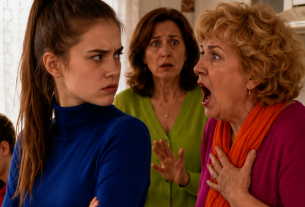
Marina realized her marriage didn’t break on the day of their big argument—or even on the day they got divorced. It happened much earlier, on that dreary Friday when she was scraping burnt milk off the stove, and her husband, not looking up from his phone, called out from the other room: “We’re going to my mom’s on Sunday, don’t forget.” Just as casually as someone might mention paying the internet bill or buying potatoes. But inside, it felt like a door slamming shut: once again, someone else’s kitchen, someone else’s rules, and those eyes that had looked at her like a defective product for three years.
“Artyom, maybe we could skip this Sunday?” Marina asked as she wiped the stove with an old sponge she really should’ve thrown out. “I’ve got a report due, laundry piled up, and your faucet has been dripping for a week. It feels like we live in a train station, but we always make it to your mom’s right on schedule—like a commuter train.”
“Marina, here we go again,” Artyom replied from the other room. “Mom’s alone. She gets bored.”
“She’s not alone. She’s got her neighbor Galina, a friend from the clinic, the cat Semyon, and the whole apartment block to tell everyone that I’m just draining the life out of you.”
“You’re twisting everything again.”
“Of course. I’m the one twisting things when she asks why I still haven’t had a baby—even though, in her words, ‘at my thirty, it’s a bit late to be picky.’ I guess I’m making it up when she says my jacket looks like a stool cover. It’s all just my wild imagination, right?”
“She’s just a straightforward person.”
“No, a straightforward person says: ‘I don’t like your jacket.’ But your mom says: ‘Artyomka, at least dress your wife properly, otherwise people will think you picked her up at the train station.’”
Artyom came into the kitchen, grabbed his mug with cold tea, peeked into the fridge, and frowned.
“Look, let’s not start. I’m tired after work. We’ll go for a couple of hours on Sunday and that’ll be it.”
“A couple of hours at your mom’s means from noon till seven. First borscht, then her blood pressure, then ‘Marina, wash the salad bowl since you’re just sitting there,’ then a lecture about how women are lazy these days, then you go watch the news with her and I stay in the kitchen listening to her tell me how to live my life.”
“Just help her out, what’s so hard about it?”
“It’s hard not to help. It’s hard to be treated like a maid and then told I don’t serve tea properly.”
“Oh come on, Marina, you take everything so personally.”
“That’s because I actually have feelings.”
Artyom rubbed his face tiredly.
“Let’s skip the drama. Mom’s older, she has her ways. Just deal with it.”
Marina looked at him and let out a short, joyless laugh.
“You know what’s the worst part? You never say, ‘She’s wrong.’ You just say, ‘Just deal with it.’ Which means you see everything.”
“I don’t want any drama.”
“You think I do? Every Sunday I wake up and think, ‘God, I’m so looking forward to a good dose of humiliation, better hurry over!’”
“You’re exaggerating.”
“I’ve been bending over backwards for three years. I’m afraid my spine won’t recover.”
They lived in a rented one-bedroom apartment in Mytishchi, up on the 14th floor of a panel building where the elevator always smelled of damp newspapers and someone else’s meat patties. Marina worked as a purchasing manager for a chain of hardware stores, making ninety-two thousand a month—unless her bonus was cut for ‘missing supplier targets.’ Artyom was an engineer for a construction company and brought home about one hundred fifty thousand. Rent was forty-five thousand, plus utilities, groceries, and a car loan for the car Artyom bought ‘for the family,’ although it was mostly used to drive his mother to the clinic and the market.
«I’ll stop by Mom’s tomorrow and bring her some medicine,» he said, closing the fridge. «So on Sunday, we won’t stay too long.»
«You’ve already said that last week. And the week before. And back in April, when there was still snow on the ground.»
«Marina.»
«What?»
«Don’t make that face.»
«And what face should I make? Grateful?»
On Sunday, they arrived at Tamara Pavlovna’s house around one o’clock. Her place was an old brick building near the station, with a peeling entryway and a permanent puddle by the trash chute. It took Tamara Pavlovna a while to open up: first, she fiddled with the locks for ages, then peered through the crack like she was expecting bailiffs, not her son and daughter-in-law.
«Artyomushka, finally!» Her voice immediately softened. «I was starting to think you’d forgotten about me. Ah, Marina’s here too. Hello. Oh, what kind of boots are those? Is that what’s in style now, or are you still wearing the ones from your college days?»
«Hello, Tamara Pavlovna,» Marina replied. «The boots are fine. They’re winter boots.»
«‘Fine’ means they’re warm and don’t make you cry to look at them. Artyom, come in, son. Wash your hands. I fried up some cutlets, the way you like. None of those frozen ones from the store that just mess up your stomach.»
«Mom, it smells amazing,» Artyom said as he took off his jacket.
«Of course it smells amazing. I don’t get lazy. Marina, hang your coat up neatly, would you? Yours always looks like it’s come from the market on a rainy day.»
«Mom, that’s enough,» Artyom muttered, almost too quietly to hear.
Marina heard him. Tamara Pavlovna heard him too, and immediately flashed a smile.
«Enough what? I’m just teaching someone to keep things in order. She’s not a stranger. Although sometimes it does feel like she’s a stranger. Three years in the family, and she still pours tea like it’s cafeteria duty.»
«I haven’t poured the tea yet,» Marina said.
«Good. Then there’s still hope not to mess it up.»
In the kitchen there was a round table covered with a red poppy-patterned oilcloth. By the wall stood a glass-fronted cabinet where crystal glasses lived on display—and nobody used them. Behind the glass were photos of Artyom: first grade, graduation, the army, university. There was no wedding photo. Marina noticed that the first year, and then made herself stop noticing so she wouldn’t get upset every time.
«Sit down, son,» Tamara Pavlovna said. «Marina, get the plates from the cupboard. Not those, the nice ones. No, not those either. My goodness, how can you come to my house for three years and still not know where the plates are?»
«Because this isn’t my home,» Marina replied.
Tamara Pavlovna turned slowly, like a teacher facing a failing student.
«What?»
«I said: because this isn’t my home. I’m just a guest here.»
«A guest? That’s interesting. Guests usually bring something with them. What did you bring? The look of a tired queen?»
«I brought a cake.»
A cake from the supermarket? Well, thank you, I guess. Good to know the celebration is a real hit.
Artyom sat at the table as if he wasn’t part of this conversation. He opened a bottle of mineral water and poured himself a glass.
«Mom, can we not do this?»
«Not do what, Artyom? I’m not saying anything. It’s just that people have different ideas about what’s appropriate. In our family, we never came to the elders’ house empty-handed.»
«A cake isn’t empty-handed,» Marina replied.
«A cake is just an excuse. Empty-handed means when someone brings nothing of themselves—no warmth, no respect, not even a decent salad.»
«I can leave, if you find me that unpleasant.»
«Where would you go?» Tamara Pavlovna smirked. «Home? To that little rental my son pays half for? Don’t get upset, Marina. A woman should know how to be patient, otherwise the family falls apart. Though I suppose nobody ever taught you that.»
«Patience is for when a bus is late or your heel breaks. When you’re humiliated at the table every week, Tamara Pavlovna, that’s not patience anymore—that’s training.»
The kitchen fell silent. Even Semyon, the fat gray cat under the radiator, stopped chewing his plastic bag.
Artyom looked up.
«Marina, what’s going on?»
«Nothing. I just actually said what I think instead of swallowing it.»
Tamara Pavlovna set the pot on the trivet with a sound like she’d just signed a verdict.
«Son, are you hearing this? She’s raising her voice to me. In my own home.»
«Marina, apologize,» Artyom said.
«For what?»
«For your tone.»
«And when is your mother going to apologize for what she says?»
«Don’t start.»
«I’m not starting. I’m already in the middle of it.»
Tamara Pavlovna sat down and crossed her arms on her chest.
«You’re so ungrateful. We welcomed you into this family, and now you set conditions. Where are you even from? Kamyshin? Figures. Brought along that provincial chip on your shoulder and acting like it’s family silver.»
«I’m from Volzhsk,» Marina said. «And unlike some, my family never insults guests at the table.»
«Your parents spent their whole lives at the factory. Maybe they just didn’t have time to teach you better.»
«My mother’s a nurse. My father’s an electrician. They worked, not just hung around.»
«Well, there you go. Just simple people. What do you expect.»
«I’d like to finish my borscht without needing to present my family tree.»
Artyom loudly pushed his chair back.
«Enough, both of you. Did we come here to eat or to start a fight?»
«I came to eat,» Marina said. «But apparently, drama is served with the cutlets.»
After lunch, Tamara Pavlovna called Artyom into the living room to «fix the TV,» even though it worked fine. Marina stayed behind to do the dishes. The water was icy, the tap was leaking, and on the windowsill stood a jar of onion skins «for Easter eggs,» though Easter was still five months away.
From the other room, voices drifted in:
«Son, just look at her. She’ll eat you alive. She’s talking back to me today, and tomorrow she’ll kick you out of the house.»
«Mom, don’t exaggerate.»
«I’m not exaggerating, I just know life. A woman without roots is like tumbleweed. Here today, gone tomorrow. You get her an apartment, hand her your paycheck, and she’s still not happy.»
«We pay for it together.»
«Sure, together. But you’re the man, so it’s your responsibility. And what does she do? Buys a dress, does her nails, acts like a princess. You really should think about your future. No kids, no apartment, but at least she’s got an attitude.»
Marina stood by the sink, gripping a plate so tightly her fingers turned white. She wanted to march in and say, «I can hear everything.» But she already knew how it would play out. Tamara Pavlovna would throw her hands up in exasperation, Artyom would tell her, «You shouldn’t eavesdrop,» and somehow Marina would end up being the guilty one—her fault for having ears, for having nerves, for merely existing within earshot.
At home, Artyom stayed quiet the entire evening. Later, as Marina was pulling laundry from the machine, he finally spoke:
«You went too far today.»
«Really? I thought your mom was the one making soup.»
«That’s not funny.»
«It’s not funny to me either.»
«She’s an elderly woman. She has high blood pressure.»
«So do I. I just don’t have a blood pressure monitor because I don’t put on a show with the cuff every twenty minutes.»
«You’ve become bitter.»
«I’ve become tired.»
«You could try to be gentler.»
«I was gentler for three years. I got chewed up.»
«Marina, my mom isn’t an angel, but she’s my mother.»
«And what am I to you?»
Artyom fell silent. Conveniently silent. Silence was kind of his universal tool: he could hammer nails with it, cover up holes, put out fires, and bury other people’s dignity.
A month later, Marina’s father got sick. Not fatally, but it was scary—his heart gave out at work and he was taken to the district hospital. Her mother called in the night, voice trembling.
«Marisha, they admitted your dad. The doctor says he needs to be examined in Kazan, we don’t have the equipment here. I don’t know where to turn.»
Marina sat in the kitchen in her nightgown, jotting down the cardiologist’s name, the department number, and a list of medicines on the back of a receipt. Artyom stepped out of the bedroom, squinting.
«What happened?»
«Dad’s in the hospital. I need to leave first thing in the morning. Can you help me get to the train station? The bag will be heavy.»
«Tomorrow?» he scratched his head. «Marina, I can’t. I have to take my mom to the dentist. She’s getting a bridge fitted.»
«Artyom, my dad has a heart condition.»
«I get it, but Mom’s had this appointment for a month. She can’t get there on her own, the metro makes her feel sick.»
«The metro makes her feel sick, but my dad is sick in intensive care.»
«Don’t be dramatic. Take a taxi.»
«Thanks. That feels really family-oriented.»
«Well, what am I supposed to do? Split myself in two?»
«No. You already made your choice on where to be whole a long time ago.»
He got offended. For two days, he only messaged brief things like: «How’s your dad?» and «I didn’t mean it.» Tamara Pavlovna called just once.
«Marina, are you going to be there long? Artyom’s eating whatever he finds. I sent him some soup, but he won’t heat it up.»
«My father is in the hospital.»
«I heard. But you have to understand—men are like children. They need someone to watch over them.»
«Then take him in and feed him with a spoon.»
«Don’t be rude. I’m talking to you like a human being.»
«If you want to act like a human being, you would ask me if my father is alive.»
«Well, he must be, since you’re picking up the phone.»
For the first time, Marina turned off her phone not because the battery died, but because otherwise she would have said something she couldn’t take back. Not that it really mattered—the way back was already gone. She was just walking along it out of habit.
Her father was discharged after two weeks. At work, Marina faced a mountain of problems: a supplier missed a shipment, her boss Lyudmila Sergeyevna looked like a tax inspector, and the accounting department lost the reconciliation statement. Marina survived on vending machine coffee, supermarket cottage cheese, and a drive that ran on sheer frustration.
At the start of December, she got a call from an unfamiliar number.
— Is this Marina Viktorovna Zaitseva?
— Yes, it is.
— This is Smirnova’s notary office calling. You need to come in regarding an inheritance case.
— What case is this about?
— The deceased is Vera Alexandrovna Kruglova. You are named in the will.
Marina stepped out of the meeting room into the hallway, which smelled of cheap coffee and damp winter coats.
— Excuse me, has Vera Alexandrovna passed away?
— Yes, on November 21st. Hasn’t anyone told you?
— No. She was my godmother. We saw each other this summer—I brought her some medicine. She… she was sick, but she never said it was this bad.
— My condolences. According to the will, you inherit a two-room apartment in Moscow’s Sokolniki district, as well as a bank deposit. Please bring your passport, SNILS, and birth certificate if you have it.
Marina leaned against the wall. The storeroom manager, Vitya, walked by carrying a box of light bulbs and said:
— Marina, why do you look so pale? More trouble with suppliers?
— No, Vitya. I think it’s just life.
Vera Alexandrovna wasn’t some fairytale rich relative. She was a lonely literature teacher, a friend of Marina’s grandmother. When Marina was a child, she used to visit Vera for school breaks, eat cottage cheese pancakes, listen to her complain about the TV, and read Chekhov out loud as if she were telling it to the neighbor. In recent years, Vera lived alone. She was sick, but always stood as straight as a ruler. Marina helped her: brought her medicine, changed her curtains, sorted her bills, argued with the building management about the radiators.
That evening she told Artyom.
— Are you serious?—he froze mid-bite with his fork. —An apartment in Sokolniki?
— A two-bedroom. Old, but it’s ours.
— Marina, this is… This is a whole new life! We won’t have to rent anymore. We could pay off the car faster. Maybe fix the place up. My mom will be nearby—it’s not far for her.
Marina slowly raised her eyes.
— What does your mom have to do with this?
— I was just saying. She’ll be happy for us.
— She’ll be happy about my apartment?
— Our apartment, Marina. We’re a family.
The word “our” didn’t sound endearing—it felt more like the first scratch of a key on a new door.
— Artyom, by law, the inheritance is my personal property.
— I’m not talking about the law. I’m talking about normal relationships. You got defensive right away.
— Because you immediately called it ‘ours.’
— So what am I supposed to say? “Your apartment, Marina Viktorovna, may I sleep on the doormat?”
— You could just say: “I’m sorry about Vera Alexandrovna.”
He put down his fork.
— I am sorry. Really. I was just happy for us.
— For us, or because we don’t have to pay rent anymore?
— That too. What’s wrong with that?
Nothing was wrong yet. Trouble, like always, didn’t arrive with a bang—but quietly, in house slippers.
Tamara Pavlovna called the next day.
— Marina, dear, Artyom told me about your loss. My condolences. Vera Alexandrovna must’ve been a good woman.
— You didn’t know her.
— Well, if she left you an apartment, she must have been good. Listen, I was thinking: it must be tough for you now—documents, stress. Don’t be shy, I can help. I’ve got experience, I went through privatization myself back in the day. The main thing is, don’t trust anyone except family.
— Thank you, I’ll manage with the notary.
— Why are you always doing everything yourself? That’s what family is for! By the way, come over this Sunday—I’ll bake a pie. What kind do you like? With cabbage? With apples? I think you prefer apples, right?
— I don’t like apple pies.
— Then you’ll learn to like them! Homemade is always better than your takeout.
On Sunday, Tamara Pavlovna greeted Marina as if they’d spent the last three years tending roses together, rather than clawing at each other.
— Marina, come in! Oh, you’ve lost weight! Your face looks so noble now, truly refined. I always told Artyom: Marina has class, she’s just tired.
— You used to say I looked like a market vendor, Marina reminded her.
— Oh, come on, don’t take everything so literally. I only tease out of love. My tongue is sharp, but my heart is pure gold.
— Looks like your tongue isn’t covered in gold yet.
Artyom coughed.
— Marina.
— What? I’m just joking—with love.
At the table, Tamara Pavlovna went all out: salad with tongue, herring under a fur coat, roast cooked in little pots. Even the cake wasn’t from the local discount store—it was from a real bakery, with a messy chocolate inscription reading “For the Family.”
— I’ve been thinking, Tamara Pavlovna began as she poured Artyom some fruit compote. Your new apartment is wonderful, of course, but happiness needs to be set up properly. You know how times are—today there’s love, tomorrow, it’s courtrooms. Not that it would happen to you, heaven forbid, but wise people think ahead.
— About what exactly? Marina asked.
— Well, about security. Everyone should have some protection—you, Artyom, me. Family isn’t just a formality, it’s about supporting each other.
— Tamara Pavlovna, the apartment was left to me in a will.
— Of course, to you! No one’s arguing. But you don’t live on an island. Your husband is next to you, right? And his mother too. Who will help you with repairs? Us. Who’ll look after you if you’re sick? Us. Who’ll take the kids to school later? Me. So it’s only fair to divide the shares.
Marina put down her fork.
— Shares for whom?
— Not for strangers! You get the main share, Artyom gets one, and I get a small one. That way, everything’s honest. I’m not asking for half. I don’t need much.
— You say you don’t need it, but you’re still asking.
— I’m not asking for myself, it’s for peace of mind.
— Whose peace of mind?
— Everyone’s.
— My peace of mind doesn’t seem to count.
Artyom quickly jumped in, as if he’d memorized his lines.
— Marina, Mom just means we should be a team. Think about it—if we’re investing in renovations, buying furniture, fixing up the kitchen, that’s family money.
— I haven’t asked anyone to invest yet.
— But we’re going to live there!
— Live there, yes. Own it? No.
Tamara Pavlovna smiled thinly.
— See? I told you, Artyom. As soon as someone gets property, their real character comes out. Marina, don’t take this the wrong way, but stinginess doesn’t look good on a woman.
— Don’t confuse boundaries with stinginess. Being stingy is asking for a share in an apartment you have nothing to do with. A boundary is when I say ‘no’ to you and don’t feel ashamed.
Artyom blushed.
— You’re speaking to my mother.
— And she speaks to me like I’m an idiot she can push aside.
— No one’s pushing you aside.
— Then what’s with all this act—tongue salad, pie, and ‘dear Marina’?
Tamara Pavlovna stood up.
— I can see there’s no point arguing with her. She got her piece and she’s clinging to it with her teeth. Artyom, you have my sympathy.
— Mom, please sit down.
— No, let her hear this. A wife like her will be the first to slam the door shut in tough times. Today she’s not dividing up the apartment, tomorrow she’ll take the child, and the day after she’ll claim you mean nothing to her.
— So far, the only one who means nothing here is you, — Marina said.
Artyom slammed his hand on the table.
— Enough!
Glasses jumped on the table. Semyon ran off to the hallway.
— Don’t you dare talk to my mother like that.
— And don’t you dare bring me here just to split up my inheritance.
— No one is splitting anything!
— Artyom, you were literally just discussing my square meters like potatoes at the market.
— Because we’re family!
— Family doesn’t start with someone asking you to sign over your property.
— You take everything so legally.
— I’ve finally started to.
After that, they drove home in silence. The car smelled of tangerines—Tamara Pavlovna had handed them a bag ‘for the house’, as if tangerines could patch up a crack. At the entrance, Artyom turned off the engine but didn’t get out.
— Marina, you humiliated my mom.
— That’s an interesting conclusion after three years together.
— I’m serious. She meant well.
— For whom?
— For us.
— Artyom, be honest. Was it your idea to talk about shares, or hers?
He turned to look out the window.
— We discussed it.
— Was it a long time ago?
— What difference does it make?
— It makes a big difference. You haven’t happened to prepare the documents already, have you?
— Don’t be ridiculous.
He answered way too quickly. Marina took note.
She got the keys to the apartment in Sokolniki in January. The place was on the fifth floor of a Stalin-era building: high ceilings, old herringbone parquet, windows overlooking a courtyard where carpets were hung out to dry and crows squabbled loudly. Vera Alexandrovna had left everything tidy: books lining the walls, a china cabinet, sewing machine, neatly labeled boxes—’Documents,’ ‘Photos,’ ‘Letters.’ On the kitchen wall hung a calendar from November, with the 21st circled in red pencil: ‘Don’t forget to live.’
Marina stood in the middle of the room while Artyom was already making calculations.
— We can knock down this wall. Combine the kitchen with the living room. Mom would like it, she’s always said old apartments have a senseless layout.
— Mom isn’t the one who’ll be living here.
— That’s not what I meant. She just knows about these things.
— About what? Other people’s apartments?
— Marina, you’re doing it again.
— Yes, I am. Because you’re dragging your mom in here again before we’ve even had a chance to put our slippers down.
— Fine. Let’s not talk about Mom. Let’s discuss the renovation. I know a foreman who can estimate it cheaply.
— I want to live here first and figure out what needs changing.
— Why wait? Now that we have the apartment, we should really fix it up. I can take out a loan.
— Don’t.
— Why not?
— Because then you’ll say you invested money in it.
He shot her a sharp look.
— You don’t trust me?
— I believe you love your mom. The rest—I’m still checking.
The move took two days. Most of the furniture in their rented place belonged to the landlord, so they only moved their clothes, dishes, Artyom’s computer, Marina’s books, and a box of Christmas ornaments. Tamara Pavlovna showed up uninvited to ‘help organize the kitchen’ and in three hours managed to rearrange all the groceries, criticize Vera Alexandrovna’s curtains, and ask where her sleeping spot would be ‘in case of high blood pressure.’
«Tamara Pavlovna, you have your own apartment,» Marina said, taking the jar of buckwheat from her.
«I do have my own, but I’m his mother. What if something happens to me at night? Artyom needs to be nearby.»
«There’s a pharmacy, a clinic, and Galina the neighbor right next to you.»
«You’re so heartless.»
«I’m the one in charge here.»
That was the first time Marina had ever said those words, and she was surprised by how naturally they came out. Not harsh, not loud—just exactly right.
A week later, while Artyom was in the shower, his tablet beeped in the kitchen. Marina hadn’t planned to read anyone else’s messages, really. But the screen lit up and a message from Tamara Pavlovna popped up right on the lock screen:
«Son, don’t drag this out. While she’s still getting used to things, persuade her to agree to the shares. It’ll be too late later. The lawyer said it can be done through an agreement, as long as she signs it voluntarily.»
Marina stood there with a wet rag in her hands and felt something inside her grow very quiet. Not angry. Not hurt. Dangerously calm.
Then a second message came:
«And don’t you dare wimp out again. Are you a man or a doormat? Tell her you won’t invest or live there without proper paperwork.»
Marina put the rag down, took photos of the screen on her phone, and went to the bedroom. Artyom came out of the bathroom ten minutes later.
«What’s wrong?»
«Nothing. I’m just tired.»
«My mom’s coming over on Saturday, okay? She wants to look at the curtains.»
«She can come.»
«Really?»
«Of course. People need to finish their conversation, after all.»
He didn’t catch on. It was clear from his satisfied face.
On Saturday, Tamara Pavlovna arrived in a new coat, with a folder under her arm and a bag of pastries. Artyom was nervous, pacing from the window to the table, straightening the tablecloth he’d laid out crooked.
«Marina dear, I brought something for tea,» Tamara Pavlovna said. «And I’m here on business. No hard feelings, okay? We’re all adults here.»
«I certainly hope so.»
«So. I found a competent lawyer. He explained everything. Look, we can draft an agreement: you give Artyom a third, I get a symbolic one-sixth. The rest is yours. No one’s taking advantage of you.»
Marina took the papers. It really was a draft gift agreement. Her surname, passport details, apartment address. The passport data seemed to come from family documents—probably taken by Artyom.
«Interesting,» Marina said. «Did my passport details walk themselves over to the lawyer?»
Artyom swallowed hard.
«Marina, don’t overthink it. It’s just a draft.»
«A draft with my passport information.»
«We just wanted to be prepared.»
«You wanted me to sign faster.»
Tamara Pavlovna sat up straight.
«No need to be dramatic. A woman who loves her husband doesn’t interrogate him over a few square meters.»
«A woman who loves herself definitely will.»
«Is that so? So you love yourself more than your family?»
«At least I’m not trying to rob myself.»
«Are you calling us thieves?»
«What else do you call people who sneak my info to a lawyer behind my back and prepare a gift agreement?»
Artyom stepped closer.
«That’s enough. We’re not your enemies. Mom is right—the apartment should be set up like a proper family home. I’m not going to live somewhere with no rights.»
«‘No rights’ means what, exactly? Not having a share in someone else’s inheritance?»
«I’m your husband!»
«Then act like one, not like Tamara Pavlovna’s representative.»
«Don’t drag mom into this!»
«She’s sitting right here in front of me with a folder.»
Tamara Pavlovna stood up.
Artem, just tell her directly. She doesn’t get the gentle hints.
Artem glanced at his mother, then at Marina. Finally, he said the words he’d clearly been holding back for a long time.
«Divide up the shares. For me and Mom. Stop pretending to be the wounded orphan. If it wasn’t for family, you’d still be running from one rental to another in Moscow, and now you act like the queen of the parquet floor.»
Marina didn’t answer right away. She looked at him and saw not the husband who once shared pizza with her on a windowsill in an empty apartment, not the man who gifted her lilacs near the metro, but someone who stayed silent for three years while her world fell apart, just waiting for the perfect moment to claim his share.
«Say it again,» she told him.
«Don’t,»
«No, repeat it. So I can remember exactly the moment things finally got easier for me.»
«Marina, I snapped.»
«No. You finally showed who you really are.»
Tamara Pavlovna snorted.
«Such fancy words. Like a theater performance.»
«The show’s over. Artem, pack your things.»
«What?»
«Pack your things and leave.»
«Are you out of your mind?»
«No. I finally came to my senses.»
«This is my home too!»
«No. This is my apartment. I inherited it. I didn’t acquire it during the marriage, and it wasn’t bought with your money. Your rights end at the doormat in the hallway.»
«Are you kicking me out?»
«Yes.»
«Mom, are you hearing this?»
«I hear you, son. I heard everything. Marina, you’ll regret this.»
«Maybe I will. But not today.»
Artem rushed around the bedroom, grabbing t-shirts, phone chargers, and documents. Tamara Pavlovna stood in the hallway, hissing:
«You’ve destroyed this family out of greed.»
«No, Tamara Pavlovna. I just stopped funding your fantasies.»
«He loved you.»
«He loved comfort. That’s cheaper.»
«You’ll end up with no one.»
«At least I’ll still have myself. That’s a good beginning.»
Artem left with his bag. His face was confused, angry, almost childlike.
«Marina, don’t go to extremes. I’ll spend the night at Mom’s. We can talk tomorrow.»
«Tomorrow I’m changing the locks.»
«You have no right!»
«I do. The lawyer confirmed it.»
«Which lawyer?»
«The one I went to after your messages. Yes, Artem, your tablet is quite talkative.»
Tamara Pavlovna turned pale.
«You went through our personal things?»
«No. Your plans just popped up on the screen. Apparently, they wanted a share too.»
Artem muttered a curse under his breath.
«You set this all up on purpose.»
«No. You two set it up. I just didn’t sign.»
He started toward her, but Marina grabbed her phone.
«One more step and I’ll call the police. Not because I’m scared, I just don’t want to have to mop up your pride from the floor afterwards.»
He left. The door closed almost quietly. Tamara Pavlovna lingered for a moment.
«You think you’ve won?»
«No. I just think for the first time in three years it’s going to be quieter in this apartment.»
«Heartless.»
«Make a note in my file. You do love collecting documents, after all.»
When the door closed the second time, Marina sat down on the hallway floor. She didn’t cry. The tears were somewhere far away, like distant noise behind a wall. She sat there among the shoes, a bag of pastries, and the folder that Tamara Pavlovna had angrily left on the cabinet. Then she got up, threw the pastries in the trash, put the folder in a bag, and took it to the neighbor’s paper recycling bin.
The next day, she changed the locks. The locksmith, a mustached man in a blue jacket, worked silently, then asked:
«Was it your husband?»
«Almost not anymore.»
Alright, then take two sets of keys and don’t give them to anyone. Not even if they show up with flowers. Flowers are the cheapest break-in tool.
For the first time in days, Marina laughed.
In the evening, Artyom started calling from different numbers.
«Marina, open up. I’m at the entrance.»
«I’m not home.»
«I see the lights on.»
«Then the apartment’s home.»
«Stop mocking me. I need my things. My computer’s in there.»
«I’ll bring it down at seven tomorrow evening. You’re not coming into the apartment.»
«You’re acting like an enemy.»
«I’m acting like the owner.»
«My mom is crying.»
«Give her some water. She’s experienced, she’ll be fine.»
«I don’t recognize you.»
«But I recognized you. That’s where we parted ways.»
He would also text: «I overreacted,» «Mom pressured me,» «You’re at fault too,» «Let’s go to a family therapist,» «Don’t destroy everything,» «I can’t live without you.» Marina would only read the first lines on the screen and then delete them. The most interesting part was that not one message said: «I had no right to demand your apartment.» There were a lot of words about love, pain, memories, even a broken heart emoji. But no acknowledgment of her rights.
A week later, Marina filed for divorce. At the registry office, the woman behind the glass asked indifferently:
«No kids? No disputes over property?»
«No kids. He might invent disputes, but there’s no shared property.»
«Then through the court, if he doesn’t agree. Or he can just come in and sign.»
Artyom didn’t come. He decided to «fight.» Tamara Pavlovna wrote to Marina’s mother on social media:
«Your daughter kicked her husband out and wants to leave him homeless. Must be her upbringing.»
Her mother called Marina five minutes later.
«Marisha, who is this witch messaging me?»
«Mother-in-law.»
«I figured I wasn’t talking to a ballerina. What happened?»
Marina explained. Her mother was silent for a long time, then said:
«Honey, I’d come over and give her a piece of my mind if I weren’t working my shift. So just know: you did the right thing.»
«Mom, I’m scared.»
«Being scared is normal. What’s not normal is getting trampled at the dinner table while you keep chopping salad.»
«I chopped for three years.»
«Well, it’s over. You’ve put the knife down.»
Her dad called separately.
«Marina, do you need money for a lawyer?»
«Not yet.»
«If you need it, let me know. And don’t even think about making up for the sake of ‘what people will say.’ People in this building can’t even throw their trash in the bin, but they all have an opinion about everything.»
At work, Marina managed to keep it together until Lyudmila Sergeyevna asked:
«Zaitseva, why have you been coming in for the last three days looking like the supplier died, but managed to sign a contract with the competitors before they passed?»
Marina closed the office door and gave a brief explanation. The boss adjusted her glasses.
«Here’s the deal. First, take a day off tomorrow and see a real lawyer, not some friend from the internet. Second, if your husband starts staking out the office, let security know. Third, submit your report Friday, not today. I may be tough, but I’m not heartless.»
«Thank you.»
«Don’t thank me. I’ve been divorced twice and I know that the people shouting the loudest about family are usually the ones wanting the wardrobe, the couch, and half your liver.»
The court session was uneventful. A small room, creaky chairs, a judge with a tired face, Artyom in a new shirt, Tamara Pavlovna in the hallway—like a one-woman support group. Artyom insisted that he loved his wife, that the conflict could be resolved, claiming Marina had become sharp-tongued under the influence of some «hereditary euphoria.» The judge asked:
«Is living together possible?»
Marina replied:
«No.»
«Is reconciliation possible?»
«No.»
Artyom turned to her.
«Marina, look at me. We’re not strangers.»
«We are now.»
«Did you just erase three years?»
«No. I finally understood them.»
After the hearing, Tamara Pavlovna caught up with her at the exit.
«Are you happy now? You stressed out my son, now you’re free?»
«Your son is an adult. Though you’d been hiding that from the world.»
«He’ll still meet a normal woman.»
«I hope she checks his tablet in advance.»
«You’re disgusting.»
«Maybe. But at least I kept the apartment.»
The divorce was finalized two months later. Artyom tried to claim he had bought the fridge and the couch for the apartment. Turned out the fridge was paid for with Marina’s card, and the couch was a gift from Vera Alexandrovna back when she was alive. He tried to claim he did renovations. Turns out the «renovation» was a shelf screwed into the bathroom and a lightbulb replaced in the hallway.
Marina’s lawyer dryly said:
«If your client insists on compensation for the lightbulb, we’re ready to discuss its market value. Factoring in depreciation.»
Artyom didn’t insist anymore.
That spring, Marina truly lived alone for the first time. Not temporarily, not «while he’s at his mom’s,» not «while we’re fighting.» Alone. At first, the silence was frightening. She caught herself still buying groceries with Artyom in mind: kefir he liked, sausage she never ate, dumplings «just in case he comes home late.» One day, she found herself standing by the fridge with those dumplings and said out loud:
«You know what, ‘just in case’? Screw you.»
And then she threw them out.
She put up new wallpaper in the bedroom. Not trendy, not «Pinterest-style,» but warm, with a tiny pattern like old book pages. She left Vera’s oilcloth on the kitchen table, because it still had faint knife marks and a round teapot stain. She bought herself a decent mattress. She put up a shoe rack in the hallway where her boots could stand as they pleased—offending no one.
Her friend Nika came over with wine and a bag of cheeses.
«Wow, the air feels different in here.»
«That’s because no one’s telling me I’m breathing wrong.»
«Has Artyom written to you?»
«He did. Then he stopped. Probably his mom took away his pencil.»
«Do you regret it?»
Marina thought for a moment.
«Sometimes I don’t regret losing him. I regret the version of myself who sat at their kitchen table and thought, ‘I’ll just stay quiet one more time, and at least the family will stay together.'»
«Would the family have stayed together?»
«Sure. Like a mummy.»
They laughed, and then Marina cried after all. Not prettily, not like in the movies, but with a swollen nose, hiccups, grabbing paper napkins from the kitchen. Nika stroked her back and said:
«There, let it all out. Then we can live.»
In June, Marina got a promotion. Lyudmila Sergeevna called her into the office.
«Zaitseva, our purchasing manager is going on maternity leave. I want to offer you the position.»
«Are you sure?»
— No, I just love risking other people’s nerves. Of course I’m sure. You work like a tractor—just quieter and a lot smarter.
— But there are people, budgets, negotiations involved.
— And you spent three years negotiating with your mother-in-law. After that, every supplier will feel like a kitten.
Her salary went up. So did the responsibility. Marina started staying late, arguing with suppliers, and learned how to say ‘no’ without a three-page explanation. That skill turned out to be more useful than English.
One evening, as she was coming home with two bags from Perekrestok, Tamara Pavlovna was sitting by the entrance. Not regal, not carrying a folder, not with a poisonous face. Just sitting on a bench, in an old coat, a bag in her lap. She looked suddenly older, all at once, without warning.
— Hello, Marina.
— Hello. Artyom doesn’t live here anymore.
— I know.
— Then you must have the wrong address?
— No. Can we talk? Five minutes. I promise I won’t yell.
Marina could’ve walked past her. She had every right. But something about this woman seemed so unexpectedly broken that Marina stopped.
— Speak here.
Tamara Pavlovna nodded.
— Artyom moved out.
— Congratulations.
— He left for another woman. She has a child and a mortgage. He said I’m suffocating him, that he needs his own life.
— Wow. What an unexpected thought.
— Don’t be sarcastic. Though you have the right.
— Thanks for the permission.
Tamara Pavlovna clenched the handles of her bag.
— He asked me to sell my flat and help them with a down payment. Said that since I’ll be alone anyway, I could get a studio outside the city.
Marina stayed silent.
— At first, I thought he was under that woman’s influence. Then I heard myself. I used almost the same words about you. Saying you didn’t need much. That family was more important. That square meters had to work for loved ones.
— And what do you want from me?
— I’m not sure. Probably to say you were right. I know it’s not an apology, and it’s late. But I saw… — Tamara Pavlovna gave a crooked smile. — I saw my son can be sweet when he needs something, and then suddenly go quiet. Just like he went quiet at your table. Only now he’s at mine.
— He didn’t learn that on his own.
— I know.
— You taught him.
— I know.
— You came because you’re hurting now, not because I was hurting before.
— Yes. Probably.
That ‘yes’ sounded truer than all her previous speeches. Marina suddenly felt tired. Not because of Tamara Pavlovna—of the family arithmetic where love was counted by shares, care measured in square meters, and respect only given in receipt.
— Tamara Pavlovna, I feel for you. Truly. But I won’t be your comfort.
— I’m not asking you to.
— You are. Just not in words yet.
The old woman lifted her eyes.
— You’ve become hard.
— No. I’ve become whole.
— Is it because of the apartment?
— No. The apartment was just a door. I simply walked through it.
Tamara Pavlovna stood up.
— Vera Alexandrovna was a smart woman.
Marina grew alert.
— How do you know her?
— I saw her once. Near the clinic. About two years ago. I was going to my cardiologist; she was on a bench outside. We started talking. She asked if I was Artyom’s mother. I was surprised. She said she’d seen all of us once in a café—you were meeting her after our dacha trip. Do you remember?
Marina’s memories were hazy: rain pouring down, a little café near the metro, Vera Alexandrovna wearing her beret, Tamara Pavlovna calling Artyom every ten minutes.
— And then what?
— She told me, «Take care of the girl. She’s not made of steel.» And I said something… nasty back. Told her you’re grown up and made your own choices. The way she looked at me—it was like I was invisible.
— Why are you telling me this?
— I don’t know. Maybe because she was right.
Tamara Pavlovna left. She didn’t ask for tea or money or forgiveness. She just left, small and stooped, with her bag—maybe inside were her medicines, or maybe it was just that old habit of holding onto her son with both hands.
A few days later, Vera Alexandrovna’s neighbor, Valentina Iosifovna, called Marina.
— Marina? This is from apartment forty-two. I was going through my papers and found an envelope. Vera asked me to give it to you when «your real life begins.» Back then I thought it was just some old poetry, but maybe now’s the right time?
Marina came to see her in the evening. Valentina Iosifovna brought out the envelope, yellowed, addressed in Vera’s neat handwriting: «To Marina. Not to be opened until she stops making excuses.»
At home, Marina didn’t open it for a long time. Then she sat at the kitchen table, poured tea into Vera’s cup with the chipped handle, and sliced the envelope open with a knife.
The letter was short.
«Marina, if you’re reading this, it means my apartment has become yours, not just on paper. Don’t give it away out of fear of being bad. We’re often called ‘bad’ by those we no longer make comfortable. I saw how you smiled when they hurt you. That smile wasn’t kind, it was just for show. Let it go. A home isn’t for everyone to come in, but for you to close the door. Live. Don’t prove to anyone that you deserve a roof over your head. No one should have to earn their safety.»
Marina read the letter three times. Then she placed her palm flat on the table and, for the first time, cried—not from anger. Because, as it turned out, someone really had seen her. Not as Artyom’s wife, not as Tamara Pavlovna’s daughter-in-law, not as the convenient girl with the salad bowl, but as a person who’d spent too long in someone else’s kitchen, waiting for permission to leave.
That evening, Artyom wrote to her. After three months of silence.
«Marina, hi. We need to talk. I’ve realized a lot.»
She looked at the screen and smirked.
— Oh, I’m sure you have. Must be the new girlfriend’s apartment doesn’t have an elevator.
She didn’t type any reply. She blocked the number and opened the window. Outside, boys were kicking a ball, the upstairs neighbor was drilling holes, a woman somewhere was shouting about parking, and the air smelled of dust, lilacs, and fried potatoes. Just ordinary life. Not festive, not like a movie, not one that promises happiness on a schedule. But it was her own.
Marina put the kettle on, took cheese from the fridge, sliced bread into thick, uneven pieces and sat down for dinner right in the kitchen, wearing a t-shirt and old pants. No one told her she was holding the knife wrong. No one asked how much her dress cost. No one announced they needed to go to visit mom on Sunday.
Her phone was silent. The door was closed. The keys lay beside Vera Alexandrovna’s letter.
In that deep silence, there was so much meaning that Marina suddenly realized—she was no longer waiting for someone to choose her. She had already chosen herself.