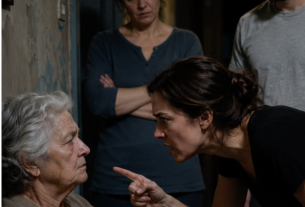
The notary looked at her over the top of his glasses and asked if she was satisfied with the terms of the transfer. Zoya had no idea about any transfer.
She had only come to get a power of attorney. Her mom had asked her to arrange the paperwork so she could pick up packages at the post office — her knees had completely given out, and the staircase there was steep and had no handrails. It was supposed to take fifteen minutes, tops.
The office smelled like old paper and something floral, sweet and overpowering, like lilies after two days. The air conditioner hummed steadily, pressing the silence against the walls. Zoya sat on a chair with a stiff back, her bag in her lap, her fingers clutching the strap so tightly that her knuckles turned white.
«Zoya Andreevna, right?» the notary clicked the mouse, peering at the monitor. «Melnikova?»
«Yes.»
«The plot in Kashira, the house and land, six hundred square meters. The transfer to Melnikova Valentina Petrovna was finalized in March. Did you sign your spouse’s consent?»
Her fingers froze on the strap.
«What consent?»
He looked up at her. Took off his glasses and rubbed the bridge of his nose with two fingers.
«Consent for the transfer of jointly acquired property. Your husband, Gennady Yuryevich, came to us in February. You…»
The notary stopped. He looked at her more closely now, as if really seeing her for the first time.
«You didn’t know.»
That wasn’t a question.
Three months. The dacha had been transferred three months ago, and she found out about it by accident, sitting in someone else’s office that smelled of lilies and old folders.
Zoya stepped outside. The June sun hit her face, and she squeezed her eyes shut as if she had just surfaced from underwater. A woman with a stroller walked by, a child laughed, somewhere a car door slammed. The world continued. But under her feet, the ground had just fallen away.
She reached a bench at the entrance of the business center, sat down, and got out her phone. Her hands wouldn’t cooperate. She missed the contacts icon three times before she finally dialed Larisa.
«Hello?»
«Lar.»
«Zoy, what’s going on? You sound strange.»
«Can you talk now?»
«I can. What’s happened?»
Zoya opened her mouth. Then closed it. How could she explain something she hadn’t even wrapped her own head around yet?
«Genka re-registered the dacha to his mother.»
Silence on the other end. Then Larisa exhaled, long and noisy, like she’d been holding her breath for thirty seconds.
«What do you mean?»
«Secretly. In February. I just went to the notary for my mom’s power of attorney and he started talking about the transfer. I didn’t sign anything, Lar. Nothing.»
«Listen to me. Don’t go home right now. Come to my place.»
«No. I’m going home.»
«Zoya.»
«I need to check the folder. With the documents. It’s in the dresser.»
«What folder, what’s it got to do with…»
«The originals. Ownership certificate, cadastral passport. I need to see if they’re still there.»
Larisa fell silent. Her hoop earrings probably swayed—she always shook her head when she was thinking.
«Alright. Check. But tonight you’re coming to me. Got it? To me.»
The way home took forty minutes. Zoya rode the bus, staring out the window without seeing anything. Stores, trees, billboards advertising toothpaste and resorts slid by. But what she saw in her mind was something else: summer, eleven years ago, an old ‘fourth’ model car, and the road to Kashira.
Grandma Klava passed away that winter. She left her apartment in Tula to Zoya—a one-bedroom on the ground floor with low ceilings and a lingering valerian scent so deep in the walls, no amount of renovations could ever wash it out. They sold the apartment for nine hundred thousand. Every ruble went to Zoya, her inheritance by will. But she didn’t dwell on ownership back then. After all, whose money is it really, when family is family.
Gennady found a plot of land through some friends. Six hundred square meters in Kashira, with birches lining the fence and a well in the yard. The air smelled of sun-warmed grass and river water. The land cost four hundred. Another five hundred disappeared into the foundation and the first walls. Grandma’s inheritance was gone in six months, down to the last ruble.
For the next two summers, they built their house. Zoya painted walls, picked out wallpaper decorated with cornflowers, lugged buckets of mortar until her palms were scraped raw by rough handles. Gennady worked with his father’s old tools—the ones that would later gather dust in the shed. And every weekend, Valentina Petrovna would visit, bringing pies and plenty of advice. The pies were dry, and so were her suggestions.
«Genka, did you check the foundation? I told you, the neighbors to the left insulated theirs differently.»
«Mom, it’s fine.»
«Fine, fine. And then when the walls start to crack, who’ll be to blame, I wonder?»
Zoya stayed quiet. She tucked a stray strand behind her right ear and said nothing. Arguing with Valentina Petrovna was like running against the wind: you get tired, but you never move forward.
«Zoyenka, why are you just standing there? Bring the pie to the table. Everything is for the family, you know that.»
Everything for the family. Her mother-in-law said those words in a tone that made it sound like she was bestowing a medal. And so Zoya brought the pie, sliced it, arranged the pieces on plates, and smiled.
The apartment greeted her with silence. Gennady was at work, and their daughter Polina was at a friend’s house until evening. Zoya took off her shoes in the hallway, went into the bedroom, and opened the bottom drawer of the dresser.
The folder was blue, plastic, with a clear front pocket. She knew its contents by heart: the property registration certificate, cadastral passport, land survey plan, an extract from the registry. She had sorted through these documents last year when she arranged insurance for the house.
The folder was right where it should be. Zoya pulled it out and undid the button.
Nothing.
No certificate, no cadastral passport, no registry extract. Only the land survey plan and an old electricity bill remained.
Her fingers instinctively found the mole on the left side of her neck. Zoya stood in front of the dresser, circling it gently with her fingertip—just like she’d always done when anxious. Ever since she was thirteen, after her homeroom teacher read her note out loud in front of the whole class. From that moment on, it became her habit: left hand to her neck, to the mole, making slow circles.
She sat on the bed. Then lay down. The ceiling was white and even, except for a crack in the corner they’d promised to fix for the past two years. The crack looked longer now. Or maybe it just seemed that way.
The clock in the hallway ticked, each tick landing alone, like a drop of water in an empty sink.
What was he thinking? Going to the notary, handing over the documents, signing the deed of gift. Not saying a word to her. Three months living side by side, eating at the same table, asking ‘what’s for dinner,’ and keeping silent. Today, the notary said, “you both signed the consent form.” Apparently, someone did. But it wasn’t her.
Looks like it was forged. Or maybe they found a loophole.
Zoya lay there, counting the chimes of the clock. Not on purpose. There was simply nothing else to do while her whole world was turning upside down inside her.
Gennady arrived at seven. She heard him rustling around in the hallway: the thud of his shoes on the rack, his jacket swishing, the click of the lock on his briefcase. These sounds were all so familiar. Every evening, the same thing, for fourteen years.
Zoya stood by the stove. The rice was coming to a boil, the lid rattling. She stirred the sauce in the pan and didn’t turn around.
«Hi,» he called from the hallway.
«Hi.»
«Is Polinka home?»
«She’s at Nastya’s. She’ll be back by nine.»
He walked into the kitchen. Six feet tall, receding hair at the temples, broad hands with neatly clipped nails. He rubbed his chin.
«What’s for dinner?»
«Rice with chicken.»
«Are there any tomatoes?»
«In the fridge.»
An ordinary conversation. An ordinary evening. Zoya set the table, laid out the plates, put down the forks. He sliced a tomato on the cutting board, sniffing from time to time. She watched his hands and thought: those fingers held a pen to sign a contract. And now they came home to dice up salad.
«How was your day?» she asked.
«Fine. The client’s being demanding again, endless fixes for the renovation. But you know, that’s always how it is.»
She nodded. She used to understand. She used to pour him tea, listen to his client stories, sympathize. But now she sat beside him, seeing the man who secretly signed away her house three months ago.
He didn’t steal it. He transferred it legally. Carefully, all according to the paperwork. Just failed to mention it.
The rice stuck in Zoya’s throat. She washed it down with water and pushed her plate away.
«Not hungry?»
«I’m just tired.»
«Go to bed early. It’s Saturday tomorrow, you can catch up on sleep.»
She got up, put the dishes in the sink, and turned on the water. The stream hit the plate, splashing the apron. Zoya watched as the water carried rice grains down the drain. He didn’t even twitch when she said she was tired. Not a single muscle moved. Because to him, tonight was just like yesterday.
He has no idea that she knows. And she isn’t going to tell him. Not yet.
The next morning, Zoya went to see Larisa. She told her husband she was going to the store, then to her mother’s. He just nodded, eyes glued to his phone.
Larisa lived alone in a two-room apartment on Kashirka after her divorce five years ago, which had left her with the apartment, a cat, and a habit of being brutally honest. The place was small but clean, smelling of coffee and fresh laundry. She wore a short bob, had broad shoulders, and her hoop earrings swayed in her ears as she poured the coffee.
«Tell me everything.»
«I checked the folder last night. Empty. All the documents are gone.»
«Who took them?»
«Who else? Genka has a key to the dresser. He knew where they were.»
Larisa set her cup on the table a bit harder than necessary. The coffee foam quivered.
«Listen. He couldn’t have done the paperwork without your consent. By law, if property is acquired in marriage, a wife’s notarized consent is needed.»
«That’s exactly what I’m saying. Someone forged something. Or found a workaround.»
Larisa shook her head.
«Or maybe the property was registered as his personal asset from the very beginning.»
«That’s impossible. We bought it together.»
«Whose name did the paperwork go under?»
Zoya paused, her cup halfway to her lips. Memories flooded back: the heat, their trip to Kashira in their Lada, Genka behind the wheel, her in the back seat with sandwiches. The paperwork had been handled quickly, thanks to a friendly seller—no unnecessary bureaucracy.
«It was registered to Genka,» she said quietly. «We did it all in his name. I didn’t think twice. We were married—so that means it’s ours, right?»
«Technically it’s shared. But if he lists himself as the sole owner and then gifts it to his mother, he doesn’t actually need your approval. That’s how gifting works, not selling. It’s all about the details.»
Zoya set her cup back on the table. The coffee had gone cold. She still hadn’t taken a single sip.
«So he could do that?»
«Yes, he could. Unless the notary looked into things more deeply. But they might not have, if all the paperwork checked out on paper.»
«But I put money into it. My grandmother’s inheritance. Nine hundred thousand. Is there a way to prove that?»
«You can. Through the courts. Bank statements, the purchase agreement for your grandmother’s apartment, proof of transfer dates. But you’ll need a good lawyer for that.»
Larisa finished her coffee and looked at her.
«Zoya. Are you sure you want to dig into this? It’s not just about the dacha. It’s about Genka. Fourteen years.»
«Fourteen years.»
The two of them fell silent. Between them stood two cups: one empty, one full. The city hummed beyond the window. Zoya listened to the noise, thinking about the white shoes that were two sizes too big, because she’d forgotten her own at her sister’s. And the smile she couldn’t wipe off her face that day. And how, fourteen years ago, she genuinely believed it would last forever.
She stayed silent for a week.
She went to work at the construction firm’s accounting department, balancing spreadsheets and signing off reports. Her colleagues didn’t notice anything—Zoya was always quiet, calm, the type to get the work done and never complain. Only Nina from the next department asked if everything was okay.
«I’m fine,» Zoya replied. «Just didn’t get much sleep.»
In the evenings, she cooked dinner. Talked to Gennady about the weather, traffic, the water bill. Checked Polina’s homework. Turned off the corridor lights. Went to bed. Didn’t sleep.
On Wednesday, Valentina Petrovna called.
«Zoya, hi there! How are you?»
«I’m fine, Valentina Petrovna.»
«I just baked a pie, with cabbage. Maybe you could come by this weekend? I haven’t seen Genka in ages—I miss him.»
«I’ll ask him.»
«Yes, please do. And bring Polina! I made her raspberry jam—let her spoil herself a little.»
Her voice was warm, soft, enveloping. The same tone her mother-in-law always used for ‘everything for family’ and ‘I want nothing for myself, just for the children to be happy.’ Zoya had been listening to that voice for fourteen years. And for fourteen years, she believed it showed she cared.
But now she heard a rhythm. Calculation. Pauses in exactly the right places.
«Zoya, are you there?»
«Yes, yes. I’ll tell Gena. Goodbye.»
She hung up and looked down at her hands. They weren’t shaking. Strange. A week ago, they trembled. Now, nothing.
On Friday, Zoya took a day off and went to the public service center. She requested the property statement from the registry. She waited forty minutes on a plastic chair next to a woman, who filled out a form as slowly as if she were writing her will.
She opened the printout right there at the counter.
Owner: Melnikova Valentina Petrovna. Registration date: March 12, 2026. Basis: Deed of gift.
Just plain paper, blue ink, tiny print. Zoya carefully folded the sheet along the creases and put it in her bag. As if it were just a store receipt, not proof that her husband had signed the house over to his mother.
Outside, a light rain was falling. She pulled up her collar and headed for the bus stop. In her jacket pocket, she felt an old bus ticket and a small stone Polina had picked up at the dacha last summer. White, smooth, perfectly round.
«Mom, this one’s magic. Make a wish.»
Zoya squeezed the stone in her fist. It was cold from the rain. Smooth. She kept it in her hand the whole way home, never letting go.
Larisa found a lawyer through her cousin. Anton Vadimovich, third floor of the business center, windows facing the courtyard, a cactus in a white pot on the windowsill.
Zoya came with a folder. Not the blue plastic kind, but a new cardboard one from the stationery shop. Inside: a printout from the property register, bank statements for eleven years, a copy of grandmother Klava’s death certificate, a copy of the sales agreement for the Tula apartment.
The lawyer listened without interrupting. He took notes in his notepad, and sometimes nodded. His pen scratched across the paper.
«The situation is complicated, but not hopeless,» he said when she was finished. «The lot was registered to your husband during the marriage. Officially, he’s the sole owner, and gifting it to a relative doesn’t require his wife’s consent.»
He raised his finger.
«But you invested your own money from an inheritance in the purchase and construction. That’s your personal money, not jointly acquired. If the court establishes that it was exactly these funds used to buy the lot and build the house, the gift transaction can be declared invalid.»
«I have account statements. The dates match up: the money came in from selling grandma’s apartment, and two months later went out to purchase the lot.»
«That’s good. Even better if you have receipts for building materials, written agreements, transfers to contractors.»
«Receipts, probably not. But there should be card transfers in the bank records.»
He nodded and wrote something down.
«Zoya Andreevna, I have to ask. Do you want to get the dacha back, or do you want a divorce?»
Zoya looked at the cactus. Small, prickly, unbothered. Just standing there, growing. It didn’t have to choose.
«I want to get back what’s mine. The rest, I’ll decide later.»
«Understood. I’ll start by filing a claim. If there’s no response, we’ll go to court.»
She left the office and paused in the corridor. Rain trickled down the glass doors. Zoya took out her phone and dialed Larisa.
«I saw the lawyer.»
«And?»
«There’s a chance. But it’ll take time and evidence.»
«Will you tell Genka?»
«I will. But not yet. First, I need to check something.»
It was painful to check. But necessary.
Zoya waited until Gennady went to the shower. His phone was left on the kitchen table, next to a half-eaten sandwich and a mug of tea. She picked it up. There was no password: he never bothered, thought it was silly.
Messages with his mother. February.
«Mom, I went to Ignatiev. He says it’ll work through a gift, no need for her consent.»
«Good job, son. I told you that was the best way. Zoya doesn’t need to know—this is our family matter.»
«Mom, what if she finds out?»
«She won’t notice. How could she? She only looks at the papers once a year. And anyway, we’re not stealing. We’re preserving things.»
Zoya kept reading and felt a chill rising from her stomach to her throat. It wasn’t anger. It was something else—heavy, solid, like the old cast-iron iron her grandma Klava kept on a shelf in the closet. «It’s for decoration,» she used to say. Back when Zoya was a kid, she’d try to lift it but couldn’t. The handles were too smooth, and the iron would slip right out of her fingers.
It wouldn’t slip now.
She scrolled further. March.
«Mom, everything’s officially done. The dacha is in your name now.»
«Thank you, Gena dear. You’re such a good son. I’m not doing this for myself—it’s for all of us. Who knows what could happen, but this way, something will stay with the family.»
«Who knows what could happen.» Zoya read that line three times. That’s when she got it: her mother-in-law was playing it safe. Against her. In case of a divorce, in case they needed to split property, in case her daughter-in-law decided to fight back. Maybe it wasn’t even ‘in case.’ Maybe she was already getting ready.
In April, she found another message.
«Gena, Mikhailych called. Said the neighbor out by Kashira sold his plot for 2.8 million. Ours isn’t any worse, and our house is better. I’m just checking the prices for now, don’t rush.»
«Mom, we agreed we wouldn’t sell.»
«We’re not selling, we’re not selling. I’m just thinking ahead, that’s all.»
Zoya set her phone back down next to her sandwich. Right where it was. The water in the bathroom had stopped running. She picked up her mug, took a sip, and burnt her tongue.
She didn’t notice.
Saturday. Gennady went to his mother’s to get jars for jam. «Stop by, Gena dear, I’m expecting raspberries and there aren’t any empty jars.»
Zoya stayed home with Polina. Her daughter was drawing at the table, tongue sticking out in concentration. Twelve years old, long legs, ears poking out from her ponytail, freckles scattered across her nose. Another year and she’d be a teenager and everything would get more complicated. But for now, she was content drawing cats with markers on sheets of paper and believing in the magic of lucky pebbles.
«Mom, when are we going to the dacha?»
«I’m not sure yet, Polya.»
«Why not? It’s great there. And Murzik misses us.»
Murzik. The ginger cat that started hanging around three summers ago and ended up staying on the porch. Zoya always left out a bowl of food for him. Baba Shura, their neighbor, fed him when they weren’t there.
«We’ll go. Soon.»
She didn’t mention that «soon» might never come. That the dacha where Polina caught ladybugs and built blanket forts now belonged to Grandma Valya. That Grandma Valya was probably thinking about selling it for over two million.
Zoya stepped out onto the balcony. Down below: the courtyard, a battered kids’ slide, poplar trees. On the neighboring balcony, laundry hung out to dry—sheets, pillowcases, a striped towel. Other people’s lives, fully in view.
But her own life felt invisible.
On Monday she went back to the lawyer. She brought her phone with screenshots of the chat. She’d photographed her husband’s screen, sent it to herself, and deleted it from the sent folder.
Anton Vadimovich read everything in silence. Then he folded his hands.
«This is good. Very good, Zoya Andreevna.»
«Why?»
«From these messages you can see: the deal was made deliberately, with the goal of hiding assets from a spouse. It’s not just a gift to a relative. It’s conscious concealment. The court will take that into account.»
«What about the fact that my mother-in-law is thinking about selling it?»
– Even more serious. If she starts the process of selling, we’ll request protective measures. The property will be frozen, with a ban on any registration activities. As long as the case is being reviewed, no one can sell or transfer anything.
– What if she manages to sell before the court?
– Then it’s tougher, but not hopeless. The buyer can be brought in too, especially if they knew the deal was questionable.
Zoya nodded. Terms, articles, law numbers—it all sounded foreign, a language she had to learn on the fly, without a dictionary. But she was picking it up quickly. She was an accountant, after all: numbers, dates, documents.
– I need to decide when to tell my husband.
– It’s better after you file the claim. Once the papers are at court, there’s no turning back. Right now, before it’s filed, he could pressure you, try to talk you out of it. Or his mother could get involved.
– His mother is already involved. Since the very beginning.
The lawyer looked at her.
– File the claim, – Zoya said.
And then something happened that she hadn’t planned on.
Valentina Petrovna organized a family dinner. She called on Thursday, her voice sweet, almost pleading.
– Zoya, come over on Sunday. I’ll cook borscht, bake some pies. We haven’t gathered as a family in so long.
– All right, Valentina Petrovna.
– And bring Polina. I knitted her a hat, light blue with a pompom. She’ll need it this autumn.
Zoya hung up and thought: what if she didn’t wait? What if she went to that dinner and told everyone everything, looking them right in the eyes?
The lawyer said: after you file the claim. The claim would be filed on Wednesday. The dinner was Sunday. But something inside wouldn’t let her stay quiet for four more days. Something hot, like tea that scalded her tongue before she noticed.
She called Larisa.
– Larisa, my mother-in-law invited us to dinner.
– And?
– I want to say it. In front of everyone.
– Zoya, the lawyer said after the claim is filed.
– I know. But I can’t take it anymore. Sitting next to him every evening and staying silent. Yesterday, he told me: ‘Maybe in July we’ll go to the dacha? Grill some kebabs.’ Kebabs, Larisa. At the dacha he gave to his mother.
Silence on the other end.
– All right, – Larisa said. – But have a plan. Don’t yell, don’t cry. Ask questions. Calmly. Let them get tangled up themselves.
– I know.
– Zoya. I’m with you.
– I know.
Sunday came quickly.
Valentina Petrovna’s apartment: a two-room flat in a five-story building, renovation from the 2000s. Floral wallpaper, the smell of borscht at the door, linoleum squeaking at the entrance. Zoya stepped over the threshold and saw a familiar scene: the table covered with a white lace-edged cloth, crystal shot glasses, a bowl of Olivier salad, and a plate with cold cuts.
Valentina Petrovna came out of the kitchen in a robe with daisies and a pink apron, her hands wet, traces of dough on her fingertips.
– Zoya! Gennady! Polina! Come in, come in quickly!
She hugged her son first. Then pulled her granddaughter close. She hugged Zoya last, quickly, just brushing her shoulder.
– Polina, go to the room, I’ll show you the hat I made.
Her daughter ran down the hallway, bare feet thumping. Gennady took off his shoes and went to the kitchen.
– Mom, need a hand?
– No, no, everything’s ready. Borscht is on, take your seats.
Zoya hung her jacket on the hook and glanced at herself in the hallway mirror. Pale skin, dark ash-blonde hair pulled back in a ponytail, narrow wrists poking out from the sweater sleeves. In the reflection behind her, the flash of her husband’s plaid shirt caught her eye. He was pouring tea, not turning around.
She walked into the room. Sat down at the table. Placed her hands on the tablecloth. The fabric was starched, stiff, a little scratchy under her fingers.
The borscht arrived in a white pot. Hot, thick, with a dollop of sour cream slowly melting on top. Steam rose, and Zoya watched the vapor, the reddish rim of her plate, the hands of her mother-in-law laying out spoons.
«Eat, eat. I made it with grated beets, just the way you like it, Gennady.»
«Thank you, Mom.»
They ate in silence. Polina came back with a blue hat on her head, spinning in front of the mirror. Her mother-in-law chatted about the neighbor with three cats and the plumber who promised to come but never showed up. Gennady nodded, stirring his sour cream. Zoya waited.
She knew the moment would come. The pie. Valentina Petrovna always served pie after borscht, with tea. And she always said something about family. About how being together was most important. About how everything was for the kids.
Zoya waited for those words.
The pie appeared half an hour later. Cabbage filling, golden crust, on a white plate with a blue border. Her mother-in-law sliced it with a large knife and set pieces on their plates.
«There you go. Everything for the family.»
Zoya put down her fork. She touched her slice—the crust was warm, smelled of butter and cabbage. She didn’t take a bite.
«Valentina Petrovna.»
Her mother-in-law looked up. Her smile still remained, but something had shifted in it. Like a painting hung crooked on the wall.
«Yes, Zoya?»
«Tell me about the dacha.»
Silence. Zoya could hear the kitchen faucet drip. In the next room, Polina hummed something to herself. Gennady stopped chewing.
«Which dacha?» Valentina Petrovna blinked.
«Ours. In Kashira. Six ares, a house, birch trees along the fence. The one Gennady gave you in March.»
The pause lasted only a few seconds, but it felt much longer.
Gennady put his cup down on the table. Slowly, with both hands, as if afraid to spill it.
«Zoya…»
«Wait.»
She didn’t raise her voice. She spoke evenly, quietly. But this silence felt different than usual. Thicker. Heavier.
«I went to the notary. I just happened to stop by for a power of attorney for my mom, and he asked if I was happy with the transfer terms. Then I ordered an extract from the property register. Owner: Melnikova Valentina Petrovna. Date: March twelfth.»
Valentina Petrovna straightened up. Her dry hands with swollen veins rested on the tablecloth.
«Zoya, you misunderstood everything.»
«And how am I supposed to understand it?»
«It’s for safety. I told Genka: you never know what might happen, but the dacha should stay in the family.»
«What family, Valentina Petrovna? It was already in the family. In ours.»
Gennady rubbed his chin. His thinning hair shone under the chandelier light.
«Zoya, Mom is right. It’s not against you. Just a precaution. You know what I mean…»
«No. I don’t understand.»
The clock on the wall ticked. Small, with a cuckoo that had stopped working about ten years ago. No cuckoo, but the clock still runs.
«I invested my grandma’s money into this summer house. Every last bit of my inheritance. Into the land, the foundation, the walls. I painted those walls myself, hauled cement, chose the wallpaper, planted the currants. This is my home. Our home. And you went and transferred it without saying a single word to me.»
Valentina Petrovna pressed her lips together. The softness disappeared, draining away like water from a dish. Her face grew cold and hard.
«Your money, you say? And who did the work? Who built those walls? My son. You brought a bucket once and now: ‘my house.'»
«I’m saying: our house. I’m saying: you can’t just give it away behind my back.»
«My son gave it to me. He has the right.»
Gennady sat between them, rubbing his chin, staring at the table.
«Genka, say something,» his mother’s voice turned sharp.
He looked up, first at his mother, then at his wife.
«I thought this would be for the best. For everyone.»
«For everyone? For who exactly?» Zoya asked.
«Mother was worried. She kept saying: what if we get divorced, or something else. I wanted to calm her down.»
«Calm her down? By giving away our summer house.»
«Zoya…»
«Why didn’t you tell me?»
He opened his mouth and closed it again. His wide hands rested on the tablecloth, fingers neatly trimmed. He always took care of his hands. Like someone who really cared that things looked tidy on the outside.
«I didn’t want a scandal. You know how it is.»
«You always say, ‘You know how it is.’ No, Gena. I’ve been understanding for fourteen years. Not anymore.»
Polina peeked into the room.
«Mom, can I have some more pie?»
Zoya turned to her daughter and smiled. This time it was a real smile: her daughter had nothing to do with any of this.
«Get some from the kitchen, Pol.»
The girl left the room. Zoya turned back to her mother-in-law. She sat straight, chin up, fingers interlocked—a battle-ready pose. Zoya knew that look: that’s how she got extra discounts at stores, argued with the maintenance company, claimed her spot in lines. Always.
«Valentina Petrovna, I always respected you. Truly. You brought pies, knit hats, always said, ‘everything for the family.’ And all this time you were setting things up.»
«I wasn’t setting anything up! Genka did it all himself…»
«I saw the messages.»
A brief silence, thick as dough.
«What messages?» her mother-in-law frowned.
«Yours with Genka. February: ‘Zoya doesn’t need to know, it’s our family business.’ April: ‘Mikhalych called, the neighbor’s plot sold for two eight hundred, ours isn’t worse.'»
Gennady turned pale. The blood drained from his face so quickly, every tiny vein in his temples stood out.
«You snooped through my phone?»
«Just once. While you were in the shower.»
«That… that’s not right.»
«Not right?» Zoya tilted her head. «Giving your wife’s summer house to your mother behind her back, that’s what’s not right.»
Valentina Petrovna stood up. The chair squeaked across the linoleum.
«I’m not listening to this in my own house. Genka, pack your things and leave.»
«Your wife,» Zoya repeated, not moving. «Yes. I’m his wife. And a wife has rights. To the house her money paid for. If we can’t settle this peacefully, we’ll go to court.»
The word hung in the air like the smell of burnt oil.
Valentina Petrovna slowly sat back down, steadying herself on the edge of the table.
«Court?» Her voice sounded different now. Not soft, not harsh—just lost.
The lawsuit will be filed this week. We’re challenging the validity of the gift agreement. I have all the documents: bank statements, dates of transfers, the sales contract for Grandma’s apartment. The amounts all match up.
Gennady dropped his spoon. It clinked against the rim of the bowl and landed on the tablecloth, leaving a bright red stain from the borscht. Small, vivid—like a punctuation mark.
«Let’s talk at home,» he said. «Calmly. Without going to court.»
«We could have talked calmly back in February. When you went to the notary. Or in March, when you signed. Or even yesterday, when you invited us for barbecue. But you stayed silent.»
She didn’t raise her voice. It was steady, just like the tabletop she had coated with varnish at that very dacha. Three layers, letting each one dry in turn. Zoya knew how to be patient. People always mistook that patience for agreement.
But her patience had run out.
The ride home was silent. Polina in the back seat with her headphones, sketching in her notebook. Gennady drove, hands on the wheel, eyes fixed on the road. Zoya looked out at the streetlights: yellow pools on wet asphalt, one after another, like an ellipsis.
«Are you serious about going to court?» he asked, not turning his head.
«Yes.»
«And there’s really nothing we can do?..»
«There is. You just didn’t have to do it.»
He fell silent. On the ring finger of his left hand was a wedding band. He never took it off, not even when washing the car. Zoya never took hers off, either—at least, not until recently. Three days ago she put it in the jewelry box on the shelf. Not on purpose. She just didn’t put it on that morning and later forgot. Or maybe she didn’t want to remember.
«Mom pressured me,» he said. «You know how she is.»
«I do. And I know you. You could have told her no. You could have told me. But you chose something else.»
«I didn’t choose.»
«Exactly. You didn’t choose. You just did what she said.»
Polina quietly sang along to her music. Her voice was still thin, still childlike. Zoya listened and thought: for her. For that voice, for the freckles on her nose, for the markers and stones she collected. For her, this has to be seen through to the end.
On Wednesday the lawyer filed the claim. Zoya got the notification at lunchtime, standing in line at the work cafeteria, holding a tray with buckwheat and a cutlet. She read the message, put down her phone, and picked up her plate.
That evening, Valentina Petrovna called. Zoya didn’t answer. Then Gennady called.
«Mom’s upset. She got the court summons.»
«I know.»
«Zoya, is there really no other way?»
«There is. Let her cancel the gift. Sign the reversal agreement at the notary. It’ll be quick and quiet.»
«She won’t agree to it.»
«Then it’s court.»
«Zoya…»
«Gena. I’ve said all I have to say.»
She hung up and looked over at her daughter. Polina was doing her homework, biting the end of her pen. Open textbook on the table, grid notebook, a glass full of pencils.
«Mom, what exactly is a ‘fraction’?»
«It’s when something whole is divided into parts.»
«What if it doesn’t divide evenly?»
«Then someone gets more.»
Polina nodded and went back to her homework.
The court date was set for September. Three months to wait. Three months to keep living, working, cooking, talking to her husband. He looked at her like someone standing before a locked door—frustrated, confused, embarrassed.
He tried several times to start a conversation.
«Maybe we can settle this? Transfer everything back.»
«Let your mom sign the cancellation.»
«She won’t do it.»
— Then it’s court, Gena.
Every single time, it’s the same. He would rub his chin. She would tuck a strand of hair behind her ear. Then they would retreat to different rooms, like neighbors in a communal apartment.
The summer house sat empty in Kashira. Birch trees, blackcurrants, wallpaper with cornflowers. Murzik slept on the porch. Grandma Shura set out food for him in a bowl. The house was waiting.
In July, Zoya arrived at the dacha alone. She didn’t tell anyone she was coming.
Morning bus, the stop, a walk past the grocery store, past the water tower, past a fence tangled with bindweed. The gate creaked long and slow, almost like a sigh.
The yard was overgrown—grass up to her knees, burdock by the shed, dandelions between the path stones. Murzik darted out from around the corner, rubbed up against her legs, and purred.
Zoya sat down on the porch. The boards were warm from the sun, rough, the paint peeling. She remembered how she painted them: blue paint, a wide brush, Polinka running around with ice cream, and Gennady sawing a board for the step. It was sunny. It was simple.
Inside, the house smelled of sun-warmed wood and something dusty. On the kitchen table sat a cup she’d left behind in autumn. White, with a broken handle. Zoya picked it up, turned it in her hands. So light, so empty. As if all its weight had left with the last of the tea.
Photos covered the wall. Polinka on the swings. Zoya with a tub of raspberries, tanned, smiling. Gennady with an axe by the shed. A family. The very same ‘for whom’ Valentina Petrovna worked so hard.
Only, the family never asked for it.
Zoya wiped the glass with her sleeve, hung the photo back up. She went outside and sat on the steps next to Murzik.
The breeze carried the scent of cut grass and river water. Somewhere in the birches, a woodpecker tapped. The sun fell in slanted stripes over the yard, the tree shadows reaching across the whole lawn.
She would never give up this house. Not for money, or for square meters, or for principle. Because here, Polina caught her first ladybug. Here, Zoya first felt: this is mine. Built with grandma’s savings, painted with her own hands, steeped in blackcurrants and sunlight.
Murzik hopped into her lap. Warm, heavy, ginger. His purr was soft, like a little motor. Zoya stroked behind his ear and gazed at the birches.
September arrived with rain.
The courtroom was small and plain: chairs in neat rows, the judge’s table, a window with bars showing the gray sky and a wet roof next door. Zoya sat beside Anton Vadimovich, fidgeting with the strap of her purse—but her hands didn’t shake.
Gennady sat across the aisle, with a man in a suit—Valentina Petrovna’s lawyer. Her mother-in-law sat right behind her son, in a gray coat and silk scarf instead of her usual daisy-printed robe. Her hands were clasped on her knees, her face stony.
The judge read the case details. The words washed through Zoya like a draft: ‘jointly acquired property,’ ‘personal funds,’ ‘gift deed,’ ‘declare invalid.’
Anton Vadimovich spoke calmly. He presented bank statements. He produced the sales agreement for the Tula apartment. He showed the dates: the sale proceeds arrived in May, the plot was bought that July. The amounts matched exactly to the ruble.
The defense lawyer objected: gifts between close relatives are legal, spousal consent isn’t technically needed. Everything by the book.
Anton Vadimovich nodded. Then he pulled out a printout of their message exchanges.
«Your Honor, the correspondence between the defendant and his mother shows the deal was made to take property out of joint ownership. Let me quote: ‘Zoya doesn’t need to know, this is our family matter.’ Then, they go on to discuss possibly selling the property.»
The courtroom went silent. Gennady stared at the floor. Valentina Petrovna looked at her son. Zoya recognized that look on her face: not anger, not fear. Hurt. Her mother-in-law was hurt because her son hadn’t protected his phone with a password.
The judge called a recess. Zoya stepped into the hallway, leaned against the wall, and closed her eyes. The cooler beside her whirred softly. Someone shuffled by, their shoes scraping the floor.
Gennady approached and stood next to her in silence. Then he said:
«Zoya.»
«What?»
«I’m sorry.»
She opened her eyes and looked at him. The receding hair, the broad hands, the wedding ring on his finger. The face of a man who realized he had lost—but couldn’t say exactly when he started to lose. Was it February? Or fourteen years ago, the first time he didn’t say ‘no’ to his mother?
«Me too,» Zoya replied.
She walked to the cooler. Filled a plastic cup with water. Ice-cold, clear. She drank it all in one go.
The decision came two weeks later.
The gift agreement was declared void. The dacha was returned to joint ownership. The reason: the plaintiff had invested personal funds inherited from her family.
Zoya read the letter in the kitchen. Polina was at school. Gennady at work. Quiet. The clock was ticking.
She folded the paper and slipped it into the blue plastic folder—the same one that had been empty since May. Now it held a new document. The first one.
She called Larisa.
«Lar?»
«Well?»
«I won.»
«I knew it. Listen, the champagne’s on me.»
«Not really in the mood for champagne.»
«Then what are you in the mood for?»
«I don’t know yet.»
October was outside the window. The trees in the yard had turned yellow, the wind sent leaves swirling around the curb. Laundry was drying on the balcony next door. The same sheets. Or maybe different ones, but just like before.
Gennady came back in the evening. Quiet, looking worn out. He sat at the table without taking off his jacket.
«Mom called. She’s crying. She says you’ve shamed her.»
«I shamed her?»
«I know that’s not true. It’s just…that’s how she sees it.»
Zoya set a cup of tea in front of him. White, with a chipped handle, brought from the dacha.
«Gena, I need you to answer honestly. Did you do it because you wanted to? Or because she asked you to?»
«She asked me.»
«And if I had asked you not to?»
«You didn’t ask. You didn’t know.»
«Exactly.»
He wrapped both hands around the cup. Stared at his tea. A thin stream of steam rose and vanished.
«I didn’t choose you. Back then, in February. I should have, but I didn’t. That was the worst thing I did.»
A single drop fell from the tap into the sink. It echoed loudly.
«Yes,» Zoya said. «The worst thing.»
She wiped her hands with a towel, hung it on the hook. Walked past him into the room. Took her wedding ring from the jewelry box and set it on the table, next to the cup.
«I need to think. Give me some time.»
He nodded, not looking up.
November.
Zoya went back to the dacha. Alone this time. In her bag—warm socks, a thermos of tea, and a pack of cookies.
The gate creaked. The yard was covered in a blanket of yellow leaves, neatly spread along the path and softly springing underfoot. Murzik sat on the porch, waiting. Or maybe just basking in the last autumn sun that broke through the clouds in a warm streak of light.
Inside the house, it was cool and quiet. Photographs hung on the wall: Polinka on the swing, Zoya with raspberries, Gennady by the shed. She hadn’t taken them down.
The chipped-handled cup was left in the city, on the table where her husband drank tea. Here at the dacha, there was different tableware: enamel mugs, blue with white polka dots, bought at the market. Zoya took one out, poured from the thermos, wrapped her hands around it. Warmth crept through her fingers, wrists, and up her arms.
She sat down on the porch. Murzik beside her. The birches stood bare and slender. The sky was gray and low, but somewhere in the west, a streak of light shone through.
Zoya thought about her grandmother Klava. About her apartment with the valerian drops. About the cast iron iron in the closet, which little Zoya couldn’t lift. Grandma would say, ‘You’ll pick it up when you get older.’
She grew up.
The tea in her mug was growing cold. Murzik curled up in a ginger ball, purring quietly and quickly. The leaves remained scattered along the path. The gate gave a soft creak.
The house stood firm. With its own wallpaper, tabletop, currant bush by the fence and the porch she’d painted blue, barefoot on the warm planks.
No one had taken it away.
Zoya tucked a strand of hair behind her right ear. An old habit, done without thinking. But she didn’t touch the birthmark on her neck.
There was no need.