“I transferred the car to Liza. She needs it more,” — the husband gave his sister the car his wife had been paying off
“I transferred the car to Liza. She needs it more — she’s about to have a baby.”
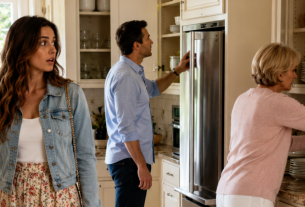
Gleb stood in the doorway, unzipping his jacket. With a привычным motion, he tossed the car keys onto the small table in the hallway.
“Ow!” Diana cried out and grabbed her earlobe. She had been taking a potato casserole out of the oven and, startled, burned herself.
The table had already been set for two: plates, linen napkins, a small crystal mustard dish with Gleb’s favorite condiment.
Diana placed the casserole dish on the table and turned around.
“The car…” she faltered for a second, “the one I’ve been paying off for a year and a half?”
Gleb shrugged and walked over to the refrigerator. He took out a bottle of water, drank several gulps, and only then replied:
“Well, the loan is in my name. Why are you starting this?”
Diana stared at him, unable to find the words right away.
Three years earlier, they had met at the city street food festival. Diana was standing in line for Vietnamese pho bo when someone accidentally bumped into her from behind.
“I’m sorry,” a man’s voice sounded genuinely apologetic. “Did I hurt you?”
She turned around and saw a tall guy in a denim shirt with brown eyes. He was holding two cups of coffee, one of which was tilting dangerously.
“It’s okay,” Diana smiled.
“Maybe a coffee? As an apology?” he offered her the untouched cup. “I’m Gleb.”
And that was how it all began. Diana worked as an economist at a logistics company — preparing reports, calculating routes, planning budgets. Her life was scheduled down to the minute: a morning run, work, evening English classes. Gleb turned out to be her complete opposite — an easygoing auto repair technician who never planned further ahead than the weekend.
“Are you always this organized?” he asked on their third date, flipping through her planner.
“And are you always this creatively chaotic?” she shot back, pointing at his car, where tools were lying on the back seat next to a gym bag.
After the wedding, Gleb moved into her apartment on the sixth floor of a nine-story brick building. It was a small two-bedroom place, but cozy — Diana had bought it with a mortgage before they met.
A month after they started living together, Gleb confessed:
“Listen, I’ve got a situation… the car loan is choking me. They cut my pay at the shop, and there aren’t many new clients.”
Diana looked at her husband.
“How much is left to pay?”
“Eighteen months. Twenty-five thousand a month.”
She opened her laptop and quickly calculated the expenses.
“I can take it on. I’m getting a bonus soon, and besides — we’re family now.”
“Diana, are you serious?” relief flashed in his eyes.
“Of course. But let’s do it properly — I’ll transfer the money directly to the bank so there’s no confusion.”
From that day on, she created a separate Excel spreadsheet — payments, interest, remaining balance. Every month she carefully transferred the money, marking each paid installment in green.
“When we pay it off, the car will be ours together,” Gleb would say, kissing the top of her head. “We’ll drive to your parents’ dacha.”
But there was always a shadow hanging over their lives — Gleb’s younger sister, Liza. After their parents died five years earlier, he had taken on the role of her older brother and guardian. Liza had been nineteen then; now she was twenty-four, but she still called him for every little thing.
“Gleb, my faucet is leaking, can you take a look?”
“Gleb, drive me to Mega so I can shop.”
“Gleb, Kolya’s away on a business trip again, I’m scared to be alone.”
Diana tried to understand. After all, family was sacred. But over time, she began to notice a strange pattern: any plans they made were easily canceled by a single phone call from Liza.
The situation got worse last winter. Diana found herself eating dinner alone more and more often, staring at plates that had gone cold.
“Sorry, I got held up,” Gleb would show up closer to midnight. “Liza needed help putting together a wardrobe. Kolya’s on the road, and she can’t handle it by herself.”
“Maybe she should hire someone?” Diana once suggested, putting the untouched dinner back into the refrigerator…
“Continuation just below in the first comment.”
The continuation wasn’t included in your message. Send the rest, and I’ll translate it too.
“I transferred the car to Liza. She needs it more — she’s about to have a baby.”
Gleb was standing in the doorway, unzipping his jacket. With a привычным motion, he tossed the car keys onto the small table in the hallway.
“Ow!” Diana cried out and grabbed her earlobe. She had been taking a potato casserole out of the oven and, startled, burned herself.
The table had already been set for two: plates, linen napkins, a small crystal mustard dish — Gleb’s favorite condiment.
Diana set the baking dish on the table and turned around.
“The car…” she faltered for a second, “the one I’ve been paying off for a year and a half?”
Gleb shrugged and walked over to the refrigerator. He took out a bottle of water, drank several gulps, and only then replied:
“But the loan is in my name. Why are you starting this?”
Diana stared at him, unable to find the words right away.
Three years earlier, they had met at a city street food festival. Diana was standing in line for Vietnamese pho bo when someone accidentally bumped into her from behind.
“Sorry,” a man’s voice said, sounding genuinely apologetic. “Did I hurt you?”
She turned around and saw a tall guy in a denim shirt with brown eyes. He was holding two cups of coffee, one of which had tilted dangerously.
“It’s fine,” Diana smiled.
“Maybe a coffee? As an apology?” he said, offering her the untouched cup. “I’m Gleb.”
That was how it all began.
Diana worked as an economist for a logistics company — preparing reports, calculating routes, planning budgets. Her life was scheduled down to the minute: a morning run, work, evening English classes. Gleb turned out to be her complete opposite — an easygoing mechanic from an auto repair shop who never planned further than the weekend.
“Are you always this organized?” he asked on their third date, flipping through her planner.
“And are you always this creatively chaotic?” she shot back, pointing at his car, where tools were lying on the back seat next to a gym bag.
After the wedding, Gleb moved into her apartment on the sixth floor of a brick nine-story building. It was a small but cozy two-bedroom place — Diana had bought it with a mortgage before they met.
A month into living together, Gleb confessed:
“Listen, I’ve got a situation… This car loan is strangling me. They cut my pay at the shop, and there aren’t many new clients.”
Diana looked at her husband.
“How much is left?”
“Eighteen months. Twenty-five thousand a month.”
She opened her laptop and quickly calculated the expenses.
“I can take it over. I’m getting a bonus soon, and besides — we’re a family now.”
“Diana, are you serious?” Relief flickered in his eyes.
“Of course. Let’s just do it properly — I’ll transfer the money directly to the bank so there’s no confusion.”
From that day on, she created a separate Excel spreadsheet — payments, interest, remaining balance. Every month, she carefully transferred the money, marking each paid installment in green.
“When it’s paid off, the car will be ours,” Gleb would say, kissing the top of her head. “We’ll drive to your parents’ dacha.”
But a shadow constantly hovered over their life — Gleb’s younger sister, Liza. After their parents died five years earlier, he had taken on the role of her older-brother guardian. Liza had been nineteen then; now she was twenty-four, but she still called him over every little thing.
“Gleb, my faucet is leaking, can you come look at it?”
“Gleb, drive me to Mega so I can shop.”
“Gleb, Kolya’s away on a business trip again, I’m scared to be alone.”
Diana tried to be understanding. After all, family was sacred. But over time, she began noticing a strange pattern: any plans they made could easily be canceled by one call from Liza.
The situation got worse last winter. Diana more and more often ate dinner alone, looking at plates gone cold.
“Sorry, I got delayed,” Gleb would appear closer to midnight. “Liza needed help putting together a wardrobe. Kolya’s on the road, and she can’t manage by herself.”
“Maybe she should hire someone?” Diana suggested one day, putting the untouched dinner into the refrigerator.
“Why waste money if I can help? She’s my sister.”
In February, Diana was preparing for an important event — her mother Tamara Pavlovna’s sixtieth birthday. She spent a whole week picking out a gift and finally chose a bone china tea set. She baked an apple pie from her grandmother’s recipe — with cinnamon and walnuts.
“We’re leaving at five,” she reminded Gleb that morning. “Mom is really looking forward to it. She hardly ever sees you.”
“Of course, I remember,” he nodded, finishing his coffee.
But at four o’clock, the phone rang. From the bedroom, Diana heard fragments of the conversation:
“Yeah… Right now?.. Okay, I’m leaving…”
Gleb came out of the room, pulling on his jacket.
“I have to take Liza to the women’s clinic urgently. She’s having some kind of problem.”
“But Mom… the birthday…”
“I’ll be quick, just drop her off and come back. You get ready in the meantime.”
He didn’t come back in an hour. Or two.
Diana went to her parents’ house alone, with the pie and a heavy heart.
“Where’s Gleb?” her mother asked, opening the door.
“He got held up at work,” Diana lied, unable to tell the truth.
At the festive table, her father, Sergey Petrovich, poured her some tea and quietly remarked:
“You know, daughter, I helped relatives too in my time. But your mother always came first for me. Your husband, it seems, is living in two households.”
Those words stuck in her mind like a splinter. On the way home, sitting in a taxi, Diana looked at the lights flashing past the window and thought: “And where is there room for me in this family? I pay for his car, cook dinners that go cold in loneliness, lie to my parents… For what?”
Gleb came home after midnight. Diana pretended to be asleep, but lay there for a long time with her eyes open, listening to him move quietly around the apartment.
“Sorry,” he whispered, lying down beside her. “We had to wait at the hospital. Liza needed an IV.”
She didn’t answer. In the darkness of the bedroom, a silence full of unspoken words hung between them.
The next morning, Diana got up earlier than usual. Automatically, she made oatmeal with apples and cinnamon — the way Gleb liked it. She set the table and poured coffee into the cups.
Gleb appeared in the kitchen, rummaging through a drawer in the sideboard.
“Have you seen the car papers? I think I left them here.”
“Did you check the top drawer?” Diana stirred the oatmeal without looking up.
“Oh, here they are… By the way,” he turned around, holding the folder in his hands, “I transferred the car to Liza yesterday.”
The spoon slipped from her hand and struck the edge of the plate with a sharp clang.
“What?” Her voice sounded foreign to her.
“I mean, I signed the car over to Liza. After the hospital, we stopped by the public services center and got it done quickly.”
Diana slowly raised her eyes to him.
“The car I’ve been paying for for a year and a half?”
Gleb frowned, closing the folder.
“Don’t start. She needs it more — she’s about to have a baby, she’ll need to drive to doctors’ appointments, then later take the kid to daycare.”
“I paid that loan for a year and a half, Gleb. Twenty-five thousand every month.”
“So what?” he shrugged. “The loan is in my name. That means the car is mine. I have the right to decide what to do with it.”
Diana looked at her husband and felt as though she were seeing him for the first time. That indifference in his eyes, that carelessness in his voice — could this really be the same man who had brought her coffee three years earlier as an apology?
“So my money was just… a gift to your sister?”
“Don’t be dramatic. We’re family — what difference does it make who drives what?”
The oatmeal on the stove burned. The coffee went cold. And Diana realized that in this family, she would always come second. After Liza. After Liza’s problems. After Liza’s future child.
After that morning, Diana could no longer pretend that everything was fine. She filed for divorce two weeks later.
At night, when Gleb drove off to his sister’s place, she sat at the dining table sorting through documents. Her bank statements formed a long chain — eighteen months of transfers of twenty-five thousand each. She carefully placed the payment receipts into transparent sleeves. In an old notebook, she found her notes written in blue ink — payment dates, amounts, even smiley faces in the months when she had managed to pay ahead of schedule.
“You transferred the money from your personal account?” asked her lawyer, Valentina Nikolaevna, an older woman with sharp, perceptive eyes.
“Yes. That’s where the inheritance from my grandmother came in. She left me an apartment outside Moscow, and I sold it for one and a half million.”
“Excellent. Those are your premarital funds. By law, you have the right to compensation.”
At the trial, Gleb looked lost. He sat beside his lawyer — a young guy in a cheap suit — and kept glancing at his phone.
“Does the defendant acknowledge receiving money from the plaintiff?” the judge asked.
“Well… yes, she helped with the loan,” Gleb muttered. “But we were family…”
“Family?” Diana lifted her head for the first time during the entire hearing. “Family is when decisions are made together. Not when one person pays and the other gives it away.”
The judge studied the documents carefully.
“The court orders the defendant, Gleb Andreevich Lebedev, to pay the plaintiff, Diana Sergeyevna Lebedeva, compensation in the amount of four hundred fifty thousand rubles.”
“Four hundred fifty thousand?” Gleb jumped to his feet. “Are you serious? Where am I supposed to get that?”
Diana calmly zipped up her handbag.
“That’s my money, Gleb. The very money you thought didn’t matter.”
As she walked out of the courtroom, she felt a strange relief. As if she had been carrying a heavy backpack along a mountain trail for a long time and could finally take it off. Her shoulders still ached with phantom pain, but each step felt lighter.
A fine spring rain was falling outside. Diana lifted her face to the drops and smiled for the first time in a long while.
Three weeks later, Gleb came to collect the last of his things. Diana had left the boxes in the hallway — tools, a winter jacket, photo albums.
“Can I have some water?” he asked, shifting awkwardly from one foot to the other.
“In the kitchen,” she nodded, not inviting him any farther than the hallway.
He looked tired — dark circles under his eyes, several days’ worth of stubble on his face. While he drank the water, Diana glanced out the window.
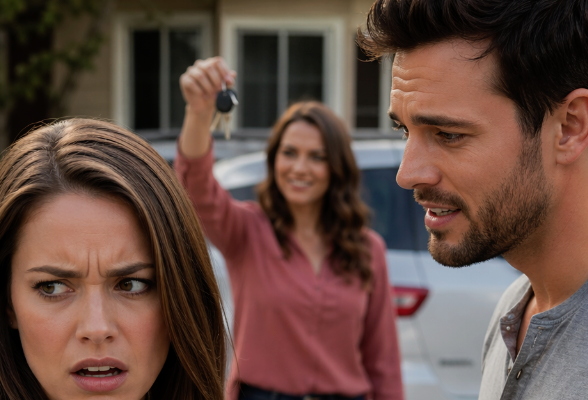
Down below, by the entrance, stood that same gray sedan. Liza was nervously trying to park it, jerking the car back and forth. The left rear taillight was broken and covered with red tape, and there was a fresh dent on the bumper.
“How are you?” Gleb asked awkwardly, handing back the glass.
“Fine,” Diana said, not elaborating.
A baby’s crying came from the car downstairs. Gleb flinched.
“I have to go. Liza’s waiting with the baby.”
He picked up the boxes and headed for the door. On the threshold, he turned around.
“Diana, I… I’m sorry, if anything.”
She nodded, not finding any words. And were they even necessary?
When the door closed, Diana walked over to the window. Gleb was loading the boxes into the trunk, while Liza shouted something at him from the car, pointing at the screaming infant. He got into the back seat, picked up the baby, and started rocking it.
Diana drew the curtains shut.
The apartment became quiet. But this silence no longer pressed on her — it wrapped around her like a warm blanket. Diana went into the kitchen, put on the kettle, and for the first time in a long while set the table for just one.
Three months later, Diana was standing in a dealership, looking at a small blue hatchback.
“Are you buying on credit?” the sales manager asked.
“No,” she smiled. “Cash.”
The compensation from Gleb had come in installments — he sold some things, borrowed from friends. Diana wasn’t interested in the details.
The first few weeks behind the wheel were difficult. Her instructor, a gray-haired man with endless patience, taught her how to park.
“Take it easy, Diana Sergeyevna. The car feels your nervousness.”
But little by little, the fear faded. She started driving to work, then to her parents’ dacha. Her mother baked her favorite apple pie.
“Good for you, deciding to do it,” her father said, helping her unload saplings for the garden from the car. “Something that’s yours is always better than something shared with who knows whom.”
One July morning, Diana stopped at a traffic light near a shopping center. In the next lane, a familiar gray sedan pulled up — still with the same taped-up taillight.
Liza was at the wheel, nervously drumming her fingers on the steering wheel. In the back seat, Gleb was trying to calm the crying baby while also gathering toys scattered across the car. They looked exhausted.
Liza shouted something, turning around toward the back. Gleb shouted back, gesturing with his free hand. Even through the closed windows, it was clear they were arguing.
The light turned green. Diana pulled away smoothly, turned on her favorite radio station, and drove on — toward the sea, where she had arranged to meet her friends.
In the rearview mirror, the gray sedan remained standing still — apparently it had stalled at the start.
Diana thought that her life used to be like a car with two drivers — each pulling the wheel in a different direction. Now she was driving alone, choosing her own route.
And that feeling of freedom was worth far more than any car, any money, any promises.
The highway stretched out ahead, the sea shimmered somewhere beyond the horizon, and her favorite song about a new life was playing through the speakers.