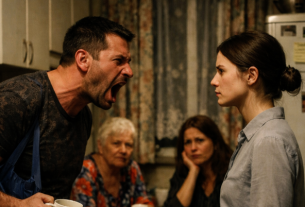
“What did you do to my card?! Why can’t I pay with it? You humiliated me in front of my friends!” my husband shouted in my office.
Alina looked up from her monitor when the door to her office flew open so hard that the glass in the partition shook. Dmitry stormed in, red-faced, his eyes shining, and she immediately understood — he’d been drinking. Again. Even though it was barely three in the afternoon.
“What did you do to my card?!” he yelled, paying no attention to the fact that the glass walls of her office were completely transparent, and that the entire marketing department was now watching the scene. “Why can’t I pay with it? You humiliated me in front of my friends!”
Alina slowly rose from behind her desk, instinctively straightening her back. Five years ago, she would have been flustered, embarrassed, would have tried to calm him down in a soft voice. But now she was the Director of Development at a large IT company, a person who made multimillion-ruble decisions every day and managed a team of eighty people. She had learned not to lose her composure.
“Dima, let’s talk about this at home,” she said evenly, casting a glance at the glass wall behind which the employees had frozen, pretending to be busy with work.
“No!” He stepped toward her desk and planted his hands on its polished surface. He smelled of whiskey. “We’ll talk now! Here! Let everyone hear what a wonderful wife you are! You blocked your husband’s card!”
Alina clenched her jaw. Memories flooded over her against her will — how seven years ago Dima had been different. A talented screenwriter whose work had been picked up by major TV channels, a man with bright, eager eyes who could talk about his projects for hours. Back then, she had only been starting her career, earning next to nothing at a startup, while he was making good money. He supported her, believed in her, told her she was bound to succeed.
And she had succeeded. Her startup had taken off, she had been noticed, lured away to a major company for an executive role. Her salary had increased several times over. And Dima… Dima seemed to deflate. At first, he was happy for her successes, then he started to resent her job, her business trips, her self-fulfillment. His scripts stopped getting accepted — he said television only wanted trash now, that nobody needed real art anymore. One project after another was shelved. The fees came less and less often. Two years ago, he announced he was going through a creative crisis and stopped working altogether. Alina understood that crises happened, that creative people needed time. She got him a card linked to her account — for groceries, for household expenses. She told him she loved him, that everything would get better.
But nothing got better. Dima spent his days at home on the couch with a laptop, supposedly working on a new script. And his evenings — in bars, with friends just like him, other “unrecognized geniuses.” At first once a week. Then more often. Alina saw the card statements — cafés, bars, restaurants. The sums kept growing. She tried talking to him.
“Dima, maybe you should look for some kind of temporary job? Teaching, copywriting, anything. Just to get back into a rhythm.”
“What, do you think I’m a loser?” he would say, offended. “I can’t cheapen myself with hack work. I need to focus on real work.”
“But you haven’t written a single line in six months.”
“That’s because I have no support! You’re only busy with work, you don’t care about me at all!”
She tried a different approach. She suggested they see a therapist together. He refused. She told him she was worried about him. He accused her of being controlling. She saw how he was changing — becoming irritable, apathetic, drinking more, and earlier in the day. Recently she had discovered that he had started drinking in the daytime, before meeting his friends. “For inspiration,” he explained.
Yesterday, Alina logged into her banking app and saw that over the past month Dima had spent nearly one hundred and twenty thousand rubles. On bars, alcohol from stores, restaurants. Her patience snapped. She blocked the card.
And now here he was, standing in her office, flushed with drink and rage, shouting across the entire floor.
“Dima, calm down,” she said, walking around the desk and moving closer to the door, hoping to lead him out of the office. “Let’s step outside and talk properly.”
“No!” He didn’t move. “You humiliated me! I tried to pay in a bar and the card was declined! Seryoga and Andrey were there. Do you have any idea how that looked?!”
“Do you have any idea what the statements from that card look like?” Alina finally snapped. “One hundred and twenty thousand in one month! On drinking! Dima, you’ve started drinking during the day! This isn’t just hanging out with friends anymore, this is a problem!”
“What problem?!” He started waving his hands. “I’m just relaxing! I need an outlet! You work like a maniac — what, am I supposed to sit at home and wait for you to finally find time for me?”
“You’re supposed to work!” Alina raised her voice, surprising even herself with the force of her anger. “You’re thirty-six years old, Dima! You’re a talented screenwriter, you had excellent work! But for two years you’ve done nothing except drink yourself into ruin!”
“Drink myself into ruin?!” He went pale, and for a second she thought she had gone too far. But only for a second. “How dare you?! I supported you! When you were making your pathetic thirty thousand and riding the metro, who paid the rent? Who bought you clothes for interviews? Me! I believed in you when no one else did! You lived on my money!”
“That’s true,” Alina said quietly. “You did support me. And I’m grateful for that. But the difference, Dima, is that back then I was doing everything I could. I worked ten hours a day, studied, developed myself, fought for every project. And what do you do? You lie on the couch and complain that the world is unfair!”
“Because the world is unfair!” he shouted. “Television only wants stupid soap operas for housewives, not real art! Nobody understands me!”
“Then find people who will! Look for other platforms, streaming services, theaters, anything! But you’re not looking, Dima. You’re drinking. And I can’t watch it anymore.”
“Oh, is that how it is?” he sneered sarcastically. “So you’ve decided to leave me? Now that you’re some big boss, you don’t need a loser husband anymore?”
“I can support someone who is trying to change something!” Alina’s voice trembled. “Someone who fights, who looks for a way out, who works on himself. But I will not support someone who is slowly killing himself with alcohol and blaming the whole world for his problems!”
“You’re cold-hearted!” Dima took a step toward her, and Alina instinctively stepped back. “Cheap! You begrudge your husband money!”
“I don’t begrudge money for my husband,” she tried to speak calmly, though her heart was pounding. “I begrudge money for vodka. Those are two different things, Dima.”
“Oh, go to hell!” He turned toward the desk and swept everything off the edge with one arm. Their wedding photo in a beautiful frame, the pen organizer, the glass of water — everything crashed to the floor with the loud sound of breaking glass.
Alina pressed the button on the internal phone.
“Oleg, please come in,” she said in an absolutely steady voice.
Thirty seconds later, the door opened, and two security guards entered the office. Dima looked at them, then at Alina, and there was so much pain and fury in his eyes at once that she almost regretted her decision. Almost.
“Please escort my husband to the exit,” she said. “And let reception know he is not to be allowed in again.”
“Alina…” Suddenly pleading notes appeared in his voice. “Are you serious?”
“Absolutely serious. Go home, Dima. Sober up. Think about what you’re doing with your life.”
The guards took him by the arms. He didn’t resist, only kept looking at her.
“You’ll regret this,” he said quietly. “I still love you.”
“And I’m no longer sure I love the person you’ve become,” Alina replied, and it was the pure truth.
When the door closed behind them, she sank into her chair and covered her face with her hands. Behind the glass wall, the employees hurriedly looked away, pretending nothing had happened. Alina knew that by the end of the day the whole company would be discussing the incident. She didn’t care.
She looked at the broken frame on the floor. In the photograph, both of them were smiling — young, happy, full of hope. That had been six years ago. It felt like another lifetime.
The next morning at seven o’clock, the apartment door opened. Alina, already dressed and ready to leave for work, saw Dima. He looked awful — unshaven, in wrinkled clothes, with bloodshot eyes.
She didn’t let him inside, remaining in the doorway.
“Alina, forgive me,” his voice was hoarse. “Please forgive me. I was wrong. I behaved like a complete asshole. Forgive me.”
He dropped to his knees right there in the hallway. Alina looked down at him and felt not pity, not sympathy, but disgust. That was the worst part — that sudden, sharp feeling of revulsion. Not at his words, but at the very sight of it. At the way he was humiliating himself.
Once, this man had been her support. Strong, confident, talented. And now he was on his knees, reeking of last night’s alcohol, begging for forgiveness. And the scariest thing was that Alina understood: if she forgave him, nothing would change. He would promise to do better, last a week, maybe two, and then everything would repeat itself. Because he was broken. Completely.
She didn’t know exactly when it had happened. Maybe when he first lied to her about a job interview he never went to. Maybe when he started drinking in the morning. Or maybe even earlier — when he decided the world was to blame for his failures, not himself.
“Dima, get up,” she said tiredly. “Don’t do this.”
“I understand everything now!” He looked up at her, his eyes full of desperate hope. “I’ll start working! I’ll be a courier, a waiter, anything! Just give me one more chance!”
“How many chances have I already given you?” Alina asked quietly. “Dima, I’ve talked to you about this dozens of times over the past two years. Every single time you promised. And not once did you keep your word.”
“But now it’s different! I’ve hit rock bottom, I understand!”
“No.” She shook her head. “You don’t understand. You’re just scared of losing your source of money. Tomorrow you’ll go to one interview to show me you’re trying. Then you’ll find a reason why they didn’t hire you. Then you’ll say you’re looking for something more suitable. And in a month we’ll be right back where we started. And I can’t do this anymore, Dima. I’m tired.”
“Alin…”
“I’m filing for divorce,” she said, and the words came out more easily than she expected. As if the decision had long since matured somewhere deep inside her, and all it needed was a push to be spoken aloud. “The apartment is in my name, but I’m not throwing you out. You have three months to find a job and move out. I’ll send you money for rent and food. But that’s all.”
Dima slowly rose from his knees. His face looked as if she had struck him.
“You’re serious?”
“Absolutely.”
“But I said I’d change!… Continued a little lower in the first comment.”
Alina looked up from her monitor when the door to her office flew open so hard that the glass in the partition trembled. Dmitry burst in, flushed, his eyes shining, and she understood at once—he had been drinking. Again. Even though it was barely three in the afternoon.
“What did you do to my card?!” he shouted, paying no attention to the fact that the glass walls of her office were completely transparent and that the entire marketing department was now watching the scene. “Why can’t I pay with it? You humiliated me in front of my friends!”
Alina slowly rose from her desk, instinctively straightening her back. Five years ago, she would have been thrown off balance, embarrassed, tried to calm him in a soft voice. But now she was the development director of a large IT company, a person who made decisions involving millions of rubles every day and managed a team of eighty people. She had learned not to lose her composure.
“Dima, let’s talk about this at home,” she said evenly, glancing at the glass wall beyond which the employees stood frozen, pretending to be busy with work.
“No!” He stepped up to her desk and planted his hands on the polished surface. He smelled of whiskey. “We’re talking now! Here! Let everyone hear what a wonderful wife you are! Blocking your husband’s card!”
Alina clenched her jaw. Memories flooded in against her will—how seven years ago Dima had been different. A talented screenwriter whose work was picked up by major channels, a man with burning eyes who could talk about his projects for hours. Back then she was just starting her career, earning next to nothing at a startup, while he was making good money. He supported her, believed in her, told her she would definitely succeed.
And she did. Her startup took off, she was noticed, poached by a large company for an executive position. Her salary grew several times over. And Dima… Dima seemed to deflate. At first he rejoiced in her success, then began to resent her work, her business trips, her self-fulfillment. His scripts stopped getting accepted—he said television only wanted trash now, that no one needed real art anymore. One project after another ended up in a drawer. Fees became rarer and rarer.
Two years ago he announced he was in a creative crisis and stopped working altogether. Alina understood that crises happened, that creative people needed time. She got him a card linked to her account—for groceries, for household expenses. She told him she loved him, that everything would work out.
But nothing got better. Dima spent his days at home on the couch with a laptop, supposedly working on a new script. And his evenings—in bars, with friends, the same kind of “unrecognized geniuses.” At first once a week. Then more often. Alina saw the card statements—cafes, bars, restaurants. The amounts kept rising. She tried to talk to him.
“Dima, maybe you should look for at least a temporary job? Teaching, copywriting, anything. Just to get back into a rhythm.”
“What, do you think I’m a failure?” he would say, offended. “I can’t cheapen myself with hack work. I need to focus on real work.”
“But you haven’t written a single line in six months.”
“That’s because I have no support! All you care about is work, you don’t care about me at all!”
She tried another approach. She suggested they go to a psychologist together. He refused. She said she was worried about him. He accused her of being controlling. She watched him change—becoming irritable, apathetic, drinking more and earlier. Recently she had discovered that he had started drinking during the day, before meeting up with friends. “For inspiration,” he explained.
Yesterday Alina opened her banking app and saw that over the past month Dima had spent nearly one hundred and twenty thousand rubles. On bars, store-bought alcohol, restaurants. Her patience snapped. She blocked the card.
And now here he was, standing in her office, red with drink and anger, shouting loud enough for the entire floor to hear.
“Dima, calm down,” she said, walking around the desk and moving closer to the door, hoping to lead him out of the office. “Let’s step outside and talk like normal people.”
“No!” He did not move. “You humiliated me! I tried to pay at the bar and the card got declined! Seryoga and Andrey were there. Do you have any idea how that looked?!”
“Do you have any idea what the statements for that card look like?” Alina finally snapped. “One hundred and twenty thousand in a month! On alcohol! Dima, you’ve started drinking during the day! This isn’t just hanging out with friends anymore, this is a problem!”
“What problem?!” He waved his hands wildly. “I’m just relaxing! I need a release! You work like a maniac, so what, I’m supposed to sit at home and wait until you deign to pay attention to me?”
“You’re supposed to work!” Alina raised her voice, surprising even herself with the force of her own anger. “You’re thirty-six years old, Dima! You’re a talented screenwriter, you had great work! But for two years you’ve done nothing except drink yourself into oblivion!”
“Drink myself into oblivion?!” He went pale, and for a second she thought she had gone too far. But only for a second. “How dare you?! I supported you! When you were making your pathetic thirty thousand and riding the metro, who paid the rent? Who bought you clothes for job interviews? Me! I believed in you when no one else did! You lived on my money!”
“That’s true,” Alina said quietly. “You did support me. And I’m grateful to you for that. But the difference is, Dima, back then I did everything I possibly could. I worked ten hours a day, studied, developed myself, fought for every project. And what do you do? You lie on the couch and complain that the world is unfair!”
“Because the world is unfair!” he shouted. “Television only wants stupid soap operas for housewives, not real art! No one understands me!”
“Then find people who will! Look for other platforms, streaming services, theaters, anything! But you’re not looking, Dima. You’re drinking. And I can’t watch it anymore.”
“Oh, is that how it is?” He gave a mocking smirk. “So you’ve decided to leave me? Now that you’re some big boss, you don’t need a loser husband anymore?”
“I can support a person who is trying to change something!” Alina’s voice trembled. “A person who fights, who looks for a way out, who works on himself. But I will not support someone who is slowly killing himself with alcohol and blaming the whole world for his problems!”
“You’re cold!” Dima took a step toward her, and Alina instinctively stepped back. “Greedy! You begrudge your husband money!”
“It’s not money for my husband that I begrudge,” she said, trying to stay calm though her heart was pounding. “It’s money for vodka. Those are two different things, Dima.”
“To hell with you!” He turned toward the desk and swept everything off the edge with his arm. A photo of them from their wedding in a beautiful frame, an organizer with pens, a glass of water—all of it went crashing to the floor with the loud sound of shattering glass. Alina pressed the button on the internal phone.
“Oleg, please come in,” she said, her voice perfectly even.
Thirty seconds later the door opened and two security guards entered the office. Dima looked at them, then at Alina, and there was so much pain and fury in his eyes at once that she almost regretted her decision. Almost.
“Please escort my husband to the exit,” she said. “And tell reception not to let him in again.”
“Alina…” His voice suddenly took on a pleading tone. “You’re serious?”
“Absolutely serious. Go home, Dima. Sober up. Think about what you’re doing with your life.”
The guards took him by the arms. He did not resist, only kept looking at her.
“You’ll regret this,” he said quietly. “I still love you.”
“And I’m no longer sure I love the person you’ve become,” she replied, and it was the simple truth.
When the door closed behind them, she sank into her chair and covered her face with her hands. Beyond the glass wall, the employees hurriedly turned away, pretending nothing had happened. Alina knew that by the end of the day the entire company would be discussing the incident. She did not care. She looked at the shattered frame on the floor. In the picture they were both smiling—young, happy, full of hope. That had been six years ago. It felt like a whole lifetime.
The next morning at seven o’clock the apartment door opened. Alina, already dressed and ready to leave for work, saw Dima. He looked terrible—unshaven, in wrinkled clothes, with red eyes.
She did not let him inside, remaining in the doorway.
“Alina, forgive me,” he said, his voice hoarse. “Please forgive me. I was wrong. I behaved like a complete asshole. Forgive me.”
He dropped to his knees right there in the hallway. Alina looked down at him and felt not pity, not sympathy, but disgust. That was the most frightening part of all—that sudden, sharp feeling of revulsion. Not at his words, but at the sight itself. At the way he was humiliating himself.
Once, this man had been her support. Strong, confident, talented. And now he was on his knees, reeking of yesterday’s booze, begging for forgiveness. And the worst part was that Alina understood that if she forgave him, nothing would change. He would promise to do better, hold out for a week, maybe two, and then it would all happen again. Because he was broken. Completely.
She did not know exactly when it had happened. Maybe when he first lied to her about a job interview he never went to. Maybe when he started drinking in the mornings. Or maybe even earlier—when he decided that the world was to blame for his failures, not he himself.
“Dima, get up,” she said wearily. “Don’t do this.”
“I understand everything now!” He looked up at her, his eyes full of desperate hope. “I’ll start working! I’ll go be a courier, a waiter, anything! Just give me one more chance!”
“How many chances have I already given you?” Alina asked quietly. “Dima, I’ve talked to you about this dozens of times over the last two years. Every time you promised. And not once did you keep that promise.”
“But now it’ll be different! I’ve hit rock bottom, I understand!”
“No.” She shook her head. “You don’t understand. You’re just scared of losing your source of money. Tomorrow you’ll go to one interview to show me you’re trying. Then you’ll find a reason why they didn’t hire you. Then you’ll say you’re looking for something more suitable. And in a month we’ll be right back where we started. And I can’t do this anymore, Dima. I’m tired.”
“Alin…”
“I’m filing for divorce,” she said, and the words came out more easily than she had expected. As if the decision had long since ripened somewhere deep inside her and all it had needed was a push to be spoken aloud. “The apartment is in my name, but I’m not throwing you out. You have three months to find a job and move out. I’ll transfer you money for rent and food. But that’s all.”
Dima slowly rose from his knees. The look on his face was as if she had struck him.
“You’re serious?”
“Absolutely.”
“But I said I’d change!”
“Words don’t mean anything anymore, Dima. I want to see actions. If in three months you really find a job, stop drinking, pull yourself together—we’ll talk. Maybe. But I’m filing for divorce anyway. I need a pause. I need to see that you’re capable of being the man I once fell in love with.”
“And if I can’t?”
Alina looked him in the eyes.
“Then you’ll lose me for good. And honestly, Dima, I’m not even sure that’s a loss for you anymore. I think you don’t need me. You need someone who will pity you, justify you, give you money for booze, and listen to you talk about how unfair the world is. And I can’t be that person anymore.”
“I’ll stay with my mother. The apartment is yours for three months. After that—we’ll see.”
“I really do love you,” he said.
“I know,” Alina nodded. “But love isn’t enough, Dima. You also need respect.”
She grabbed her bag and walked out of the apartment, closing the door behind her. In the elevator, on the way down, Alina suddenly felt a weight lifting from her shoulders, one she had carried for so long she had stopped noticing it. Guilt. Obligation. A debt to the past.
Yes, Dima had supported her once. But she had repaid him a hundredfold over the years. And now it was time to move on—with someone who wanted to grow alongside her, or alone. But not with someone who had turned into an anchor dragging her down.
She walked toward her car and, for the first time in a long while, felt free. It hurt, it was frightening, but it was the pain and fear of the unknown, of a new phase in life. Not the dull despair of being unable to change the situation.
Three months later Dima still had not found a job. He tried—or at least that was what he said. He went to a couple of interviews, tried to write a new script. But he relapsed again and again. Alina helped him find a small apartment in a residential neighborhood, paid the first six months of rent, and with that drew the line.
The divorce was finalized quickly, without scandals.
The last time they saw each other, Dima looked older, gaunt. But sober.
“Thank you,” he said unexpectedly. “For not letting me rot completely.”
“That’s your achievement,” Alina replied. “If anything has changed, it’s only because of you, Dima.”
“I got a job,” he said, trying to smile. “As a copywriter at a small agency. Not much, but steady. And I… I quit drinking. Six weeks now.”
“I’m glad,” she said sincerely. “I really am.”
“Do you think we still have a chance?”
Alina looked at him—at this man who had been part of her life for seven years. Who had supported her and destroyed her, loved her and blamed her, believed in her and betrayed her. And she understood that the answer had long since ripened.
“No, Dima. I’m proud of you. I’ll be rooting for you. But I don’t want to be your wife anymore. Too much has happened. Too much has changed.”
He nodded, as if he had expected that answer.
“Well then. Live happily, Alin. You deserve the very best.”
“And so do you,” she said, holding out her hand for a handshake. “Take care of yourself.”
They shook hands like old acquaintances and went their separate ways.
Alina walked toward the exit, the sun bright in her eyes. Spring was just beginning, the world was full of possibilities, and a whole life lay ahead. Without anchors. Without the burden of someone else’s unresolved problems. Free.
She did not know what would come next. But for the first time in a long while, that uncertainty did not frighten her. On the contrary—there was something sweet and dizzying about the hope inside it.
Alina took out her phone, looked at the screen—ten missed calls from work—and smiled. Work could wait. Today she would take a day off. Walk through the spring city, stop by her favorite café, read the book she had been putting off for six months.
And tomorrow a new life would begin. Her life. And she alone would decide what it would be.