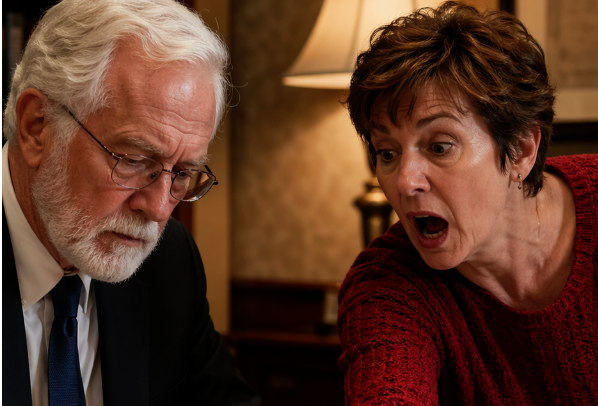
The notary adjusted his glasses and looked down at the documents again. I stared at his neat hands with their well-groomed nails and thought of my mother’s hands — worn from work, always calloused, with broken nails. She never painted them. She used to say, “It’ll peel off at the dacha anyway.” At the dacha. That damned dacha.
“So, according to the will,” the notary said in an even, emotionless voice, like a newsreader reporting the weather, “the three-room apartment at 17 Stroiteley Street goes to Kirillovich Mikhail Sergeyevich…”
I heard Misha exhale loudly beside me. Of course. Of course it went to him.
“And the garden plot in the Rassvet partnership,” the notary continued, “goes to Kirillovich Irina Sergeyevna.”
I stared at the wall behind the notary, where a framed portrait of some important lawyer was hanging. He had the same impassive eyes. The dacha. I had inherited the dacha. The very same dacha where I had spent every weekend for the last fifteen years. Where I dug, weeded, whitewashed, painted, carried water from the well, while Misha was “studying,” “working,” “building his personal life.”
“There is, however, one nuance,” the notary said, removing his glasses and looking at us. “The garden plot is encumbered.”
“What kind of encumbrance?” I felt cold spreading down my back.
“The plot has been pledged as collateral. It secures the debt of Mr. Kirillovich Mikhail Sergeyevich to the microfinance organization Quick Money. The amount owed is one million two hundred thousand rubles, including interest.”
Silence. I could hear the clock ticking on the wall, the paper rustling under the notary’s fingers, Misha shifting in his chair.
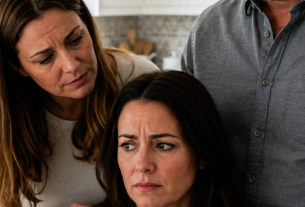
“Misha?” I slowly turned to my brother.
He was staring at the floor. Forty-two years old, yet sitting there like a guilty schoolboy.
“Mishka, what does this mean?”
“Irka, well… it was temporary. I needed money for a business, you understand? I wanted to start my own thing, but the banks wouldn’t give me a loan. So I… Mom agreed. She offered the dacha as collateral herself. She said it would go to me anyway.”
“Oh, right. Brother gets the apartment, and I get the debts?” I couldn’t hold back and slammed my hand on the notary’s desk.
The notary did not even flinch. Apparently, he had seen worse in his practice.
“I understand your emotions,” he said in the tone of a pediatrician calming a spoiled child, “but I ask you to remain calm. You have the right to refuse the inheritance. In that case, the dacha will pass to the next heir, meaning your brother, and he will be responsible for the debts.”
I stood up. My legs were trembling.
“I need to step outside.”
It was cold outside, even though the calendar said it was the end of May. I leaned against the building wall and closed my eyes. Images flashed before me: Mom in an old tracksuit, digging up the beds. Me beside her at seventeen, hauling watering cans. “Irochka, water the tomatoes, or they’ll dry out.” Eighteen. Nineteen. Twenty. Twenty-five. Thirty. Thirty-eight.
Every weekend. Every summer. While my friends went to the seaside, had picnics, dated men, I weeded my mother’s vegetable garden. “You’re so hardworking, Irochka. Not like Mishka — his hands grow from the wrong place.” Mishka. For whom everything was always “difficult,” “not working out,” “the circumstances weren’t right.” He lived with Mom until he was thirty-five, then married and moved in with his wife. But he never gave up the apartment — “what if we have to separate someday, I need somewhere to lay my head.” Mom didn’t object. “Let the boy have a backup option.”
And I rented a one-room apartment on the outskirts. Because “you manage, Irochka, you’re strong.”
The door slammed — Misha came out after me.
“Ir, don’t get worked up. Let’s talk calmly.”
“What is there to talk about, Mish?” I opened my eyes. “You mortgaged the dacha. Decided to build your business at my expense? And Mom helped you? She pledged the dacha I worked on with my own hands?”
“She wanted to help me!” he flared up. “You know how badly she wanted me to get back on my feet.”
“And what about me? Was I on my feet, in your opinion? I slaved away at that dacha for twenty years! Every weekend, every summer! While you were ‘getting back on your feet,’ I was digging garden beds!”
“No one forced you! You came yourself!”
“Because Mom needed help! And you were never there. You always had something more important to do.”
Misha was silent for a moment, then said more quietly:
“Listen, let’s do this. You refuse the inheritance, the dacha goes to me. You help pay off the debts, I’ll sell the apartment, pay you everything back, and there’ll still be some left — we’ll split it in half. That’s fair, isn’t it?”
I laughed. The laugh came out hysterical, and the sound frightened even me.
“Help pay off the debts?! Fair?”
“Well, what else can we do? I need money. I have another loan, my wife has a mortgage. And you’ll get your share too. I’m not going to leave you with nothing.”
“How noble.”
He winced.
“Why are you so angry? I didn’t do it on purpose. The business failed, circumstances happened. You think I enjoy this?”
I looked at my brother and suddenly realized I barely knew him. This middle-aged man with a receding hairline and a tired face — who was he? Once, we had played together, he had carried me on his back, defended me from the boys in the yard. And then something changed. Or had it never been there? Maybe I had simply imagined a closeness that never existed.
“You know what, Mish,” I said, now regretting that I had quit smoking. “I won’t accept the inheritance.”
He exhaled with relief.
“That’s my smart girl. So we’ve agreed…”
“We haven’t agreed. I’m refusing the inheritance. The dacha goes to you, along with the debt. And you deal with it yourself.”
“What do you mean, myself? I told you, I’ll sell the apartment…”
“Then sell it. Just don’t offer me anything. This is your debt, your problem. You’re a grown man. Clean up the consequences of your own decisions.”
“Irka, what are you doing? We’re family!”
“Family,” I said, taking a drag, the smoke burning my lungs. “You know, Mish, I spent my whole life being family. I was the obedient daughter, the reliable sister. I helped Mom because you couldn’t. I sat at that dacha while you were ‘building a career.’ I never started my own family because when was I supposed to, if every weekend was spent in the garden? And you were always somewhere off to the side. But Mom loved you more. That’s a fact.”
“That’s not true…”
“It is, Mish. You know it is. The boy, the only son, the continuer of the family line. And I was just Irka — the one who would manage, who would help, who wouldn’t let anyone down. And it’s fine. I’m not holding a grudge. But I’m not cleaning up your problems anymore.”
I turned and walked toward the bus stop. Misha called after me, but I did not turn around.
The refusal of the inheritance took a week to process. Misha called every day. First he pleaded, then threatened, then whined about how his wife didn’t understand him, how the banks were demanding payment, how everything was terrible. I listened to his voice through the phone and felt a strange calm. For the first time in many years, I was doing something not for someone else, but for myself. I wasn’t helping, wasn’t offering my shoulder, wasn’t “being understanding.”
“You’re selfish,” Misha said during our last conversation. “You’ve only ever thought about yourself.”
I silently hung up. Then I blocked his number.
He sold the apartment two months later. I found out by chance, from a neighbor who messaged me on social media. “Some people came to look at the place. Your brother says he sold it. Where are you moving?”
I wasn’t moving anywhere. I continued renting my one-room apartment on the outskirts, going to work, meeting my friends once a month. Life flowed as usual, except suddenly it became easier to breathe. As if someone had taken off a backpack I had carried for so many years that I had stopped noticing its weight.
In September, I received a message from an unknown number: “Irka, I need money. Can you lend me at least fifty thousand? I’ll pay you back later. Misha.”
I deleted the message without replying.
In October, another one came: “Are you really not going to help? I’m your brother. I’m in debt again. They’re threatening me.”
I blocked that number too.
In winter, I quit my job. Just like that, with no backup option, no plan. My colleagues twirled their fingers at their temples. “At your age, you won’t find a new job.” Maybe. But I suddenly realized I did not want to live until retirement doing something I disliked.
I had savings — the same ones I had put aside “for a rainy day.” The rainy day never came. Mom died in the hospital, quickly, within a week. Her insurance paid for the surgery. The funeral was paid for with joint money from Misha and me, though I covered two-thirds of it. The dacha did not need my money — it had turned into a debt. Why had I been saving? I bought a ticket to Kaliningrad. I had never been there. I simply pointed at a map and thought, “Why not?”
On the train, I looked out the window at the passing landscapes and thought about Mom. Was I angry with her? Probably. She could have divided the apartment equally. She could have not pledged the dacha. She could have told Misha at least once, “Deal with it yourself, you’re an adult.” But she didn’t. Until the very end, she played the role of savior to an eternal child.
And I played the role of the convenient daughter.
But now the performance was over.
In Kaliningrad, I rented a room by the sea. A small one, on the top floor of an old German house. From the window, I could see the bay. In the mornings, I drank coffee, looked at the water, and thought that I needed to find a job. Then I thought I didn’t need to hurry. Then I simply drank coffee.
The landlady, Vera Pavlovna, turned out to be a talkative woman of about seventy. She often came by for tea and a chat. I didn’t mind — I liked that she talked about everything at once, without prying into my soul or asking uncomfortable questions.
One day she asked:
“Do you have a fam
ily? Children, a husband?”
“No. I had a brother, but we don’t communicate anymore.”
“You had a falling-out?”
“Something like that.”
“You know,” Vera Pavlovna said, pouring tea, “I didn’t speak to my sister for twenty years. She believed I had to care for our mother because I wasn’t married, while she had children and a family. I cared for her. Five years. Mother died, and the apartment went to my sister. ‘The children need housing,’ she said. And you know, at first I was terribly angry. Then it passed. I thought: why do I need this anger? It eats away at me, not her.”
“So you forgave her?”
“No. I just stopped wasting energy on it. My sister and I saw each other once after that, at her husband’s funeral. We greeted each other like strangers. And you know, I felt neither pain nor joy. Just emptiness. The relationship had died, and that’s normal. Not every bond is meant to last forever.”
I drank my tea and thought that Vera Pavlovna was right. I wasn’t angry at Misha. Well, almost not angry. I was simply tired of being part of a system where I was loved for being useful, and he was loved just because.
In spring, I got a job at a small publishing house. They printed local history books and guidebooks. The pay was modest, but it was enough for me. My boss, a young woman with three children, once said to me:
“Ira, you’re so calm. As if nothing has power over you.”
I smiled. If only she knew how many years I had been under the power of circumstances, other people’s expectations, family patterns. “Irochka, help.” “Ira, you’ll manage.” “Irka, you understand, don’t you?”
Now I understood something else: I owed nothing to anyone. And that was an incredible freedom.
Sometimes, while falling asleep, I thought about Misha. I wondered how he was doing. Had he paid off the debts? Found a job? I didn’t know and, it seemed, I didn’t want to know. He was an adult. Let him deal with it himself.
And I lived. For the first time, I simply lived — without plans to save someone, help someone, meet someone’s expectations. I bought myself a new coat, bright blue, even though Mom had always said dark colors suited me better. I got a cat, a ginger and shameless one who slept on my pillow and demanded attention. One evening, I received a message from Misha’s wife: “Ira, we divorced. I know Misha is to blame for everything. I just wanted you to know — he regrets it. He really wants to talk to you.”
I looked at the phone screen, then at the cat, who was peacefully sleeping with his paws spread out. I typed a reply: “Thank you for writing. But we have nothing to talk about. I wish both of you the strength to sort out your problems. Take care of yourself.”
I sent it. Turned off my phone. Sat by the window with a cup of tea.
Outside, the sea was roaring. Somewhere out there, a thousand kilometers away, was the city of my childhood, the yard where Mishka and I had played, the home that now belonged to strangers. The dacha where someone else was now watering the garden beds. My mother, who never understood that love is not measured by sacrifice.
And I was here. In a new city, in a new life I had built myself. Without an inheritance, without the past, without obligations.
The cat yawned, rolled over, and placed his paw on my hand. I scratched him behind the ear, and he began to purr.
“Well, Ryzhik,” I said aloud. “Shall we live for ourselves?”
He purred in response, and in that purring was all the wisdom I needed.