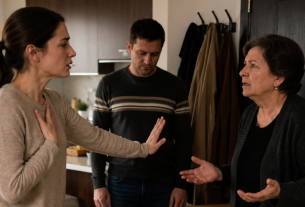
— “Our family debt has grown, Victoria, so I think it’s time for you to sell your property and move in with us,” my mother-in-law declared, confidently stirring sugar in my favorite mug.
— “We’ll use the money to pay off the loan, and we’ll all live together happily under one roof.”
I set my phone aside and looked at my husband. Dima, who had been peacefully chewing his sandwich, froze like a malfunctioning android.
Antonina Romanovna had a remarkable gift: she could manage other people’s property with the grace of a general conquering enemy territory.
In her worldview, my pre-marital two-bedroom apartment was an annoying misunderstanding that should have long ago been turned to the benefit of her personal empire.
— “Excuse me, Antonina Romanovna,” I said, tilting my head slightly as I watched this parade of vanity with interest.
— “Whose debt exactly have you so generously elevated to the rank of ‘our family’?”
— “Mine, of course!” my mother-in-law snapped, clinking her spoon indignantly.
— “I’m your husband’s mother! We’re one family! And in a family, it’s customary to share burdens. I decided to make you happy and unite us in the face of financial difficulties.”
— “What an interesting geography your ‘family’ has,” I smirked.
— “When it comes to sharing income, we’re a commune—but when it comes to taking out a loan, you’re an individual entrepreneur. What was the loan for?”
My mother-in-law straightened proudly, like a monarch on a palace balcony.
— “For the future! I bought Lena”—she rolled her eyes, mentioning her thirty-year-old unemployed daughter—“a шикарный plot of land outside the city. For building a cottage. She needs somewhere to raise my future grandchildren.”
Dima finally swallowed his bite and pushed his plate away.
— “Mom,” he said calmly, “you took out a loan for a plot for Lena. I assume it’s registered in her name as well. What does Vika’s apartment have to do with it?”
— “Because you’re a man!” Antonina Romanovna snapped, shooting her son a scorching look.
— “You should help your sister! And your wife is obliged to support you as part of a family initiative!”
I slowly got up from my seat.
— “As the great schemer Ostap Bender once said: the rescue of drowning people is the work of the drowning themselves,” I shot back, taking my favorite mug from her as I did.
— “Antonina Romanovna, you’ve confused wishful thinking with reality and mixed up the family code with a charity fund. The apartment stays with me, and please pass my sincere congratulations to Lena on her successful land purchase.”
My mother-in-law pressed her lips together in offense, stood up abruptly, and left our kitchen as if we had just refused to save humanity from a meteorite.
I thought that was the end. Naively. That was only her warm-up.
Three days later, the suspense began. Debt collectors from the bank started blowing up Dima’s phone. It turned out his caring mother had listed him as a guarantor—his signature, of course, forged.
Fortunately, with cameras now installed everywhere in bank branches, the bank’s lawyers, after receiving Dima’s fraud complaint, quickly backed off and redirected all their anger at the real borrower.
When Antonina Romanovna realized her son wasn’t going to silently carry her burden, she decided to organize a “family tribunal.”
On Saturday morning, the doorbell rang. On the doorstep stood my mother-in-law, and behind her shuffled a heavy supporting cast: Aunt Zina from the suburbs, cousin Uncle Valera, and, of course, Lena herself, wrapped in a winter coat out of season.
I looked at this delegation that had come to plead their case and realized: today our theater would be sold out.
— “Come in, since you’re already here,” I said, stepping back into the hallway and nodding to Dima, who had just come out of the bedroom. He crossed his arms, making it clear we’d hold the line together.
The guests settled into the living room. Antonina Romanovna took the central armchair, preparing to take the lead.
— “Relatives!” she began dramatically, pressing a dry handkerchief to her completely dry eyes.
— “Look at these selfish people. Their mother is drowning in debt, and they’re living in luxury! Victoria is clinging to her square meters, and my son has turned his back on his own blood!”
Aunt Zina shook her head reproachfully at me.
— “This isn’t Christian, Vika. In a family, you help each other. Greed leads nowhere good.”
— “And who are the judges?” I said quietly but clearly, looking straight into Aunt Zina’s eyes.
— “Zinaida Pavlovna, didn’t you spend five years in court with your own sister over an old dacha? You helped her a lot, didn’t you?”
Aunt Zina faltered and suddenly became very interested in the wallpaper pattern.
— “Don’t you dare change the subject!” my mother-in-law barked, losing her martyr image.
— “We demand a decision! You sell the apartment, we pay off my four-million debt, and with what’s left we’ll buy you a studio on the outskirts. That’ll be enough for the two of you!”
There it was. The demand had been voiced, the audience frozen in anticipation of my repentance.
I slowly walked to the table, pulled out a drawer, and took out a neat plastic folder. Dima winked at me encouragingly—we had worked out this backup plan the night before.
— “You know, Antonina Romanovna,” I said in a deliberately gentle tone, “Dima and I discussed it and decided to support you. Out of total care.”
My mother-in-law’s face lit up. Lena squealed with delight. Uncle Valera grunted approvingly.
— “We’re ready to pay off your loan in full,” I continued, watching greed completely replace reason on their faces.
— “As early as tomorrow, Dima will transfer the required amount to the bank.”
— “What a golden daughter-in-law you are, Vika!” my mother-in-law exclaimed, throwing up her hands.
— “I always knew you’d come to your senses!”
— “But,” I raised my index finger, cutting off her excitement, “there’s one tiny, purely technical condition.”
I opened the folder and placed a draft contract on the table.
— “Since we’re paying off Lena’s land loan, the land becomes the property of Dima and me. A transfer deed. We pay the bank, Lena signs the papers with a notary right now, and the land becomes ours. Fair deal: whoever pays for the party calls the tune.”
The room fell so silent you could hear the neighbors’ washing machine upstairs.
Antonina Romanovna stared at the papers as if they were a poison recipe.
— “What do you mean—yours?” Lena asked hoarsely. “Where am I supposed to build my cottage?”
— “With money you earn yourself, Lena,” Dima answered gently. “Vika and I actually have plans for a country house.”
— “Have you lost your minds?!” my mother-in-law shrieked, jumping out of her chair.
— “That’s Lena’s land! I did it for her! You want to rob your own sister?! You mercenary monsters!”
I watched the outburst with satisfaction. The trap had snapped shut.
— “Antonina Romanovna,” I said quietly, each word landing like a nail,
— “You wanted me to sell my apartment, pay for land for your daughter, and then move into a kennel. But when I offer a fair deal—money in exchange for property—you accuse me of theft?”
I turned to the relatives.
— “Ladies and gentlemen of the jury, you’ve all heard it. Mom wanted us to simply gift Lena four million. Now tell me: which one of us is greedy?”
My mother-in-law faltered. She had expected me to argue or make excuses, but instead she ran into cold accounting.
— “You’re obliged! This is your… tribute for me raising Dima!” she blurted out, completely losing face.
— “Serfdom was abolished in 1861,” I said with a smile, closing the folder.
— “Dima, see our guests out. Negotiations have reached a dead end due to the counterparty’s insolvency.”
Realizing there would be no free spectacle of apartment redistribution—and that the mother-in-law had exposed herself not as a victim but as a calculating schemer who had tried to use them as extras for pressure—the relatives hurried to leave.
— “Let’s go, Antonina,” Uncle Valera muttered. “You made this mess, you deal with it. No need for theatrics here.”
My mother-in-law stormed out, dragging a stunned Lena behind her like a tugboat pulling a damaged barge.
Antonina Romanovna was left alone with her multimillion debt. She had to sell her beloved dacha and some jewelry to repay the bank, as Lena didn’t lift a finger to help her.
And Dima and I went furniture shopping that weekend. No loans. No relatives.
Justice isn’t when everyone hugs and forgets grievances for the sake of some mythical “family peace.”
Justice is when everyone gets exactly what they tried to set up for someone else.