This apartment was my pride. Sixty square meters of pure, hard-won happiness on the fourteenth floor, overlooking a city falling asleep. Maxim and I had poured our whole souls into it, all our savings, and three years of strict economizing on vacations and restaurants. I personally chose every inch of wallpaper, every handle on the kitchen cabinets, and that very fluffy living-room rug the color of baked milk.
It was our fortress. A safe harbor where I could walk around in an oversized T-shirt, drink wine straight from the bottle on Fridays, and make love to my husband on the kitchen table without fearing anyone’s gaze.
The idyll collapsed on one rainy November evening.
The doorbell rang at nine o’clock on a Sunday night. I was just applying a clay mask in the bathroom, and Maxim was watching football.
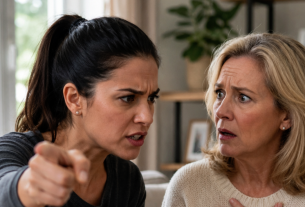
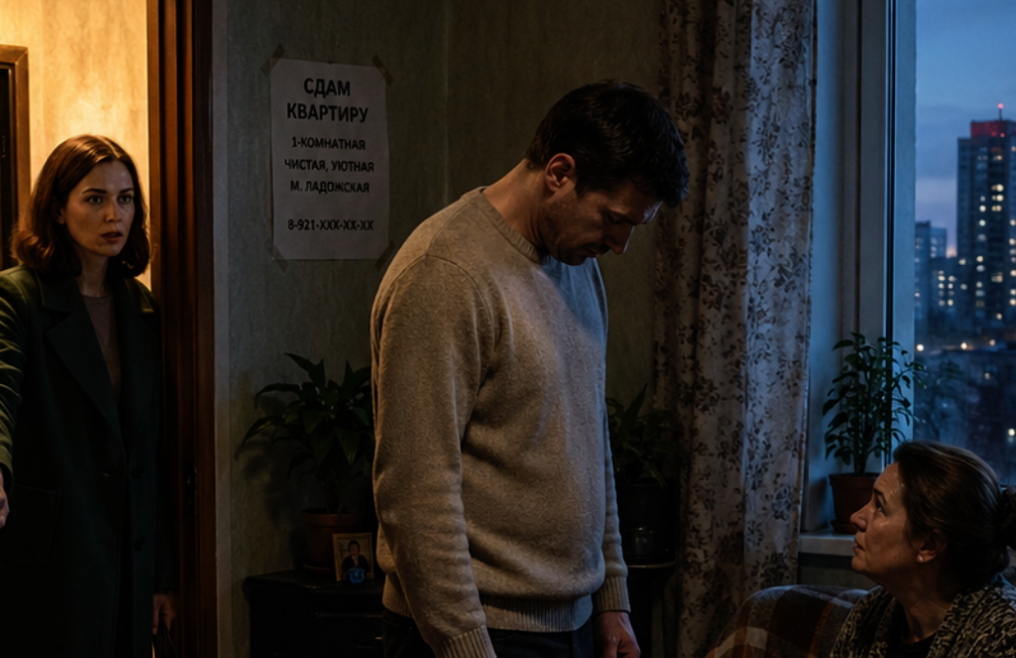
When I stepped into the hallway, my heart dropped somewhere near my slippers. Standing on the doorstep was Zinaida Petrovna. My mother-in-law. As always, her face expressed a mixture of universal sorrow and unwavering certainty in her own righteousness. Around her, like picturesque mountains, towered three plaid shuttle bags, an antique floor lamp, and a cage with Kesha the parrot, paralyzed with terror.
“Hello, Anechka,” she said in a tone that tolerated no objections. “I’ve come to stay with you. For good.”
I slowly shifted my gaze to my husband. Maxim was hunched over, hiding his eyes and nervously tugging at the hem of his house sweater.
“Anya, you see… Mom rented out her apartment. It’s hard for her to be alone, and the extra money won’t hurt… We’re family, right? She needs help.”
He had not even asked me. He had simply presented me with a fact. In that very second, the fluffy baked-milk-colored rug seemed like cold concrete beneath my feet.
My mother-in-law did not simply move in with us. She occupied the territory with the aggression of an experienced military commander. My life turned into a survival reality show, where every day brought new trials.
Day one. The culinary revolution.
I came home from work exhausted, dreaming only of silence. The kitchen was filled with the suffocating smell of fried onions and old lard. My expensive little jars of spices, which I had brought back from Georgia, had been shoved into the far corner. On the stove, a huge battered pot she had brought with her was bubbling away.
“Your little salads are nonsense, Anya,” Zinaida Petrovna declared, wiping her hands on my best linen towel. “Maxik needs proper food. I made borscht. Real borscht. Otherwise, he’s become terribly thin with you.”
Day three. The laundry catastrophe.
On Wednesday morning, I could not find my favorite silk lingerie. I found it later on the balcony. It had been mercilessly washed at ninety degrees with cheap bleach and now looked like crumpled gauze.
“No need to breed germs in the washing machine at thirty degrees!” my mother-in-law snapped when, holding back tears, I showed her the ruined things. “And anyway, it’s indecent for a married woman to wear lace like that. Who are you prancing around for?”
Day five. The destruction of personal boundaries.
It was Friday evening. Maxim and I had closed ourselves in the bedroom. For the first time in a week, we were alone. I hugged my husband, hoping to feel at least a drop of the old warmth…
The door flew open without a knock. The light switch clicked, blinding us with bright light.
“Maxik, I knitted you some warm socks, try them on,” Zinaida Petrovna stood in the doorway, completely unembarrassed by the fact that we were lying under the blanket.
“Mom!” Maxim squeaked, pulling the blanket up to his chin.
“What haven’t I seen there?” she snorted. “Such secrets, honestly. And you, Anya, could at least close the window. The boy will catch a chill.”
Saturday morning began with me not recognizing my own living room. My beloved Scandinavian minimalism had been destroyed. Some hideous knitted covers were lying on the sofa, an army of plastic pots with wilting geraniums lined the windowsill, and the television was covered with a lace doily. The air was thick with the smell of Corvalol, mothballs, and someone else’s old age.
Zinaida Petrovna sat in the middle of the room, talking loudly on the phone with her friend:
“Yes, Ninochka, I live with the young ones now. Oh, what kind of housewife is she? Dust in the corners, can’t cook, always ordering those deliveries of hers. Never mind, I’ll put things in order here quickly. My golden Maxik just puts up with her…”
I stood in the hallway, my back pressed against the wall, feeling something inside me break with a quiet crunch.
I looked at Maxim as he came out of the bathroom. He had heard every word.
“Max,” my voice was frighteningly calm. “Either she moves out today, or…”
“Anya, stop being hysterical!” For the first time that week, he raised his voice at me. Irritation was visible in his eyes. “She is my mother! She is an elderly woman! You should show some respect and endure it. This is her home now too.”
“This is her home now too.”
Those words sounded like a sentence. At that moment, I realized the most terrifying thing: I was no longer angry at my mother-in-law. Zinaida Petrovna was simply an invader acting according to her nature. The real betrayal had been committed by the person with whom I had planned to spend my whole life. He had not merely let the enemy into our fortress — he had opened the gates himself and handed over the keys.
I did not scream. I did not smash dishes or pack suitcases. The tears dried up, leaving behind an icy, crystalline clarity.
“All right, Maxim,” I said quietly. “You’re right.”
I turned around, went into the bedroom, and closed the door behind me. I sat on the bed, took out my phone, and opened a real-estate app.
I owned half the rights to this apartment. Legally, morally, and financially. But I had no intention of staying for even one more second within walls that had become soaked with someone else’s smell and my husband’s betrayal.
I methodically walked around the apartment. I photographed the spacious kitchen, trying to keep the hideous pot of borscht out of the frame, the bright living room, and the bedroom. My hands were not shaking.
On Sunday morning, exactly one week after Zinaida Petrovna’s arrival with her bags, Maxim was sitting in the kitchen drinking tea. My mother-in-law was loudly peeling carrots while criticizing the quality of modern knives.
I entered the kitchen wearing my favorite cashmere coat. In my hands, I had a travel bag with the essentials and a printed sheet of paper.
I placed the sheet on the table, right in front of Maxim.
“What is this?” he frowned, not understanding.
“This, dear husband, is our listing on the real-estate website. The apartment is up for sale. Urgently. Negotiable price.”
Zinaida Petrovna dropped the knife. The carrot rolled across the floor with a dull thud.
“What sale?!” she shrieked. “Are you out of your mind, you shameless woman?! We live here!”
“You live here,” I corrected her, savoring the sight of Maxim’s face turning pale. “I am moving out. My lawyer will contact you tomorrow morning regarding the division of property and the divorce. Stay here for now. Enjoy the comfort. Buyers will start coming on Tuesday; the realtor has the keys. Try not to cook borscht during the viewings. It lowers the value of the apartment.”
I turned and walked toward the door.
“Anya! Anya, wait! You can’t do this!” Maxim’s voice broke into a pitiful falsetto. He rushed after me into the hallway. “Destroying a family over some quarrel?!”
I stopped, took hold of the front-door handle, and looked him straight in the eye.
“The family fell apart a week ago, Max. You were just too busy hiding behind your mother’s skirt to notice.”
I walked out, carefully closing the door behind me. The stairwell smelled of dampness and coffee. I took a deep breath. The air seemed incredibly clean and fresh. I no longer had my perfect apartment, but I had myself again. And that was worth starting over from scratch.
The gray November wind struck me in the face the moment I stepped outside the building. I walked toward the metro without looking back, although I could feel with my back how, on the fourteenth floor, behind the window of our — now former — perfect bedroom, a family drama was unfolding.
I rented a room in an inexpensive business hotel on the other side of the city. A small room, standard chipboard furniture, faceless beige wallpaper, and the smell of chlorine from the bed linen. There were no fluffy rugs or designer lamps there. But there was silence. Absolute, ringing silence, in which I could hear neither Zinaida Petrovna’s shuffling steps, nor her lecturing tone, nor Maxim’s guilty silence.
I dropped my bag on the floor, sat on the edge of the hard bed, and that was when it hit me. The adrenaline retreated, giving way to deafening pain. I was not crying over the apartment. I was mourning three years of illusions. I remembered how Maxim had proposed to me in a small rooftop café, how we had chosen names for our future children together, how we had sworn to be each other’s support. It turned out that his support ended exactly where his mother’s authority began.
My phone was going crazy. Ten missed calls from Maxim. Two from my mother-in-law. Messages came pouring in one after another: “Anya, have you lost your mind?” “Come home, we’ll talk like adults.” “Mom’s heart is acting up because of your tantrums!”
Silently, I blocked both numbers and fell into a heavy, dreamless sleep.
Monday morning began with vending-machine coffee and a visit to a lawyer. Vadim had been recommended to me by a colleague who had gone through a difficult divorce two years earlier. He was a tall, calm man of about forty, with a sharp gaze and a surprisingly pleasant, deep baritone. His office was piled with folders, but he himself radiated absolute confidence, and some of it transferred to me.
I explained the situation to him: the apartment had been purchased during the marriage, the mortgage had been paid off a year earlier, and the down payment had consisted of my premarital savings and our joint funds.
Vadim listened attentively, making notes in a notebook.
“The division of property in your situation is a standard process, Anna. We will prove that part of the funds were your personal property, and the rest will be divided equally. But before filing a claim, I will request your husband’s credit history. It’s standard procedure.”
“Credit history?” I raised my eyebrows in surprise. “We don’t have any debts. On principle, we never took out loans after paying off the mortgage.”
Vadim looked at me with professional sympathy, and a chill ran down my spine.
“In divorce cases, Anna, the word ‘principle’ often changes its meaning. Let’s just check.”
The next day, he called me himself.
“Anna, good afternoon. Are you sitting down?” His voice was more serious than usual. “I received the report from the credit bureau. Your husband has a consumer loan in the amount of one and a half million rubles. It was taken out six months ago.”
The ground slipped out from under my feet. Six months ago? In May? I frantically tried to remember what had happened in spring. No major purchases. No renovations.
“Vadim, that can’t be. What could he have spent that kind of money on?”
“I’m afraid you will have to find that out from him,” the lawyer answered gently. “The problem is that, under the law, debts acquired during marriage may be recognized as joint debts unless we prove that the money was not spent on family needs.”
That evening, for the first time in three days, I unblocked Maxim’s number and wrote one message: “We’re meeting tomorrow at the café near my office at 7:00 p.m. The conversation will be about one and a half million.”
Maxim looked awful. Gaunt, with dark circles under his eyes and a wrinkled shirt. Without my supervision and with his mother’s borscht, for some reason he had not blossomed — on the contrary, he had faded.
He sat down at the table, nervously twisting a paper napkin in his hands.
“Anya…” he began in a pathetic tone. “Come back. Mom agrees to give you a shelf in the refrigerator for your… salads.”
I almost laughed at the absurd generosity, but remembered why I had come.
“Where did you put one and a half million, Max?” My voice was like a blade.
He turned pale. The napkin tore in his hands.
“You… you checked up on me?”
“I hired a good lawyer. Answer the question.”
Maxim lowered his head. The seconds stretched painfully long. Finally, he exhaled.
“Mom needed money. Her… her dacha burned down in the region. Or rather, the old house on the plot. She cried so much, Anya. Her blood pressure shot up. She wanted to build a new little house, a small one, made of timber. I took out the loan.”
“Six months ago,” I said slowly, putting the puzzle together in my head. “You took out a loan to build a dacha for your mother. Behind my back. We were saving on vacations, I wore last year’s coat, and you were building a dacha for Zinaida Petrovna. And why, then, is she not living in this wonderful new dacha?”
Maxim flushed red to the roots of his hair.
“The contractor turned out to be a fraud. He took the advance payment and disappeared. Mom was left without money and without a dacha. And she didn’t rent out her old apartment in the Khrushchev-era building, Anya… She sold it to repay debts to some relatives who had also invested in the construction. She has nowhere else to live. Nowhere at all.”
I sat there, stunned by this avalanche of lies. My husband, the person with whom I had shared a bed and plans for the future, had turned out to be an infantile liar who had destroyed our financial stability with his own hands for the whims of his despotic mother.
“And you kept silent,” I stated. “You brought her into our home permanently, knowing it was forever, and didn’t even bother to tell me the truth.”
“I was afraid you would fight with me!” he cried out, drawing the attention of people in the café. “You always control everything!”
I stood up. The conversation was over.
“My lawyer will prove that this money was not spent on the needs of our family. You will pay off the loan yourself. And we are selling the apartment. Half of the money is mine. Goodbye, Maxim.”
Selling an apartment with residents who were resisting it with all their might is a task for people with nerves of steel. My realtor, a brisk woman named Marina, turned out to be exactly that kind of person.
The first viewing was scheduled for Saturday. We arrived fifteen minutes before the buyers. When I opened the door with my key, I was hit by the smell of burnt rubber and boiled cabbage.
Zinaida Petrovna had outdone herself. She had placed old, dirty shoes all over the hallway, apparently collected especially from the trash. In the bathroom, in the most visible place, hung disgusting torn underwear, and in the kitchen, a frying pan was smoking with something indescribably foul-smelling.
My mother-in-law herself sat in an armchair, her head wrapped in a towel, groaning. Maxim was hiding on the balcony.
“My God,” Marina whispered, pinching her nose. “What kind of installation is this?”
“These are defensive fortifications,” I answered grimly.
I walked over to the stove, turned off the gas, and threw the frying pan into the trash can. Then I opened all the windows wide.
When the buyers arrived — a young couple with a child — Zinaida Petrovna turned into an actress from a burned-down theater.
“Oh, I don’t advise you to buy this place!” she wailed from the armchair while Marina showed them the bedroom. “The upstairs neighbors are alcoholics, banging on the radiators at night! The pipes are rotten, it floods every week! And the drafts are so bad, look, I’ve been blown through completely!”
The young woman buyer pressed herself fearfully against her husband.
“Zinaida Petrovna,” I said loudly and clearly, looking straight into her darting eyes. “If you do not stop this circus right now, I will call the police and report that an outsider is refusing to leave my property. You are not registered here. You have no legal right to be in this apartment.”
My mother-in-law fell silent. Her mouth snapped shut with a quiet click. The buyers quickly retreated, promising to “think about it.”
Similar scenes happened twice more. Maxim did nothing, allowing his mother to sabotage the sale. But Marina was relentless. She lowered the price by five percent and found a buyer who did not care about the smell of cabbage or an old woman’s groaning.
He was a stern middle-aged man buying the apartment to rent it out. He looked over my mother-in-law, glanced at frightened Maxim, and said:
“I’ll take it. But on one condition: I get the keys on the day of the transaction, and the apartment must be completely empty. Take the furniture too. I’m not going to evict your relatives with the police. Can you handle that?”
“We can,” I answered, looking at Maxim as he turned pale. “They have exactly two weeks to find themselves a rental apartment.”
The day of the transaction was gloomy and cold, typical for the end of December. We met at a bank branch. Maxim came alone. He looked as if he had aged ten years. His shoulders were slumped, and there was a hunted look frozen in his eyes.
I sat beside my lawyer, Vadim. Over that month, we had communicated a lot, and his calm, reinforced-concrete confidence had become a kind of anchor for me. He had helped me not only with the apartment, but also fought off Maxim’s attempts to saddle me with part of his ridiculous loan.
The process of signing the documents took about an hour. Papers rustled, stamps thudded. I signed the purchase agreement with surprising ease, as if I were throwing a heavy, dusty sack off my shoulders.
When the money had been transferred into our separate accounts, we stepped out onto the bank’s porch.
“Anya…” Maxim tried to take my hand, but I instinctively stepped back. “We rented a one-room apartment on the outskirts. Mom sleeps in the kitchen… Anya, I understand everything now. I was an idiot. Let’s try to start over. I’ll file for divorce from her, we’ll rent a place just for the two of us…”
I looked at the man I had once loved more than life itself and felt nothing but faint pity.
“Too late, Max. You made your choice the day you let her and her bags into our life and forced me to endure it. You betrayed me twice: first with the money, then with the home. I don’t go back to traitors. Take care of your mother.”
I turned and walked toward the metro. Snow began falling in large flakes, covering the dirty sidewalks with a clean white carpet.
“Anna!” a deep baritone called after me.
I turned around. Vadim, his coat thrown open, was walking quickly toward me, holding a folder in his hands.
“You forgot a copy of the court decision regarding the loan,” he said, handing me the papers and smiling slightly. For the first time throughout our work together, his smile was not professional, but warm and sincere. “The case is closed. You are completely free.”
“Thank you, Vadim,” I said, taking the documents. “You literally saved me.”
“Not at all. You know, Anna… My work is finished, and now I can allow myself one liberty. How would you feel about having coffee? Not vending-machine coffee at the courthouse, but proper coffee in a good place. They say there’s a café around the corner that makes an amazing raf. In honor of your new life.”
I looked at his calm face, at the falling snow, and felt something timid and warm blooming inside me, in the place where everything had frozen over a month earlier. A feeling of hope and anticipation of something new. Exciting. Real.
“With pleasure, Vadim,” I smiled. “With great pleasure.”