When a loved one dies, the most terrifying thing is not grief, but how quickly other relatives forget about love for the sake of money and square meters.
Chapter 1. The Uninvited Guest
My brother arrived three days after Mom’s funeral. I still hadn’t come to my senses. I still couldn’t believe she was gone. Her scent lingered in the apartment — lavender and vanilla pastries. An unfinished magazine lay in the kitchen, and her favorite blanket was on the sofa. I sat with a cup of cold tea and simply stared out the window, unable even to cry — my tears had run out.
The doorbell rang sharply, harshly. I flinched.
Victor was standing on the threshold — my older brother, whom I hadn’t seen in more than a year. An expensive suit, polished shoes, a leather briefcase in his hand. His face was tense, but there was no trace of grief on it.
“Hello, Lena,” he said dryly, without hugging me. “I need to talk to you. Seriously.”
I stepped aside to let him in. Victor walked into the living room and looked around with an appraising gaze, the way people look at real estate before buying it.
“My condolences, of course,” he threw out without even turning around. “Mom was… well, anyway, it’s a tragedy.”
A tragedy. He called our mother’s death a tragedy in the same tone people use when talking about traffic.
“Victor, if you came to offer condolences, then thank you,” I said, feeling something tighten inside me. “But I’m not up for conversations right now.”
“You’ll have to be,” he said, taking a thick folder of documents from his briefcase and placing it on Mom’s dining table. “We need to settle the inheritance issue. Today.”
I froze.
“The inheritance? Mom died three days ago! Three days, Victor!”
“That’s exactly why everything needs to be settled quickly,” he said, opening the folder and ignoring my voice. “Here is the will. Mom made it six months ago, certified by a notary. According to this document, the entire apartment and all her savings go to me.”
The world swam before my eyes.
“What?” I grabbed the back of a chair. “That’s impossible. Mom would never… she promised…”
“Promises are one thing, legal documents are another,” Victor said, taking out a pen and sliding some papers toward me. “Here is a waiver of claims to the inheritance. Sign here, here, and here. Then you can be free.”
“Free?” I stared at him, unable to believe my ears. “Victor, do you understand what you’re saying? This is Mom’s apartment! I lived with her for the last five years! I took care of her when she was sick! And you came once a year for half an hour!”
His face hardened.
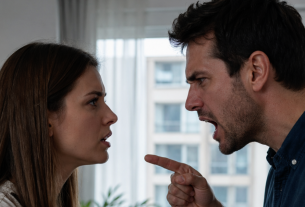
“Lena, don’t get sentimental. The law is the law. A will is a will. As the eldest son and sole heir, I have the right to this apartment. And you…” He looked me over appraisingly. “You can look for a rental. You have one month to vacate the premises.”
I stood there, gripping the edge of the table so hard that my knuckles turned white. Everything inside me was boiling — with rage, pain, and the impossibility of believing what was happening.
“Get out,” I whispered.
“What?”
“I said get out of Mom’s apartment. Now!”
Victor smirked as he gathered the documents.
“My apartment, Lena. Legally, it’s already mine. But fine, I’ll give you time to think. I’ll come back in three days. I advise you to find a good lawyer by then — if, of course, you have the money for one.”
He left, leaving the folder on the table. I collapsed onto a chair and only then burst into tears. But through my tears, one thought was already forming: something was wrong here. Mom couldn’t have done this. She couldn’t have.
And I had to prove it.
Chapter 2. Mom’s Secrets
I didn’t sleep all night, rereading the will. It looked real — seals, signatures, date. It had been drawn up six months earlier, in March. I tried to remember what had been happening then. Mom had been sick, recovering from heart surgery. Victor never came then, saying he had an important business trip.
But I was there. Every day. I fed her, gave her medicine, read books aloud to her. And it was then, when she was especially weak, that she took my hand and said:
“Lenochka, I want you to know. The apartment will be yours. I’ve already decided everything. You deserve it — you were the only one who stayed by my side.”
I had brushed it off then, not wanting to talk about bad things. But Mom insisted:
“No, listen to me. I’m serious. Victor made his choice long ago — he chose career and money. And you chose me. I value that.”
Those words were etched into my memory. Mom couldn’t have changed her mind. She couldn’t have left everything to Victor.
In the morning, I started searching. Mom’s apartment was small — a two-room place in an old building — but she had kept her whole life there. I opened drawers, sorted through papers, photographs, letters.
In the old writing desk, in the very back drawer, I found an envelope. On it, in Mom’s handwriting, were the words: “For Lena. Open if something happens.”
My hands trembled as I opened it. Inside was a handwritten letter and a flash drive.
“My dear Lenochka,” I read Mom’s words, and tears welled up in my eyes again. “If you are reading this, then I am no longer here. Forgive me for not telling you while I was alive, but I was afraid. Afraid that Victor would find out.
Six months ago, when I was in the hospital after surgery, your brother came to see me. I was happy — I thought he had finally remembered his mother. But he did not come to visit me. He came with a demand.
Victor said he had problems with his business, that he urgently needed money. A lot of money. He demanded that I sell the apartment and give him the money. Or transfer it to him so he could take out a loan using it as collateral.
I refused. I said the apartment was all I had, and I wanted to leave it to you. You deserved it.
Then he started threatening me. He said that if I didn’t do what he wanted, I would never see him again. That he would forbid me from seeing my grandchildren — although he doesn’t have children, but that’s what he said. He shouted that I was a bad mother, that I had loved you more my whole life.
Lenochka, I got scared. I was weak after the surgery, alone in a hospital room. And I agreed to sign the will in his favor. He brought some notary directly to the hospital, and I signed it.
But later, when I came home and you were by my side again, I realized I had made a mistake. I went to another notary and drew up a new will — the real one, in which I leave everything to you. It is with the notary Svetlana Igorevna Morozova at 15 Sadovaya Street.
And also… I started recording our conversations with you. And conversations with Victor when he came. Just in case. On the flash drive are all the recordings from the last six months. There is the conversation where he threatened me. And the conversations where I tell you that everything will be yours.
Forgive me, daughter. I didn’t want to drag you into this. But I knew Victor would not stop. He has become a different person — greedy, angry. He is not the boy I gave birth to.
Take care of yourself. And know that I have always loved you more than anything in the world.
Mom.”
I sat on the floor of Mom’s room, pressing the letter to my chest, sobbing. Mom had known. She had thought of everything. She had protected me even after her death.
I wiped my tears, took the flash drive, and inserted it into my laptop.
Chapter 3. A Voice from the Past
There were more than a hundred audio files on the flash drive. Mom had carefully labeled each one — date, participants in the conversation. I opened the first one, dated March of that year.
Mom’s voice came from the speakers — weak, tired, but so dear:
“Lenochka, today is March 15. I have just returned from the hospital. I want to record that today I made a decision: the apartment at 8 Zelenaya Street, apartment 45, I leave to my daughter, Elena Mikhailovna Sokolova. This is my will, and I am of sound mind and firm memory.”
I listened to recording after recording. Here was Mom talking to me about the weather, about the neighbors, and then suddenly saying, “Lena, I want you to know — I will go to the notary next week and make everything official. The apartment will be yours. You deserve it.”
Here was a recording of our conversation in the kitchen:
“Mom, why are you talking about this? Don’t say that, you’ll live for many more years!”
“Lenochka, I have to. I want to be sure you won’t end up on the street. I know Victor. He’ll want to take everything for himself.”
How right she had been.
And then I found that very recording. May, two months earlier. Victor had come to see Mom — I had been at work then. On the recording, you could hear the door opening.
“Vitya! How good that you came!” Mom’s voice sounded joyful.
“Hi, Mom. I won’t be long. I need to talk to you.” Victor’s voice was cold, detached.
“Come in, come in. I’ll put the kettle on…”
“No tea. Mom, I found out that you rewrote the will in Lenka’s favor.”
A pause. Then Mom’s voice, now cautious:
“How did you find out?”
“Doesn’t matter. What matters is that you have no right to do that. I am the eldest son, the only man in the family. By law, the apartment should go to me.”
“Vitya, the law has nothing to do with it. This is my apartment, and I decide whom to leave it to. And Lena…”
“Lena is a weakling and a loser!” Victor’s voice rose. “She’s thirty-eight years old, works as a schoolteacher for pennies, and has never even been married! And I built a business, I have connections, money! I can manage this apartment properly!”
“You mean sell it,” Mom said bitterly. “Vitya, this apartment is my home. I lived here for forty years with your father. You both grew up here. I don’t want it sold.”
“Then transfer it to me. I won’t sell it, I promise.”
“No, Vitya.”
“Mom!” he almost shouted. “Do you understand that I have problems right now? I need collateral for a loan! If I don’t get the money, I’ll lose everything!”
“That is not my problem, son. You are an adult.”
“Fine. Then I’ll tell you this: either you rewrite the will back to me, or I disappear from your life. Forever. And you can die alone — I won’t even come to the funeral.”
I listened to that recording, and I felt more and more frightened. This was my brother speaking. The person I had grown up with, played with, shared toys with.
“Vitya, you can’t talk to your mother like that…” Mom’s voice trembled.
“I can. And I am. You have one week to think. Me or Lenka. Choose.”
The door slammed. Mom cried — quietly, heartbreakingly. Then her voice sounded again, now directed at the recorder:
“Lena, if you are listening to this… forgive me. I couldn’t protect you from him while I was alive. But I will do everything to protect you after my death. Tomorrow I will go to Svetlana Igorevna and draw up a new will. The real one. And what I signed in the hospital under Victor’s pressure is invalid. He blackmailed me, threatened me. It was not my free will.”
The recording ended. I sat in silence, absorbing what I had heard. I had proof. Irrefutable proof that Victor had manipulated Mom, threatened her, forced her to sign the will. But most importantly — Mom had made a new one. And it had to be with Notary Morozova.
I looked at the clock. Half past ten in the morning. The notary’s office was open. I grabbed my bag, the flash drive, Mom’s letter, and ran out of the apartment.
Chapter 4. At the Notary’s Office
Svetlana Igorevna Morozova’s office was located in an old two-story building in the city center. I climbed the creaking stairs, clutching Mom’s letter in my hand, praying that everything would turn out to be true.
Svetlana Igorevna met me in her office — a woman of about fifty-five, in a strict suit, with an attentive gaze behind her glasses.
“Elena Mikhailovna Sokolova?” she clarified when I introduced myself. “Come in, sit down. My condolences for your loss. Your mother was a wonderful woman.”
“You knew her?” I sat on the edge of the chair.
“Of course. Nina Petrovna came to me twice. The first time in April, the second in June, a month before…” She tactfully fell silent. “She was very worried. She said she was having problems with her son.”
My heart began to beat faster.
“Svetlana Igorevna, did she leave a will with you?”
The notary nodded and opened the safe.
“Yes. And she asked me to keep it in a very unusual way. She said she was afraid her son might find the document at home and destroy it. So she asked me to keep the only copy here and give it to you only after her death.”
She took out an envelope and handed it to me. My hands trembled as I opened it.
“Will. I, Sokolova Nina Petrovna, being of sound mind and firm memory, hereby bequeath the apartment belonging to me by right of ownership, located at: Moscow, 8 Zelenaya Street, apartment 45, as well as all monetary savings and personal belongings, to my daughter Sokolova Elena Mikhailovna…”
I read and reread those lines, unable to believe my eyes. The date was April 20 of that year. Mom’s signature, the notary’s seal — everything was properly executed.
“Is this… is this a real will?” I whispered.
“Absolutely legal and fully valid,” Svetlana Igorevna confirmed. “Moreover, your mother specifically left a video recording of the procedure of drawing up the will with me. She said she was afraid her son would contest the document, and she wanted to protect herself as much as possible. Or rather, to protect you.”
“May I see the recording?”
The notary turned the computer monitor toward me. Mom appeared on the screen — sitting in this same office, on the same chair where I was sitting now. Thin, pale, but with clear and determined eyes.
“I, Sokolova Nina Petrovna,” she said into the camera, “declare that I am making this will of my own free will, without coercion. I revoke the previous will, which I made in March under pressure from my son Victor. He threatened me, blackmailed me, and took advantage of my weakened condition. I am now of sound mind, I have undergone a medical evaluation — the certificate is attached — and I want all my property to pass to my daughter Elena. She is the only person who has been by my side all these years. She deserves this inheritance.”
Tears rolled down my cheeks. Mom had thought of everything. Every detail. She knew Victor would not stop, and she had protected me in the only way she could.
“Do you have a copy of this will?” I asked, wiping away my tears.
“Yes. And a certificate of your mother’s legal capacity, signed by a psychiatrist. And the video recording. And the notarial protocol. Your brother can present his March will a hundred times — it is invalid because it was revoked by the later one. And the later one is this one, from April.”
I exhaled. For the first time in several days, I felt like I could breathe normally.
“Thank you. Thank you so much.”
“Don’t thank me. Thank your mother. She was a very wise woman. And she loved you very much.”
I left the notary’s office with a certified copy of the will, Mom’s recordings on the flash drive, and firm determination. Victor would come in three days.
And he would be very surprised.
Chapter 5. The Hour of Reckoning
Victor appeared exactly three days later, as promised. In the same expensive suit, with the same folder of documents, and the same self-assured expression on his face.
“Well, Lenka,” he said without even greeting me, “did you sign the inheritance waiver? Or are we going to court? I warn you, I have a good lawyer.”
I was sitting at Mom’s table, calm and composed. In front of me lay the documents, the laptop, and the recorder.
“Sit down, Victor. We really do need to talk.”
He raised his eyebrows in surprise, but sat down.
“You know, I found something after Mom’s death,” I said, sliding the envelope with her letter toward him. “Read it.”
Victor took the letter and skimmed it. His face slowly changed — his confidence gave way to wariness.
“This means nothing,” he muttered, tossing the letter aside. “The dying delirium of a sick woman.”
“Not delirium,” I said, turning on the laptop. “And this is a recording of your conversations with Mom. Want to listen?”
I pressed play. Victor’s voice floated through the room:
“Either you rewrite the will back to me, or I disappear from your life. Forever. And you can die alone — I won’t even come to the funeral.”
Victor turned pale.
“This… where did you get this?”
“Mom recorded all conversations during the last six months. She was a prudent woman. Everything is here — how you threatened her, how you blackmailed her, how you forced her to sign the will in the hospital when she was helpless.”
“Lena, I can explain…”
“No,” I raised my hand. “I’m not finished. Here is the will Mom drew up in April with Notary Morozova. The real will, made of her own free will. Here is the video recording of the procedure. Here is the certificate of her legal capacity from a psychiatrist. And your March will is invalid because it was made under pressure and revoked by the later one.”
Victor stared at the documents, and I saw his confidence collapse. I saw him understand that he had lost.
“Lena, listen,” he tried to change his tone, almost pleading now. “I really do have problems. The business is falling apart, loans, debts… I need money. At least half from selling the apartment.”
“And I need Mom,” I said quietly. “The mother you drove to the point that she spent the last months of her life afraid of her own son. She hid from you, recorded conversations, went to a notary because she couldn’t trust you.”
“I didn’t mean to… I just…”
“You just thought only about yourself,” I said, rising from the table. “Mom was dying, and you were thinking about square meters. You didn’t come to visit her in the hospital — you came to shake real estate out of her. You didn’t call even once in the last six months just to ask how she was feeling. You showed up at the funeral and didn’t even cry. And three days later, you came to divide the inheritance.”
Victor sat with his head lowered. For the first time, I saw a crack in his armor.
“I’m not that bad,” he muttered. “It’s just circumstances…”
“Circumstances don’t make people cruel, Victor. It’s a choice. You chose money over your mother. Career over family. And now you have nothing. No money, no family.”
“Lena, we’re brother and sister…”
“We were,” I corrected him. “We were brother and sister. Then you became a stranger. Do you remember how we dreamed when we were children? You wanted to become an astronaut, and I wanted to become a teacher. You laughed and said I had chosen a boring profession. And I said I wanted to help children. We were close then.”
“We grew up,” Victor shrugged. “Life changed us.”
“No,” I shook my head. “Life changed you. I stayed the same. I became a teacher. I help children. And I also helped Mom — every day for five years. Do you know what that is like? Coming home exhausted from work, then cooking, cleaning, going to the pharmacy, changing bed linen when Mom couldn’t get up? Sitting through the night when she felt bad? Calling an ambulance and being afraid every time that this was the end?”
Victor was silent.
“And you came once a year,” I continued, my voice trembling. “You sat for half an hour, talked about your achievements, your business. Mom was so happy. She prepared for your visit for a week. She baked your favorite pie, even though it was hard for her to stand at the stove. And you ate a slice, praised it for formality’s sake, and left. And then you appeared again only a year later. Until you needed the apartment.”
“Enough,” he stood up abruptly. “Enough lecturing me! I understand, all right? The apartment is yours, the inheritance is yours. I’m leaving.”
“Wait,” I said, holding out another envelope to him. “This is for you. From Mom.”
He took the envelope suspiciously and opened it. Inside was a photograph — the two of us as children, around five and seven years old. We stood hugging each other and smiling. And there was a note in Mom’s handwriting:
“Vitya, I still love you. You are my son, and I pray that someday you will remember what a good boy you used to be. Forgive me for not being able to leave you the apartment. But I could not betray Lena. She deserved it. Be happy, my son. Mom.”
Victor stood there holding the photograph, and tears ran down his cheeks. For the first time in many years, I saw him cry.
“She forgave me,” he whispered. “And I… I was such a bastard.”
“Mom always forgave,” I said quietly. “It was her gift and her curse. She forgave you everything. But that doesn’t mean what you did was right.”
He nodded, clutching the photograph.
“I’ll go. Forgive me, Lena. For everything.”
“I’m not Mom,” I replied. “I don’t know how to forgive that easily. Maybe someday. But not now. I need time.”
Victor left, hunched over, aged. He was no longer the self-assured man in the expensive suit who had come three days earlier. He was a broken, lost man who had finally understood what he had lost.
I closed the door behind him and leaned my back against it.
Silence.
Mom’s apartment.
My home.
Chapter 6. A New Life
Six months passed. I officially entered into the inheritance and reissued all the documents. The apartment became mine — legally and in reality. Victor never appeared again and never called. I heard through mutual acquaintances that his business really had collapsed, that he had sold everything and moved to another city. He had started from scratch.
Sometimes I felt sorry for him. Sometimes I didn’t. I still hadn’t forgiven him. Maybe I would someday, maybe not. That was my right.
I didn’t touch Mom’s room. I left everything as it was — her books on the shelf, her photographs on the wall, her blanket on the sofa. Sometimes I go in there, sit in her armchair, and talk to her. I tell her how my day went, what’s new at school, what plans I have.
And I did have plans. I decided to make Mom’s dream come true — she had always wanted me to open a small center for children, where struggling students could study for free. Mom used to say, “Education should not depend on how thick the parents’ wallet is.”
I registered a nonprofit organization, found a space, and gathered a team of equally enthusiastic teachers. Mom’s savings — the very ones she had left me — I invested in this project. We opened two months ago, and twenty children are already attending. For free. Math, Russian, English, homework help.
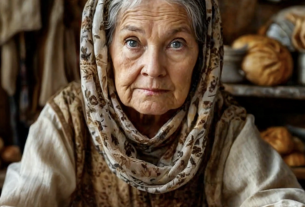
I named the center “Nina” — after Mom. Her photograph hangs in the lobby, and everyone who enters sees her warm smile.
Yesterday, a woman came into the center with a boy of about nine.
“Hello,” she said uncertainly. “I heard you help children for free? My son is falling behind in math, and I don’t have money for a tutor…”
“Of course we help,” I smiled. “Come in. Let’s introduce you to the teacher.”
The woman looked at Mom’s photograph in the lobby.
“She has such a kind smile,” she said. “Is that your mother?”
“Yes,” I looked at the photograph too. “She taught me the most important thing — that true wealth is not in money or square meters. It is in love, care, and what you leave behind.”
Mom left me an apartment, savings, documents. But the most important thing she left me was a lesson about what matters in life. That family is not blood relation, but the choice to stay by someone’s side. That what needs protecting is not property, but the people you love.
Victor learned that lesson too late.
And I learned it in time.
Every evening, returning home to Mom’s apartment, I thank her. For her love, for her wisdom, for continuing to protect me even as she was leaving.
And for teaching me to be human.
Epilogue
A year passed. The “Nina” center grew — now we have fifty students and six teachers. We received a grant from the city administration, and the local newspaper wrote about us. Children come after school, do their homework, study with teachers, and drink tea with cookies.
Sometimes I see in their eyes the same gratitude I once saw in Mom’s eyes when I cared for her. And I understand — this is the real inheritance. Not the apartment, not the money. But the chance to continue something meaningful.
Three days ago, I received a letter. From Victor. He wrote from Yekaterinburg, where he now works as a manager in a small company. He wrote that he goes to therapy, rethinks his life, tries to become better. He asks for forgiveness. Again. He does not ask for money, does not ask for a meeting. He simply wants me to know that he understands.
I haven’t answered that letter yet. I don’t know if I will. But the photograph Mom gave him — the one where we are little and happy — I took from Mom’s album and placed on the shelf. Next to her portrait.
Maybe someday Victor and I will become family again. Maybe not. But Mom would have wanted me to at least try. She always believed in people. Even when they betrayed her.
Yesterday evening, while sorting through Mom’s things, I found one more recording on that same flash drive. The last one. It was dated July — two weeks before her death.
For a long time, I couldn’t bring myself to listen to it. But then I pressed play.
Mom’s voice was very weak, but calm:
“Lenochka, my dear girl. If you are listening to this, then I have already gone. Please don’t cry. I lived a good life. Yes, there were mistakes. Yes, I couldn’t keep the family together — Vitya left us, chose a different path. But I have you. And that is my greatest happiness. I know I am leaving you not only the apartment. I am leaving you problems with your brother, perhaps court battles. Forgive me for that. But I could not do otherwise. You deserved this apartment with your love, your care, your kindness.
Do not waste your life hating Vitya. He has lost his way, but he is still your brother. Maybe someday he will find the road back. Maybe not. That is his choice.
And you live, daughter. Live a full life. Start a family if you want. Or don’t — your happiness does not depend on having a husband. Do what you love. Help people — you are so good at it. And know that I am always with you. Always.
I love you more than life itself, my Lenochka. Thank you for these years. For being there. For not abandoning me. For remaining human in this cruel world.
Take care of yourself. I am proud of you.
Your mother.”
I listened to those words, and tears ran down my cheeks — but they were bright tears. Not bitter, like before. They were somehow… grateful.
Mom was gone. But she had left me so much. Not only the apartment and money. She left me lessons, values, faith in goodness. She left me recordings of her voice that I could listen to when I felt bad. She left me the memory of true love — the kind that demands nothing in return.
And she left me the strength to forgive. Not Victor — I am not ready yet. But myself. For the times I got tired, irritated, snapped. For not always being the perfect daughter.
Mom loved me anyway. No matter what.
Today is Saturday. I am going to the cemetery, bringing Mom her favorite white roses. I will sit on the bench beside her grave and tell her how things are going at the center, what progress the children are making, what plans I have for the future.
And I will say thank you.
For everything.
My brother arrived with inheritance documents — but he didn’t know I had recordings of all his conversations with our mother. And those recordings did more than save my inheritance. They saved the memory of Mom. They proved that she had been a wise, loving, far-sighted woman until the very end.
And that is worth more than any apartment.
Call to Action
Value the people who are beside you today. Do not wait for an inheritance to understand the worth of your parents. Call them, visit them, hug them, tell them you love them — while there is still time. Because afterward, only voice recordings, photographs, and the eternal words “I didn’t have time” will remain.
Protect your family. Your real family — the one built not on blood, but on love and care.