“Wasn’t there any cheaper pink salmon at Magnit, Nadya?”
Tamara Vitalyevna lifted the chilled fish by the tail with disgust—the fish I had paid fifteen hundred rubles for at the supermarket half an hour earlier. It was excellent: firm, with a pink side.
“It isn’t pink salmon, it’s salmon,” I said, unloading three heavy bags onto the kitchen table. “For baking with cream. You asked for it yourself.”
My mother-in-law sighed so heavily, as if I had brought her not delicacies for her anniversary, but utility bills for major repairs. Her face froze in that same expression with which she had greeted me for the last fifteen years.
“Salmon,” she repeated with a slight smirk. “Living richly, are we? And Vadik has been wearing the same shoes for three months—the soles are practically begging for porridge. Fine, put it by the sink. Did you bring my porcelain strainer? The one with the cracked handle, for the berry drink?”
I nodded and took out the old cheap little thing from my bag, the one my mother-in-law had forgotten at our place six months ago. I placed it on the edge of the wall shelf.
My husband stirred on the sofa in the living room. Vadim poked his head out from behind his phone and yawned.
“Nadya, did you get the mayonnaise? Mom asked for three packs.”
“I got it.”
“And buy Father cigarettes.”
“Your father hasn’t smoked in five years, Vadim.”
“Well, then for Uncle Kolya. He’s coming.”
I looked at my fingers. The skin around my nails was red from the plastic handles of the bags. I had three hundred rubles left in my wallet. The shopping for my mother-in-law’s seventieth birthday had eaten up my entire quarterly bonus. Thirty-two thousand three hundred rubles.
Tamara Vitalyevna was already sorting through the containers with tartlets.
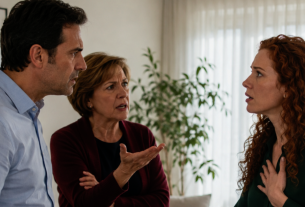
“Nadenka, come tomorrow around twelve. There’s a lot of work. Salads to chop, hot dishes to prepare. The table has to be set properly, so I’m not ashamed in front of people from the administration. My girls from the planning department are coming; they’re used to luxury.”
“I actually work until five, Tamara Vitalyevna. I’ll come when I can.”
My mother-in-law froze with a jar of olives in her hand. Her eyes narrowed.
“She has work. As if you sit in a bank, and don’t just shuffle papers at a transport office. Ask for time off. For your husband’s mother, you can make an effort once.”
Vadim buried himself in his screen again. He did not even turn around. The conflict hung over the kitchen table—sticky and suffocating, like steam from boiling-over broth.
I arrived at two in the afternoon. I had to lie to my director and say I was going to the dentist. My boss frowned with displeasure, but let me go, cutting my daily pay. Minus two thousand two hundred rubles from the family budget.
My mother-in-law’s kitchen looked like a battlefield. Dirty dishes were piled in the sink, oil was sizzling on the stove. Tamara Vitalyevna was sitting on a chair in a festive blue dress, giving orders to her neighbor, Lyubov Semyonovna.
“Nadya, finally!” my mother-in-law wailed the moment I crossed the threshold. “Who’s going to clean the fish? It’s two o’clock, the guests are coming at six! Lyuba has worn herself out already, dragging chairs from her own apartment.”
Lyubov Semyonovna looked at me sympathetically, wiping her forehead with her apron.
“Oh, come on, Toma. Look how pale Nadya is. She must be tired from work.”
“What is there to get tired from?” Tamara Vitalyevna waved her off. “She sits at a computer and presses little buttons. Nadya, the apron is on the nail. Hurry up.”
Silently, I put on the gray, washed-out apron. I took out a knife. My fingers were still aching from yesterday’s bags.
I remembered the previous month. The utility bill for my mother-in-law’s apartment—six thousand eight hundred rubles. Vadim brought it to me with the words, “Mom’s pension wasn’t enough for medicine, transfer it from your card.” Then there were his microloans. Twelve thousand, which he had borrowed “for car repairs” and spent on new rims. I paid them off from the money I had been saving for our daughter’s driving school.
I said nothing then. Out of exhaustion. It was easier to give the money than listen for a week to how I did not respect the family.
“Cut them bigger, Nadya!” my mother-in-law shouted from the hallway. “This isn’t a cafeteria. Respectable people will be here.”
I cut cucumbers. The knife knocked dully against the wooden board. Inside, I felt empty. No anger, no hurt—just a heavy, gray dampness.
“We’re one family, Nadenka,” my mother-in-law said, peeking into the kitchen while fixing her hair in front of the mirror. “Who else should help, if not your own mother? Vadik understands that. A golden son.”
I remembered how that golden son had eaten the last cutlet from our daughter’s plate yesterday while she was doing her homework.
“Tamara Vitalyevna,” I said quietly, without lifting my eyes from the cutting board. “These groceries cost me a month’s emergency savings. Plus my bonus.”
My mother-in-law raised her eyebrows in surprise.
“You never said it was hard for you. You volunteered to arrange everything yourself. Nobody dragged you by the hand. Why are you making that face before the celebration?”
She was right about one thing. I had not said anything. I brought things, paid, washed, and kept silent.
At four in the afternoon, while the salmon was baking, I went into the bathroom to wash my hands. The phone in my pocket vibrated. A notification came from the Sberbank app.
I opened the screen, thinking it was a charge for the internet.
Withdrawal. Fifty thousand rubles. Transfer to the card of Tamara Vitalyevna V.
Below, in small print: “Transfer by phone number.” The confirmation code had gone to Vadim’s phone—we had a shared personal account linked to his old number, which I had been too lazy to re-register.
I stood in front of the bathroom mirror. A weak draft blew into my face from the ventilation. It smelled of cheap lilac-scented air freshener.
They had taken money from the savings account. The very account where the remaining money for Masha’s first semester at the institute was kept. Vadim had simply logged into the app from his phone and transferred a round sum to his mother.
I walked out into the hallway. My husband was sitting on the pouf near the phone, tying the laces on new polished shoes. The very shoes my mother-in-law had said were falling apart. An empty box from an expensive shoe store in the city center stood on the floor.
“Vadim,” I said, showing him the screen. “What is this?”
He glanced over the numbers and shrugged.
“Why are you starting again? Mom didn’t have enough for a gift. She picked out a gold jewelry set with topaz. It’s her anniversary, Nadya. You only turn seventy once.”
“That was Masha’s tuition money.”
“There’s still six months until school starts. You’ll earn it,” Vadim said, standing and straightening his jacket. “Don’t embarrass me in front of the guests. Go on, the berry drink is boiling over in the kitchen.”
I did not answer. I turned and went back to the stove. A pot stood on the stove; on the shelf lay the small porcelain strainer with the cracked handle.
By six o’clock, the apartment filled with noise. My mother-in-law’s friends arrived—heavyset women with teased hair and strong perfume. Nikolai Petrovich rolled in too, a former deputy department head, important-looking, with a leather briefcase.
Tamara Vitalyevna was blooming. She led the guests around the room, showing off the table covered with my salads and baked salmon.
“Oh, Tomochka, what luxury!” Lyubov Semyonovna exclaimed, throwing up her hands. “Caviar, fish! What a hostess!”
“We try,” my mother-in-law nodded graciously. “I chose everything myself, ran around the markets all week. Vadik gave me new shoes too; he takes care of his mother.”
I stood in the kitchen doorway with a hot baking tray in my hands. The oven mitts were almost burned through, and my fingers were hot.
The guests began taking their seats. Vadim sat to his mother’s right. There was no chair left for me. In the room, there were no free places at all.
I took a step toward the table, intending to bring a stool from the hallway.
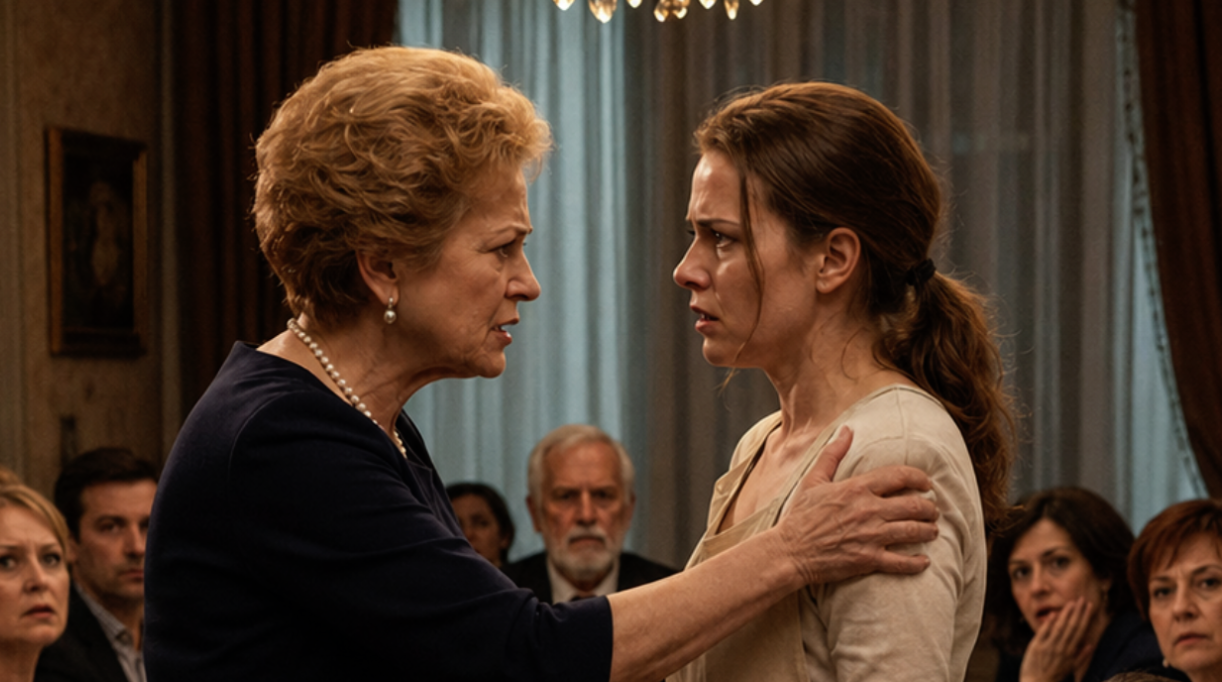
Tamara Vitalyevna caught me by the elbow right in the doorway. Her fingers dug into my skin with surprising strength. She leaned toward my ear, breathing the smell of hairspray and strong wine over me.
“Eat in the kitchen. I’m not letting you sit at the table with the guests!” she hissed, smiling at Nikolai Petrovich as he passed by. “There are places only for decent people there. And you, in that apron, pale as a toadstool, with greasy hair—you’ll ruin the whole picture for me. Sit on the stool by the stove, serve the hot food, then clear the plates.”
I looked at Vadim. He saw it. He definitely saw it, because at that moment he sharply turned away and began pouring cognac for Nikolai Petrovich.
Something clicked inside me. Quietly, like a switch in an empty room.
I placed the baking tray on the cabinet in the hallway. Slowly, I untied the strings of the gray apron. I hung it on the nail.
“Nadya, where are you going?” my mother-in-law frowned when she saw me reach for my jacket on the hanger. “Have you lost your mind? The guests are sitting down! Who is going to serve the hot dishes?”
The guests in the room fell silent. Lyubov Semyonovna peeked out from behind the doorframe, looking at us fearfully.
“I’m leaving,” I said. My voice sounded surprisingly even. As if I were dictating a quarterly report.
“Leaving where?” Tamara Vitalyevna took a step forward, blocking the way with her body. Three emotions crossed her face: first confidence, then a condescending smirk, and now approaching shock. “Vadik, tell her! She’s going to ruin my celebration!”
Vadim rose from his chair and grimaced with irritation.
“Nadya, stop acting foolish. Mom got carried away, and there really isn’t enough room. Why are you making a scene in front of people? Go back to the kitchen.”
I zipped up my jacket. Took my bag from the cabinet. Reached for the wall shelf and silently took the porcelain strainer with the cracked handle. I shoved it deep into my pocket.
“Nadya!” my mother-in-law grabbed my sleeve. Her face suddenly became pitiful, aged. “I wanted to shine in front of the girls from the department, Nadya! All their lives they thought I was a queen, that I had an exemplary family, a meek daughter-in-law. Where was I supposed to seat you looking like that? Stay, please. Is it so hard for you?”
I removed her hand from my sleeve.
“Yes,” I said. “It is hard for me.”
I turned the key in the lock, opened the heavy wooden door, and stepped out onto the stairwell landing. Vadim was shouting something behind me, but I had already pressed the elevator button.
The entryway of my own apartment smelled of silence. My daughter Masha was sitting in her room, soft light spilling from under the door.
I took off my shoes. Pulled the porcelain strainer from my jacket pocket and placed it on the clean kitchen table.
The phone on the cabinet was exploding with calls. Vadim was calling for the seventh time in a row. Then messages came from my mother-in-law: “You’re selfish,” “You destroyed the family,” “Return the money for the fish.”
I blocked both numbers. Right in the app.
Three days later, someone began pounding furiously on my apartment door. I went to the doorframe and looked through the peephole. Tamara Vitalyevna was standing on the landing. Without her teased hair, in an old little raincoat, with tear-filled eyes. Behind her loomed gloomy Vadim. The bank had blocked the card after my report of the mistaken transfer of fifty thousand, and now they had been left without a kopeck before the next payment on the microloan.
My mother-in-law pressed her forehead to the wooden paneling of the door.
“Nadenka, open up…” came her voice from the corridor. “Vadik is a fool, he didn’t mean it. Open the door, let’s talk like family. We have nothing to live on…”
I stepped away from the door. The lock was turned twice from the inside.
On the table lay the small porcelain strainer. It had only one crack, but I was no longer going to fix it.
What do you think: can a family be restored after close people have shown their true attitude, or should such a “no” be final?