Lena had never liked family dinners at her mother-in-law’s.
Not because the food was bad. The food was actually good: salads were served in huge bowls, meat came out on baking trays, pies were stacked in piles, as if the people gathering in the house were not relatives, but a small military unit returning from a winter campaign.
And not because it was boring. It was never boring there. Someone was always lecturing someone else, comparing them, bringing up old grievances, asking when they would have children, why there had been no renovation, why they had bought that kind of jacket, and why a woman after forty had “let herself go so badly.”
Lena disliked those dinners because at every table like that, she felt not like a person, but like an exhibit. Here sits Andrey’s wife. Here she is smiling wrong. Here she is eating too little. Here she is eating too much. Here she is silent, so she must be proud. Here she answered back, so she must be insolent.
Her mother-in-law, Valentina Petrovna, knew how to look at a person in such a way that even the tea in the cup cooled from guilt.
“Lenochka, try the salad,” she would say in a gentle voice that made you want to apologize immediately for everything in the world. “I made it without mayonnaise especially. You can’t have fatty foods, after all.”
“Why can’t I?” Lena once asked.
“Well, what do you mean why…” Her mother-in-law looked at her with soft pity. “Age, after all. You need to take care of yourself.”
Lena was thirty-eight at the time.
Andrey usually did not react to such conversations. He sat beside her, ate, laughed with his brother, poured himself more, told stories about work. And when Lena later said at home that it was unpleasant for her, he waved it off.
“Oh, come on. Mom is just like that. Don’t pick at every word.”
“Mom is just like that” was the universal excuse in their marriage.
Mom is just like that, so she can come over without calling.
Mom is just like that, so she can open the wardrobe and say Lena has “strange underwear for a married woman.”
Mom is just like that, so she can tell guests that her son “dreamed of a different fate all his life.”
And Lena, according to her husband, was supposed to be wiser.
Wiser meant staying silent.
Smiling.
Not ruining the atmosphere.
Not airing dirty laundry in public, even if that dirty laundry had long been lying in the middle of the room and everyone was stepping over it.
That day was Valentina Petrovna’s anniversary. Sixty-five. A serious family date, with the obligatory photo by the laid table and toasts about “a mother who lived her whole life for her children.”
Lena had ironed Andrey’s shirt that morning. A white one with thin blue stripes. He stood in the bathroom in front of the mirror, shaving and humming under his breath.
Too pleased with himself.
He had often been like that in recent months. Pleased for no reason. He kept his phone screen-down. Took it with him into the shower. Answered calls in the hallway. Spent less and less time at home and more and more at work.
Before, Lena would have asked. Then asked again. Then started a conversation in the kitchen, where she would speak quietly and seriously while he got irritated, tapped his spoon against the table, and snapped:
“Are you starting again?”
But now she no longer asked.
She knew.
Not everything. But enough.
The first suspicions had appeared by accident. Not because of lipstick on a collar, like in a cheap TV show. Andrey was more careful than that. And not because of messages full of little hearts. He was not that stupid.
It all began with a bank notification.
Lena received a message about a charge on a card she almost never used. The amount was small, but strange. Some flower salon in the city center.
At first she thought: maybe it was a surprise. Maybe Andrey had decided to remember that his wife also had days when she wanted not only to pay the utilities, but to receive a bouquet.
There was no surprise.
A week later, there was another charge. A restaurant.
Then a taxi.
Then a hotel for one night.
Lena did not make a scene. She simply sat down at the laptop that evening and, for the first time in many years, looked at their shared life not through the eyes of a wife, but through the eyes of someone checking documents.
And she saw many interesting things.
A loan Andrey had not told her about.
An attempt to transfer part of the money from the savings account.
A messenger conversation left open on the home tablet, where a certain Karina had written: “You promised that after your mother’s anniversary you would settle everything.”
After your mother’s anniversary.
Lena stared at that phrase for a long time.
She did not cry. She did not scream. She did not run around the room wringing her hands.
She simply understood: the performance had already been scheduled. They had only forgotten to give her a role.
But that was all right. She chose her role herself.
They arrived at the anniversary celebration at three.
Her mother-in-law’s apartment already smelled of roasted meat, perfume, and other people’s expectations. Fur coats, overcoats, and jackets hung in the hallway. Laughter came from the room.
“And here they are!” Andrey’s sister, Oksana, cried out. “Finally! We were already thinking Lena would be late again, as usual.”
Lena looked at her watch. They had arrived ten minutes early.
“Happy birthday, Valentina Petrovna,” she said, handing over the bouquet.
Her mother-in-law accepted the flowers as if she had been handed not roses, but a court summons.
“Thank you, Lenochka. They’re beautiful. Only the smell is strong. Flowers like these give me a headache.”
“Mom, don’t start,” Andrey said with a smirk, kissing his mother on the cheek.
But he said it lightly, without any real irritation. Just for appearances. So Lena would not think he had completely failed to defend her.
Though she had stopped thinking anything like that long ago.
The table was crowded. Many relatives had gathered: Valentina Petrovna’s brother and his wife, Oksana and her husband, second cousins, neighbor Aunt Galya, who for some reason attended every family celebration, though no one could remember how exactly she was related to the family.
Lena was seated next to Andrey, but somehow slightly off to the side. Close enough to be with her husband, but not in the center.
The center belonged to Valentina Petrovna, in a burgundy dress, with a high hairstyle and the expression of a woman who had given birth to herself, raised herself, and therefore had the right to be respected.
The toasts began quickly.
They spoke about health, wisdom, feminine strength, and how Valentina Petrovna had “always held the family together.” Andrey spoke beautifully. He could, when he wanted to.
“Mom, you are the most important person in our family,” he said, raising his glass. “If it weren’t for you, we would all have scattered in different directions long ago.”
“That’s true,” Oksana added. “Some people especially.”
And she looked at Lena.
Lena calmly sipped her water.
She was not drinking today. She needed a clear head.
Andrey was drinking. Not too much, but enough for his eyes to grow shiny and his voice to become louder. He laughed, slapped relatives on the shoulder, told everyone about a new project at work, how valued he was there, how everything would “come to a halt” without him.
No one asked about Lena.
Although she worked too. Worked well. More than ten years in the accounting department of a construction company. Not romantic, of course. Not heroic. But it was her salary that had once pulled them out of debt when Andrey decided to open a small business that ended with the large phrase “it didn’t work out.”
She had paid the mortgage in the first years.
She had cared for his father after surgery while her mother-in-law “could not bear hospitals.”
But at Valentina Petrovna’s family table, none of that counted.
The only thing that counted was that Andrey was the son.
And Lena was the woman lucky enough to have married him.
Closer to evening, when the pies had already appeared on the table, Andrey suddenly stood up. Lena felt it before she understood it.
Like in a room before a storm: the sun is still shining, the birds are still singing, but the air has already become heavy.
Andrey tapped his fork against his glass.
“My dear family, may I have a minute of your attention?”
Everyone fell silent.
Valentina Petrovna straightened her shoulders. She probably thought her son was about to say the most important toast. About his mother. About family. About gratitude.
Lena set her glass down on the table.
Andrey smiled.
Not at her. At everyone.
“Today is an important day for us. Mom’s milestone birthday. Almost the whole family has gathered. And I thought…” He paused, enjoying the attention. “Some things are better said honestly. In front of everyone.”
Lena heard Oksana quietly snort.
Andrey turned to his wife. In his eyes there was no pain. No regret. Not even guilt.
There was pleasure.
He wanted this moment.
He wanted her to sit there under the eyes of his relatives, small, confused, abandoned. He wanted everyone to see: he was the one deciding. He was the one leaving. He was the winner.
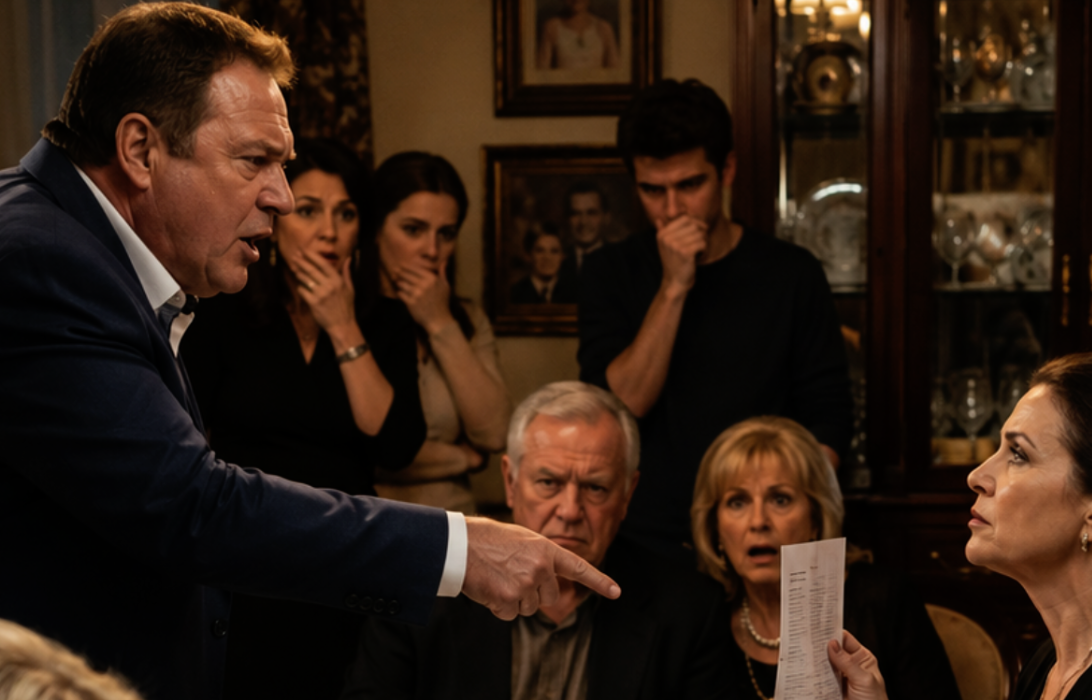
“Lena,” he said loudly. “I won’t pretend anymore. I’m filing for divorce.”
The room became so quiet that somewhere in the radiator, a pipe clicked.
Aunt Galya’s mouth fell open.
Oksana covered her lips with her hand, but her eyes were shining.
Valentina Petrovna froze with a fork in her hand. Only the corner of her mouth twitched, almost imperceptibly.
But Lena noticed.
Andrey continued:
“I’m tired. Tired of living without warmth, without respect, without femininity in the home. Tired of carrying everything on my shoulders. I’m a man, after all. And I have the right to a normal life.”
At that, Lena nearly smiled.
“Carrying everything on my shoulders.”
He had really said that.
The man who, three months earlier, had asked her for money to repair his car. The man who did not know where the utility bills were kept in their apartment. The man who once put dumplings on to boil and went off to watch football because “they’ll manage somehow.”
“Son…” Valentina Petrovna said softly, but she did not stop him.
Of course she did not.
Andrey lifted his hand.
“Mom, I’ve made up my mind. I just wanted to say it honestly, so there wouldn’t be talk afterward. Lena is an adult. She’ll manage.”
He looked at his wife.
He waited.
For tears. A scream. A trembling voice. Maybe the phrase: “How could you?”
Lena slowly wiped her fingers with a napkin.
“Are you finished?” she asked.
Andrey blinked.
“What?”
“I’m asking if you’ve finished your performance.”
Someone at the table coughed.
Her mother-in-law frowned.
“Lena, don’t be rude. Andrey is saying serious things.”
“I also intend to say serious things, Valentina Petrovna,” Lena replied calmly. “That is why I’m clarifying whether I may begin now, or whether Andrey still has more text.”
Oksana quickly lowered her eyes to her plate.
Andrey flushed.
“Don’t make a circus out of this.”
“You started the circus. I just brought the tickets.”
Lena leaned down, took a thick blue folder from her bag, and placed it on the table next to the herring under a fur coat.
The folder looked alien among the plates, shot glasses, and napkins with gold trim. Too businesslike. Too calm.
Andrey looked at it.
And for the first time that evening, the smile disappeared from his face.
“What is that?”
“Documents.”
“What documents?”
“Various ones. For a family discussion. You wanted it in front of everyone.”
The room became even quieter.
Lena opened the folder.
First she took out printed bank statements.
“Let’s start with something simple. Here are the expenses from our joint card for the last four months. Flowers. Restaurants. A hotel. Taxis. A jewelry store.”
Oksana raised her eyebrows.
“Maybe he was buying gifts for you?”
“For me?” Lena looked at her. “No. In the last four months, Andrey bought me one yogurt. And even that was for himself; I just ate it.”
Someone gave a nervous little snort, then immediately fell silent.
Andrey stepped toward the table.
“You were digging through my things?”
“Through our bank statements,” Lena corrected him. “The card is joint. Part of the money is mine. So the phrase ‘digging through’ does not apply here.”
“That’s low.”
“Low is paying for a hotel from the family account, Andrey. Printing out a receipt is accounting.”
Lena took out the next sheet.
“Next. A loan. For three hundred and eighty thousand. Taken out by you two months ago. You did not tell me about it. But you told the bank that part of the family income was stable. Apparently, you meant my salary.”
Valentina Petrovna set her fork down on the plate.
“Andryusha?”
“Mom, I’ll explain later.”
“No,” Lena said. “Now. You chose the ‘in front of everyone’ format.”
Andrey clenched his jaw.
“That is my personal business.”
“When you try to cover your personal business with my money, it stops being personal.”
Aunt Galya whispered quietly to the woman beside her:
“What an anniversary…”
Lena heard her, but did not react.
She took out another sheet.
“And here is the application to the bank restricting access to the savings account. I filed it yesterday. So, Andrey, the transfer you were planning to make on Monday will not go through.”
He turned pale.
Now truly pale.
Not from hurt. Not from shame.
From fear.
“You had no right.”
“I did. The account is in my name. You were an authorized user. Were.”
That word hung over the table like a lid.
Were.
Valentina Petrovna no longer looked at her son so proudly.
“Andrey, what is going on?”
He turned sharply toward his mother.
“Nothing! She’s twisting everything! We’re getting divorced, so now she’s taking revenge!”
“I’m not taking revenge,” Lena said. “I’m summing things up.”
She pulled out the final document.
A copy of the property ownership certificate.
And Andrey recognized it immediately.
He did not even manage to hide it.
Lena noticed his fingers tremble.
“Now, the most important thing. The apartment.”
Oksana perked up.
“Well, the apartment is joint property. You lived in marriage.”
“We lived in marriage,” Lena nodded. “But the apartment was bought before the marriage. With money from the sale of my father’s house. Here is the contract. Here is the date. Here is the registry extract.”
She turned the page so everyone could see.
“Andrey has been telling certain people in recent months that after the divorce, I will ‘go to my mother,’ and he will stay in the apartment. So, no. I am not going anywhere.”
Andrey stood beside his chair, his face turning grayer and grayer.
“Lena, let’s talk at home.”
Lena looked at him carefully.
“At home? Five minutes ago, you announced our divorce at your mother’s anniversary celebration. In front of the neighbor, the nephews, and the salad. What home, Andrey?”
Someone at the table coughed again. This time not from awkwardness, but to hide a laugh.
Her mother-in-law turned sharply toward Lena.
“You arranged all of this on purpose? On my birthday?”
Lena slowly closed the folder.
“No, Valentina Petrovna. Your son arranged all of this on your birthday. I simply came prepared.”
“You could have done it decently!”
“I could have,” Lena agreed. “That is exactly what I intended to do. Calmly. At home. Without an audience. Without humiliation. But Andrey decided he needed an audience. I did not argue.”
Andrey suddenly sat down.
As if his legs could no longer hold him.
A minute earlier, he had been the master of the situation. A man who “had the right to a normal life.” A son whose mother understood him. The hero of his own toast.
Now he sat among plates, empty glasses, and other people’s eyes, looking not like a hero, but like a schoolboy whose diary full of bad marks had been found.
Oksana was the first to break the silence.
“And who is Karina?”
Andrey snapped his head up.
“That’s none of your business.”
“It is now ours,” his mother-in-law said coldly.
And at that, Lena almost laughed.
Not from joy. From the absurdity of it.
Valentina Petrovna, who for many years had explained to her that a wife should endure, suddenly remembered family dignity. Simply because the shame now fell not on the daughter-in-law, but on the son.
“Karina,” Lena answered for him, “is the woman Andrey promised to ‘settle everything after his mother’s anniversary.’ I have the messages. But I’m not going to read them. Even I feel embarrassed.”
Aunt Galya leaned closer.
“Too bad.”
The brother’s wife shushed her.
Andrey slammed his palm on the table.
“Enough!”
The pies jumped on the platter.
“You think you won?” he hissed. “You think you made me look like a fool, and that’s it?”
Lena looked at him without fear.
Before, she had been afraid of his outbursts. Not because he hit her. No. Andrey had never hit her. He was one of those men who consider themselves intelligent because they do not raise a hand. They simply raise their voice, slam doors, humiliate with words, disappear for a day, and then say, “You brought it on yourself.”
Lena had been afraid of that coldness after arguments. Afraid of the silence. Afraid of the feeling that she was guilty again.
But now she was not afraid.
A strange thing: when a person lives in fear for a long time, it seems that fear is endless. And then one day, something inside burns out. Not loudly. Not beautifully. Just click, and that is it.
Empty.
And in that emptiness, sometimes you can hear your own voice very clearly.
“No, Andrey,” she said. “I don’t think I won. No one has won here at all. You simply wanted to hurt me in front of everyone. But instead, you showed everyone who you really are.”
He turned away.
Her mother-in-law sat pale. Her anniversary was falling apart before her eyes. Not because Lena had ruined the celebration. But because the celebration had been built on a very fragile legend: a good son, a bad wife, a wise mother, a strong family.
Legends do not survive documents very well.
“Lena,” Oksana’s husband, who had been silent all evening, suddenly said quietly. “Should I drive you?”
Andrey shot him a sharp look.
“Why are you getting involved?”
“Because a woman was just almost smeared across this table,” he answered calmly.
Oksana nudged him with her elbow, but said nothing.
Lena stood up.
“Thank you, but no. I’ll take a taxi.”
She took her coat from the back of the chair.
Valentina Petrovna also stood.
“Wait. You can’t just leave like this. You need to talk. You’re family, after all.”
Lena turned to her.
“Valentina Petrovna, family is when people do not finish someone off in front of witnesses. When they do not wait for someone to cry for everyone’s entertainment. When they do not pretend nothing is happening just so the son can look good.”
Her mother-in-law opened her mouth, but said nothing.
“For many years, I tried to be convenient,” Lena continued. “Not to argue. Not to take offense. Not to notice. All of you became very used to that version of me. I understand. She was convenient. You could mock her, teach her, correct her, make her guilty. But that version is over.”
Andrey rose after her.
“Lena, stop. Let’s not turn this into theater. I lost my temper.”
She looked at him almost with curiosity.
“You announced a divorce in front of the whole family.”
“I was emotional.”
“You planned this in advance. Karina knew. Your mother, it seems, suspected. Oksana was waiting for the show. What emotions, Andrey?”
He was silent.
“I am not against the divorce,” Lena said. “On the contrary. I agree. Only the terms will not be the ones you invented for yourself.”
“What terms?”
“Very simple ones. Today you pack your things and leave. Not for a week. Not ‘until we think things through.’ For good. Everything concerning the loan, the lawyer, and the division of the remaining obligations will be handled officially. Not through your mother. Not through shouting. Not through ‘we’re adults, aren’t we?’ Through documents.”
The word “lawyer” affected Andrey worse than all the previous papers.
“Why are you doing this?”
And that was almost funny.
Why are you doing this?
Not “forgive me.”
Not “I’m guilty.”
Not “I hurt you.”
But: why are you defending yourself?
Lena suddenly remembered how many years ago they had chosen curtains for their first apartment. Andrey had been different then. Or maybe it had seemed to her that he was different. He laughed in the store, held fabric samples up to himself, said beige was not a color but a surrender. They bought green curtains, terrible, cheap ones, which later faded in the sun. But Lena loved them. Because in that life, they had been a team.
Where had that Andrey gone?
Maybe nowhere.
Maybe she had simply loved for too long a person she had invented out of his best moments.
And a person is not made only of his best moments.
“I am doing this because you don’t understand any other way,” she said quietly.
He took a step closer.
“Lena, where am I supposed to go right now?”
And at that, the table became completely awkward.
Because the question sounded pathetic.
The man who, ten minutes earlier, had publicly given his wife divorce as punishment was now asking where he was supposed to go.
“To Karina, I suppose,” Aunt Galya suggested.
This time, no one even shushed her.
Andrey flushed.
“That’s not funny.”
“I wasn’t joking,” the neighbor said.
Lena picked up her bag.
“You can stay with your mother. It is a family celebration today, after all.”
Her mother-in-law sharply lifted her head.
“With me? But I have repairs in the small room. And the sofa is old…”
Lena looked at Andrey.
He heard it.
Everyone heard it.
Even the mother who had spent her whole life saying her son was her support did not want to take him in with his suitcases and debts.
There it was, family love, once the toasts were over.
Lena went into the hallway.
Behind her, everyone began talking at once.
Oksana asked her brother how he could be such an idiot. Valentina Petrovna demanded explanations. Aunt Galya wondered whether there was still cake left, because “since the scandal already happened, the sweets should be eaten.”
Andrey caught up with Lena at the door.
“Wait,” he said, now without his former confidence. “Are you really going to throw me out?”
She put on her coat.
“No, Andrey. I am simply no longer going to hold on to you.”
“That’s the same thing.”
“No. People are thrown out of what belongs to someone else. I am taking back what is mine.”
He lowered his eyes.
“I didn’t think you would react like this.”
“Of course. You thought I would cry.”
He was silent.
“And I did cry,” Lena said. “Only earlier. When you didn’t come home at night and said you were tired. When your mother called me cold. When you took my money and pretended it was normal. When I tried to understand what was wrong with me. I have already cried all my tears, Andrey. You just didn’t notice.”
He reached out as if he wanted to touch her sleeve, but did not dare.
“Lena…”
“Leave the keys on the hall table when you come for your things.”
“Maybe we can talk tomorrow?”
“Tomorrow I’ll be changing the lock.”
He looked at her in fear.
“Are you serious?”
“For the first time in a long while, yes.”
Lena opened the door.
The stairwell was cool and quiet. From a neighboring apartment came the smell of fried potatoes. Somewhere below, the entrance door slammed.
The most ordinary life.
Without toasts.
Without an audience.
Without someone else’s relatives waiting for your fall.
She stepped out, pressed the elevator button, and suddenly felt her hands trembling.
Not from doubt.
Because the tension was letting go.
In the elevator, she leaned against the wall and closed her eyes.
There were no tears. Only exhaustion. Great, years-long exhaustion, like a heavy bag you carry from the market while telling yourself, “It’s not far to home. Endure it.”
And then you reach home, set it down on the floor, and do not immediately understand why your hands still hurt.
The taxi arrived quickly.
The driver asked:
“Home?”
Lena looked out the window at the evening courtyard, at the glowing windows, at people hurrying somewhere with their bags, children, dogs, conversations.
“Yes,” she said. “Home.”
And for the first time in many years, that word had nothing to do with Andrey.
At home, it was quiet.
Lena took off her coat, put her bag on a chair, and went into the kitchen. On the table stood the cup Andrey had left after his morning coffee. Before, she would have washed it automatically. Now she simply looked at it and left it as it was.
Let it stand.
Not everything in life has to be cleaned up after others immediately.
She turned on the kettle, took out her phone, and wrote a short message to the lawyer she had already consulted:
“He announced the divorce. We begin.”
Then she opened the window.
Cold evening air entered the apartment.
The phone rang.
Andrey.
Lena looked at the screen and did not answer.
A minute later, a message came:
“You destroyed my family.”
She read it.
And suddenly laughed quietly.
Not cruelly. Not hysterically. Just wearily.
Then she typed back:
“No, Andrey. I stopped being its decoration.”
And turned off the sound.
Two hours later, he came for his things.
Not alone. With Valentina Petrovna.
Lena opened the door, already changed into a house sweater. Her face was calm.
Her mother-in-law held herself straight, but her eyes darted around.
“We’ve come for Andrey’s things,” she said in an official voice.
“Come in.”
Andrey entered without looking at Lena. He went into the bedroom, took out a suitcase, and began packing shirts, jeans, chargers, various boxes.
His mother stayed in the hallway.
“Lena,” she said after a long silence. “Everything could have been resolved differently.”
“It could have.”
“Men make mistakes.”
“Women do too. My mistake was that I called this a marriage for too long.”
Valentina Petrovna pressed her lips together.
“You have become cruel.”
Lena looked at her.
“No. It’s just that before, everyone received my softness except me.”
Her mother-in-law turned away.
Andrey’s voice came from the bedroom:
“Where is my blue folder with the car documents?”
“In the bottom drawer of the dresser,” Lena replied.
He was silent for a moment.
“Thank you.”
That “thank you” sounded so unusual that Lena was almost surprised.
When the suitcase was packed, Andrey lingered at the door.
“I’ll come later for the rest.”
“Message me in advance.”
“Lena…” He looked at her as if he still hoped to find the old version. The one who would start pitying him, explaining, saving. “I really didn’t think it would all turn out like this.”
“You should have thought before the toast.”
He nodded. Slowly, as if every word reached him late.
Valentina Petrovna went out first. Andrey took the suitcase and stepped after her.
At the threshold, he turned around.
“Did you ever love me?”
The question was unfair. Late. Almost insolent.
Lena could have answered sharply. She could have struck him with words. She could have said it had all been in vain.
But she was tired of striking.
“I did,” she said. “That is why I endured longer than I should have.”
He lowered his head and left.
The door closed.
And the silence that remained after him seemed enormous at first.
Lena stood in the hallway and listened to that silence.
There was no joy in it. No triumphant music. No feeling that life had instantly become beautiful.
No.
It hurt.
It was bitter.
It was frightening.
But along with that, there was another feeling — faint, almost imperceptible, like the first light under a door in the morning.
Freedom.
The next day, she really did change the lock.
The locksmith, an elderly man in a knitted hat, worked in silence and only asked:
“Lost your keys?”
Lena looked at the old lock being removed from the door.
“You could say that.”
He nodded, as if he understood more than she had said.
After he left, Lena washed Andrey’s cup. Not because she forgave him. Simply because it was her kitchen, her sink, her morning.
Then she sat by the window with coffee and, for the first time in a long while, did not check her phone every five minutes.
Messages kept coming.
From Andrey: “We need to talk.”
From Oksana: “I didn’t know about the loan.”
From Valentina Petrovna: “Lena, you must understand that divorce is serious.”
Lena did not answer anyone right away.
She watched as a woman in a red jacket led a child by the hand through the yard, as the janitor lazily raked leaves, as the neighbor’s cat cautiously walked along the fence, as if it too knew: the main thing in life is not to step where it has already hurt before.
By evening, one more message arrived.
From Aunt Galya.
“Lenochka, you did well. And the cake was dry.”
Lena laughed for real for the first time in twenty-four hours.
Then she took out that same blue folder and carefully put the documents away in a drawer.
Not as a weapon.
As confirmation.
Sometimes, to reclaim your life, you do not need to shout louder than everyone else.
Sometimes it is enough to rise from the table where they intended to humiliate you, lay the truth before everyone, and leave.
Let them eat their salad by themselves.