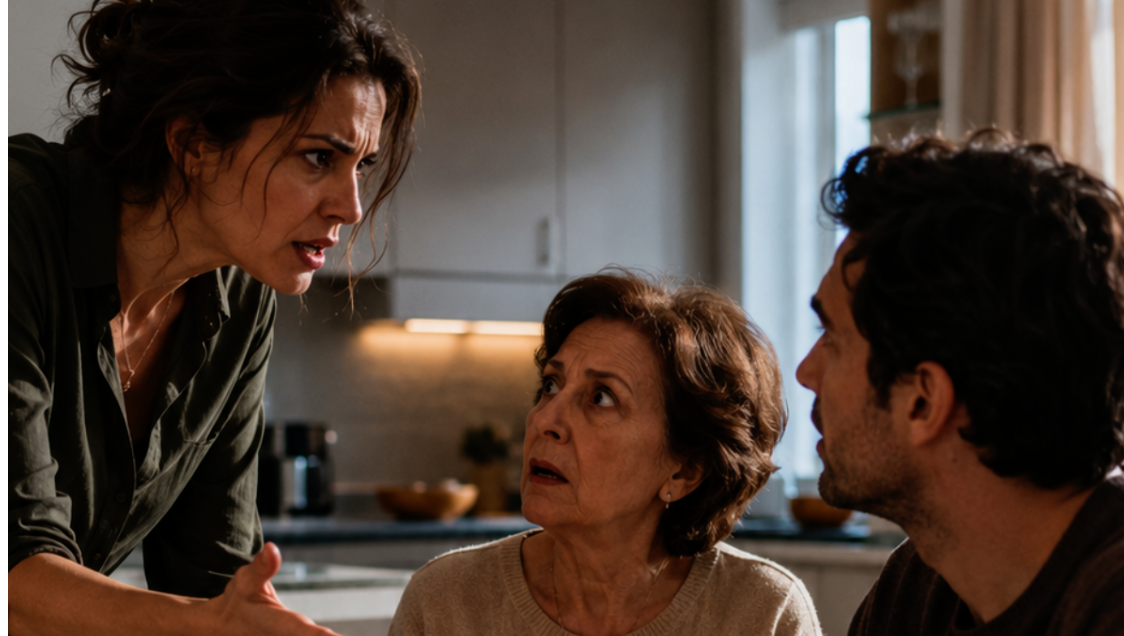
She stood in the middle of the living room and looked at them — at the three people she had considered her family. Artur was sitting in an armchair with one leg crossed over the other, wearing the expression of a man who had been unfairly accused of something insignificant. His mother, Tamara Vikentyevna, had pursed her lips and was demonstratively studying the painting on the wall — a landscape with birch trees, which she herself had hung there long before Vika had appeared in this house. Nastya, Artur’s twenty-year-old sister, was turning her phone over in her hands and occasionally rolling her eyes.
Three people she had been giving money to. Three people she had trusted.
Vika felt her throat tighten, but she pulled herself together. She had already cried enough — three hours earlier, in the car, right in the parking lot of the shopping center, while Lena’s voice was still ringing in her ears. The calm, slightly mocking voice of Artur’s ex-wife.
“From this day on, I won’t give a single kopeck for your whims,” Vika said, and her voice did not tremble. “Not to anyone. That’s it.”
The silence lasted about three seconds. Then everyone started talking at once.
Three months earlier, everything had looked different.
Vika had moved into this apartment with two suitcases and an endless belief that the second time was not a repetition of a mistake, but a correction of it. Her first husband had been a cold man who knew how to remain beautifully silent and skillfully avoid conversations. Artur was different — loud, lively, cheerful. He knew how to make fried eggs with tomatoes, knew poems by heart that he recited to her at night, and never fell asleep without kissing her temple.
The fact that he was unemployed for the time being seemed like a minor detail. A temporary difficulty. He had left his previous job himself — a conflict with management, a murky story, but Vika did not dig into it. He would find a new one, Artur said; the market was big, his specialty was in demand. She nodded and believed him.
Her own job was going well — she managed a small department at an advertising agency, earned decent money, knew how to organize processes and keep people on their toes. Her colleagues respected her. Clients came back. There was money — not huge amounts, but stable and enough.
“Until we get a mortgage, we’ll live with my family,” Artur had said before the wedding. “For a year, maximum. Mom doesn’t mind, and neither does Nastya.”
Vika agreed. She knew how to adapt. She knew how to negotiate. She knew how to be flexible.
The first weeks went normally. Tamara Vikentyevna cooked borscht and baked pies, Nastya talked about her classmates from college, and in the evenings Artur sat with Vika in the kitchen and made plans. Life seemed full.
Then the small requests began.
Nastya was the first to ask. Simply, without any preface — she came into the room where Vika was working on her laptop and said:
“Vik, I have a small problem. I saw a pair of sneakers I really like, but my scholarship won’t come for another two weeks. Can you lend me some money? I’ll pay you back.”
Vika looked up from the screen. A young girl, a student, wanted sneakers. What was the big deal?
“Of course,” she said. “No problem.”
Nastya beamed. The sneakers appeared the next day — white, fashionable, and clearly expensive. Vika briefly thought that the amount had been quite large for a student, but pushed the thought away.
A week later, Nastya came in again. This time, she needed money for some skincare products, an eyeshadow palette, and a trip with her friends. Vika gave her money again. Then there was another time, and another. “I’ll pay you back” gradually disappeared from Nastya’s vocabulary — not demonstratively, it simply dissolved on its own. Vika did not remind her. It felt awkward.
Tamara Vikentyevna approached things differently — through complaints about her health. She was a master of that genre: sighing, rubbing her lower back, talking about her blood pressure, her heart, about “something wrong with my legs, the doctor said I need an examination.” In her stories, doctors constantly recommended sanatoriums — sometimes in the south, sometimes at mineral springs, sometimes simply “a change of climate, otherwise there’s no way.”
“The doctor says I need to go to the mineral springs,” she announced one evening at dinner, serving herself potatoes. “He knows best, of course. But the vouchers are expensive now.”
Vika looked at Artur. Artur looked down at his plate.
“I can help,” Vika said.
Tamara Vikentyevna’s face brightened so instantly that it was almost indecent.
Then there was another sanatorium. Then some procedures that were not covered by insurance. Then a new robe and slippers “especially for the sanatorium, because you need something comfortable there.” Vika gave money and convinced herself that it was normal — helping an elderly person, especially her mother-in-law. That was what family meant.
Meanwhile, Artur went to job interviews. At least, he said he did. He left in the morning and returned by lunchtime. Sometimes he went to see his daughter from his first marriage — Masha, six years old, who lived with Lena. Vika understood that this was important to him, did not feel jealous, and did not object. The child was not to blame for the fact that her parents had separated.
Only gradually, the trips to see Masha became longer. And more expensive. One day Artur said casually:
“I bought Masha a tablet. She’d wanted one for a long time. It has games and good educational programs.”
Vika looked at him.
“Where did the money come from?”
“Well, you gave me money for groceries. There was a little left over, and I added some from my stash.”
His stash. Vika did not ask where a man with no income had a stash.
That day, she went to the shopping center to buy a gift for a colleague — the woman was going on maternity leave, and Vika needed something warm and cozy. Vika wandered between the shelves, looking at pajamas and candles, thinking about her own things.
She recognized Lena immediately — she had barely changed, only her hairstyle had become shorter. She was standing by a display case with children’s toys, looking at construction sets.
They had met several times — at children’s parties, when Masha was being handed over. Always politely, always briefly. Vika did not know how to feel about her husband’s ex-wife: she was not jealous, but she did not feel any special warmth either.
“Hi,” Vika said, because simply walking past would have been strange.
Lena turned around. She looked at her for a second — appraisingly, but without hostility.
“Oh, Vika. Hi. Buying a gift?”
“Mm-hmm. And you?”
“I’m thinking about what to buy for Masha. Artur recently brought her a tablet — an expensive, good one. I was surprised, to be honest. He’s unemployed, isn’t he? So now I’m wondering — maybe he found a job?”
Vika felt a slight stab beneath her ribs.
“No. Not yet.”
Lena was silent for a moment. Then she said quietly:
“Shall we have coffee? There’s a decent place on the third floor.”
They sat at a table by the window. Ordered cappuccinos. Lena looked into her cup, then raised her eyes.
“I’m not trying to interfere in someone else’s life. But I think you should know something. About how this works.”
“What do you mean — this?”
“Artur and I lived in my apartment. Back then I earned good money — I had my own small interior design firm. Artur also said he was looking for work. And, in general, he did find work. But somehow it always turned out that his salary was small, or the contract ended, or something didn’t work out. And I paid. For everything. For the two of us, for his mother, who always needed something, for Nastya, who had just started college back then.”
Vika put her cup down on the table.
“I thought it was temporary,” Lena continued calmly. “That he would straighten himself out any moment, get back on his feet, and everything would change. Three years passed. Nothing changed. I got tired and separated from him. Then he found a job — literally a month after the divorce. A normal one, with a good salary. He lasted there six months and quit again.” She smiled slightly. “You’re living in their apartment now?”
“Yes.”
“Vika, you are living in their apartment, earning money, and supporting someone else’s family. And on top of that, he’s spending money on Masha — which means he’s taking it from you, because there’s nowhere else for him to get it. I’m not saying he’s a bad person. He’s not evil. He just… knows very well how to make himself comfortable.”
Vika looked at her and heard something in her own head click into place — like a puzzle that had been lying scattered for a long time, and suddenly someone’s hand had taken it and put the picture together.
Nastya’s sneakers. Her mother-in-law’s sanatorium. Masha’s tablet.
“Are you all right?” Lena asked.
“Yes,” Vika lied. “Everything’s fine.”
She walked to the car, got in, closed the door, and burst into tears. Her shoulders shook, and she pressed her hand over her mouth so no one outside would hear.
Three months. She had been living there for only three months. And she had already become a sponsor for an entire family. For a family where the husband did not work, the mother-in-law treated herself at her expense, and the husband’s sister dressed herself with her money and did not consider it necessary to pay anything back.
She wiped her face. Took out her phone, wrote to her friend, “I’ll call you tonight,” then deleted the message without sending it. She took out the car keys.
So that was how it was.
All three of them were home. Artur was watching something on his laptop. Nastya was painting her nails on the sofa. Tamara Vikentyevna was knitting in the armchair — a peaceful picture of a family evening.
Vika put her bag by the door and said:
“I need to talk to all of you.”
Something in her voice made Artur close the laptop. Nastya set aside the nail polish. Tamara Vikentyevna stopped knitting.
“I learned something interesting today,” Vika said. “About how things are arranged here. About how this works.” She looked at Artur. “You bought Masha a tablet with my money. You take her to the movies — also with my money. At the same time, you haven’t been working for several months and, judging by everything, you aren’t exactly in a hurry.”
“Wait,” Artur began.
“No,” Vika said. “I’ll speak. Then you can speak.” She turned to her mother-in-law. “You went to a sanatorium. Twice. I don’t consider that wasteful — health is important. But I would like to know: did you really go there on a doctor’s recommendation, or was it simply convenient that someone had appeared who gives money?”
Tamara Vikentyevna opened her mouth.
“That is insulting,” she said. “I have never in my life…”
“Nastya,” Vika continued, “you borrowed from me several times. You said you would pay me back. You didn’t. I don’t hold a grudge — but it needed to be said out loud.”
Nastya flushed.
“Well, sorry, I forgot! I’m a student, I don’t have money, and you earn well. What’s the problem?”
“The problem is that it’s my money,” Vika said quietly. “Money I earn. Money no one simply gives me for free.”
She looked at all three of them.
“From this day on, I won’t give a single kopeck for your whims. Not for sanatoriums, not for sneakers, not for tablets. I will pay for groceries — half with you. Utilities — half. That’s fair. But I am not a sponsor and I am not a mutual-aid cash desk.” Her voice was even, almost cold. “Artur. You have one month. One month to find a job and change the situation. Not talk about the market and interviews, but a real result. If nothing changes in a month, I will make a decision.”
Silence.
Then everything exploded at once.
Tamara Vikentyevna began speaking loudly and offendedly about how Vika had “come into the house and started acting like the mistress,” about how “we accepted you,” about how she had “never seen such ingratitude.” Nastya shouted something about “greed” and “I only asked for a little.” Artur did not shout — he spoke quietly, saying that Vika had “understood everything wrong,” that he had “almost agreed on one position already,” that it was “not what you think.”
Vika stood and listened. Then she raised her hand.
“I’m tired. I’m going to sleep. I have a workday tomorrow.”
She walked past them into the bedroom, closed the door, and sat for a long time on the edge of the bed, staring at the wall. Voices could still be heard behind the door for a while — indignant, muffled. Then they fell silent.
A month passed.
Artur really did do something — went somewhere, called someone, sometimes left in the morning looking businesslike and focused. Vika watched. Waited.
On the twenty-eighth day, he said:
“There’s an option. A small company, an interesting project. But for now it’s still negotiations, not an offer.”
“Negotiations are not a job,” Vika said.
“Vik, you understand this can’t be done in a month. The market isn’t easy, it takes time…”
She listened to him say the words — correct and convincing words. Words that explained why nothing had worked out. Words that promised everything would definitely work out — a little later, very soon, any moment now.
She remembered Lena’s voice. He’s not evil. He just knows very well how to make himself comfortable.
“Artur,” she said. “I want to ask you something, and I want an honest answer.”
He looked at her.
“You left your last job yourself. You worked there for more than a year. Before that, there was another job, and you left that one too. Is this your usual pattern?”
“What do you mean?”
“You know how to work. You are an educated man with a good profession. But you find reasons to leave. And there is always someone nearby who pays. Lena paid. Now I do.”
Artur slowly put down his phone.
“You talked to Lena.”
“Yes.”
“And you believe her.”
“I believe what I see with my own eyes,” Vika said. “She simply helped me see it.”
He was silent for a long time. Then he said:
“That’s unfair. I’m trying.”
“I know you’re trying.” Vika stood up. “But trying isn’t enough. I need results.”
There were no results.
She filed for divorce at the beginning of the following month.
Not with a light heart — that would have been a lie. It hurt. She felt sorry — for him, for herself, and for what could have been. There were tears — ugly ones again. There were nights when she lay awake thinking: what if I’m wrong, what if it really was just a difficult period, what if I should have waited a little longer?
But then she remembered the parking lot of the shopping center, and her own voice — from this day on, I won’t give a single kopeck for your whims — and three pairs of eyes in which there had been no understanding, no gratitude, not even ordinary human embarrassment. Only offense. Only “how dare you” and “we accepted you.”
Accepted her. As if that had been their mercy, and not her money.
She did not want to repeat someone else’s story. Three years was too long. Lena had lost three years. Vika was losing less — and for that she was almost grateful to the woman with whom she had drunk coffee by the window on the third floor of the shopping center, and who had spoken calmly, without anger, simply because she thought it was necessary to say it.
After the divorce, Artur found a job two months later. Vika learned about it by chance — through mutual acquaintances. He found one, got hired, and was working. A normal salary, an interesting project.
She was not surprised.
She rented a small apartment, where only her cups stood in the kitchen and only her coat hung on the rack. Where no one asked for money and no one sighed about sanatoriums. Where she came home in the evening, put the kettle on, and sat in silence — silence that did not press down on her, but soothed her.
Sometimes she thought about the fact that her second marriage had turned out to be shorter than the first, and that perhaps this should have hurt more. But, strangely enough, it did not. Her first marriage had left behind a cold emptiness — the feeling that she had lived for years beside a person and still had never truly known him. This one left something different — sharp, alive, a little angry, but honest.
She had learned something important. About how easy it is to become convenient. About the fact that kindness without boundaries is not a virtue, but an invitation. About the fact that the word “family” does not always mean what it is supposed to mean.
And also about the fact that sometimes the kindest thing you can do is stand in the middle of someone else’s living room and say out loud what should have been said long ago.
She opened her laptop and checked her email — a client had sent revisions for a project, and she needed to sort them out before morning. Rain was falling outside the window, tea was cooling in her cup, and somewhere in a neighboring apartment, someone was quietly playing the guitar.
Life went on. Her life. Only hers.