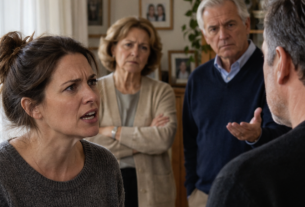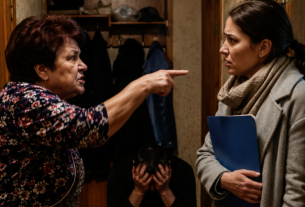
“Your husband works himself to the bone while you lie around and still have the nerve to argue? I’ll throw you out of here myself!” the mother-in-law snapped.
“Hello, Zlata Viktorovna. I’m busy right now… No. No, I’m not ‘just sitting at home.’ I’m working… This is work… I’ll call you back.”
Karina placed her phone face down on the desk and stared at it for several seconds as though it might bite her. The cursor blinked on an unfinished design on her second monitor, a paused track waited in her headphones, and a client was expecting revisions by Tuesday.
Anton’s mother had just called yet again to inform her that her daughter-in-law did nothing all day.
It was not as though her mother-in-law had called to ask her anything. She had called simply to remind her. Casually, almost in passing—and to slip in another cutting remark while she was at it.
Karina worked as a designer. She created brand identities and packaging and sometimes built entire websites from start to finish. She had left office work for freelancing about seven years earlier and had never regretted it. Clients came through recommendations, she always had enough projects, and in a good month she earned one hundred and twenty or one hundred and thirty thousand rubles.
That was more than Anton earned as a shift supervisor at the factory. He made about seventy-five thousand.
But somehow, that did not count.
Anton “worked himself to the bone.” He left at seven in the morning and returned at eight in the evening, tired and dressed in his work uniform—a real working man.
Karina stayed at home. In slippers. In front of a computer.
How could that possibly be considered work?
The apartment belonged to her. It was a two-room apartment in a new building that Karina had purchased with a mortgage before she ever met Anton. She had already paid off almost the entire loan, with only a small amount remaining.
When they married two years ago, Anton moved in with her. It was only logical. She owned an apartment, while he had a room in a factory dormitory. He brought over his belongings, placed his dumbbells in a corner, installed a second shelf in the bathroom, and they began their life together.
They might have lived quite happily if not for Zlata Viktorovna.
Her mother-in-law had developed a habit of visiting. She never called or gave any warning. The doorbell would simply ring in the middle of the day, and there she would be, standing on the doorstep with a bag of pastries and her lips pressed tightly together.
“I came to see my son. I thought I’d stop by and see how the two of you are doing.”
Except her precious son was not home. He was at work.
So instead of visiting Anton, Zlata Viktorovna was really there to inspect her daughter-in-law. She would walk through the apartment, run her finger over a shelf, peer into the kitchen and open the refrigerator.
“Why haven’t you washed the dishes from breakfast yet? Oh, Karina, how can you leave them like this? Anton will come home and find the kitchen in a mess.”
“Zlata Viktorovna, it’s eleven in the morning. I’m working. I’ll wash them by lunchtime.”
“Working,” her mother-in-law would drawl, settling into an armchair and folding her hands over her stomach. “We know what kind of work that is. Drawing little pictures and sitting on the internet. You call that work? My Antosha works. You’re just amusing yourself.”
At first, Karina tolerated it.
She explained everything calmly, over and over again. She had clients, deadlines, contracts and real income—money they both lived on, incidentally.
Zlata Viktorovna barely listened and nodded as though her daughter-in-law were telling her fairy tales. In her view, work meant leaving the house, travelling somewhere and standing at a machine or sitting in an office from eight until five.
Everything else was merely playing around and avoiding real responsibility.
Gradually, Karina’s patience wore thin, and she began answering back. Not rudely, but sharply.
“Little pictures, you say? I was paid seventy thousand rubles last week for one of those ‘little pictures.’ That’s more than Anton earns at the factory in a month. So you might want to be more careful about calling it ‘playing around.’”
At remarks like that, Zlata Viktorovna would purse her lips into a thin line and fall into offended silence.
But not for long.
A week later, the same thing would happen again.
Karina tried speaking to her husband about it. More than once.
“Anton, your mother came over again today. Without calling. She sat here for two hours, telling me I was lazy and that the apartment was dirty.”
Anton would let out a heavy sigh as he removed his shoes in the hallway.
“Karinochka, she doesn’t mean any harm. She’s getting old, and she’s lonely. So she talked for a while. Don’t take it personally.”
“I don’t take it personally. But she comes here when you’re not home and interrogates me in my own apartment. Can you at least ask her to call before coming?”
“It would feel wrong to forbid my own mother from visiting. She’ll be offended. Just be patient, all right? Is it really that difficult? Listen to her, nod a few times, and she’ll leave happy.”
That phrase—“Is it really that difficult?”—especially infuriated Karina.
Yes, it was difficult.
It was difficult to listen every week as someone called her a lazy freeloader in an apartment she had purchased herself and was still paying for—an apartment in which that very person was merely a guest.
But Anton did not see it that way. Or perhaps he did not want to.
To him, his mother was his mother, which meant she automatically had rights. His wife could step aside and endure it. It was not difficult for her, after all.
Once again, Karina swallowed her frustration, nodded and returned to her computer to finish her design. Arguing with Anton was like repeatedly banging her head against the same wall where his ridiculous shelf was hanging.
Realizing that she was not facing any serious resistance, Zlata Viktorovna grew even bolder.
She no longer merely criticized Karina. She began giving orders.
She rearranged the jars of grains in the kitchen because “this way is more convenient, and I know better.” She declared that the living-room curtains looked “tasteless” and ought to be replaced. Once, she even said that Karina should spend less time sitting at the computer and more time cooking borscht.
“Antosha looks so thin. You clearly aren’t feeding him properly.”
Karina listened to all of this with one thought running through her mind: this woman genuinely believed she was on her own territory.
She believed the apartment belonged to her son, and if it belonged to her son, then it also belonged to her. It was her maternal domain.
Zlata Viktorovna seemed to have completely forgotten that the apartment actually belonged to her daughter-in-law.
Or perhaps she only pretended to have forgotten because it made giving orders more convenient.
Everything finally came to a head on Friday.
Karina had endured a hellish week. She had been working on a major project—a complete rebranding for a chain of coffee shops. There had been three sleepless nights and endless rounds of revisions.
By Thursday, however, she had finished everything and submitted the designs a day ahead of schedule. The client was delighted and transferred an advance payment for the next stage.
Karina could finally breathe.
For the first time in two weeks, she had a genuine, well-earned day off—a Friday when she could do absolutely nothing.
Nothing at all.
She slept until ten. She made herself cocoa instead of coffee, having consumed what felt like a year’s supply of coffee over the previous week. Then she wrapped herself in a blanket and lay on the sofa with a book she had started in winter but had never managed to finish.
A light rain drizzled outside the window. The room was warm and sleepy, and for the first time in a long while, Karina felt like a human being again.
She had earned this.
She had every right to rest.
At around two o’clock, the doorbell rang.
Karina immediately knew who it was from the way the bell sounded—long, persistent and possessive.
Only one woman in her life rang the doorbell like that.
She could have ignored it.
For a moment, Karina considered lying quietly and pretending she was not home. But her car was parked beneath the windows, and her mother-in-law had probably seen it.
Besides, Karina was not accustomed to hiding.
She sighed, put down her book and went to open the door.
“Hello, Zlata Viktorovna.”
“Hello, hello.”
Her mother-in-law walked past her into the hallway without waiting to be invited. She removed her raincoat and hung it up. Then she sniffed the air.
“Are you drinking cocoa? At two in the afternoon?”
“It’s my day off.”
“Your day off,” Zlata Viktorovna repeated slowly, as though she had just heard something obscene.
Then she headed toward the living room like a battleship—massive and unstoppable.
Karina followed, already knowing how this was going to end.
In the living room, her mother-in-law surveyed the scene: the crumpled blanket on the sofa, the pillow with an indentation where Karina’s head had rested, the open book lying cover-up and the cup of cocoa on the coffee table.
It was a portrait of a person resting.
A triumphant expression appeared on Zlata Viktorovna’s face.
There it was.
She had caught her.
She had finally proven everything.
“Well, well,” her mother-in-law said, planting her hands on her hips. “So, you’re lying around. In broad daylight. On a Friday. Reading your little books.”
“Yes, I am,” Karina confirmed calmly. “Like I said, it’s my day off.”
“What day off? You don’t even work!” Zlata Viktorovna was almost breathless at such audacity. “Why would you need a day off? Days off are for people who actually go to work! You sit at home, so every day is a day off for you! Look at you, sprawled out on the sofa! You could at least wash the floors or clean the windows. Look how dirty they are. Anything would be better than lying around doing nothing.”
Karina slowly sat up on the sofa and placed her cocoa on the table.
Surprisingly, everything inside her remained completely calm. She did not boil with anger or begin to tremble.
Instead, she became focused and quiet, the way a person feels after walking toward something for a very long time and finally reaching it…
The continuation is just below, in the first comment.
“Hello, Zlata Viktorovna. I’m busy right now… No. No, I’m not ‘just sitting around at home.’ I’m working… This is work… I’ll call you back.”
Karina placed her phone facedown on the table and stared at it for several seconds as though it might bite her. On her second monitor, the cursor blinked over an unfinished design. A track sat paused in her headphones, and a client was waiting in the messenger app for revisions by Tuesday. Anton’s mother had just called yet again to inform her that her daughter-in-law was doing nothing.
Her mother-in-law had not even called to ask her anything. She had simply called to remind her. Casually, almost in passing—and to slip in another barb while she was at it.
Karina worked as a designer. She created brand identities, packaging, and sometimes entire turnkey websites. She had left office life for freelancing about seven years earlier and had never regretted it. Clients came through referrals, and she always had plenty of orders. In a good month, she earned a hundred and twenty or a hundred and thirty thousand rubles.
That was more than Anton earned as a shift foreman at his factory. He brought home about seventy-five thousand. But somehow, that did not count.
Anton “worked himself to the bone.” He left at seven in the morning and returned at eight in the evening, tired and dressed in work clothes—a real working man.
Karina, meanwhile, stayed at home. In slippers. In front of a computer.
How could that possibly be considered work?
The apartment belonged to her. It was a two-room apartment in a new building that Karina had bought with a mortgage before she even met Anton. She had already paid off almost all of it, with only a little left.
When they married two years earlier, Anton moved in with her. It was only logical. She had an apartment of her own, while he had a room in the factory dormitory. He brought over his belongings, placed his dumbbells in a corner, installed a second shelf in the bathroom, and they began their life together.
It would have been a good life, too, if not for Zlata Viktorovna.
Her mother-in-law developed a habit of visiting. She never called or gave any warning. The doorbell would simply ring in the middle of the day, and there she would be on the doorstep with a bag of homemade pies and her lips pressed tightly together.
“I’m here to see my son. I thought I’d stop by and see how you two are doing.”
Except her precious son was not home. He was at work.
So Zlata Viktorovna was not really stopping by to see him. She was coming to inspect her daughter-in-law. She would walk through the apartment, run a finger along a shelf, and peer into the kitchen and the refrigerator.
“Why haven’t you washed the dishes from this morning? Honestly, Karina, how can you leave them like that? Anton will come home and find the kitchen in a mess.”
“Zlata Viktorovna, it’s eleven in the morning. I’m working. I’ll wash them by lunchtime.”
“Wor-king, she says.” Her mother-in-law would settle into an armchair and fold her hands over her stomach. “We know all about that kind of work. You draw little pictures and sit on the internet. Is that really work? My Anton works. You’re just amusing yourself.”
At first, Karina tolerated it.
She explained calmly, over and over again, that she had orders, deadlines, contracts, and real money—money they used to live on, incidentally.
Zlata Viktorovna only half listened, nodding as though her daughter-in-law were telling her fairy tales. In her view, work meant leaving the house, traveling somewhere, standing at a machine, or sitting in an office from eight to five.
Everything else was merely playing around and avoiding real labor.
Gradually, Karina’s patience began to wear thin, and she started answering back. Not rudely, but sharply.
“Little pictures, you say? I was paid seventy thousand rubles last week for one of those ‘little pictures.’ That’s more than Anton brings home after a month at the factory. So I’d be more careful about calling it ‘playing around.’”
At comments like that, Zlata Viktorovna would press her lips into a thin line and fall into offended silence.
But not for long.
A week later, it would all happen again.
Karina tried speaking to her husband. More than once.
“Anton, your mother came over again today. Without calling. She sat here for two hours lecturing me about being lazy and keeping the apartment dirty.”
Anton would sigh heavily as he took off his shoes in the hallway.
“Karinochka, she doesn’t mean any harm. She’s getting old, and she’s lonely. So she talked for a while. Don’t take it personally.”
“I’m not taking it personally. But she comes here when you aren’t home and interrogates me in my own apartment. Could you at least ask her to call before she comes?”
“It would be awkward to tell my mother she isn’t allowed to visit. She’d be offended. Just put up with it, all right? Is it really that difficult? Listen to her, nod a few times, and she’ll go home happy.”
That phrase—“Is it really that difficult?”—bothered Karina more than anything else.
Yes, it was difficult.
It was difficult to hear someone call her a freeloader every week in the home that she had bought and was still paying for—a home in which that person was, in fact, merely a guest.
But Anton did not see it. Or did not want to see it.
To him, his mother was his mother, which meant she was automatically entitled to do whatever she wanted. His wife could step aside and tolerate it. After all, it was supposedly not difficult for her.
And every time, Karina would swallow her frustration, nod, and return to her computer to finish another design.
Arguing with Anton was like banging her head against the very wall on which his stupid shelf was mounted.
Realizing that no one was truly standing up to her, Zlata Viktorovna became even more brazen.
She no longer limited herself to criticism. She began giving orders.
She rearranged the jars of grains in the kitchen because, as she put it, “This way is more convenient. I know better.”
She said the living-room curtains were tacky and ought to be replaced.
Once, she declared that Karina should spend less time at the computer and more time cooking borscht.
“Anton looks so thin lately. You obviously aren’t feeding him properly.”
As Karina listened to all this, she could think of only one thing: this woman genuinely believed she was on her own territory.
She believed the apartment belonged to her son, and since it belonged to her son, it belonged to her too—a mother’s private domain.
Zlata Viktorovna seemed to have completely forgotten that the apartment belonged to her daughter-in-law.
Or perhaps she was only pretending to have forgotten. It was much easier to give orders that way.
Everything finally came to a head on Friday.
Karina had endured a hellish week. She was working on a major rebranding project for a chain of coffee shops. She had spent three sleepless nights going through round after round of revisions.
By Thursday, however, she had finally finished everything. She submitted the designs a day ahead of schedule, the client was delighted, and they transferred an advance payment for the next stage.
Karina could finally breathe.
For the first time in two weeks, she had a genuine day off—a Friday on which she could do absolutely nothing.
Nothing at all.
She slept until ten. She made herself cocoa instead of coffee, having already consumed what felt like a year’s supply of coffee that week.
She wrapped herself in a blanket and lay down on the sofa with a book she had started during the winter but had never found time to finish.
A light rain drizzled outside. The room was warm and sleepy, and for the first time in a long while, Karina felt human again.
She had earned this.
She had every right to it.
At around two o’clock, the doorbell rang.
Karina immediately knew who it was from the way the bell sounded—long, persistent, and proprietorial.
Only one woman in her life rang the bell like that.
She could have ignored it. For a moment, Karina considered lying still and pretending she was not home.
But her car was parked beneath the windows, and her mother-in-law had probably seen it.
Besides, Karina was not accustomed to hiding.
She sighed, put down her book, and went to open the door.
“Hello, Zlata Viktorovna.”
“Hello, hello.”
Without waiting to be invited inside, her mother-in-law walked past her into the hallway, took off her raincoat, and hung it up. Then she sniffed the air.
“Are you drinking cocoa? At two in the afternoon?”
“It’s my day off.”
“Your day o-off,” Zlata Viktorovna repeated, drawing the words out as though she had heard something indecent.
Then she advanced toward the living room like an unstoppable battleship.
Karina followed her, already knowing how this would end.
Her mother-in-law surveyed the entire scene: the rumpled blanket on the sofa, the indentation left by Karina’s head on the pillow, the open book lying cover-up, and the cup of cocoa on the table.
It was a perfect picture of a person relaxing.
A triumphant expression appeared on Zlata Viktorovna’s face.
There it was. She had caught her. She had proven everything.
“Well, well,” her mother-in-law said, planting her hands on her hips. “So we’re lying around. In broad daylight. On a Friday. Reading little books.”
“We are,” Karina confirmed calmly. “As I said, it’s my day off.”
“What day off? You don’t even work!” Zlata Viktorovna was almost breathless with indignation. “Why would you need a day off? Days off are for people who actually go to work! You sit at home, so every day is a day off for you! Look at you, sprawled out here! You could at least wash the floors. Or the windows—they’re filthy. Instead, you’re lying around doing nothing.”
Karina slowly sat up and placed her cocoa on the table.
To her surprise, everything inside her was calm. She was neither boiling with rage nor trembling.
On the contrary, she felt focused and quiet, the way people sometimes feel when they have been moving toward something for a long time and have finally reached it.
“Zlata Viktorovna,” she said evenly, “today is the first day in two weeks that I haven’t worked. I completed a major project a day ahead of schedule. I earned this day off honestly—with my own hard work and my own sleepless nights. I am going to lie on my sofa, in my apartment, and read my book for as long as I want. And I have no intention of justifying myself to you.”
“What kind of tone is that?”
“A normal tone. I am asking you politely to let me rest. Anton isn’t home. He’s at work and won’t be back until eight. And if you came here to tell me once again what a lazy freeloader I am, you had better not. Certainly not today. I am not in the mood to listen to it, and this could end with me asking you to leave.”
That was when Zlata Viktorovna exploded.
Dark red blotches spread across her face. She stepped toward the sofa, towered over her daughter-in-law, and jabbed a finger in her direction.
“My son works himself to the bone while you lie around, and you still have the nerve to talk back?! I’ll throw you out of here myself!” her mother-in-law screamed, her voice filling the entire room.
The words “I’ll throw you out of here myself” hung in the air.
Both women heard them clearly, and in the silence that followed, it became obvious just how absurd they were.
Karina rose from the sofa.
Slowly. Without rushing.
She straightened to her full height—she was half a head taller than her mother-in-law—and looked down at Zlata Viktorovna calmly and firmly.
“You’ll throw me out?” she repeated quietly. “Me? Out of here?”
“Why not? Anton is my son! This is his home, and as his mother, I have the right—”
“No,” Karina cut her off. “You do not. And this is not his home, Zlata Viktorovna. Remember this, since you still haven’t managed to understand it: this apartment is mine. I bought it myself. Before the wedding. With a mortgage that I am still paying myself. Anton lives here because I allowed him to. Of my own free will. And you come here because I allow you inside. Also of my own free will—for now.”
Zlata Viktorovna opened her mouth, but Karina did not allow her to say a word.
“So the only person who can throw anyone out of this apartment is me. I am the owner. And do you know something? At this very moment, I would very much like to exercise that right. Put on your coat and go home. This visit is over.”
“How dare you… I’m going to tell Anton everything! I’ll tell him how you treated me!”
“Tell him. Make sure you tell him everything.”
Karina walked into the hallway, took her mother-in-law’s raincoat from the hook, and held it out to her.
“Tell him how you came into someone else’s apartment without being invited and threatened to throw the owner out of her own home. Make sure you repeat those exact words. It will be interesting to hear what Anton has to say.”
Zlata Viktorovna snatched the raincoat from her hands, gasping with indignation. She tried to say something else, but Karina had already opened the front door and was standing beside it, holding it open with a completely unreadable expression.
Her mother-in-law had no choice.
She awkwardly pulled on her raincoat and stepped onto the landing, muttering something about “ungrateful women” and “driving an old lady to her grave.”
The door closed behind her.
Karina remained in the hallway for a moment, leaning against the wall.
Her heart was pounding. It was pounding after all, no matter how composed she had appeared on the outside.
But beneath the pounding was another feeling, something new and unfamiliar—a kind of lightness.
It was as though she had finally said aloud what she should have said a year ago.
She returned to the living room.
She picked up the blanket, which had slipped onto the floor even though her mother-in-law had not touched it during her outburst. She straightened the pillow, sat down on the sofa again, picked up the cocoa, and took a sip.
It was cold.
She went to warm it up.
Then she finished her book in silence, listening to the rain outside. Although the day had been somewhat spoiled in the middle, it still turned out to be a good one.
Anton came home sometime after eight, looking darker than a storm cloud.
His mother had, of course, already called him and told him her version of events.
He began the moment he stepped through the door, before he had even properly taken off his shoes.
“Karina, what do you think you’re doing? You threw my mother out? She called me in tears! She said you insulted her and shoved her through the door!”
“I didn’t shove her through the door,” Karina replied calmly without rising from the sofa. “I asked her to leave and opened the door for her. Those are two different things.”
“What difference does it make? She’s my mother! She’s an elderly woman! How could you?”
“Sit down, Anton. Let me tell you what actually happened. Then you can decide how you want to react.”
He did not sit.
He stood in the middle of the room with his shoulders hunched and his arms crossed.
But he listened.
Karina told him everything from beginning to end.
She told him how Zlata Viktorovna had arrived without calling. How she had found Karina enjoying her first legitimate day off in two weeks. How she had once again called Karina lazy and ordered her to wash the floors.
And how—word for word—she had promised to throw Karina out of the apartment.
The very apartment Karina had bought herself and was paying for alone.
“Those were her exact words, Anton: ‘I’ll throw you out of here myself.’ Your mother said that to me. In my own home. Do you understand what that means?”
Anton was silent for a moment.
He rubbed his face with his hand.
Karina waited, hoping that at least now he would understand.
Instead, he said, “She didn’t mean it seriously. She said it in the heat of the moment. And you’re not innocent either—picking a fight with an elderly woman. You could have kept quiet. It wouldn’t have killed you. You should apologize to her, and then everything will be peaceful again.”
Karina slowly placed her cup on the table.
“Apologize. Me. To her.”
“Well, yes. She’s my mother. Is it really that difficult? So she said a few things she shouldn’t have. She’s old. What can you expect? You’re young. You could have been the bigger person.”
At that moment, Karina finally understood.
The real problem was not even Zlata Viktorovna.
Her mother-in-law was simply the way she was, and no one was going to change her.
The problem was Anton.
To him, his mother was always right, and his wife was always the one who had to give in.
In two years of marriage, he had never—not once—taken Karina’s side.
It was always “put up with it,” “give in,” and “is it really that difficult?”
It was as though Karina had no feelings, no dignity, and no rights of her own. Her only obligation was to please everyone and smooth over every conflict.
“You know, Anton,” she said quietly, “I’ve just realized something. This entire time, I thought your mother was the problem. I thought that if she stopped coming here and stopped criticizing me, everything would be fine. But she isn’t the problem. You are.”
“What do you mean?”
“I mean that you have never defended me. Not once. I am called a freeloader and threatened with eviction in my own home, and you come here and tell me that I should apologize. Whose side are you on, Anton?”
“I’m not on anyone’s side! I just want everyone to live peacefully!”
“Peacefully means that I remain silent and tolerate everything while everyone else does whatever they wants.”
Karina stood up.
“No. That is not how it is going to be. Enough.”
“Enough of what?”
She looked at him—this grown man who had never learned how to be a husband because he had spent his entire life remaining his mother’s little boy.
She did not even feel angry anymore.
She felt tired.
A deep, quiet exhaustion over two years wasted.
“Pack your things, Anton,” Karina said. “Go and live with your mother. Since her word is law to you and mine means nothing, the two of you can live together. It will be easier for both of you. I no longer want to be treated like a servant and a freeloader in my own apartment.”
Anton stared at her in shock.
“You’re throwing me out? Because of my mother? Are you serious?”
“Not because of your mother. Because of you. Make sure you understand that correctly. She didn’t destroy our marriage. You did—with your endless demands that I ‘put up with it.’”
“Oh, come on. Calm down! Tomorrow you’ll be singing a different tune!”
But Karina was not singing a different tune the following day.
Or the day after that.
For several more days, Anton tried everything. Sometimes he pleaded with her. Sometimes he acted offended. Sometimes he walked around silently with a gloomy expression, hoping she would eventually lose her nerve and make peace with him.
She did not.
She calmly packed his dumbbells, his shirts, and his razor. He took the second bathroom shelf with him as well.
A week later, he moved in with his mother.
The divorce was completed without any unnecessary ugliness.
There was nothing to divide. The apartment belonged to Karina and had been purchased before the marriage. The car was hers, and they each had their own savings.
According to rumors, Zlata Viktorovna was triumphant at first. She had brought her precious son back under her wing.
Her triumph did not last long.
Apparently, only a couple of months later, she began complaining to the neighbors that a grown man was living at her expense, leaving his socks everywhere, and refusing to move out.
But that was no longer Karina’s problem.
Karina remained where she had always been—in her bright two-room apartment with its nearly paid-off mortgage.
Only now, no one rang her doorbell in a proprietorial manner every morning. No one rearranged her jars or lectured her about cooking borscht.
Her work continued as usual, and the orders never stopped coming.
During one particularly successful month, she managed to pay off her mortgage early. She made the final payment and could hardly believe it.
She printed out a certificate from the bank confirming that she no longer owed anything and attached it to the refrigerator with a magnet.
She simply wanted to be able to see it.
Sometimes Anton’s mother tried to call her. Perhaps she wanted to reconcile, or perhaps she only wanted another opportunity to lecture her. There was no way to tell.
Karina never answered.
Not out of revenge. There was simply nothing left for them to discuss.
That chapter of her life was closed, and she had no desire whatsoever to open it again.
Instead, something new appeared in her life.
Karina finally created a proper workspace. She bought a large desk, hung a corkboard covered with sketches, and brought in an enormous, comfortable armchair that was perfect for thinking.
After finishing another project, she would often curl up in that chair with her feet tucked beneath her and a cup of cocoa in her hands—hot this time, with no one there to interrupt her.
She would simply sit and gaze through the window at the rooftops of other buildings.
And sometimes she would catch herself smiling.
For no particular reason.
Simply because her home was quiet.
And that silence belonged entirely and completely to her.