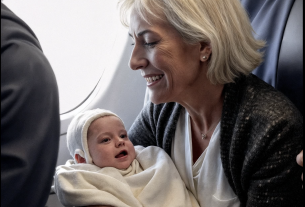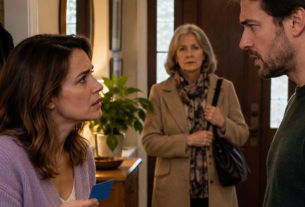
— I already bought it, understand? That’s it. It’s decided! — Igor threw the phrase across the table as if he were talking about a carton of milk, not someone else’s life. — Mom is coming with us to Turkey. I bought her ticket last week.
Katya lifted her eyes from her plate.
Slowly. Very slowly.
Outside the window, the city was humming — somewhere below, cars were honking, the elevator in the stairwell rattled on the third floor, and the neighbor upstairs was dragging something heavy across the floor. An ordinary Tuesday evening, April 2026. Nothing special. Only something inside Katya clicked — quietly, almost soundlessly, like a safety catch.
— Did you ask me? — she said evenly.
— Why would I ask? — Igor shrugged and reached for the bread. — She’s alone. She’s bored. You know that.
Katya knew. Oh yes, she knew very well.
Nina Vasilyevna — her mother-in-law — was a special kind of person. The kind who complains about her health all her life but will outlive everyone around her. Plump, loud, with lips forever pressed together and a look that could assess and condemn at the same time. Her home had its own particular chaos — cardigans hanging over chair backs, unwashed cups on the windowsill, the television blaring from morning till night. At the same time, she sincerely considered herself a delicate, refined woman who was unfairly underappreciated.
Nina Vasilyevna treated her daughter-in-law with professional dislike. She didn’t insult her openly — no, she was more cunning than that. She sighed. Pressed her lips together. Said, “Well, Katyusha, as you wish,” in such a tone that it was clear: Katyusha was wrong, Katyusha understood nothing about life at all.
— My Igoryok was always so neat, — she liked to repeat at every opportunity. — I don’t know where that went.
The hint was transparent. Everyone knew where it had gone. He had married the wrong woman.
After dinner, Katya cleared the table and went out into the hallway. Igor was already sitting on the sofa with his phone, scrolling through something, relaxed and pleased with himself. A man who had solved the issue.
— Igor.
— Hm?
— Are you serious about your mother?
He looked up from the screen with the expression of a person who had been interrupted from something important.
— Katya, what is it now? I already explained. She’s alone. She’s seventy-two. Is it really that hard?
— You and I haven’t been alone together in three years.
— So what? Mom is quiet. She won’t bother us.
Katya looked at him. At that calm, slightly offended face — the face of a man who was always right because he was always on his mother’s side.
“Quiet,” she thought.
Last year, Nina Vasilyevna had sent a dish back three times in a café. She said the chicken was dry, the music was too loud, and the air conditioner was blowing straight at her head. By the end, the waitress simply disappeared from their half of the room.
— Fine, — Katya said.
— Good.
He buried himself in his phone again. The conversation was over.
In the bedroom, Katya closed the door, sat down on the bed, and opened her laptop. Her fingers found the tab on their own — it had been open since last week, since the very moment her intuition had told her: something is coming.
A trip to the Maldives.
A small hotel she had read about in a travel Telegram channel — not flashy, but with character. White sand, wooden bungalows over the water, apricot-colored sunsets. She looked at the photos for a long time.
Then she opened the booking form.
One place. Departure in three weeks. The dates matched Igor’s Turkey trip — almost day for day. Almost. Her flight was two days earlier.
Katya filled out the form. Entered her card details. Clicked “Confirm.”
A confirmation email arrived immediately. She read it twice, closed the laptop, and lay down, staring at the ceiling.
Behind the wall, Igor was talking on the phone — judging by his tone, with his mother. A pleased voice, little laughs.
“Yes, Mom, I got everything. And insurance too. Don’t worry.”
Katya closed her eyes.
The next two weeks passed in a strange double rhythm.
On the outside, everything was as usual. Breakfasts, work, dinners. Igor occasionally said something about Turkey — about the hotel, the buffet, how Mom wanted to sit by the sea. Katya nodded. Smiled in the right places. Once, she even asked what hotel they would be staying at — purely so she wouldn’t look suspicious.
Inside, she was already there. In the Maldives. Alone. Without schedules, without complaints, without someone else’s needs.
On Friday, she went to the shopping center — supposedly for cosmetics. In reality, she stopped at a small swimwear shop on the second floor and bought three swimsuits. Bright, bold ones — not the kind she usually chose. The saleswoman packed them in a striped bag. Katya stepped outside, stood for a minute in the sun, and suddenly felt something strange — lightness. Real lightness, almost forgotten.
On Saturday, Nina Vasilyevna came over “to help pack.”
She appeared at eleven in the morning with a large bag and an even larger list of things they needed to take to Turkey. She settled in the kitchen, drank tea, praised Igor for “organizing everything,” and told Katya that last time she had packed the suitcase incorrectly.
— Heavy things first, then light ones, — she explained in the tone of a person revealing a law of nature. — You simply don’t know how.
— I’ll remember, — Katya said.
— And take proper sunscreen. Last time you got burned — you looked awful.
Igor, meanwhile, was watching football in the other room. The standard arrangement.
Katya made herself coffee, leaned against the countertop, and watched as Nina Vasilyevna methodically criticized the contents of her refrigerator. The olives were wrong. Yogurt with additives was unhealthy. The bread was too dark.
“Ten more days,” Katya thought. “Then I’m flying away.”
That evening, when her mother-in-law finally left, Igor came out of the room satisfied and full.
— So, did you two have a nice chat?
— Wonderful.
— She just worries. You understand that.
Katya looked at him for a long time — the way you look at something you have already mentally said goodbye to.
— I understand, — she said.
And that was the pure truth.
Three days before departure, Katya began packing her suitcase.
Not the one standing in the hallway — the large gray shared one, already half-filled by Igor and his mother’s advice. Her own. A small burgundy suitcase she had bought three years earlier on a business trip to St. Petersburg and had never used since. She took it down from the storage shelf late in the evening, when Igor was already asleep, and placed it in the bedroom behind the door.
She packed quietly, almost solemnly. Three swimsuits from the striped bag. A light linen dress the color of ivory. A book — a real paper one, the kind she had been meaning to read for ages but never got around to. Sunscreen — good, expensive, not the one Nina Vasilyevna had recommended.
She zipped it shut. Put the suitcase back behind the door.
Then she lay down and fell asleep quickly — for the first time in several weeks.
In the morning, Igor was in a good mood. He was frying eggs, humming something under his breath, and saying that Mom had already packed four bags.
— Four? — Katya asked.
— Well, she says you never know what might be needed. Pills, creams, robes…
— To Turkey. For ten days.
— Katya, come on. A person is going on vacation, she has the right to take what she wants.
Katya poured coffee and said nothing. That, too, was a new skill — staying silent where before she would have started explaining, proving, exhausting herself with her own words.
At lunchtime, Nina Vasilyevna called to clarify what time they were leaving for the airport. Then she clarified it again. Then she called once more and said that something was wrong with her blood pressure and maybe it would be better to leave earlier, in case there was traffic.
— Mom, we’re leaving at six, — Igor said patiently into the phone. — Yes. Yes. No, there won’t be traffic. Mom, I already told you.
At that moment, Katya was sitting in an armchair with her phone, looking at the airline app. Her flight was the day after tomorrow, at 2:40 p.m. A layover in Dubai, arrival in the Maldives in the evening local time. Everything confirmed.
She stepped out onto the balcony. The city below was living its own life — humming, moving, not rushing anywhere and not asking anyone’s permission. Somewhere in that city, there were thousands of women who were also standing on balconies at that very moment, thinking about something. Katya wondered what they were thinking about.
Igor’s departure day turned out noisy.
Nina Vasilyevna arrived at half past four — an hour and a half earlier than agreed. With four bags. One of them turned out to be packed with food — homemade cutlets in a container, a jar of jam, and some dried herbs “for the stomach.”
— Mom, they’ll feed us there, — Igor said.
— Feed you! — Nina Vasilyevna set down the bag with the expression of a person who had heard that before. — I know how they feed people there. Tasteless and expensive.
— It’s a buffet.
— Exactly.
Katya helped carry the bags to the elevator. Nina Vasilyevna looked her over — quickly, sharply, habitually.
— Why are you so calm? — she asked suspiciously.
— I’m tired, — Katya replied.
— She’s tired. — Her mother-in-law pressed her lips together. — We’re going on vacation, and you’re staying behind. You could have come with us.
— Another time.
— Always “another time.” — Nina Vasilyevna was already saying it into the air, not expecting an answer. — Igoryok, did you take my blood pressure pills? I put them in the side pocket of the big bag, don’t mix them up.
Igor carried the suitcases and nodded.
By the car, he hugged Katya — a little absentmindedly, his thoughts already at the airport, on the plane, on the Turkish beach.
— Well, don’t be bored. Ten days will pass quickly.
— I know, — she said.
The car drove away. Katya stood by the entrance for another minute, then returned home to the silence of her own apartment. She put the kettle on. Sat at the table. The apartment felt so good and so quiet that she simply sat there for several minutes, doing nothing.
The next day, she flew away.
The airport, check-in desk, passport control — everything passed as if in a light dream. Katya traveled lightly — a small suitcase, a backpack over her shoulder, coffee from a machine in her hand. Nobody called to clarify anything about blood pressure. Nobody asked whether she had packed correctly.
On the plane, she opened her book and read forty pages without stopping.
Meanwhile, in Turkey, things were beginning.
Igor later told her — afterward, already back home, with the face of a man who had survived something — that the first scandal happened at Antalya Airport. Nina Vasilyevna decided her suitcase had been damaged in transit — she had found a scratch that, judging by everything, had been there before the flight. She demanded that a report be filed. The airport employee didn’t speak Russian. Igor translated through an app. Half an hour.
At the hotel, it turned out that the room had “the wrong view.” The view was of the sea — but not the right sea, a “side sea.” Neither reception nor Igor himself could explain what a “side sea” was.
— I didn’t come here to look at a side sea for this kind of money, — Nina Vasilyevna declared.
They changed the room. The new one was smaller. But the sea was “right.”
By dinner, she had studied the restaurant menu and found it “disgraceful.” The portions were small, the meat was obviously not fresh — she could tell — and, in general, why pay for a restaurant if the hotel had a buffet?
— Mom, you yourself said the buffet was tasteless.
— This is a different buffet.
Igor ordered her a steak and a glass of local wine. The steak was tough, the wine sour. At least, that was what Nina Vasilyevna said. The waiter took away the plate and never approached their table again.
At that same time, Katya was sitting on the terrace of a bungalow over the water, watching the sun sink into the ocean.
The sky was a color that had no proper name — not orange and not pink, but something in between, with a stripe of cold gold along the horizon. The water below was warm and clear. Somewhere to the right, music was playing softly — live, unhurried.
At the next table, a young man was reading a book and drinking something with ice.
He looked up, sensing her gaze. Smiled — just like that, without intruding. The way people smile when they feel good and don’t mind if someone nearby feels good too.
— Beautiful, isn’t it? — he said in Russian, nodding toward the sunset.
— Very, — Katya replied.
His name was Anton.
Not Antosha, not Tosha — simply Anton, and somehow that was immediately right. Thirty-eight years old, an architect from Novosibirsk, he had come to the Maldives alone after finishing a large project that had taken a year and a half of his life. He spoke quietly, listened attentively, and had a habit of narrowing his eyes slightly when he thought — as if testing words for strength before saying them.
That first evening, they sat on the terrace until midnight. They talked about nothing in particular — books, cities, why people go on vacation alone. Katya caught herself laughing — truly laughing, not politely. When she returned to her bungalow, she lay in the darkness for a long time and thought: when was the last time that had happened at all?
She couldn’t remember.
On the second day, they took masks and snorkels together and swam over the reef. Anton dived deeper, pointing out fish to her — poking his finger underwater in a funny way, while she laughed into her mask and blew bubbles. Then they had lunch in an open-air café right by the water, eating something with coconut and spicy sauce, and Anton told her about Novosibirsk in winter in such a way that she could almost feel that frost and blueness. She barely checked her phone. Once, a message came from Igor in their shared chat: “Mom’s blood pressure again, found a pharmacy. How are you?” Katya wrote: “Good. Hope everything settles down,” and put the phone away.
On the third evening, Anton took her hand.
Just like that — they were walking along a wooden bridge above the water, and he took it, and she didn’t pull her hand away. They both pretended that nothing special had happened. But something had happened — it could be felt in the way they fell silent, and in the kind of silence it was.
Warm.
By the middle of the week in Turkey, Igor had completely stopped understanding why he was there.
Nina Vasilyevna had mastered every restaurant within a kilometer and compiled her own ranking of their inadequacy. In one, the music was too loud. In another, the tablecloths were stale — she could feel it. In a third, they served fish that “smelled like fish,” which was deemed unacceptable.
On the beach, she sat under an umbrella, wearing a hat and several layers of sunscreen, and c
ommented on everyone around her. Loudly. In detail.
— That one over there, in yellow — why would she go out looking like that…
— Igoryok, go find out why the sand is so hot, this isn’t normal…
— Why is there music? I came to the sea, not to a disco…
Igor went, found out, explained, apologized to strangers for something his mother had said out of line. On the fourth day, he caught himself envying an unfamiliar man on the neighboring sun lounger — the man was lying there with headphones, alone, and his face was completely serene.
That evening, he called Katya.
— So, how are you?
— Good, — she said. — Resting.
— Listen, it’s been crazy here… — he began telling her about the restaurants, the blood pressure, the sand. Katya listened. Then he said, — Maybe it was a mistake, planning it like this. With Mom.
— Maybe, — Katya agreed.
A pause.
— Do you miss me?
She looked at the ocean. Anton was sitting beside her, looking at the water, not listening — giving her space, something he knew how to do.
— I’m resting, Igor, — she repeated.
He didn’t understand. Or didn’t want to. He said, “Okay, well, all right,” and said goodbye.
She returned home a day before him.
The apartment greeted her with silence and a foreign smell — something uninhabited, the way places smell when they haven’t been aired out for a long time. Katya opened the windows, made coffee, sat at the table, and simply sat there in silence. Then she took out her phone and found a contact — a lawyer whose business card an acquaintance had once given her. Just in case. “You never know,” the acquaintance had said then, laughing.
Katya wasn’t laughing. She dialed the number.
Igor came back angry and tanned.
From the doorway, he said the vacation had been “so-so,” that Mom had been capricious the whole time, that the restaurants there charged three times too much for ordinary food. He threw his suitcase into the hallway and lay down on the sofa.
— Did you at least get some rest? — he asked.
— Yes.
— Lucky you.
He turned on the television. Katya walked into the kitchen, put the kettle on, and realized that everything had already happened — not now, not today, but back then, on the terrace, when she was watching the sunset and feeling herself breathe fully. Some things simply need time to take shape in words.
A week later, she told him.
Calmly. Without a scandal. Without tears — from either side.
— I want a divorce.
Igor looked at her for a long time, as if checking whether she was serious. Then he said:
— Because of Mom, or what?
— No. Because of us.
He didn’t understand that either. But that no longer changed anything.
The divorce was finalized in three months — without court, without a war over property. There wasn’t much to divide: the apartment belonged to Katya, bought before the marriage. Igor moved in with his mother — temporarily, as he said. When Nina Vasilyevna learned the news, she called Katya and said she had “always known.” What exactly she had known, she did not specify.
Katya did not call back.
Anton wrote a month after the Maldives. Simply: “Hi. How are you?”
She replied: “Good. Getting divorced.”
A long pause. Then: “I understand. If you need anything, I’m here.”
They didn’t rush. That was probably the most important thing — that no one rushed anything. He came to Moscow in September for work, for a project. They met in a small café at Chistye Prudy, sat for three hours, and everything was just as it had been on that terrace over the water: warm, quiet, right.
In November, she came to him in Novosibirsk.
The city turned out to be exactly as he had described it — frosty, blue, with wide avenues and unexpectedly cozy courtyards. Anton walked with her along the embankment, showed her his projects, and amusingly explained something about cantilevered floors. She understood nothing, but listened with pleasure.
That evening, they sat in his kitchen — large, bright, overlooking the city at night. He made mulled wine, she sliced an orange, and there was something strangely peaceful about the scene. Nobody demanded anything. Nobody sighed with hidden meaning. Nobody called to clarify anything about blood pressure.
— Do you think you did the right thing? — he suddenly asked without turning away from the stove.
Katya looked at the orange in her hands. Thought about it — honestly, without rushing.
— Yes, — she said. — Late, but right.
He nodded. Poured mulled wine into two mugs. Set one in front of her.
— To late but right decisions.
She raised her mug.
Outside the window lay November Novosibirsk, somewhere far away was Moscow, and even farther away were the Maldives with their apricot sunsets. And here, in this kitchen with the smell of cinnamon and orange zest, Katya thought that life was a strange thing. Sometimes your husband needs to buy his mother a ticket to Turkey for you to finally understand where you want to go yourself.
In spring, Anton moved to Moscow.
Not for her — he had landed a major project, the reconstruction of an old apartment building in Zamoskvorechye. But they both knew it wasn’t entirely a coincidence. Or not a coincidence at all.
He rented an apartment ten minutes away from hers. They didn’t rush to move in together — they simply lived nearby, met whenever they wanted, and there was its own kind of freedom in that, one they both knew how to value.
In the mornings, they sometimes had breakfast at a small coffee shop on the corner. Anton ordered an Americano and something with cottage cheese; she ordered a cappuccino and a croissant. They each read their own things, sometimes talked, sometimes sat in silence. One day, Katya caught herself thinking that she couldn’t remember the last time she had expected something bad to happen. She simply didn’t expect it — and that was all.
Igor sometimes wrote. Briefly, about practical matters — documents, a tax deduction, a shared account they had forgotten to close. Katya answered the same way — briefly, without anything extra. There was no resentment. There was fatigue, gradually turning into peace.
After the divorce, Nina Vasilyevna fell ill three times — seriously, demonstratively, with detailed messages in the shared chat, which Katya had quietly left back in January. They said Igor was still living with his mother. Temporarily.
In May, Anton showed her the project — printed drawings spread all over the table, a cardboard model, pencil notes in the margins. He explained something about the historical façade and the inner courtyard. She listened and looked at his hands — quick, precise — and thought that a year ago she had been sitting in the same kitchen, in the same Moscow, unable to remember the last time she had laughed.
— Do you like it? — he asked.
— Very much, — she said.
He looked up. Understood that she was not talking about the drawings. He smiled — that same smile, the first one, from the terrace over the water.
Chestnut trees were blooming outside the window. The city lived, made noise, and was in no hurry. And Katya — for the first time in a very long while — was in no hurry either.