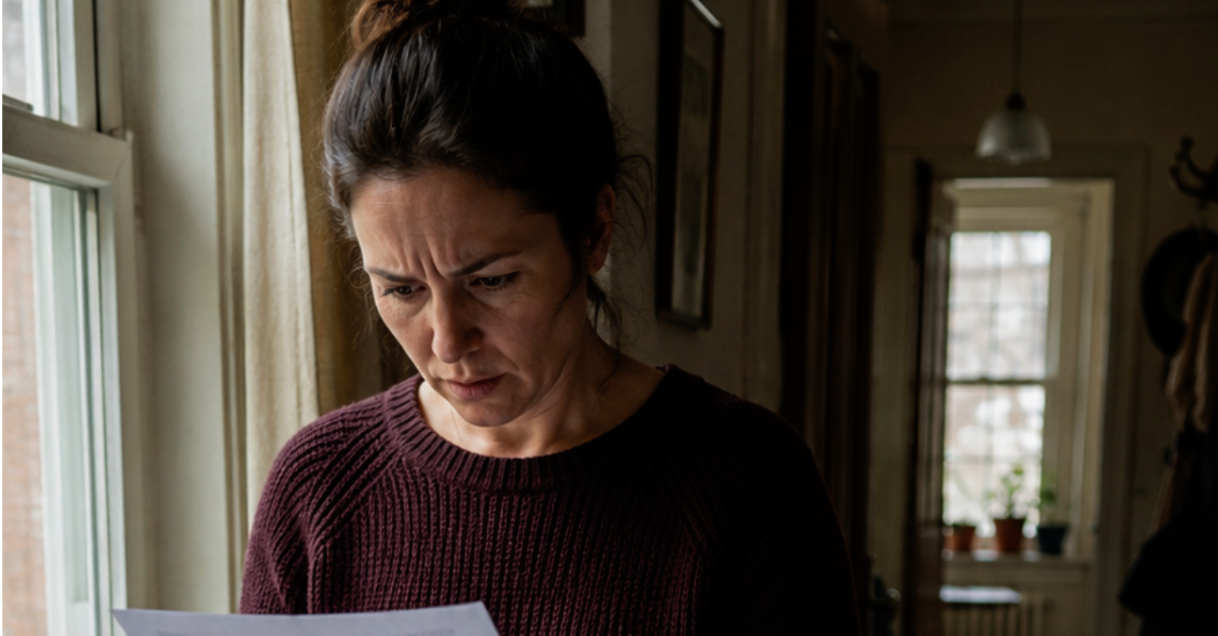
Galina found his passport by accident. She was looking for the water bill, reached into the dresser drawer, and came across a blue cover with worn corners. He had left four months ago, taking his jackets, boots, electric razor, and even the half-used jar of protein powder from the top shelf. But he had left his passport behind.
She opened it to the page with the registered address. The stamp was clear and fresh: Lenin Street, building 14, apartment 9. Her apartment. The very one she had bought before the wedding, with money she had saved over six years of working at the clinic.
The kettle on the stove began to whistle. Galina closed the passport, put it back in the drawer, and went to take the kettle off the heat. Her hands were dry and steady. For now.
Her story with Roma had begun simply. He came to fix the faucet, stayed for tea, then for dinner, then for the night. Six months later, he moved in. Galina was thirty-seven, he was thirty-nine. She worked as a nurse in the treatment room; he was a plumber for the property management company. No prince and princess. Just ordinary people with ordinary arithmetic: her salary was thirty-eight thousand, his was sometimes forty, sometimes fifty, depending on the season and the number of calls.
She registered him at her address after a year of living together. Her mother called then and said one word:
“Why?”
Galina answered that it was easier that way with documents, with the clinic, with the work pass for the neighboring district. Her mother stayed silent for a while and hung up. She knew how to be silent in such a way that the air thickened.
And Roma was grateful. At first. He fixed all the faucets in the house, installed a new mixer tap, replaced the outlet in the hallway. Galina looked at his hands — broad, with short fingers and a permanent stripe of machine oil under his nails — and thought: this is it. Not fireworks, not poetry. Just a person who is nearby and who does things.
Then he stopped doing things. Not all at once, but gradually, the way a radiator cools after the heating is turned off. First he started coming home later. Then he began “staying late at a job site.” Then she found a receipt from the Veranda restaurant for two people in the pocket of his work jacket. The amount was more than the two of them spent on groceries in a week.
“That was with a client,” he said, not looking up from his phone.
“At Veranda? With a client?”
“Yeah. It happens.”
He changed the channel. She stood in the doorway and counted the tiles on the floor. Twenty-three to the threshold. She knew that number by heart.
Her friend Zinaida worked at the public services center. They weren’t exactly close, but twelve years of acquaintance did their work: a person becomes part of the scenery, like the birch tree outside the window or the shop on the corner.
Zinaida was thin, with a long nose and a habit of adjusting her glasses with her index finger every thirty seconds. She spoke quickly, swallowing endings, as if afraid the person she was talking to would leave before hearing her out.
“Galya, are you serious? He’s still registered there?”
“Still.”
“And you stayed quiet for four months?”
“What was I supposed to do? Scream?”
Zinaida adjusted her glasses and looked at her the way people look at someone standing on railway tracks and not hearing the train.
“You should have come to me. Or to a lawyer. Or at least to someone.”
Galina said nothing. She poured herself water from the cooler, took two sips, and put the plastic cup on the windowsill, where three others already stood, forgotten by someone earlier.
“Listen,” Zinaida lowered her voice, though there was no one in the hallway of the public services center. “As long as he’s registered there, he has the right to live there. Do you understand? The right to live in your apartment. If he wants to come back, the law is on his side. You won’t be able to throw him out until he deregisters himself or until the court decides.”
The plastic cup of water on the windowsill trembled from a draft. It didn’t fall, but Galina instinctively steadied it with her hand.
“And what should I do?”
“For starters, talk to him. Like a human being. Ask him to deregister voluntarily. If he refuses, then court. But court means time. Months. And nerves, Galya. A lot of nerves.”
She called him that same evening. It took her a long time to dial the number, though he was in her favorites. Her finger hovered over the screen like over an elevator button when you don’t know which floor to choose.
He answered after the sixth ring.
“Hello.”
His voice was different. Not the one she remembered in the mornings, hoarse and warm. This one was smooth, even, unfamiliar. As if the person had changed not only his address.
“Roma, we need to talk.”
“About what?”
“About the registration. You forgot to deregister.”
A pause. Something rustled on the line: either a television or someone’s voice in the background.
“Oh, that. Well, I’ll stop by sometime.”
“When?”
“Well… during the week. Or next week.”
She squeezed the phone so hard that the case creaked. Her stomach went cold, as if she had swallowed ice water on an empty stomach.
“Roma, this is my apartment. I bought it before you.”
“I know, Galya. I said I’ll stop by. Don’t pressure me.”
He hung up. She stood in the middle of the kitchen with the phone in her hand and listened to the beeps. Then the silence. Then her own breathing.
He didn’t come the next week. Or the week after that. Galina wrote him a message: “Roma, please, let’s resolve the registration issue.” He read it and didn’t answer. The two blue check marks stood there like two little knives.
She wrote again three days later. Shorter: “When will you deregister?” Read. No answer.
She typed the third message for a long time, erased it, typed it again. It came out like this: “If you don’t deregister voluntarily, I’ll file a claim in court.” She sent it and went to bed. Not because she wanted to, but because there was nothing else to do.
In the morning, the answer came. One word:
“Go ahead.”
Galina reread it four times. Go ahead. Either permission. Or a challenge. Or maybe he simply didn’t care.
She sat on the edge of the bed and looked out the window. March. Snow still lay in the yard in dirty islands, with streams running between them. Pigeons tramped along the ledge of the neighboring building. One turned sideways toward her, and for a second it seemed as if it too was waiting for an answer.
She went to a lawyer two days later. She found one on Zinaida’s recommendation: Tamara Ivanovna, sixty-two years old, with an office on the second floor of an old building near the market. The linoleum in the hallway had swollen into bubbles; it smelled of coffee and paper.
Tamara Ivanovna was small, about five foot one, with a gray bob and a habit of writing everything down in a notebook, even though there was a laptop in front of her. She spoke slowly, weighing every word like a pharmacist weighing powders.
“The apartment is yours?”
“Mine. I bought it with a mortgage and paid it off completely before the marriage.”
“Was the marriage officially registered?”
“No. We never got married.”
Tamara Ivanovna looked over her glasses. For a second, Galina felt as if this small woman could see everything: the receipt from Veranda, the two blue check marks, and the pigeon on the ledge.
“That’s good,” she said, and the word “good” sounded without joy, simply as a fact. “Since there was no marriage, there will be no property division. The apartment is unquestionably yours. The only issue is the registration. He was registered with your consent?”
“Yes.”
“How long ago?”
“Three years.”
“Family members?”
“No. We weren’t married. No children.”
Tamara Ivanovna nodded and wrote something in her notebook. The pen was blue, with an advertisement for a dental clinic on it.
“Then here is how it works. You are the owner of the residential premises. He is registered at the place of residence, but he is not a member of your family. The family relationship has ended; he moved out voluntarily. Under Article 31 of the Housing Code, Part Four, you have the right to file a lawsuit to recognize that he has lost the right to use the residential premises.”
“And the court will decide?”
“The court will decide. But you’ll need evidence that he does not live there. Statements from neighbors, utility bills in your name, perhaps photographs. And you’ll also need to prove that the family relationship no longer exists.”
Galina nodded. Prove that there is no family relationship. As if that needed proving. As if the empty hanger in the hallway and the silence in the evenings were not eloquent enough.
“How long will it take?”
“If he doesn’t contest it, two or three months. If he does… longer.”
“And if he simply doesn’t come to court?”
“They’ll consider the case without him. That’s even easier.”
Galina took her wallet out of her bag. Tamara Ivanovna named the amount. Not outrageous, but significant. Half a salary. Galina paid and went outside. The air smelled of wet asphalt and something sweet from the pastry stall on the corner. She inhaled deeply, like after a long dive.
At home, the first thing she did was open the dresser drawer. The passport was in its place. Blue cover, worn corners. She took it, placed it on the table, and photographed the page with the registered address. Then the page with the photo. Roma looked younger there than he was now: the photo had been taken five years earlier, when he still didn’t have receding hair above his temples or the crease between his eyebrows that appears when a person has been dissatisfied with himself for too long.
She put the passport back. Wiped the table. Took cottage cheese out of the refrigerator and began eating it with a spoon straight from the package, standing by the window.
In the yard, a neighbor’s boy was kicking a ball. He was about eight, maybe nine. The ball was orange, bright, the only spot of color in the gray March courtyard. The boy kicked it, the ball bounced off the wall and came back. Another kick. Another return. Galina watched this and chewed her cottage cheese, and something inside her slowly formed into a decision she could not yet name in words.
The lawsuit was filed in April. Tamara Ivanovna prepared the statement, Galina signed it and took it to court. The courthouse was yellow, with columns that looked like giant fingers. Inside, it smelled of disinfectant and institutional linoleum.
The clerk accepted the documents without emotion. She stamped them as received, gave Galina a receipt, and told her to wait for the summons. Galina went outside and sat on a bench by the entrance. She took out her phone. She wanted to call someone, then realized there was no one to call. Zinaida was at work. Her mother would be silent. She had lost her school friends, and never made new ones: eight years with Roma had eaten up all her free time, like acid eats metal.
She put the phone away and just sat there. Five minutes. Ten. A woman with a stroller passed by, then a man in a suit with a folder, then two female students laughing over something on a phone. Everyone walked past. No one knew that she had just taken the first step toward reclaiming her own home.
Roma’s summons was sent to his registered address, which meant to her apartment. She received the envelope and stared at it for a long time. Then she called Tamara Ivanovna.
“The summons came to my address. He doesn’t live here.”
“That’s normal. The court sends it to the defendant’s registered address. You can give it to him personally or send it to his actual address, if you know it.”
Galina knew it. Zinaida had found out through an acquaintance: Roma now lived on Sadovaya Street, building 7, apartment 22. With Svetlana. That was the other woman’s name. Galina tried not to say it, even in her thoughts, as if by saying it, the name would gain density and weight.
She sent the summons by mail. Registered letter with delivery confirmation. The post office was in the basement of a residential building; it smelled of sealing wax and old paper. There were three people in line: a grandmother with a parcel, a bearded man paying a fine, and her.
When her turn came, the woman behind the counter asked:
“Valuable?”
“No,” Galina said.
And thought: It is valuable. More valuable than anything.
Roma called four days later. It was eleven at night. Galina was already lying in bed, reading a book. Not because she wanted to, but because she was used to it: without a book, the silence in the apartment became too large, filling the corners and pressing against her temples.
“Are you serious, Galya? Court?”
She sat up. The book slipped from her stomach onto the blanket.
“I asked you. You didn’t want to.”
“It’s not that I didn’t want to. I forgot. A lot of work.”
“You forgot for four months.”
“It happens, Galya. Why go straight to court?”
“What was I supposed to do? Wait until you decided to come back with a suitcase?”
He fell silent. It was quiet in the background: no television, no stranger’s voice. Maybe he had gone out onto the balcony.
“I’m not coming back,” he finally said. Quietly, almost in a whisper.
“I know.”
“Then why court?”
“Because you’re registered in my apartment. And as long as you’re registered there, I pay utilities for you. Electricity, water, garbage. I pay for a person who doesn’t live with me.”
He fell silent again. Then he sighed. A long, heavy sigh, the kind a person gives when they’ve been caught in something they had tried not to think about.
“All right. I’ll deregister. I’ll stop by this week. Seriously.”
“You already said that.”
“Galya…”
“Come by. I have your passport.”
She hung up. The book lay open on the blanket, spine up. Page one hundred twenty-seven. The heroine of the novel was also waiting for something from a man who had promised. Galina smirked, closed the book, and turned off the light.
He didn’t come. Not that week, not the next. Galina wasn’t even surprised. Being surprised would have been foolish, like being surprised by rain in November.
The hearing was scheduled for May twentieth. Tamara Ivanovna called the day before and clarified:
“Will there be witnesses?”
“The neighbor, Valentina Pavlovna, agreed. She’ll confirm that he hasn’t lived there since December.”
“Good. Have you collected the utility bills?”
“All of them. From October to May. In my name.”
“The apartment documents?”
“Certificate of ownership. Purchase agreement. Certificate showing there are no encumbrances.”
“Excellent. Galina, you’re doing well. Go to sleep. Tomorrow you’ll simply tell everything as it is.”
Galina hung up and went to the kitchen. She put the kettle on. Took a cup from the cupboard. A white one with a chipped edge, which Roma had once brought back from a trip to Kazan. It had the words “Kazan Cat” on it. The cat had worn off; only the whiskers and tail remained.
She held the cup in her hands. Turned it around. Put it back and took another one, without any writing.
The judge was a woman of about fifty, heavyset, with a short haircut and a low voice. She read the documents quickly, turning the pages with a crisp rustle. The courtroom was small: three rows of benches, the judge’s desk, a flag in the corner, a water carafe.
Roma did not come. His place was empty. No one sat on the defendant’s bench.
Galina sat upright, her hands on her knees. Beside her, Tamara Ivanovna sorted through papers. Valentina Pavlovna, the neighbor from the third floor, fidgeted on the witness bench and touched a button on her jacket.
“Plaintiff, tell the court the circumstances,” the judge said without lifting her eyes from the file.
Galina stood up. Her throat tightened, as it does before an injection, though she had spent so many years giving injections to others and knew: the main thing is to relax the muscle.
“We lived together from 2020 to December 2025. Without registering a marriage. The apartment belongs to me; it was acquired before we began living together. I registered him at the place of residence voluntarily in 2021. In December, he moved out. He took his things. But he did not deregister.”
“Did you ask him to deregister?”
“Yes. By phone and in writing. He promised, but didn’t do it.”
“Do you have evidence of these requests?”
Tamara Ivanovna stood and handed the judge a printout of the correspondence. Screenshots of the messages: three sent, one read without an answer, one with the reply “go ahead.”
The judge looked at them and nodded.
Valentina Pavlovna was invited to the microphone. She straightened her jacket and cleared her throat.
“I live one floor above. I haven’t seen him since winter. Definitely since December, because before New Year’s he still came around; I heard the door slam. But after New Year’s, silence. Only Galina alone.”
“Thank you,” the judge said.
The hearing lasted twenty minutes. The judge went out to deliberate and returned seven minutes later.
“The claims are satisfied. The defendant is recognized as having lost the right to use the residential premises. The decision will enter into legal force in one month, unless it is appealed.”
Galina exhaled. Not loudly, not theatrically. She simply released the air she seemed to have been holding inside since that December evening when Roma had walked out with his suitcase and left the door open behind him.
A month passed. Roma did not appeal. Galina received the court decision and took it to the passport office. The procedure took fifteen minutes. The stamp in his passport no longer meant anything, and her apartment was once again only hers.
She came out of the building and stopped on the steps. June. Poplar fluff flew through the air, got into her eyes and stuck to her lips. Children in the yard across the street were riding scooters. Somewhere music was playing — something summery, indistinct.
She took out her phone. Dialed Zinaida.
“That’s it. He’s been deregistered.”
“Well, finally! Galya, do you hear me? I told you! You should have done it right away!”
“I should have.”
“All right. The main thing is you did it. Come over this evening, I made okroshka.”
“I’ll come.”
She put the phone away and walked to the bus stop. The bus arrived immediately, as if it had been waiting. The doors opened with a hiss; inside, it smelled of gasoline and heated plastic. She sat by the window, pressed her temple against the glass, and watched the city drift past: houses, shops, people, trees. Everything was the same. But lighter.
That evening, after okroshka at Zinaida’s, she came home. She opened the door and turned on the light. The hallway was empty: no his boots, no his jacket, no smell of someone else’s cologne. All of that had disappeared long ago. But before, the emptiness had seemed temporary, like a room from which the furniture had been removed before renovation. Now it had become permanent. And that did not make it worse. It made it calmer.
Galina went to the kitchen. Put the kettle on. Opened the cupboard and took out that very cup from Kazan, the one with the remains of the worn-off cat. She looked at it. Whiskers and tail.
She turned the cup around, held it above the trash can. Stood like that for a second, maybe two. Then she put it back on the shelf.
Not because she felt sorry for it. The cup was simply a good one.
The next day, the doorbell rang. Galina opened it without looking through the peephole, and Roma stood on the threshold. She did not recognize him right away: he had lost weight, gotten a tan, grown a beard. He held a bag in his hands.
“Hi.”
“Hi.”
“I came for my passport. And here… this is your money for the utilities. I calculated it. Roughly.”
He held out the bag. Inside was an envelope. Galina took it and looked inside. Banknotes. She didn’t count them.
“Come in. The passport is in the dresser.”
He came in and stopped in the hallway. He didn’t go farther, though before he had always gone straight to the kitchen, opened the fridge, taken something out. Now he stood like a guest. No, not like a guest. Like a courier.
“New wallpaper?” he asked, nodding at the wall.
“It’s been there for a while.”
“It’s nice.”
She brought the passport. He took it, opened it, looked at the stamp. Then closed it.
“Galya, I…”
“Don’t, Roma.”
He nodded. Stood there for another second. Shifted from one foot to the other, like a child who had been put in the corner and not told when he could leave.
“Well, all right. Bye.”
“Bye.”
He left. The door closed. The lock clicked. But this time, she locked it herself.
Galina returned to the kitchen. The kettle was still warm. She poured water into the cup from Kazan, dropped in a tea bag, and sat down at the table. The envelope with the money lay beside her. She did not open it again.
Sparrows screamed outside the window. Poplar fluff flew in through the small vent window and settled on the stove. Galina took a sip of tea and burned her tongue. Just a little, only the very tip.
She set the cup down and looked at the wall. The wallpaper was beige, with a small pattern she had chosen herself. Without advice, without help. She had put it up herself too: crooked at the corners, perfect on the straight sections. Like life.
The phone on the table buzzed. A message from Zinaida:
“Well?”
Galina answered:
“Fine.”
And for the first time in a long time, that word was not a lie.
She finished her tea. Washed the cup. Put it on the shelf with the others.
Then she closed the window, because there was too much fluff, and went into the room. On the nightstand lay the book, open to page one hundred twenty-seven. The heroine of the novel was still waiting.
Galina turned the page.