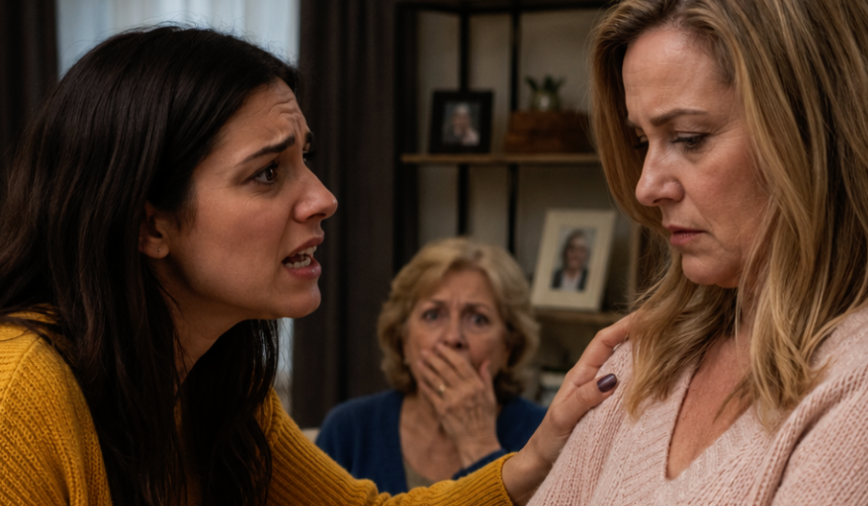
“Who are you here to see?”
Irina blinked in confusion, not immediately realizing the question was addressed to her. In front of her stood an unfamiliar woman in a terry bathrobe, water dripping from her wet hair onto the rug — her rug, the one she had bought three years ago at IKEA.
“I… I’m home. This is my apartment.”
The woman frowned and glanced at the travel bag at the guest’s feet. From the kitchen came loud male laughter; someone rattled dishes. In the hallway, unfamiliar jackets hung on the coat rack — a man’s and a woman’s.
“Yours? We rented it from Sveta. For one day. We’re already getting ready to leave. We’re waiting for Sveta so we can give her the keys.”
“You can give them to me. I’m the owner of the apartment. I’ll wait outside the door for now.”
Irina stepped back into the stairwell and felt for her phone in her pocket. Her fingers were trembling as she dialed her sister. The ringing seemed endless.
“Sveta,” she breathed as soon as she heard her voice. “Sveta, I’m standing at the door. Who are these people in my apartment?”
There was silence on the other end. Then came a frightened, hurried whisper:
“Ira, you’re home?.. Why didn’t you warn me you were coming?”
Irina sank down onto the stairwell step, pressing her bag to her knees. Her sister’s voice on the phone rushed on, making excuses, promising to “explain everything,” but the words passed her by. Only one thought kept spinning in her head: one year. She had been gone for only one year — and now there were strangers’ slippers at her doorstep.
“I’ll be there in an hour, do you hear me? Just don’t do anything,” Sveta pleaded.
“What could I possibly do?” Irina answered quietly and ended the call.
She leaned the back of her head against the cold wall. A year ago, she had left for Moscow as if jumping off a cliff. After her divorce from Kostya, it had become impossible to breathe in her hometown: mutual friends, cafés where they had celebrated anniversaries, even the bus stop near work — everything pricked like shards of glass.
“Stay with me for a week,” her Moscow friend had said back then. “Clear your head.”
One week stretched into a month, then into six months. Irina got a job at a small salon on the outskirts. At first, she was afraid of the clients, but within three months they were booking appointments with her two weeks in advance. She took shifts one after another, returned to her rented studio at night, and collapsed into bed without even undressing. But at least she didn’t think.
Then Andrey appeared — a client of her friend’s, an engineer, calm, with gray at his temples and a quiet laugh. He didn’t rush her, didn’t pressure her, he was simply there. Six months later, she moved two bags of belongings and her toothbrush into his place.
Before leaving, she had left the apartment in her hometown to Sveta.
“Water the plants, pay the bills,” she had said then, tossing the keys onto the table. “I won’t be gone long.”
During the first few months, her sister called: “Your ficus dried up, sorry.” Then the calls became less frequent.
When the tenants finally vacated the apartment and Irina stepped inside, it felt as though she had mistaken the floor. Everything was different.
Her chest of drawers was gone from the hallway — the walnut one she had bought with her first university salary. In its place, a crooked chipboard shelf hung on the wall. The mirror in its carved frame had disappeared from the bedroom. In the corner of the living room, where her father’s floor lamp with the green lampshade had once glowed warmly, there was now an empty space. The television was gone too.
In the kitchen there were chipped mugs, plastic containers, and a cheap oilcloth. In the bathroom — someone’s disposable razors, cheap shampoo, and a stranger’s bath sponge.
Forty minutes later, Sveta arrived with their mother. Her sister rushed in first and began talking right from the doorway without even taking off her coat.
“Ira, you have to understand, we were careful… The apartment was just standing empty, it was a shame… So we rented it out by the day. We changed the bed linen every time, cleaned up…”
“Where is the chest of drawers?” Irina interrupted. “Where is Dad’s floor lamp?”
Sveta stopped short and exchanged a glance with their mother. Their mother put down her bag, slowly removed her headscarf, and did not raise her eyes.
“We thought you didn’t need those things anymore,” she finally said. “You settled in Moscow. You have a man there, your own apartment…”
“It’s not mine. It’s Andrey’s.”
“Well, still. Your own life, a new one. And here, everything would have just gathered dust.”
Irina was silent. What hurt her was not that they had rented out the apartment. Not even the missing chest of drawers. What hurt was how casually, how calmly her mother had said, “you didn’t need it anymore” — as if Irina herself had also been put away somewhere. Onto a shelf. Into a storage room. Written off.
As if she no longer had the right to come home.
The evening dragged on tensely. Sveta bustled around the kitchen, brewing tea in someone else’s mugs, chattering about her nephew, prices, the neighbor from the third floor — anything to avoid silence. Irina nodded, barely listening. Her sister’s phone beeped on the table. Sveta went into the room to their mother, and the screen remained beside Irina — lit up, with a classifieds app open.
Irina glanced at it — and froze.
“Soviet tea set, grandmother’s porcelain. Urgent.” In the photo was her tea set — or rather, her grandmother’s, the one her grandmother had left specifically to her.
With trembling fingers, she scrolled through the listings from the same seller. A coffee machine — hers, a gift from Kostya. A pendant. Gold earrings with garnets, which she had searched for for half a year, thinking she had lost them at the dacha.
“Sveta,” she called evenly. “Come here.”
Her sister came out, saw the phone in Irina’s hands — and turned pale.
“Ira, don’t think… It was Dima… Our loan was overdue, and Misha needed a phone for school, the washing machine broke…”
“You were selling my things. You were selling Grandma’s tea set.”
Dima appeared in the doorway — apparently he had just arrived. He heard the last phrase, sighed heavily, and threw his jacket onto a chair.
“Listen, stop making a tragedy out of it,” he muttered without looking at Irina. “You started a new life there, you’ve got a man, Moscow. And here, the apartment was bringing in money, the things were just lying around uselessly. What’s the big deal?”
Irina looked at him — at his irritated face, at her sister hiding her eyes, at her mother quietly stepping into the hallway — and suddenly understood one very simple thing.
They had buried her long ago. Not as a sister, not as a daughter — as a person. What remained was only a useful function: an apartment, belongings, a resource. And they had calmly divided that resource among themselves while she was there, in Moscow, naively missing home.
Irina barely slept that night. She sat in the kitchen and watched the windows in the building across the yard go dark one by one. Images kept turning over in her mind — not from the last evening, but from the years before it.
There she was, transferring money to Sveta for her wedding. There she was, paying for her mother’s dental treatment. There she was, taking out a loan so Dima could “grow his business,” which later quietly fell apart. And not once — not once — had anyone returned a single ruble. And not once had she asked.
“Idiot,” she said aloud, and the sound of her own voice made the empty kitchen feel even quieter.
She had always given first, without bargaining. And that was exactly why no one heard her “no.” What boundaries can a person have if she opens every door herself?
In the morning, Irina calmly took out the apartment documents, called a company, and ordered a locksmith. By lunchtime, there was a new lock in the door.
Sveta arrived by evening, saw the shiny new cylinder, and burst into tears right there on the landing. Their mother arrived soon after.
“Ira, how can you do this? We’re family…”
“Family doesn’t sell someone else’s things behind their back,” Irina said quietly, and closed the door.
For the first time in her life, guilt did not tighten around her throat.
A few weeks later, Irina put the apartment up for sale. The decision came easily — without long hesitation, without sleepless nights full of doubt.
Her mother found out through a neighbor and called immediately.
“Irochka, think it over one more time. This is memory. Your father received that apartment. Why are you in such a hurry?”
“Mom, I have thought it over. For ten years.”
Sveta played the victim in public. She called aunts, cousins, their grandmother in the village, and told everyone the same story: her sister had become spoiled in Moscow, forgotten her relatives, and left the family without help during a difficult time.
“She could have simply signed it over to us,” Sveta sobbed into the phone to yet another relative. “But she’s selling it, can you imagine? To strangers!”
Fragments of these conversations reached Irina — someone retold them, someone messaged her with reproaches. Before, she would have rushed to justify herself, explain, prove her side. Now she simply closed the chats.
A buyer was found quickly — a young couple with a mortgage. The sale was completed within a month. When Irina left the entrance for the last time with empty hands, she did not look back.
With the money from the sale, she bought a small one-room apartment in the near Moscow suburbs — bright, on the fourth floor, with a balcony and a view of birch trees. She made modest renovations and furnished it simply, but in her own way. Then she rented it out to a reliable woman who worked as a teacher.
“Just one condition,” Irina smiled as she handed over the keys. “The spare set stays only with me. No one else.”
The rent money went into a separate account. The apartment was hers alone — and for the first time, she was truly sure of it.
A year passed.
What Sveta had always feared finally happened: Dima was laid off, the car loan was still hanging over them, and their child had started a paid extracurricular class that they could no longer afford. The familiar lifesaver was no longer nearby — Irina did not call, and asking felt awkward.
For the first time, Sveta understood what it meant to manage on her own. To count every thousand, to give things up, to sell belongings not out of greed, but out of desperation. And somewhere between night shifts at the supermarket, it dawned on her that this was exactly how her sister had lived all those years. Only without anyone’s help.
She called first. She stayed silent on the phone for a long time, then forced the words out:
“Ira… forgive me. For everything. Back then, I really didn’t understand.”
“I know, Sveta,” Irina answered calmly. “Now you do.”
They did not become close friends, and they did not restore what had been before. But there was no longer reproach or guilt in their voices.
Irina put down the phone, stepped out onto the balcony of her apartment near Moscow, and looked at the birch trees for a long time. Sometimes a person leaves to start a new life. And sometimes — to finally understand who truly considers them family.