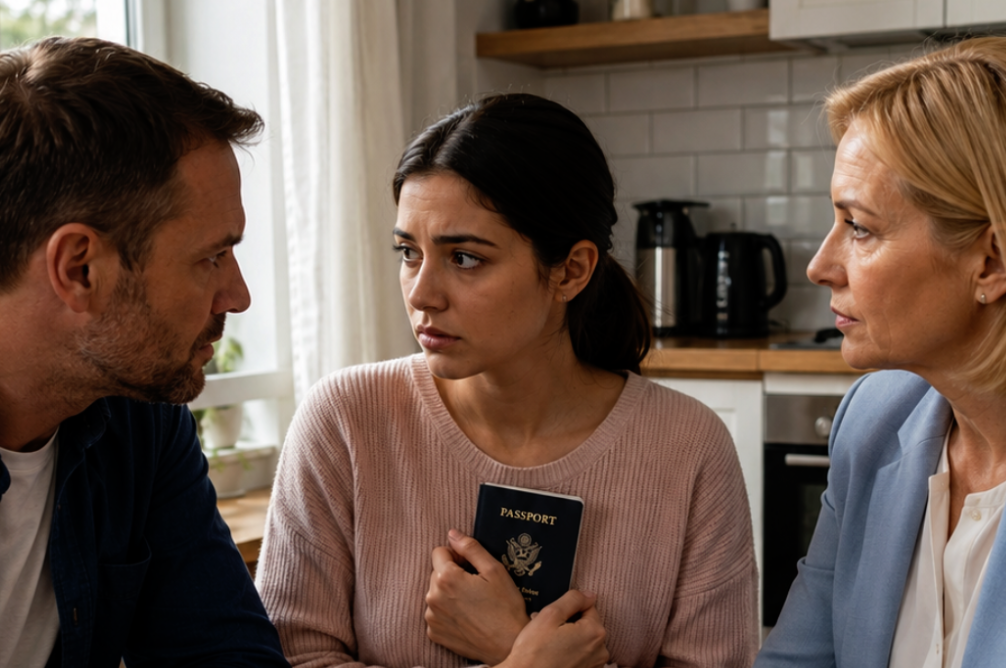
“Sign here. Tomorrow at nine fifteen, they’re expecting us at the MFC,” Dmitry said, placing the application in front of me. Next to it, he set down my passport, as if it were an ordinary saltshaker he could take from the cupboard without asking.
I looked at the paper, then at my mother-in-law. Tamara Igorevna was sitting at my kitchen table in a light-colored suit and was already explaining to Alla where it would be more convenient to put a wardrobe in my house.
“You’ll clear out the back room, Nadya,” she said calmly, as if we had already discussed it. “There’s a good spot by the window. I’ll put my wardrobe, chest of drawers, and armchair there. Your desk can be moved into the hallway. It’s small.”
There were six people sitting at the table: me, my husband Dmitry, his mother Tamara Igorevna, his sister Alla, Alla’s husband Vadim, and Dmitry’s aunt Nina Pavlovna. I had been called to the table last. All day, Dmitry had been saying that “the family just wanted to have dinner,” but in reality, he had arranged a family meeting in my own house and had already laid out the documents in advance.
“Where did you get my passport?” I asked.
Dmitry grimaced as if I had ruined everyone’s evening over some trivial matter.
“In the dresser. Where it always is. Don’t start in front of people.”
“In front of what people? This is my house.”
Alla immediately cut in.
“Nadya, don’t start with that. Mom isn’t a stranger. It’s not like we’re moving someone in off the street.”
I took my passport from the table, but Dmitry covered it with his palm.
“Wait. First sign the application. Tomorrow we’ll simply submit the documents, and the issue will be closed.”
At that moment, I saw another piece of paper underneath the application. An electronic queue ticket. The MFC, nine fifteen, service: registration at place of residence. They had not planned to ask me. They had already scheduled everything.
The house in the village of Yasny, on Sadovaya Street, number 11, belonged to me. Ninety-two point four square meters, seven sotkas of land, a deed of gift dated May 18, 2021, and an entry in the Unified State Register of Real Estate dated May 25, 2021. My mother had transferred the house into my name long before Dmitry appeared in my life with a suitcase, two jackets, and promises that he “didn’t need much.” After the wedding, I agreed to register him here myself. A husband, a shared household, a normal family. Back then, it seemed to me that registering my husband changed nothing about my right to the house.
But now my husband was sitting at my table, holding my passport, and, in front of his relatives, waiting for me to sign my consent to register his mother.
“Give me my passport,” I repeated.
Dmitry kept his hand there for another second, then moved it away. In front of his relatives, he did not want to look like a man forcibly holding on to his wife’s document. I took the passport and put it into the pocket of my house cardigan.
Tamara Igorevna looked at this with offense.
“So that’s how it is. I’m your husband’s mother, and you’re hiding your passport from me.”
“Not from you. From people who take it without asking.”
“Nobody stole it,” Dmitry said sharply.
“I didn’t use that word. I said you took it without asking. Do you understand the difference?”
Vadim leaned back in his chair and smirked.
“Nadezhda, why are you acting like you’re being interrogated? The house is big. There’s enough space. Your husband is registered here. His mother will live with her son. What’s the big deal?”
“Tamara Igorevna has her own apartment on Lesnaya Street.”
“It’s being renovated,” Alla said. “You know that.”
“I know they’ve been talking about that renovation for three years.”
Tamara Igorevna tapped her fingernail on the table.
“The apartment is small and inconvenient. This is a proper house. I need to establish myself here so I won’t have to ask permission every time I want to come in.”
She said the words “establish myself” casually, as if she were talking about a shelf in the bathroom. Dmitry did not even correct his mother. Alla stayed silent too. Vadim looked at me as if I was supposed to appreciate the honesty of the wording.
I looked toward the hallway and only then noticed two travel bags by the shoe cabinet. On one of them lay a bag with house slippers and a robe. In the corner stood another box, tied with tape. Written on it in marker were the words: “Mom’s. Dishes.”
“So you didn’t come here for dinner,” I said. “You came here to move in.”
Dmitry quickly stood up.
“Nadya, don’t put on a show. Mom will spend the night. Tomorrow we’ll arrange the registration, and then we’ll calmly sort out the room.”
“What room?”
“The back one. You only spread papers around in there anyway.”
That phrase hit harder than a loud scandal would have. In the back room stood my work desk, documents, printer, a box with my mother’s letters, and a shelf with things I did not want to hide in someone else’s corners. Dmitry knew that. But in front of his relatives, he called my work “papers,” so it would be easier for his mother to walk in there with a chest of drawers.
“The back room is occupied,” I said. “And the house is occupied. It is not empty.”
“One woman doesn’t need this much space,” Tamara Igorevna snapped. “You live like a lady of the manor while your husband’s mother sits in a cramped apartment.”
Nina Pavlovna, who had been silent until then, carefully put down her fork.
“Nadya, maybe there’s really no need to be so harsh. They’re family, after all.”
“Family doesn’t bring an application with my personal information and take my passport from the dresser.”
Dmitry slid a pen toward me.
“Sign it. Let’s do this without a circus. We’re family.”
“Family doesn’t schedule an MFC appointment for me behind my back.”
“I told you in advance there would be dinner.”
“You told me about dinner. Not about registering your mother in my house.”
Alla exhaled irritably.
“Listen, you just don’t want to help. Say that, then. Don’t hide behind paperwork.”
“Fine. I’ll say it: I do not want to register Tamara Igorevna in my house.”
“Do you understand how that sounds?” Dmitry asked.
“Better than your ‘I found your passport and already booked us an appointment at the MFC.’”
He did not answer. Vadim decided the silence was on his side.
“And if Dmitry is registered here, he has a say too. Don’t pretend he’s nobody.”
“Dmitry has the right to live here while we have a marital relationship and my consent. But he is not the owner. He cannot move third parties in here and promise them a room.”
“You’re humiliating your husband in front of everyone,” Tamara Igorevna said.
“No. I’m bringing the conversation back to the facts.”
I stood up, went to the sideboard, and took out a clear file with copies of documents. After Dmitry’s registration, I kept them separate from the common drawer. Not because I had been expecting an evening like this, but because once before, I had noticed my mother-in-law leafing through my papers while I was washing dishes after her visit.
Dmitry saw the file and smirked.
“Here comes the lecture.”
“Not a lecture. A reality check.”
I placed the EGRN extract and the deed of gift on the table. The relatives immediately started looking not at the documents, but at one another. In words, “we’re family” sounded confident. On paper, everything looked different.
“The owner of the house is Romanova Nadezhda Sergeevna,” I said. “The basis is a deed of gift dated May 18, 2021. Dmitry Romanov is not listed as having ownership rights.”
Alla crossed her arms.
“So what? He’s your husband. He invested in it.”
“In what exactly?”
“In the renovation.”
I looked at Dmitry. He knew this conversation well. The house had been renovated before the wedding. After the wedding, he had bought two light fixtures, a bathroom shelf, and a drill, which he later took to work.
“Dima, tell us what you invested in,” I asked.
“Don’t lecture me like a little boy.”
“Then don’t pretend in front of witnesses that my house became common property because of two light fixtures.”
Vadim snorted.
“There it is, a real family. Counted everything down to the last kopeck.”
“Yes. Because you started dividing up rooms that don’t belong to you.”
After those words, Tamara Igorevna stood up and went into the hallway. A minute later, she returned with one of the bags and put it right by the kitchen doorway.
“I am staying here tonight. Dima, tell your wife that a mother is not sent out into the street for the night.”
Alla immediately joined in.
“Mom has been on the road. She can’t keep going back and forth. Do you want her to go back with all her bags?”
“She has an apartment. You have an apartment. Vadim has a car. That is not the street.”
Alla fell sharply silent. Vadim stopped smirking. That was when it became clear that the plan had not been only Tamara Igorevna’s. Alla also wanted their mother to end up at my place. She had no intention of accommodating her in her own home.
“It’s inconvenient for us right now,” Alla said in a different tone. “We’re renovating.”
“Tamara Igorevna is renovating too. So you decided it would be convenient at my place.”
Dmitry came closer and lowered his voice.
“Nadya, you’re crossing a line now. Mom is staying at least for the night. Tomorrow we’ll arrange the registration, and then we’ll calmly discuss everything.”
“No.”
“What do you mean, no?”
“She is not staying. There will be no registration. You cancel the MFC appointment yourself.”
He looked at me as if, in front of the guests, I had spoiled not his plan, but his authority. Yesterday he had been a husband in his wife’s house. Now he was trying to become the master by using an audience.
“You’re destroying our marriage over a formality,” he said.
“A formality isn’t destroying the marriage. The marriage is being destroyed by the person who takes his wife’s passport, fills out an application without her consent, and invites relatives so she won’t be able to refuse.”
Nina Pavlovna said quietly:
“Dima, honestly, this really didn’t turn out well.”
Tamara Igorevna immediately turned to her.
“Didn’t turn out well? What’s disgraceful is treating your husband’s mother like an outsider.”
“Anyone becomes an outsider when they are being moved in without the owner’s consent,” I said.
My mother-in-law was no longer looking offended. She was looking angry.
“You might as well call the police.”
“I will, if the bags stay here and you continue demanding my signature.”
Dmitry abruptly reached for the application.
“Give me the paper.”
“No. It contains my information and my home address. I’m keeping it.”
“This is Mom’s application.”
“Then Mom can explain to the district police officer who filled in my information and why my passport was lying next to it.”
He moved his hand away, but not immediately. That pause contained the whole essence of the evening: they had counted on me being afraid of a scandal in front of the family. For the first time that dinner, I acted faster than they could come up with more pressure.
I took out my phone and dialed 112. I spoke calmly: I gave the address and explained that my husband’s relatives were in the house with belongings, demanding that I sign consent for the registration of an adult, while the owner did not give consent. I separately said that my passport had been taken from the dresser without permission. They asked me to wait for the district police officer.
After the call, the conversation changed. Tamara Igorevna stopped demanding a room and sat back down. Alla whispered with Vadim. Dmitry paced from the window to the table and kept repeating that I had “crossed the line.” I answered once: the line had been crossed by the people who brought bags before getting my consent. After that, I stopped arguing.
District police officer Sergey Antonov arrived about forty minutes later. He did not lecture anyone or hold a family trial. First, he asked for my passport and the documents for the house, then asked Dmitry whether he had ownership rights. Dmitry replied that he was the husband and was registered at that address. The officer repeated the question. Dmitry said he had no ownership rights.
Then the officer turned to Tamara Igorevna.
“Do you have the owner’s consent to live here and be registered here?”
“She’s refusing out of spite,” my mother-in-law said.
“I asked whether you have it or not.”
“No.”
“Then the belongings do not get unpacked. The residence and registration of an adult are resolved with the consent of the owner or through the legally established procedure. You do not pressure someone to sign in front of relatives.”
Vadim tried to object that “family is more important than paperwork,” but the officer stopped him briefly:
“Family relationships do not replace property rights.”
He took statements. I showed him the application, the MFC ticket, and the bags in the hallway. I asked him to note that my passport had ended up on the table without my consent. The officer wrote everything down and told the relatives to leave so that the conflict would not continue through the night.
After he left, no one talked about the back room anymore. Tamara Igorevna sat with her back straight and looked at Dmitry as if he had betrayed her. Alla suddenly remembered that their place was “cramped and under renovation.” Vadim stopped talking about how much space there was. All the family concern ended exactly where the possibility appeared of taking Tamara Igorevna into their own home.
“Dima, decide,” my mother-in-law said. “I’m not going back with bags.”
“Then go to Alla’s,” he answered tiredly.
Alla immediately flared up.
“There’s absolutely no way for us right now. We have things everywhere, and Vadim is leaving early tomorrow.”
“Then to Lesnaya,” Dmitry said.
“It’s inconvenient there.”
“She can’t stay here.”
That “can’t” was not a defense of me. Dmitry said it only because he had seen the documents, the application, the police officer, and Alla herself backing away from her own idea. But that was enough for me. The plan stopped being their collective decision and became what it had been from the beginning: an attempt to settle my mother-in-law in my house using someone else’s hands.
They left shortly after ten. Tamara Igorevna left two bags in the entryway, declaring that they would be picked up in the morning because she was “not a porter.” I did not argue. I photographed the bags and sent Dmitry a message: “Tamara Igorevna’s belongings must be removed by 10:00 on May 21, 2026. I do not consent to her residence or registration in the house at 11 Sadovaya Street. All further matters in writing.”
He read it almost immediately and replied: “Cruel.”
I wrote: “Legal.”
Dmitry did not come home that night. He called around half past midnight, said he was staying at his mother’s, and once again tried to turn the conversation into guilt: after something like this, he said, it was impossible to live with a wife. I did not argue or persuade him. I only said that the house documents and my passport were no longer kept in common access, and that my answer regarding the registration of his mother had already been given.
On the morning of May 21, the bags were still in the same place. I put a sheet of paper beside them: “Tamara Igorevna’s belongings. Pick up by 10:00.” Then I called Marina Sergeevna, a lawyer I had previously consulted about the house. I explained everything without emotion: my husband had taken my passport, the application had been prepared, relatives had arrived with belongings, and the district officer had recorded the conflict.
Marina Sergeevna did not frighten me with courts or terrible consequences. She said one simple thing: sign nothing, accept demands only in writing, keep my passport and documents separately, and if there was another attempt to move someone in, call the police again and document the owner’s refusal. She separately advised me to keep the MFC ticket and my correspondence with Dmitry.
Dmitry appeared at nine forty. Alone. In the entryway, he saw the paper on the bags and my phone in my hand.
“Filming again?” he asked.
“Documenting that you are taking the belongings.”
“So now I’m a stranger to you?”
“You are a person who took my passport yesterday and tried to pressure me into signing in front of relatives.”
He wanted to answer, but stayed silent. He took the first bag, then the second. A box of medicine and a small calendar fell out of the bag with the slippers. Dmitry picked everything up himself. When he carried the belongings out to the car, he came back for his jacket, charger, and documents. He placed his set of keys on the kitchen table.
“Not because you’re right,” he said. “I just find it disgusting to be somewhere my mother was thrown out of.”
“Leave the keys on the table. We’ll discuss everything else in writing.”
He looked at me for a few more seconds, as if expecting me to start justifying myself. I did not. Then he left and closed the door.
That same day, I sent him an email. No long explanations, only facts: on May 20, he had taken my passport without consent, prepared an application to register Tamara Igorevna, brought relatives and belongings, and on May 21, the belongings had been removed. At the end, I wrote that I did not consent to his mother living in or being registered in my house, and that any discussions about third parties in the house would be accepted only in writing.
In the evening, Alla called. She began without greeting:
“You got what you wanted. Mom has been on pills all day, Dima is furious, and the family is falling apart.”
“Alla, if you feel so sorry for Mom, take her in yourself.”
It became noticeably quieter on the other end.
“It’s really inconvenient for us right now.”
“It’s inconvenient for me too.”
“You’re cold, Nadya.”
“No. I simply didn’t sign something that had already been decided for me.”
Alla hung up. After that call, it became completely clear to me: none of them thought about Tamara Igorevna the way they had claimed at the table. They did not want to protect her. They wanted to place her somewhere convenient. Preferably at my place, in the back room, with my consent on paper.
Two days later, Dmitry sent a message: “I’m filing for division of property. We’ll see what the court says about your house.”
I replied briefly: “The house was received under a deed of gift. As for the light fixtures, shelf, and drill, you may provide receipts. Everything else through the lawyer.”
After that, he went silent for almost a week. When we filed for divorce on June 21, 2026, he still tried to talk about the “family home,” but quickly moved on to household purchases. The lawyer put them on a separate list, provided Dmitry could confirm the expenses with documents. The house was not included in that list.
Tamara Igorevna never registered on Sadovaya Street. Her wardrobe never stood by the window. Her chest of drawers never took over the back room. The bag with slippers left together with the suitcases, and the MFC ticket remained in my file next to the unsigned application.
After that dinner, there were fewer voices in the house, but more order. Dmitry’s keys lay in an envelope, the documents were removed from common access, and the back room remained what it had been before their family decision: my workspace, not someone’s way to “establish themselves.”