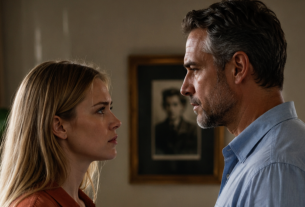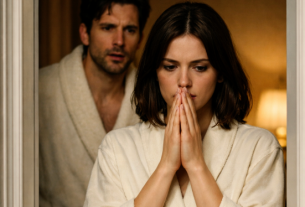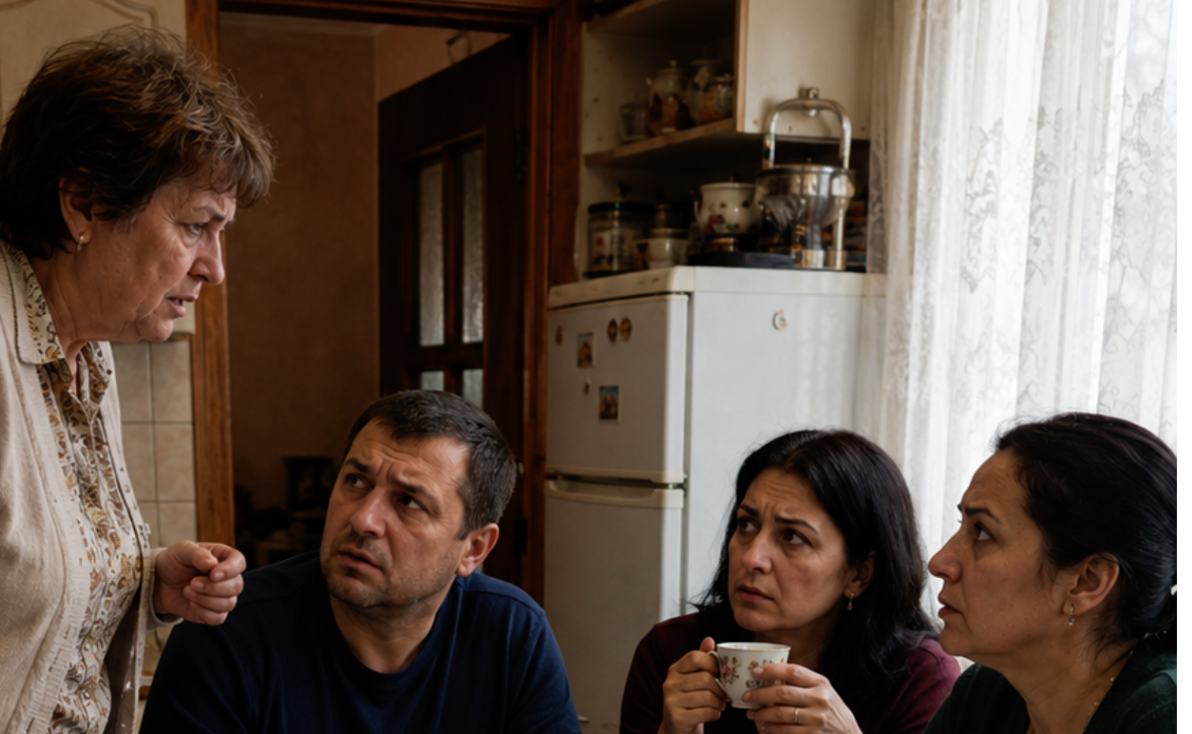
“Pavel, just don’t tell me later that I laugh too loudly,” a familiar female voice drifted from my kitchen. “Your mother will arrive on Sunday. By then everyone will already be used to it.”
“She’ll grumble and calm down,” my son replied. “The main thing is, the money’s already been taken, and keeping the room empty is stupid.”
“Nadezhda Pavlovna is kind,” another woman said, and her voice was unfamiliar to me. “Older people are afraid of change at first, but later they’re grateful when everything is arranged sensibly.”
I was standing in the hallway with my sanatorium bag by my foot and the keys in my hand. I had returned two days early because the schedule had changed, and now I was listening to people in my own apartment distributing my consent without me.
I was sixty-three years old, and suddenly I understood a simple thing: if you stand quietly in your own hallway, people very quickly begin to count you as furniture.
I took off my shoes, placed my bag by the coat rack, and walked toward the kitchen.
The door was slightly open, and on my table lay someone else’s bags, a bunch of spare keys, and a sheet of paper with a large heading about the small room. On the edge of the table stood my cup with daisies on it, and Oksana was drinking from it.
“Good afternoon,” I said, entering. “Who exactly has already gotten used to my apartment?”
Oksana, Pavel’s wife, was sitting by the window and immediately put my cup down on the saucer. Beside her stood a woman of about forty with a travel bag, while Pavel was holding money in his palm and clenched his fingers so sharply that it seemed I had walked not into my own home, but into someone else’s conversation.
“Mom, why did you come back?” he asked, getting up too quickly. “You were supposed to be at the sanatorium until Sunday.”
“I was supposed to be resting,” I replied. “Not listening from the hallway while you signed me up as consenting in advance.”
Oksana smiled far too brightly, but her laughter had already vanished. I had recognized that laugh behind the door immediately: she always laughed that way when she wanted to turn someone else’s discomfort into her own celebration.
“Nadezhda Pavlovna, please don’t start with that strict voice right away,” she said. “We were just about to explain everything to you calmly.”
“Explain what?” I asked. “Why are my keys lying on my table next to someone else’s bag?”
The woman with the travel bag stood up. She looked embarrassed, but not guilty, as if she had been promised a lawful room and only now realized that the owner knew nothing about it.
“My name is Rimma,” she said. “Pavel and Oksana rented your small room to me for a month.”
“Rented?” I looked at my son. “Pavel, repeat that yourself, so I don’t think I misheard.”
He put the money on the table, but covered the banknotes with his palm. His face became angry, the way it had in childhood when he was caught with unfinished homework.
“Mom, don’t turn this into a disaster,” he said. “The room is empty, you live alone, and Rimma has nowhere to stay while her sister’s place is being renovated.”
“The room is not empty,” I replied. “My things are there, my books, and my sewing machine.”
“The machine can be moved,” Oksana cut in. “We already folded the fabrics neatly into a box. We didn’t throw anything away.”
“You touched my things?” I asked. “While I was at the sanatorium and thought you were simply watering the flowers?”
“Not at the sanatorium, on vacation,” Pavel muttered. “Let’s be honest, Mom, you yourself said it would be good for you to have a change of scenery.”
“Don’t change the subject,” I said. “Watering flowers and renting out a room are different things.”
Rimma slowly sat back down on the edge of the chair. She looked from me to Pavel, and worry began to show on her face.
“I paid 38,000 rubles,” she said quietly. “They told me you had approved everything, but simply couldn’t meet me in person yet.”
I turned to my son. He was no longer looking me in the eyes, and Oksana began straightening the tablecloth, as though a fold in the fabric was more important than what had just been said.
“You took the money?” I asked. “And what exactly did you promise for that amount?”
“A month of living here and the keys,” Rimma answered. “I even asked whether the owner had definitely agreed, because I didn’t want to bother anyone.”
“And they told you the owner had agreed?” I clarified. “Who exactly said that?”
Oksana threw up her hands. She always did that when she wanted to turn a question into a whim.
“Well, of course I said it,” she said. “Nadezhda Pavlovna, you would have agreed anyway if we had explained everything properly.”
“Then why didn’t you explain before taking the money?” I asked. “Why are my keys already on the table?”
Pavel sat down across from me. He was forty-one years old, but now he spoke in the tone of an offended teenager who had not been allowed to manage his mother’s wallet.
“Because you answer everything with refusal,” he said. “And we have renovations, debts, and a child to get ready for school.”
“You have your own expenses,” I said. “And I have my own apartment.”
“The apartment will be mine someday anyway,” he snapped. “What’s so wrong if it starts benefiting the family now?”
The kitchen fell silent. Even Oksana stopped rubbing the edge of the saucer with her finger.
“Now it’s clear,” I said. “You weren’t renting out a room. You were renting out your future property, which you do not yet own.”
“Don’t cling to words,” Pavel waved me off. “I’m your only son.”
“An only son does not become the owner while his mother is still opening the door with her own key,” I said. “And he certainly does not take money for her room.”
Oksana laughed again, but the laugh came out short and uneven. She got up, went to the stove, and for some reason began adjusting the kettle.
“You’re taking everything too personally,” she said. “We didn’t bring in strangers. Rimma is decent, quiet, and pays right away.”
“I take personally what happens personally in my apartment,” I replied. “And my kettle does not need your mediation either.”
Rimma took hold of the handle of her bag. It was obvious she felt uncomfortable sitting in the middle of someone else’s family quarrel.
“Nadezhda Pavlovna, if you didn’t know, I’ll leave,” she said. “But my money must be returned.”
“Of course it must,” I said. “And it will be returned now.”
Pavel lifted his head sharply. The money beneath his palm seemed to grow heavier.
“That won’t be possible right now,” he said. “We’ve already spent part of it.”
“On what?” I asked. “On the boxes you moved my things into?”
“On materials,” Oksana replied. “We bought paint and shelves for the child’s room. We didn’t think you’d start an interrogation.”
“You started the interrogation when you took money for someone else’s room,” I said. “Rimma should not have to wait while you figure out where to get it back.”
Rimma turned pale. She was already standing by the chair, pressing her bag against her leg.
“I can’t be without that money,” she said. “Tomorrow I have to pay for another place if I can’t stay here.”
“You cannot stay here,” I replied. “But the people who took your money must return it.”
Pavel struck the table with his palm. Not hard, but enough for my cup to jump on the saucer.
“Mom, do you understand what you’re doing?” he asked. “You’re humiliating us in front of a stranger.”
“No,” I said. “You humiliated me in front of a stranger by presenting me as an owner who supposedly agreed.”
“We wanted to do what was best,” Pavel said. “The room is empty, Rimma is a decent person, and the money would be useful for the family.”
“In a family, people do not earn money off their mother while she has gone away on a sanatorium voucher,” I replied. “And they do not offer a tenant consent that does not exist.”
Oksana sat back down and crossed her arms. There was no more playfulness in her now, only irritation.
“Nadezhda Pavlovna, let’s be honest,” she said. “You live alone in two rooms, while we squeeze ourselves in and count every kopeck.”
“Then solve your expenses according to your own means,” I replied. “But do not rent out my room without my word.”
“You’re always saying ‘mine, mine, mine,’” Oksana said. “Your grandson is growing up, and you keep doors closed.”
“Don’t hide behind the child,” I said. “His school bag does not give you the right to my keys.”
Pavel took the sheet from the table and tried to fold it in half. I reached out and held down the edge.
“Show me the whole paper,” I said. “Since it’s lying on my table.”
“It’s just a receipt,” he said. “For Rimma’s peace of mind.”
“For whose peace of mind?” I asked. “Does the receipt say that I am providing the room?”
Rimma looked at Pavel. He was silent, and Oksana turned away toward the window too quickly.
“It says the owner does not object,” Rimma said. “That’s what they showed me when I handed over the money.”
I unfolded the sheet and placed it in the center of the table. At the bottom was my surname, but there was no signature, only an empty line, as if they had planned to confront me later with a completed fact.
“Read it aloud, Pavel,” I said. “Especially the part where I supposedly do not object.”
“Mom, don’t,” he said. “You’re humiliating me on purpose.”
“No,” I replied. “I’m reading a paper where my name was used without my consent.”
I took the sheet by the upper edge and turned it toward Rimma. On the back was a list: the small room, access to the kitchen, a set of keys, the length of stay, and the amount.
“There it is, your main work,” I said. “Not paint, not shelves, and not helping Rimma, but a paper with my surname and a blank space for my signature.”
Oksana swallowed nervously. Pavel reached sharply for the sheet, but I pulled it closer to myself.
“The paper stays with me,” I said. “It has my surname, my apartment, and your promise made in my name.”
“You have no right to take our receipt,” Pavel said. “It’s our document.”
“It would be yours without my surname,” I replied. “But with my surname on it, it becomes proof that you tried to formalize my consent after the fact.”
Rimma slowly sank onto the chair. She looked at the empty signature line as though only now realizing what she had been dragged into.
“They told me you would sign it in the evening,” she said. “That you’re simply a cautious person and like paperwork.”
“I like paperwork that I read before signing,” I replied. “Not after money has already been taken for my room.”
Pavel ran a hand over his face. His usual confidence began to crumble, but he was still trying to hold his tone.
“All right, we made a mistake with the paper,” he said. “But the essence is fine: the room is free, it’s convenient for Rimma, and we need the money.”
“The essence is that you took money for property you do not have the right to manage,” I said. “Everything else is decoration around that fact.”
Oksana leaned forward. Her voice became quieter, but harder.
“If you ruin everything now, we’ll be the ones guilty in front of Rimma,” she said. “Do you enjoy putting your son in that position?”
“My son put himself in that position,” I replied. “And with my keys in his hand, no less.”
Rimma carefully pulled her travel bag closer to herself. She had already understood that she would not be spending the night here.
“I want my money back and I want to leave,” she said. “I don’t want any disputes with the owner.”
“You will get your money,” I said. “Now we will record who took how much and who owes how much.”
Pavel stood up abruptly.
“Mom, you’re crossing a line,” he said. “We could have solved this as a family.”
“You already solved it as a family while I was at the sanatorium,” I replied. “Now it will be solved properly.”
I took out my phone and dialed the number of the district police officer, which I had saved after a neighborhood dispute over noisy renovations. Oksana immediately straightened up.
“Nadezhda Pavlovna, why bring outsiders into this?” she asked. “We’re family.”
“Family does not rent out a room in the owner’s absence,” I replied. “And they do not take 38,000 rubles for it.”
Pavel stepped toward me, but Rimma suddenly said:
“No. I want everything to be clear myself.”
He stopped. Anger flickered across his face, not at me, but at Rimma, who had stopped being a convenient witness to their righteousness.
The duty officer listened to me and said I could come in with a statement or wait for an officer if all parties were present. I chose the second option, because everyone involved was sitting in my kitchen.
“You really called them?” Pavel asked. “On your own son?”
“I called someone who will record that my room was rented out without my consent,” I said. “And you carried kinship out the door yourself when you took the money.”
Oksana grabbed her bag and began gathering her papers from the table. I stopped her with my hand.
“Leave that,” I said. “You can take your bags. But the receipt and the list of keys stay.”
“The list of keys?” Rimma asked. “They told me there was only one set.”
I looked at Pavel. He darkened.
“How many sets did you make?” I asked. “Answer immediately.”
“One for Rimma,” he said. “And one spare, so we wouldn’t have to run to you.”
“Where is the spare?” I asked, now looking at Oksana. “Put it on the table right now, without searching or talking.”
Oksana took a small ring with two keys out of her bag. She placed it on the table sharply, as if I were the one who had stolen them from her.
“Here, take them,” she said. “Are you satisfied?”
“I’ll be calmer when the lock is changed,” I replied. “Because now I don’t know how many hands have held my keys.”
Pavel sat back down and covered his face with his palm. His familiar confidence did not collapse all at once, but in pieces: first Oksana’s laughter, then the receipt, and now the keys.
Rimma said quietly:
“I feel terribly awkward. I really thought everything had been agreed upon.”
“Your only fault is that you believed people who spoke confidently,” I replied. “But you will not live here, and your money will be returned.”
“Not today,” Pavel said. “I told you, part of it has been spent.”
“Today you return everything you still have,” I said. “For the rest, you write Rimma a receipt in front of the officer, because now she has to protect herself from your promises too.”
Oksana flared up and sharply lifted her head. This time her indignation was not about family, but about the money that would have to be taken back out.
“Why should we immediately take all the responsibility?” she asked. “Rimma is an adult too. She could have checked.”
“You were the ones who had to check with the owner,” I said. “And Rimma checked the way you allowed her to: she believed your receipt with my surname on it.”
The doorbell rang. This time I went to open it myself, without asking permission from those who had already tried to dispose of my door.
The officer entered calmly, without unnecessary noise. I showed my passport, the apartment documents, the receipt with my surname, the keys, and explained everything in order.
At first, Pavel tried to interrupt. Then the officer asked everyone to speak one at a time, and my son fell silent, because in front of an outsider his words no longer looked like a family request.
“Was money taken?” the officer asked. “And who exactly received the payment?”
“It was taken,” Pavel said. “But it was an agreement within the family.”
“With which of the owners exactly?” the officer asked. “Who is the owner here?”
I showed the document. Oksana lowered her eyes, and Rimma sighed heavily.
“My mother is the owner,” Pavel said. “But I’m her son.”
“A son is not the same as an owner,” the officer replied calmly. “If someone paid for accommodation based on your words, return the money or record the debt.”
Pavel looked at Oksana. She took out her phone and began writing to someone, but the officer asked them to resolve the matter there and then.
“We have 21,000 rubles right now,” Pavel said after a long pause. “We’ll return the rest in a week.”
“The balance is 17,000 rubles,” Rimma said. “I need a paper, because I already believed words once.”
“There will be a paper,” I said. “And without my surname as a party to the rental.”
Pavel wrote a receipt for Rimma. He wrote slowly, with an expression as though every letter were an injustice.
“Now the keys,” the officer said. “All sets that were made without the owner’s knowledge.”
Pavel took another key from his pocket. I didn’t even immediately understand why my breath caught: he had already said there were two sets, and the third was lying in his pocket.
“This one is mine,” he said. “Just in case.”
“For what kind of case?” I asked. “To enter when I’m not home?”
He did not answer. And the answer was no longer needed.
The officer wrote down the explanations and separately noted that the keys had been handed over to the owner. Then he asked Pavel and Oksana to remove from the room everything they had brought in without my permission.
Rimma received part of the money, a receipt for the remaining amount, and lifted her travel bag. Before leaving, she stopped at the kitchen doorway.
“Nadezhda Pavlovna, forgive me,” she said. “I truly didn’t want to move in through deception.”
“You are leaving with your bag and without my keys,” I replied. “That is enough.”
When the door closed behind her, the three of us remained in the kitchen. But it was no longer the same family kitchen: on the table lay keys, statements, and a paper where someone else’s scheme had become a fact.
“Mom, this could have been done without all that,” Pavel said. “You made us into strangers.”
“No,” I said. “You made me into a stranger when you decided I would come back on Sunday and get used to it.”
“We wanted to solve our problems,” Oksana said. “Your room is just standing there.”
“It is standing there because I decided so,” I replied. “Not because it is waiting for your tenant.”
Pavel got up and went into the small room. I followed him, because now I no longer trusted that my things were where I had left them.
The sewing machine had been pushed against the wall, the fabrics were lying in a box, and someone else’s bedspread was already lying on the bed. By the window stood a new shelf, still with the price tag on it, and on it lay a bag with Rimma’s linens.
“Is this yours too?” I asked. “Or did you decide my things weren’t good enough for a stranger?”
Oksana said nothing. Pavel removed the bedspread, folded it, and shoved it into a bag.
They collected the things in silence. I stood in the doorway of the room and watched someone else’s plans leave my space: travel bags, a cheap shelf, a box of paint, spare keys.
“I don’t need the key to your door anymore,” Pavel said when he came out into the hallway. “Live peacefully.”
“You didn’t need it for me,” I replied. “That’s why I took it back.”
Oksana put on her jacket and, already at the threshold, suddenly tried to return to her usual tone. She smiled again, but now that smile solved nothing.
“Nadezhda Pavlovna, when you cool down, you’ll understand that we didn’t mean any harm,” she said. “We were just looking for a way out.”
“When you return the rest of Rimma’s money, then we’ll talk about harm and good intentions,” I replied. “Until then, you do not enter this apartment.”
They left. I locked the door and immediately called a locksmith.
“I need the lock cylinder replaced today,” I said. “Yes, urgently. Three keys, all handed to me.”
The locksmith arrived closer to evening. While he worked, I sat in the kitchen and looked at the bunch of old keys, which that very morning had seemed like an ordinary household trifle.
I paid 9,500 rubles for the replacement. I placed the receipt beside Pavel’s written note and the list of returned keys.
“Don’t give the keys to anyone,” the locksmith said, checking the lock. “Especially if there have already been extra copies.”
“Now I won’t,” I replied. “Not even for the flowers.”
He left, and I returned to the small room. I placed the sewing machine back by the window, arranged the fabrics on the shelves, and removed from the bed the stranger’s bedspread they had forgotten to take.
Then I carried the bedspread into the hallway and wrote Pavel a short message: “Pick it up by the entrance door. Do not enter the apartment.”
I sent it and placed the phone on the windowsill.
Later, Rimma called. Her voice was tired, but calm.
“Nadezhda Pavlovna, Pavel transferred the remaining 17,000 rubles,” she said. “I wrote to him that I have no financial claims.”
“Good,” I replied. “And I’m sorry you ended up in my kitchen in such a story.”
“You are the one who needed to apologize least of all,” Rimma said. “From now on, I’ll ask the owner personally.”
When the call ended, I sat at the table for a long time. From the sanatorium, I had brought a jar of herbal tea, a folded towel, and the hope of quiet days at home.
Instead, I was greeted at home by someone else’s laughter. But now that laughter no longer sounded in my kitchen.
The next morning Pavel sent a message: “We returned the money. Don’t call for now.”
I did not answer, because I had no intention of persuading my grown son to respect the door through which he had entered with someone else’s receipt.
I took the old towel from my sanatorium bag and wiped the kitchen table. Then I thought: the table at which they had tried to replace me with a signature had to become mine again.
After that, I placed a vase with dried lavender from the sanatorium in the center of the table and put the only new set of keys beside it.
Now, in my kitchen, no one rents out rooms, no one laughs at my absence, and no one makes decisions for the owner.
Someone else’s plans left this place together with someone else’s bag.