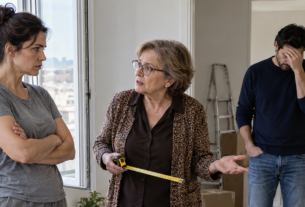
Lyudmila Borisovna stood with her back to the doorway, facing the open refrigerator as she carefully transferred containers of food into a large checkered bag. The cutlets went in. The syrniki left over from yesterday went in too. Half a stick of sausage and a jar of homemade pickles that Nika and her mother had preserved back in the autumn.
In the hallway by the mirror, two of her mother-in-law’s friends were cooing over the stroller in which three-year-old Denis was sitting.
“Oh, Lyudochka, he’s the spitting image of his grandfather when he was young!” exclaimed one of them, Zinaida Pavlovna, a heavyset woman wearing a mink hat despite the warm weather. “And look at those cheeks! Those cheeks!”
“Everything they have here is homemade,” Lyudmila Borisovna replied without turning around as she added a packet of cheese to the bag. “My daughter-in-law cooks quite well, I have to admit. I make sure my grandson doesn’t go hungry.”
Nika froze in the kitchen doorway, holding grocery bags in both hands. She had just returned from work, her legs were aching, and the bags contained everything she had spent an hour choosing from the discounted shelves, carefully comparing price tags and putting the more expensive items back.
Now everything she had so painstakingly budgeted for was being transferred into her mother-in-law’s checkered bag.
“Hello,” Nika said quietly.
Lyudmila Borisovna turned around without the slightest trace of embarrassment.
“Oh, Nikusya, you’re home. I thought I’d take a few things to tide me over until my pension comes. There’s nothing at my place until the tenth, while your refrigerator is full. It would be a shame to let it all go to waste.”
The women in the hallway fell silent and listened.
“Go ahead,” Nika said.
She placed her own bags on the table.
What else could she say? Not in front of guests, not in front of strange women in mink hats. Telling her mother-in-law not to take the food would mean gaining a reputation throughout the neighborhood as a greedy daughter-in-law who begrudged an elderly woman a bite to eat.
Nika feared that almost more than she feared an empty refrigerator.
And so it continued.
It had been going on for almost a year.
At first, everything had been different. Five years earlier, when Nika married Anton, Lyudmila Borisovna had seemed like a gift. She was lively and energetic, nothing like the endlessly complaining mothers-in-law from jokes.
She lived separately in her own one-room apartment three bus stops away. She visited in a friendly way, bringing treats, and babysat little Denis after he was born. Nika had been delighted. This was what a normal family was supposed to be like—a family with a grandmother, where everyone behaved like decent human beings.
But somehow, the treats gradually stopped while the visits did not.
In fact, they became more frequent.
First, Lyudmila Borisovna began arriving at lunchtime.
“I missed my grandson, so I thought I’d stop by.”
Then she began coming for lunch and dinner.
Eventually, she simply stayed all day, moving between the kitchen and the living room like the mistress of the house who had stepped out for a moment and then returned.
She always arrived empty-handed.
She left with her hands full.
“Would you like some tea, Lyudmila Borisovna?” Nika would ask during the first few months.
“Pour me some, dear, pour me some. And bring whatever you have to go with it. My cupboards at home are completely bare. My pension is tiny, as you know.”
Nika knew.
Or rather, she thought she did.
Her mother-in-law constantly complained about her miserable pension, about how difficult life was for a woman living alone and how everything kept getting more expensive. Nika was not heartless, so she fed her, packed food for her, and deprived herself in order to help.
Anton saw nothing wrong with it.
“She’s my mother. She lives alone. What is she supposed to do, choke down every meal by herself? Let her eat with us.”
“I don’t mind her eating with us, Antosha. But she doesn’t just eat and leave. She takes food home with her. Bags of it.”
“So let her. They’re only a couple of cutlets. Are two cutlets going to bankrupt us?”
A couple of cutlets.
That was what Anton always said.
“A couple of cutlets.”
“One bowl of soup.”
“A slice of bread for my own mother.”
Whenever Anton spoke, everything his mother took shrank into something tiny and insignificant, something Nika should have been ashamed even to mention.
Every time, Nika ended up feeling petty, miserly, and unworthy, as though she were the one taking food from a helpless elderly woman instead of the other way around.
Saving money was already difficult for them.
They rented a two-bedroom apartment on the outskirts of the city. Both of them worked—Nika as an accountant at a small company and Anton as a mechanic at an auto repair shop.
Every month, they saved whatever they could while denying themselves nearly everything. They had not taken a vacation in four years. Nika was still wearing the coat she had bought before the wedding. They bought Denis clothes that were too large so he could grow into them, and only when they were on sale.
They were doing it all for one purpose: the down payment on a mortgage.
Their own apartment.
A home where Denis could have his own room instead of a little corner behind a wardrobe. A place where they would no longer depend on a landlady who threatened to raise the rent every year.
For the sake of that dream, Nika counted every kopek.
She kept a spreadsheet on her phone and entered every expense down to the last ruble.
That was why she eventually began noticing that the numbers did not add up.
Her mother-in-law complained about poverty, yet every two months she went to a health resort to improve her well-being.
She tearfully claimed she could not afford her medication, yet she visited a cosmetologist. Once, Nika had seen a receipt fall out of Lyudmila Borisovna’s purse with her own eyes.
“Correction, Botox, facial cleansing.”
The total was equal to Nika and Anton’s entire weekly grocery budget.
“Anton,” Nika said after picking up the receipt. “Your mother says she doesn’t have enough money for bread. Then what is this?”
Anton glanced at it and shrugged.
“She’s a woman. She wants to take care of herself. What’s wrong with that? Maybe her friends helped pay for it. Maybe there was a discount. Why are you always picking on my mother, Nika?”
Nika said nothing.
She folded the receipt and returned it to her mother-in-law the next time they met. Lyudmila Borisovna snatched it from her, muttered a quick thank-you, and did not mention poverty again for the rest of that day.
But things only became worse.
The problem had long since stopped being only about food.
Lyudmila Borisovna had grown accustomed to acting like the mistress of the house. She rearranged the dishes in the kitchen because “everything is kept in the wrong place.” She criticized Nika’s cooking because it was “too salty” or “too tough,” or because “that’s not how I used to cook for Antosha.”
She also interfered in the way Denis was being raised.
“Why are you giving him porridge in the morning? He needs meat.”
“Why are you making him sleep alone? Let him sleep with you.”
She ruled over a home toward which she did not contribute a single ruble as though it were her own private estate.
Whenever Nika tried to establish even the gentlest boundary, Lyudmila Borisovna turned it against her.
“Lyudmila Borisovna, money is genuinely tight for us right now. We’re trying to save. Perhaps you shouldn’t come for meals every day?”
“Oh, so that’s how it is!”
Her mother-in-law would press a hand to her chest, and her eyes would immediately fill with tears.
“So I’m eating you out of house and home! Your own mother is no longer welcome at her son’s table! Anton! Anton, can you hear what your wife is saying? She’s reproaching me over every bite I eat!”
Anton would come in, frowning, and say to his wife:
“Nika, why did you have to say that? Starting a scandal over a bowl of soup. She’s my mother.”
Nika would fall silent.
She would swallow her anger, walk into the kitchen, and chop onions for longer than necessary so she could blame them for the burning in her eyes.
“Over soup,” she would mutter to the knife. “Of course. It’s all over soup.”
She endured it because she believed they needed only a little more time.
Just a little more saving, and they would have their own apartment. Then everything would work itself out, and her mother-in-law would visit like a normal grandmother rather than descending upon their home like a swarm of locusts.
Nika clung to that thought like a passenger gripping the rail inside a shaking bus.
By the beginning of autumn, she and Anton had almost saved enough.
Almost.
Nika had calculated everything. Another couple of months, and they would have the down payment. They made an appointment with a bank for preliminary mortgage approval.
Nika walked into the bank as though she were going to a celebration. For the first time in five years, it seemed as though their dream was within reach.
The bank manager, a young woman named Olga, tapped at her keyboard, examined their income and savings, and performed several calculations.
“Based on your circumstances, this is the down payment you’ll need. How much do you currently have in the account?”
Nika told her.
Olga tapped at the keyboard again and frowned slightly.
“That isn’t enough. Unfortunately, you’re considerably short. At your current rate of saving, it will take you another eight to ten months to reach this amount.”
“Eight to ten months?” Nika leaned forward. “But I calculated everything. We almost had enough two months ago.”
“This is the amount currently in the account.” Olga turned the monitor toward her. “See? Perhaps you spent more than you realized. It happens. Small expenses can disappear unnoticed.”
Nika stared at the figure without understanding.
They had been saving.
They had denied themselves everything.
Where had the money gone when they had nearly had enough during the summer?
Nika walked home despite being exhausted. She needed to walk so she could think.
Anton had stayed at work, and Denis was with Nika’s mother. The apartment greeted her with emptiness and silence.
Nika sat at the table, opened her spreadsheet and bank statement on her phone, and took an old shoebox out of a kitchen drawer. Throughout the year, she had thrown receipts and bills into it.
Then she began calculating.
Properly this time.
Not approximately, as she had before, but down to the last kopek.
She sorted the receipts by month. She wrote down every transfer. Then she began separating one category from another: what had been spent on their family and what had been spent on Lyudmila Borisovna.
“Transfer to Mom—medication, 4,000.”
“Groceries bought and taken by L.B.—approximately 3,500.”
“Health resort—8,000.”
“Paid her electricity and water because she forgot—2,200.”
“Food for her gathering with friends—2,800.”
“Another trip to the spa—6,000.”
Receipt after receipt.
Transfer after transfer.
The numbers formed a column. The column grew longer, crawling down the screen, and Nika continued adding everything together.
When she entered the final line and pressed the equals sign, she sat motionless for a long time, staring at the total.
That amount would have been enough.
More than enough.
It would not merely have completed their down payment. There would have been money left over to renovate Denis’s room—the room they had dreamed of while going without meat on weekdays and taking no vacations for four years.
That was how much they had spent in six months.
What about five years?
Nika did not attempt to calculate the five-year total.
The very thought made her feel ill.
She carefully placed the receipts back in the box, copied the total in large numbers onto a separate sheet of paper, placed it on the table, and waited.
She did not have to wait long.
The following evening, Lyudmila Borisovna appeared with empty hands, as usual, and went straight to the refrigerator. Denis was running around the living room with a toy car. Anton had not yet returned.
“Oh, you made borscht!” her mother-in-law exclaimed happily as she looked into the pot. “I’ll pour some into a jar to take home. And I’ll take a few of those cutlets too. You’re not a greedy person, are you, Nikusya?”
Nika rose from the table.
“Put the pot down, Lyudmila Borisovna.”
“What?” Her mother-in-law turned around with the ladle in her hand.
“I said put the pot back. Then sit down. I need to show you something.”
Something in her daughter-in-law’s voice made Lyudmila Borisovna set the ladle aside.
She perched on the edge of a chair with her lips tightly pursed, her entire posture radiating injured dignity.
Nika placed the sheet of figures in front of her.
“What is that?” her mother-in-law asked without even leaning closer.
“That is the amount of money our family has spent on you. And that is only for the last six months. Read it. The health resorts. The cosmetologist. Your electricity and water. The groceries you carry out of here in bags. The food for your friends. I calculated everything down to the last ruble.”
Lyudmila Borisovna glanced over the sheet and immediately shoved it away.
“You’ve been keeping count? You’ve been recording every kopek behind my back as though I were your enemy? What am I to you, some kind of freeloader?”
“You are a person who has been living at our expense for six months while visiting health resorts and getting Botox injections, while we buy Denis’s clothes from the clearance rack.”
Nika’s voice trembled, but she did not retreat.
“The bank rejected us yesterday. Do you know why? Because this amount”—she jabbed a finger at the paper—“is exactly what we were missing for the down payment. Exactly the amount you consumed from our family in six months.”
“How dare you!”
Lyudmila Borisovna turned scarlet, sprang to her feet, and sent the chair flying backward.
“I am his mother! I raised Anton! And now you’re throwing every bite of food in my face!”
“Stop stuffing yourself at my expense! I am not your personal cafeteria!” Nika roared.
Her mother-in-law shoved the list away again, and Nika snatched it up and threw it at her feet.
“Five years! I stayed silent for five years! I blushed and felt like the greediest woman alive because every time I said anything, you made me look like a miser who begrudged you a bowl of soup! But you were simply milking us! Calmly and methodically, year after year, you milked us like a cow—and still had the nerve to act like the mistress of our home!”
The front door slammed in the hallway.
Anton had returned.
Hearing the shouting, he rushed into the kitchen.
“What’s happening? What happened?”
“Antosha!”
Lyudmila Borisovna instantly changed her tone. She collapsed onto the chair, pressed both palms to her cheeks, and allowed her voice to tremble.
“My son, she called me a thief! She’s throwing me out! I came to see my grandson, and she attacked me with papers and figures! She said I’m eating you out of house and home! Me! Your own mother!”
Anton turned toward his wife, his face darkening.
“Nika, have you lost your mind? You’re shouting at my mother? Over what? Food again?”
“Take this.”
Nika picked up the sheet from the floor, smoothed it out, and pushed it into her husband’s hands.
“This isn’t about food. Read it. Just read it before you defend your mother. This is everything we have spent on her in six months. It is exactly the amount we were missing yesterday for the apartment. For your son’s room, Anton.”
Anton took the sheet reluctantly.
He began reading.
His lips moved as he silently pronounced each line. Nika watched him reach the final total at the bottom and stop.
“This… this is a lot,” he murmured. “But, Nika, not all of it was for her. Some of it was for medication and necessary things.”
“What medication, Anton?” Nika threw up her hands. “A woman who cannot afford medication goes to a health resort every two months! She visits a cosmetologist while I’m still wearing a ten-year-old coat! Can’t you see any of this? Or is it still just ‘one bowl of soup’ to you?”
Anton remained silent, staring at the sheet.
Realizing that her son was wavering, Lyudmila Borisovna immediately intensified her performance.
“Antosha, don’t believe her! She manipulated everything. Those accountants can make the figures say whatever they want! She’s trying to drive me out of your home. She always has been! She’s trying to come between a mother and her son!”
“I didn’t manipulate anything,” Nika said more quietly now, but no less firmly. “Here are the receipts. Here are the bank statements. Everything is in the box. Check every line yourself. Anton, I am not asking you to choose which of us you love more. I am asking you to look at the figures and answer one question. What are we saving for? An apartment for Denis, or your mother’s health-resort trips? Because we cannot afford both at the same time. There is only one pool of money.”
Anton raised his eyes from the sheet.
His expression was that of a man being asked to decide which of his own hands should be cut off.
“I… I need to think.”
“Think.”
Nika gave a bitter smile.
“Go ahead and think.”
That refusal to answer—that “I need to think”—at a moment when his wife stood before him with evidence in her hands while his son played with a toy car in worn-out clothes in the next room, told Nika more than any words could have.
The problem was not her mother-in-law.
Her mother-in-law simply did what she was allowed to do.
The real problem was that Nika’s husband was still unable to stand with his own family against his mother.
That realization was deeper and more frightening than any amount of money they had lost.
Lyudmila Borisovna left that evening offended to the very depths of her soul.
She pointedly refused to take either the cutlets or the borscht.
“Choke on your precious food!”
Then she slammed the door so violently that Denis dropped his toy car in the other room and began to whimper.
She disappeared for several weeks.
Instead of visiting, however, she launched an energetic campaign among the relatives.
She telephoned everyone—her sister, her cousins, and her old friends—and gave each of them her version of the story.
Her daughter-in-law was a snake who counted every kopek, reproached a poor elderly mother over every piece of bread, prevented her from seeing her only grandson, and tormented poor Anton.
It was a convincing and pitiful story, and some of the relatives eagerly believed it.
Anton’s aunts began calling Nika to lecture her.
“How could you, Ninochka? A mother is sacred. You cannot treat an elderly person that way.”
Anton found himself directly in the middle—between his deeply offended mother, to whom he was still her “poor little son,” and his wife, who no longer intended to remain silent.
During the first few weeks, he avoided discussing the matter. He walked around gloomily and looked at Nika reproachfully, as though she were the one who had destroyed the family’s peace.
Then he began to notice things.
It happened gradually, through small details.
One day he visited his mother and saw that she had a brand-new, expensive phone, still in its box.
“Where did that come from, Mom?”
“A friend sold it to me cheaply.”
A week later, Lyudmila Borisovna had a new coat, every bit as expensive as the mink hats her friends wore.
Then Anton happened to learn from one of his mother’s neighbors that she was planning another spa trip and had already bought the voucher.
This was during the very same period when Lyudmila Borisovna was telling the entire family that her daughter-in-law had left her without a morsel of bread.
Anton compared everything.
He remained silent, but he compared it.
He calculated the figures mentally. He compared his mother’s new purchases with the fact that he and Nika had not taken a vacation in four years and that his son slept in a corner behind a wardrobe.
Something inside him began to shift.
Slowly and noisily, like a rusted door that had not been opened in years.
One evening, after Denis had fallen asleep, Anton sat beside Nika in the kitchen.
For a long time, he said nothing, turning a cup around in his hands.
“Nika, I… calculated everything myself. Using the receipts in your box.”
Nika put down her knitting and looked at her husband.
“And?”
“You were right.”
Anton said it with difficulty, as though every word were being torn out of him along with a piece of flesh.
“Mom isn’t poor. She isn’t struggling at all. It turns out she lives better than we do. And she does it using our money. I was blind. I kept saying, ‘It’s only soup, only soup.’ I’m sorry.”
Nika did not rush to embrace him or say, “Finally.”
She had carried the burden alone for too long.
“It wasn’t about the soup, Anton. It was about the fact that you always chose her. You never chose me.”
“I know.”
He covered her hand with his.
“I won’t do that anymore. I’ll speak to her myself. She’s my mother, so I’m the one who needs to draw the line.”
And he did.
Not immediately and not in a single conversation. Lyudmila Borisovna resisted, cried, and summoned relatives to support her.
But for the first time in his life, Anton did not back down.
“Mom,” he said during one of her visits, “we are saving for an apartment. For Denis. Money is extremely tight. That means no more health-resort trips at our expense, no more bags of groceries, and no more parties with your friends in our kitchen. You want to visit your grandson? Come. You can arrive empty-handed, and we’ll still be happy to see you. But you will leave empty-handed too. Do you understand?”
“How dare you speak to your mother this way? She turned you against me!”
“Nobody turned me against you, Mom. I saw the figures myself. It took me too long, but I saw them.”
Once the customary benefits disappeared from her relationship with her son and daughter-in-law—once there were no more free meals, no money for spa trips, and no bags of groceries to carry home—Lyudmila Borisovna somehow quickly lost interest in visiting every day.
Apparently, traveling across the city merely because she “missed her grandson,” without receiving anything in return, was not particularly appealing.
Now she visited once a week at most, sat for an hour with her lips pursed, and left.
Nika and Anton began saving again.
This time, they made real progress.
Without the invisible leak through which their money had been draining away, their savings grew before their eyes.
Nika could hardly believe it.
It was as though they had finally patched a hole in a bucket and the water had stopped disappearing into the sand.
A year later, they moved.
They moved into their own apartment.
It was small, located on the outskirts of the city, and part of a newly built development, but it belonged to them.
It had a room for Denis, who was now four years old and immediately turned it into a garage for all his toy cars.
Nika walked through the still-empty rooms and across the bare floors, unable to believe it had finally happened.
The dream for which she had swallowed her resentment for five years had finally become walls, windows, and a front door with a key of their own.
They invited their relatives to the housewarming party.
Lyudmila Borisovna came as well.
As usual, she arrived empty-handed, without a gift or even a bottle of something for the table. Nevertheless, she immediately marched through the apartment like its owner, looking into every corner.
“You could have bought better furniture,” she remarked, touching Nika’s new sofa. “And the wallpaper is rather pale. I could have advised you, but nobody listens to me anymore.”
Nika and Anton exchanged a glance.
He gave a barely perceptible shake of his head, asking her not to start an argument.
“Thank you for the advice, Lyudmila Borisovna,” Nika said evenly. “We’ll bear it in mind.”
Her mother-in-law walked into the kitchen and, out of habit, opened the refrigerator.
“Oh, you have sausage and cheese in here. I’ll take a little…”
“Lyudmila Borisovna.”
Nika approached and gently but firmly closed the refrigerator door.
“Sit down at the table. I’ll serve you a plate, and you can eat with us like all the other guests. But you cannot take anything home. I’m sorry. The food is for the celebration and for our guests.”
Lyudmila Borisovna straightened and looked at her daughter-in-law.
Something in Nika’s calm, unhostile, yet unyielding expression told her mother-in-law that the old days were over for good.
This was Nika’s kitchen.
This was Nika’s refrigerator.
No one would allow Lyudmila Borisovna to give orders here again.
“Have it your way,” she said, pursing her lips before walking over to the table with the other guests.
Her old habits never disappeared.
Lyudmila Borisovna remained exactly as she had always been. She admitted nothing, offered no apology, and continued to consider herself the injured party.
But now her grievance belonged to her alone.
It was something she carried with her rather than a club she used to beat Nika’s household into submission.
That evening, after the guests had left and Denis had fallen asleep in his new room hugging his favorite toy car, Nika and Anton sat on the living-room floor. Not all the furniture had arrived yet.
They drank tea from two mismatched cups, the only ones they had unpacked.
“You know,” Anton said, “I genuinely believed that loving my mother meant never refusing her anything. But it turns out I wasn’t buying her love. I was buying her comfort with my own hands—and paying for it with our future.”
Nika rested her head against his shoulder.
“The important thing is that you finally saw it. It was late, but you saw it.”
“Late, but I saw it,” Anton echoed.
He looked around at the bare walls surrounding their own hard-won life, a life no swarm of locusts had managed to devour.
“And do you know what the funniest thing is? I worry less about Mom now. I used to keep rescuing her, but there was never anything to rescue her from. She was living very comfortably. I was the one who invented the idea that she wouldn’t survive without me.”
Denis murmured something in his sleep in the next room.
His own room.
A separate room at last.
Nika listened, smiled, and did not go to check on him.
There was no need.
Her son was home.
They were all home.
And for the first time in five years, that home belonged only to them.