“My mother is moving into your studio apartment today. I already warned the tenants. She has the keys.”
Kirill said it as casually as if he were announcing a water delivery.
I was standing at the kitchen counter with a folder for a new project. On the cover was the site plan: retaining walls, pathways, clusters of juniper, and a small dry creek beside the terrace. The client was expecting the estimate by lunchtime. My mind was occupied with gradients, drainage, and stone delivery schedules.
My husband’s mind was occupied with my studio apartment.
“My studio apartment?” I asked.
“Oh, don’t start, Irina.”
“Say it again.”
Kirill placed his phone face down on the table. It was his usual gesture when he had already decided that a conversation was over.
“Mom is going to stay there for a while. Living alone is inconvenient for her. Her building is old, the elevator works every other day, and the neighbors are noisy. Meanwhile, your apartment is sitting empty.”
“It isn’t sitting empty. I have tenants.”
“Not anymore.”
Three words.
Even. Dry.
And they immediately formed an entire chain in my head. Lidia and Yegor. The lease agreement. The inspection report. The security deposit. Our correspondence. The payment for the next month that was supposed to arrive on Friday. My passive income, which I had built brick by brick—not for the sake of impressive conversations, but for freedom.
“What do you mean, ‘not anymore’?”
Kirill sighed.
“I spoke to them. They’re reasonable people. They understood that we had a family situation. They moved out yesterday evening.”
I slowly placed the folder on the table.
“You spoke to my tenants?”
“Our tenants.”
“The studio is mine.”
“On paper. But in real life, we’re a family.”
It was the first time that morning he had used that phrase.
I remembered it.
Kirill was fifty-two. Antonina Markovna was seventy-four. And they both knew perfectly well that I had bought the studio long before our marriage. Not with family savings. Not with a joint loan. Not under some vague arrangement where we would “sort everything out together later.”
I had bought it with my own money before we were legally married.
Kirill stood up, poured himself a glass of filtered water, took two sips, and continued with greater confidence.
“You’re a completely useless property owner and a greedy wife if you can’t help your own family without expecting something in return. Your square meters are making money for you while my mother has to count stairs and listen to the neighbors talking through the walls.”
I looked at his hands.
He was holding the glass so calmly, as though he had not just taken control of someone else’s property.
“Where are the keys?”
“Mom has them.”
“Who gave them to her?”
“I did.”
“On what grounds?”
He smirked.
“On human grounds.”
That was especially convenient.
Whenever the law did not suit them, they suddenly appealed to “basic human decency.” When they needed money, it was called help. When the resource belonged to me, it became a family asset. When I asked for documents, it was called greed.
The phone on the table briefly lit up.
A message from Lidia.
“Good afternoon, Irina. We handed the keys to Kirill as he requested. He said you had an urgent family situation and had decided to terminate the lease. We left the apartment clean. I’ll send the handover report this evening.”
I read it twice.
Then I forwarded the message to my email.
Kirill noticed.
“Just don’t make a scene. Everything has already been decided.”
“By whom?”
“By us.”
“No, Kirill. Not by us. By you and your mother.”
He set the glass down irritably.
“Mom is already there. You’re not going to throw an elderly woman out, are you?”
I did not answer.
That was also part of their calculation.
First, they would do it.
Then they would present me with a fait accompli.
Then they would hide behind Antonina Markovna’s age.
Then they would make me look cruel if I tried to take back what belonged to me.
I bought the studio in 2012, before I was married. I was thirty-six at the time and had already been working as a landscape designer for ten years.
Not the kind of designer who only spoke beautifully about flowers.
I visited construction sites in rubber boots, argued with contractors about soil levels, calculated cubic meters of sand, and knew that poor drainage could eventually destroy an entire garden.
At first, I had been saving for a car.
Then I realized that a car depreciates, while a small apartment in a good neighborhood could quietly support me for years.
The studio measured twenty-eight square meters. One room with a kitchenette, a bathroom, a wide windowsill, and an enclosed balcony that I had refused to merge with the living space despite everyone’s advice.
I had not created a flashy interior. I had created a clean, practical rental property: light-colored walls, thick curtains, reliable appliances, and built-in storage without unnecessary visual clutter.
Kirill came into my life later.
At first, he seemed easygoing.
Cheerful.
Free.
A freelancer who could earn well one month, wait two months for payment, and spend the entire time discussing a promising new direction.
Back then, I thought there was something vibrant about it.
Later, I discovered that his vibrancy was usually financed by someone else’s stability.
My stability.
He received an additional card linked to my bank account “just in case.”
At first, it was for groceries.
Then subscriptions.
Then equipment for his work.
Then trips to visit Antonina Markovna.
I raised the spending limits myself. Not because I could not count, but because I did not want to turn our marriage into an accounting ledger.
By the age of fifty, I already knew that the most expensive mistake a woman could make was allowing others to call her prudence pettiness.
It was June 15, 2026.
Forty minutes later, I was standing outside the studio.
The door was ajar.
Two of Antonina Markovna’s plaid shopping bags stood in the hallway, along with a small suitcase and a box of dishes. The hooks from the old entryway shelf had been removed and left on the floor.
A dry tearing sound came from inside the room.
Someone was ripping the wall covering.
I walked in.
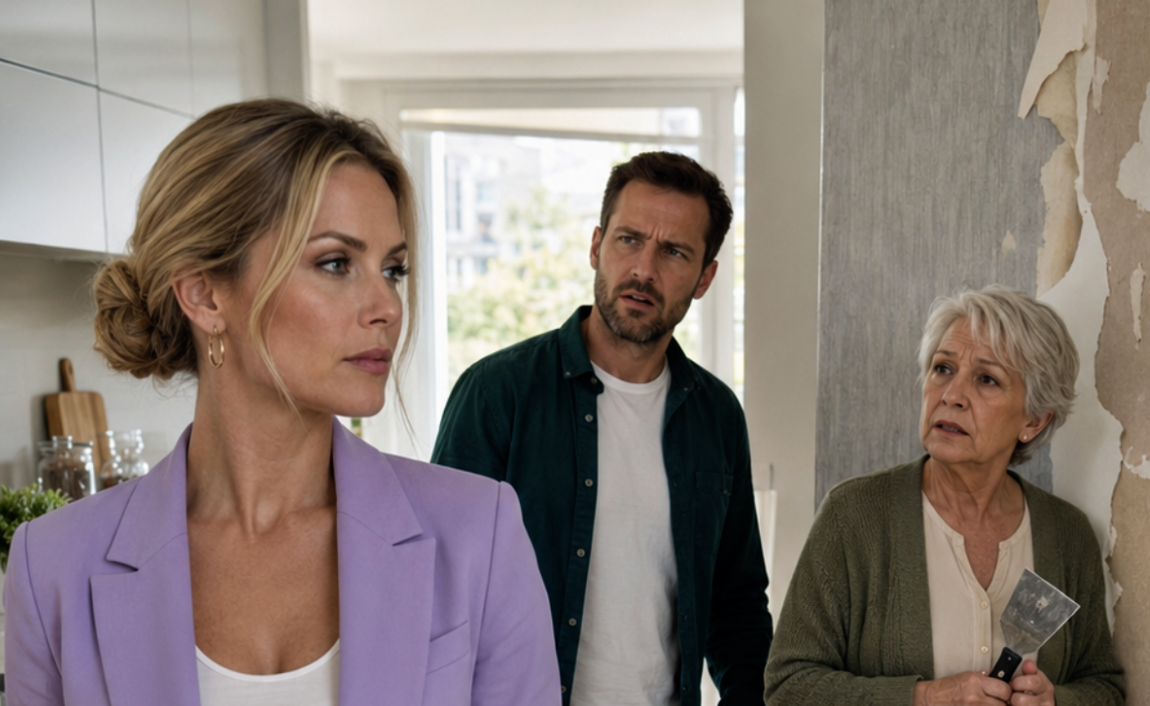
Antonina Markovna was standing beside the wall in a house vest, pulling at the edge of the covering near the work area. A putty knife lay on a chair beside her. Several jars containing paint samples stood on the windowsill. They had not been there before.
“Oh, you’re here,” she said without even turning around. “Look at what you’ve done to this place. The walls look like something from a gardener’s office. No warmth. No soul.”
Without saying a word, I took out my phone and started recording.
She turned around.
“What are you filming?”
“The condition of my apartment.”
“Mine, mine, mine,” she mimicked. “Kirill said I could live here, and he was right. How long are you planning to keep squeezing money out of people? You’re supposed to help your relatives.”
Long strips of wall covering were already lying on the floor.
Smooth, expensive material, chosen not merely because it was attractive, but because tenants did not leave marks on it every time they moved a chair.
“Who gave you permission to touch the walls?”
Antonina Markovna snorted.
“I’m not touching the walls. I’m removing this tasteless mess. I’m going to live here, so I should be the one deciding.”
“You are not registered at this address. You have no tenancy agreement. You do not have the owner’s permission.”
“The owner,” she drawled. “What a word to use. People don’t speak like that in a family.”
“In my apartment, that is exactly how people speak.”
She looked at me more closely.
It was beginning to dawn on her that the familiar scene was not unfolding as expected.
I was not defending myself.
I was not explaining how many years I had spent paying for the apartment.
I was not trying to prove that I was tired.
I was not asking whether she had any shame.
I was recording.
The bags.
The suitcase.
The torn strips of wall covering.
The putty knife.
The box of dishes.
The open door.
My phone screen displaying Lidia’s message.
Antonina Markovna came closer.
“Irina, don’t go too far. I’m an elderly woman. What do you expect me to do, live on the street?”
“Discuss your housing arrangements with your son.”
“He’s your husband.”
“And the apartment is mine.”
She narrowed her eyes.
“This is exactly why Kirill says you’re greedy. Everything is always ‘mine, mine, mine’ with you. A normal wife doesn’t treat her husband like a stranger.”
“A normal husband does not give away the keys to someone else’s property.”
Antonina Markovna abruptly turned away and pulled at the wall covering again.
This time, I did not raise my voice.
“Stop.”
“Don’t order me around.”
“I said stop.”
She froze for a second.
Then she threw the putty knife onto the chair.
“I’m calling Kirill.”
“Go ahead.”
I stepped into the hallway and called a security systems company I had worked with on several commercial projects.
We had installed electronic access systems in sales offices for residential developments: key cards, access codes, biometric scanners, and entry logs.
I had wanted to install a similar system in the studio for a long time, but had kept postponing it.
That had clearly been a mistake.
“I need a technician today,” I told the dispatcher. “The owner is on site. I can provide the documents. The old mechanical lock needs to be removed and replaced with an electronic unit with biometric access and an emergency key stored in a lockbox.”
“A technician can be there within an hour.”
I gave her the address.
Then I messaged my lawyer, Svetlana.
We had met while I was designing a country property for her sister. Since then, she had occasionally helped me with rental agreements.
“Situation: my husband, without power of attorney, removed the tenants from my premarital studio apartment and gave the keys to his mother. His mother is already inside and is damaging the finishes. I need a claim concerning our joint bank accounts and advice regarding compensation for the damage.”
Her response came quickly.
“We are not including the studio in the division of property. It is premarital property. The accounts are a separate matter. Document everything. Do not argue. Send me the paperwork.”
I sent her the extract from the Unified State Register of Real Estate, the 2012 purchase agreement, our marriage certificate, a screenshot of Lidia’s message, and the video from the studio.
Kirill arrived twenty minutes later.
He came in quickly, without a jacket, holding his phone.
Antonina Markovna immediately brightened.
“Kiryusha, tell her! She’s trying to frighten me with documents!”
Kirill looked at the strips of torn covering on the floor but pretended not to see them.
“Irina, enough.”
“Enough of what?”
“Humiliating my mother.”
“I’m documenting the damage.”
“What damage? That covering was old.”
“It was replaced two years ago.”
“So what? Mom will redo it to suit herself. She didn’t come here to live in a museum.”
I looked at him and, for the first time that day, clearly saw not merely an isolated action, but an entire system.
Kirill had not made a mistake.
He had not become confused.
He had not accidentally crossed a boundary.
He simply did not recognize boundaries when they belonged to me.
My studio apartment was an unused resource in his eyes.
My bank account was a convenient cash register.
My work was background machinery that produced money on its own.
My peace mattered only as long as it supported his comfort.
“Kirill,” I said, “are you confirming, in my presence, that you gave your mother the keys to my apartment without my consent?”
He grimaced.
“Don’t play word games.”
“Are you confirming it?”
“I helped my mother.”
“Your answer has been recorded.”
He abruptly turned toward the phone.
“You’re recording this?”
“Yes.”
Antonina Markovna raised her hands.
“Look at her. Recording her own family.”
“This is not a family dinner. This is unauthorized access to my property.”
Kirill stepped toward me.
“Have you completely lost all sense of boundaries?”
I calmly slipped the phone into the breast pocket of my jacket with the camera facing outward.
“No. I’ve finally found them.”
The doorbell rang.
The technician arrived carrying a black case and a tablet.
First, he looked at me.
Then at Kirill.
Then at Antonina Markovna, who was already standing in the middle of the room as though she owned the place.
“Who is the owner?” the technician asked.
“I am,” I replied, showing him my passport and the property registry extract.
Kirill smirked.
“Yes, she’s the owner, the owner. But it’s a family apartment.”
The technician did not engage in the discussion.
He did not care whose mother had arrived with a suitcase or who considered whom greedy.
He saw the documents, opened the service order, and asked me to sign.
Antonina Markovna became agitated.
“And where am I supposed to go?”
“Your son is right here,” I said. “You can take your belongings now.”
“I was going to the store. I need to look at curtains.”
“Your belongings first.”
She looked at Kirill.
“Tell her.”
Kirill wearily rubbed his face with his palm.
“Irina, at least give her a week.”
“No.”
“One day.”
“No.”
“We’re a family.”
The second time.
I looked at him.
“Being a family does not abolish property rights.”
The technician worked quickly.
He removed the old hardware, installed the electronic unit, and configured the application. He added my fingerprint to the device’s memory, then set up the backup code and the entry log.
He showed me how to download the complete access history.
It was such a simple thing.
Who entered.
When.
By what method.
It suddenly seemed to me that our marriage could also have benefited from such a log.
Who took something.
When.
Under what pretext.
And why it was called love every single time.
Antonina Markovna eventually left for the store.
Proudly.
With her handbag hanging from the crook of her arm.
She announced that she would return “to her own place.”
By the time she came back, a small screen was glowing on the door.
She inserted the old key.
Nothing happened.
She tried again.
Nothing.
Then she pressed the doorbell.
I opened the door from the inside but left the security restraint in place.
“Irina, open the door.”
“No.”
“My things are inside.”
“Your things are beside you. Three bags, a suitcase, and a box. I brought out the bag with your slippers while recording the process. I did not open anything.”
She looked around.
Her belongings were indeed neatly arranged against the wall.
Kirill stood beside them, silent, angry, and confused.
“You’re leaving me out here in the hallway?”
“No. Your son brought you here. He can decide where to take you next.”
“You have no conscience.”
“I have documents.”
She opened her mouth but could not find the words.
Then she sharply turned toward Kirill.
“Do something.”
Kirill took out his phone.
“I’ll book a room. Just for a couple of days.”
“With whose money?” I asked.
He looked at me as though the question itself were indecent.
“Irina.”
“With whose money?”
“We’ll sort it out later.”
“No. We’ve already sorted it out.”
I pressed a button in the application.
The system switched into owner-only access mode.
There was no door slamming.
No elegant final remark.
They simply lost the ability to enter a place where nothing belonged to them.
A new entry appeared in the application:
“User: Irina. Locked. 18:42.”
At eight that evening, Kirill called me from the car.
“My card isn’t working.”
I was sitting at the table in the studio.
The documents lay in front of me: the property registry extract, the purchase agreement, the technician’s report, photographs of the damage, and my correspondence with Lidia.
The room smelled of construction dust from the removed hardware, but it was a working smell.
Understandable.
Repairable.
“Which card?” I asked.
“Mine.”
“The additional card linked to my account?”
He remained silent.
“I blocked it.”
“Are you serious?”
“Yes.”
“I need to pay for my mother’s hotel room.”
“Use your own card.”
“I don’t have much money on it.”
“Now that is visible.”
He exhaled into the phone.
“You’ve decided to leave me without money?”
“No. I have left you without my money.”
“That’s despicable.”
“What was despicable was evicting my tenants and moving your mother into my apartment.”
“I was trying to do the right thing.”
“For whom?”
He did not answer.
I opened the additional-card section in my banking application.
Kirill—blocked.
Online purchases—disabled.
Spending limit—zero.
I moved the subscriptions linked to my account that supported his work into a cancellation list. Not all of them at once. Only those for which he was the beneficiary while I was the one paying.
Then I sent the account statements to Svetlana.
She called me late that evening.
“Here is the situation. The studio is premarital property, so we are leaving it out of the division. But money accumulated during the marriage, deposits, savings, and activity in the accounts are a separate issue. We will file a claim for division of marital property as it relates to those funds. We will also request interim measures concerning the disputed amounts so they cannot be transferred before the court rules.”
“Can he claim that all of it belongs to him?”
“He can claim anything. That is why we need the statements. We need proof of your income, proof of his income, and all spending through the additional cards. Not emotions. Documents.”
“I have the documents.”
“Then we get to work.”
I liked that expression.
We get to work.
Not endure.
Not persuade.
Not wait for someone to understand on his own.
We work.
Kirill came home around lunchtime the following day.
I was sorting bank statements into folders.
The labels were dry and factual:
“Rental income.”
“Additional cards.”
“Joint accounts.”
“Studio damage.”
He stopped in the kitchen doorway.
“You’ve taken this too far.”
“I’ve only just started.”
“Mom didn’t sleep all night.”
“She was in a hotel room.”
“She feels unwell.”
“Call a doctor if necessary.”
“You’ve become a stranger.”
I looked up.
“No, Kirill. I’ve become a separate person.”
He sat across from me.
The confidence he had displayed before was gone. Apparently, the additional card had not been a minor convenience.
It had been his familiar cushion.
Soft.
Mine.
“Let’s discuss this calmly,” he said. “Mom can live there for a month. Then I’ll find another option for her.”
“No.”
“Then at least pay for her accommodation. You know my current project has been delayed.”
“No.”
“Irina.”
“No.”
The third refusal landed evenly.
Without anger.
Without strain.
Like a signature at the bottom of an official report.
Kirill stared at me for a long time.
“You’re destroying our family over an apartment.”
“The apartment is not destroying the family. The family is being destroyed by someone who decided he could give away another person’s property without asking.”
He smirked, but the expression was weaker than usual.
“Another person’s property? I’m your husband.”
“Which is precisely why you knew that I bought the studio before our marriage.”
“Formally.”
“Legally.”
“So now you’re a lawyer?”
“No. I’m an owner who reads her documents.”
He stood up.
“Mom said she will never forgive you.”
“That is her right.”
“Neither will I.”
“That is yours.”
On Wednesday, June 17, 2026, Svetlana filed the documents.
A claim for the division of marital property insofar as it concerned money held in accounts and deposits.
Separately, she sent Kirill a formal demand for compensation for the damage to the studio and the lost rental period.
There were no grand declarations.
No theatrical resentment.
Only a list:
Date.
Action.
Consequence.
Estimated amount.
Evidence.
Kirill called immediately after receiving his copy.
“You’re demanding compensation from me too?”
“Yes.”
“Mom only wanted to refresh the walls.”
“In my apartment.”
“Do you understand how this looks?”
“Yes. An owner is protecting her property.”
“It’s not as though you’re poor.”
There it was.
The main argument.
Not “I was wrong.”
Not “I’m sorry.”
Not “I’ll compensate you.”
But:
“It’s not as though you’re poor.”
In other words, if a woman has money, it can be taken.
If she has an apartment, it can be occupied.
If she has a job, it can be treated like the family’s personal cash machine.
And if she refuses, she is greedy.
I listened to him and, for the first time, made no attempt to translate his words into normal language.
He had said exactly what he believed.
“Kirill,” I replied, “you have ten days to compensate me voluntarily for the damage specified in the formal demand. After that, it will go to court with everything else.”
“You’re speaking to me as though I’m a contractor.”
“Contractors at least sign agreements.”
He ended the call.
The following day, I received confirmation that the documents had been accepted.
A week later, on June 22, 2026, Antonina Markovna sent me a voice message.
I did not listen to it immediately.
First, I forwarded it to Svetlana.
Then I played it at low volume.
“Irina, you have always been cold. I told Kirill that from the very beginning. A woman without softness is not a wife. You count your apartments and your accounts, but where is your family in all of this? I am his mother. I am entitled to respect.”
I saved the message.
Not as a memory.
For the file.
The folder was labeled:
“Communications.”
The studio had to be repaired.
The covering near the work area could not be replaced partially because the new production batch was a slightly different shade. The contractor was honest with me.
“There will be a visible patch.”
I chose a different finish for the entire wall and scheduled the work for the earliest available day.
Not because I wanted to make the apartment beautiful for Antonina Markovna.
Because the property needed to generate income again.
At work, I always taught my clients one simple principle:
If water flows somewhere it does not belong, it will find the weakest point.
It will wash out a pathway.
Shift the soil.
Damage the roots.
Families turned out to work the same way.
When someone else’s entitlement is allowed to flow unchecked for years, it undermines everything.
First, the limit on the bank card.
Then my weekends devoted to his mother.
Then my professional contacts used for his projects.
Then the studio apartment.
And every time, they call it a small thing—until they take an entire door.
Kirill moved out on June 27, 2026.
He did not move in with his mother.
He rented a small apartment on the outskirts through an acquaintance.
Antonina Markovna went to stay with her niece in a neighboring city.
Before leaving, she sent word through Kirill that she would like to see how I managed without a husband.
I managed.
On Friday, July 3, 2026, the new tenants came to view the studio.
A young couple who did not ask unnecessary questions.
They carefully inspected the kitchenette, the bathroom, the enclosed balcony, and the newly finished wall.
The woman ran her palm along the built-in wardrobe and said:
“It feels peaceful here.”
I nodded.
“That is the main condition.”
I added a clause to the lease stating that all negotiations concerning the apartment could be conducted only with me.
No relatives.
No verbal promises.
No “family emergencies” communicated through third parties.
There were no conventional keys anymore.
There was electronic access.
A temporary code for the tenants.
A separate entry log.
And my right to disable access in accordance with the agreement if its terms were violated.
After they left, I remained alone in the studio.
Not by the window.
Not holding a cup.
Not posing like a triumphant victor.
I stood in the middle of the room with a tablet in my hands, reviewing the handover report.
The wall was smooth.
The floor was clean.
A line glowed in the application:
“Access active. Owner: Irina.”
That evening, Kirill sent me a message.
“Maybe we don’t need to divide the accounts. I’m not a stranger.”
I looked at the message and did not answer immediately.
Then I typed:
“That is precisely why the division is necessary. So that everyone can finally see what belongs to them, what is shared, and what belongs to someone else.”
He read it.
He did not write again that day.
The financial cushion he had been relying on turned out not to belong to him.
The studio apartment he had already mentally given to his mother remained mine.
Antonina Markovna, who was accustomed to entering other people’s lives carrying bags and making demands, had encountered something for the first time that was stronger than my personality:
An access-control system.
Documents.
And a lawsuit.
It proved far more reliable than any argument.